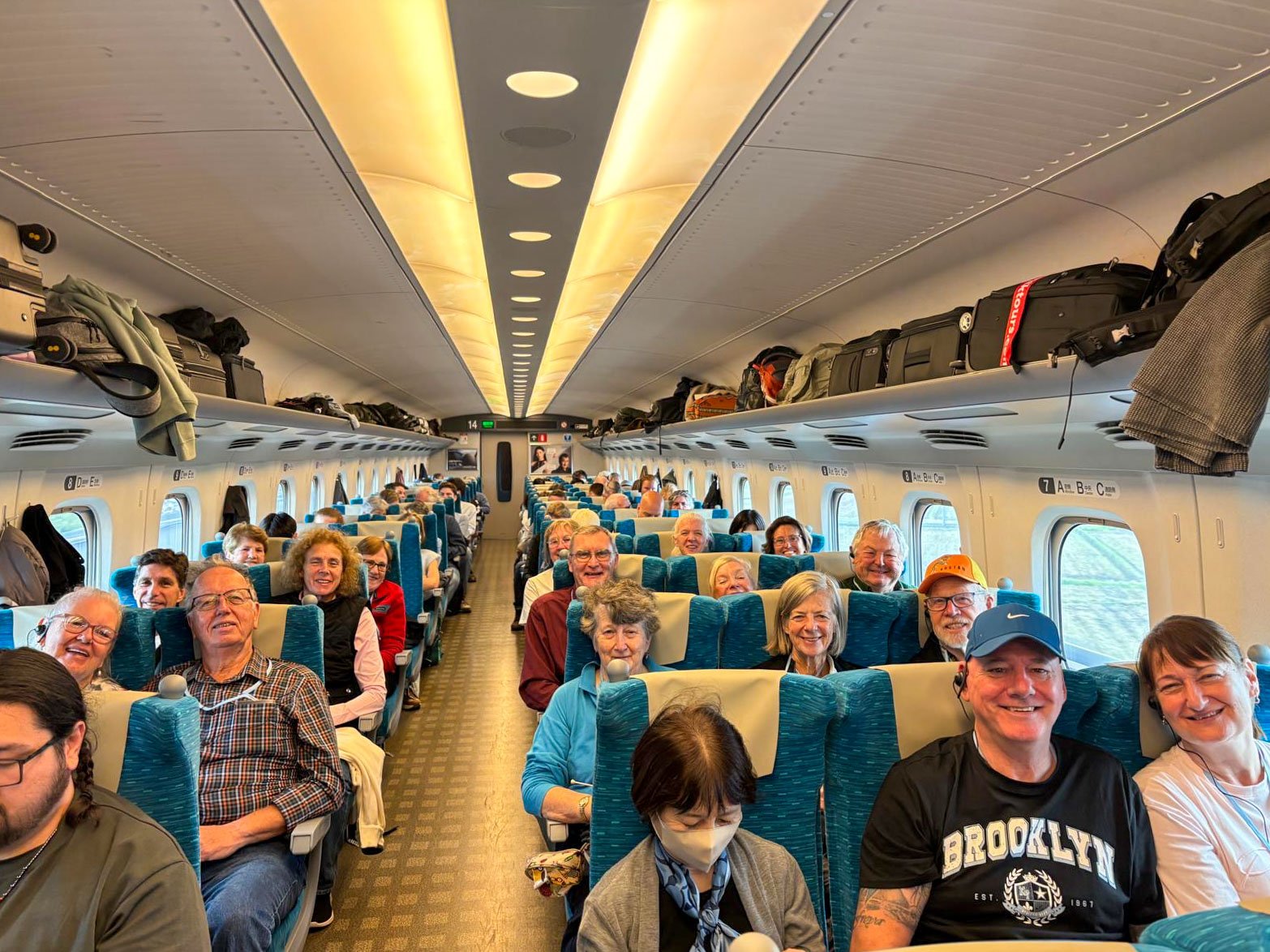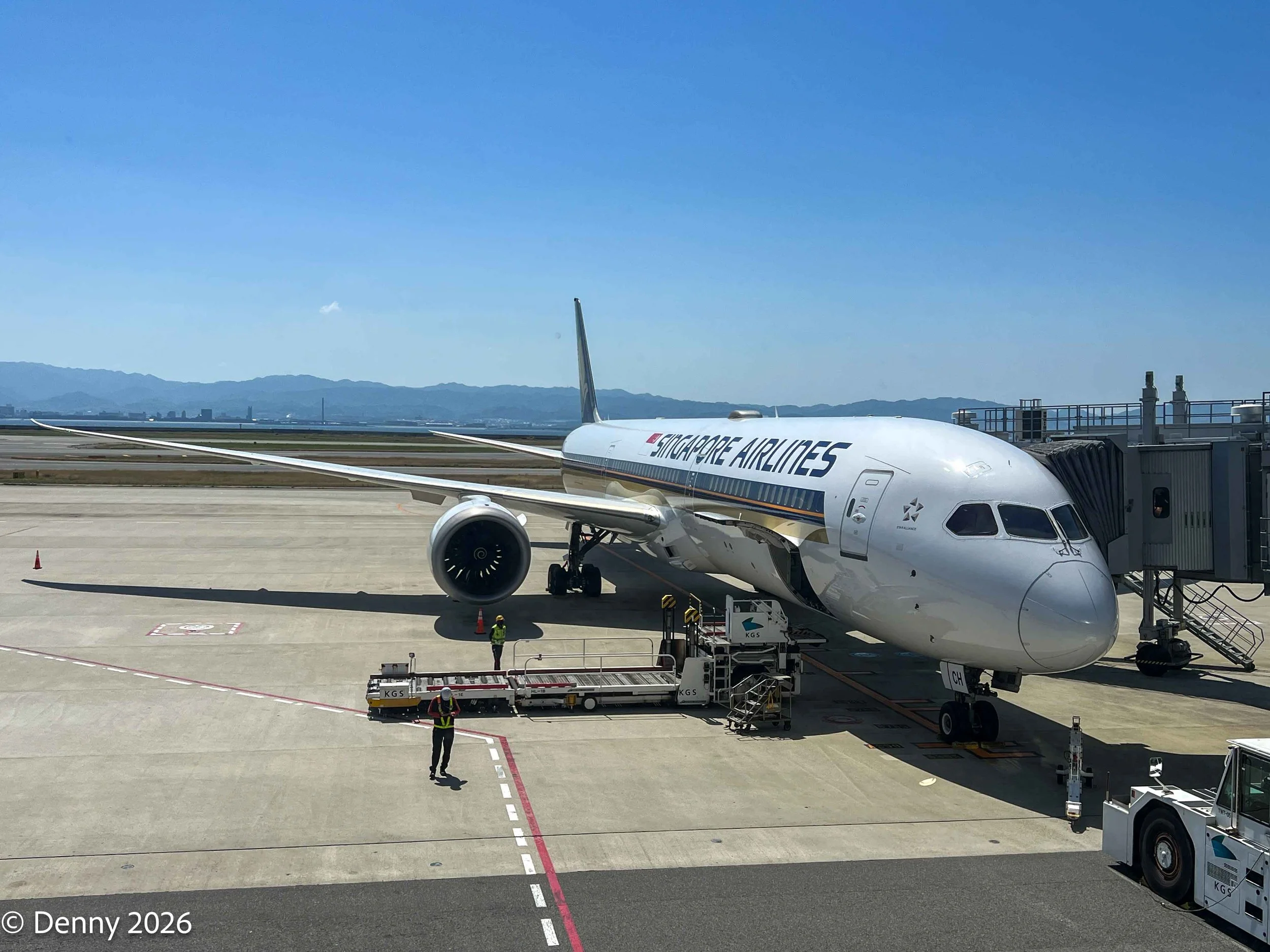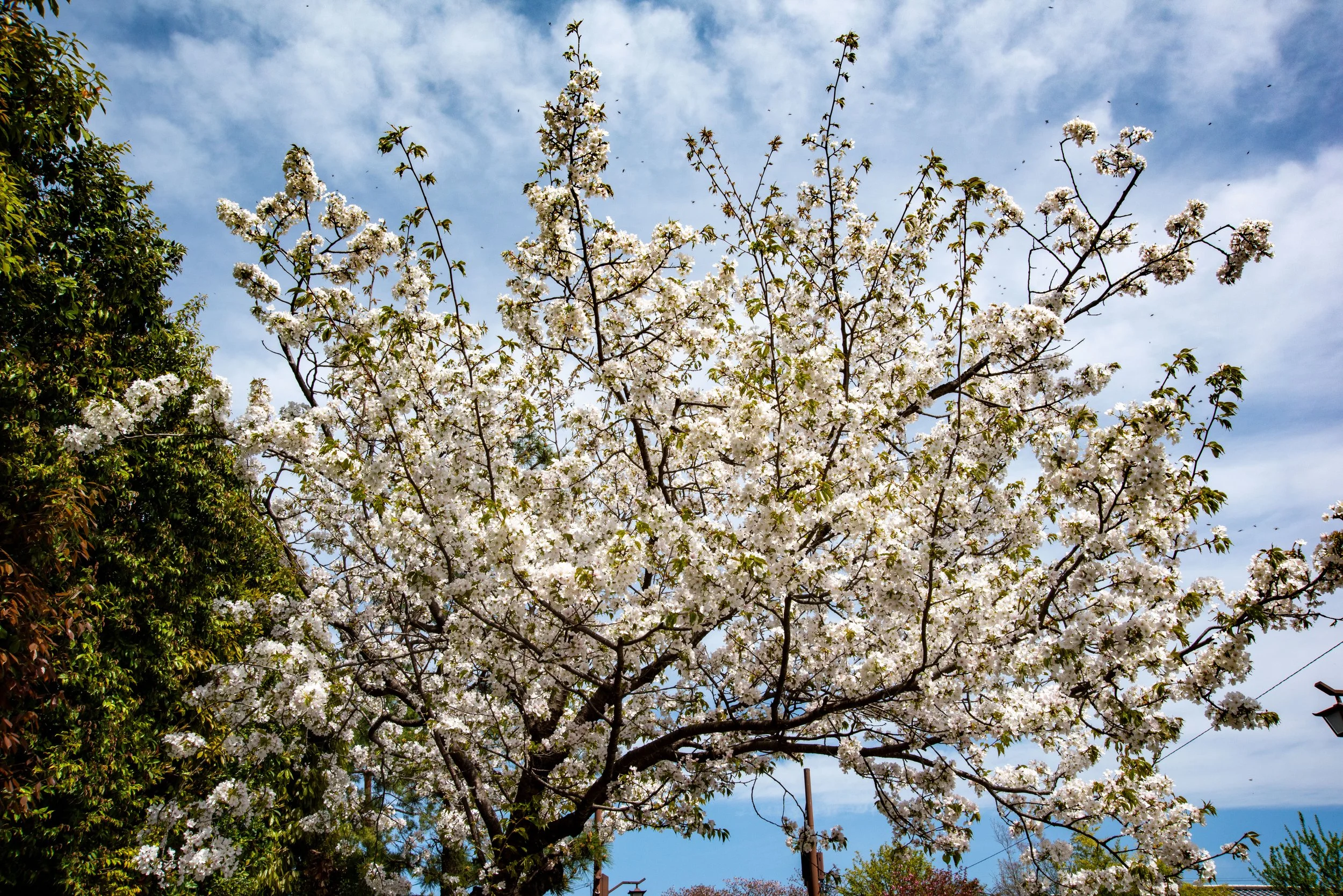
DAY 20: Wednesday 1st April 2026 TOKYO, JAPAN

The weather early on looked as if rain was imminent so we planned to spend the day indoors and the agreed best option was the National Museum of Nature and Science in Uenokoen, Taito. This required a train trip on the subway from Shinjuku, the suburb where we are staying, to Ueno.

With raincoats at the ready we walked quickly to the nearby Shinjuku Station. This station has over three and a half million passengers passing through each day and is considered the busiest train station in the world!

We needed to use the Yamanote Line this morning and decided to wait until the rush hours had finished because between 07:30 and 09:00 staff are employed to push the last few commuters onto the train.
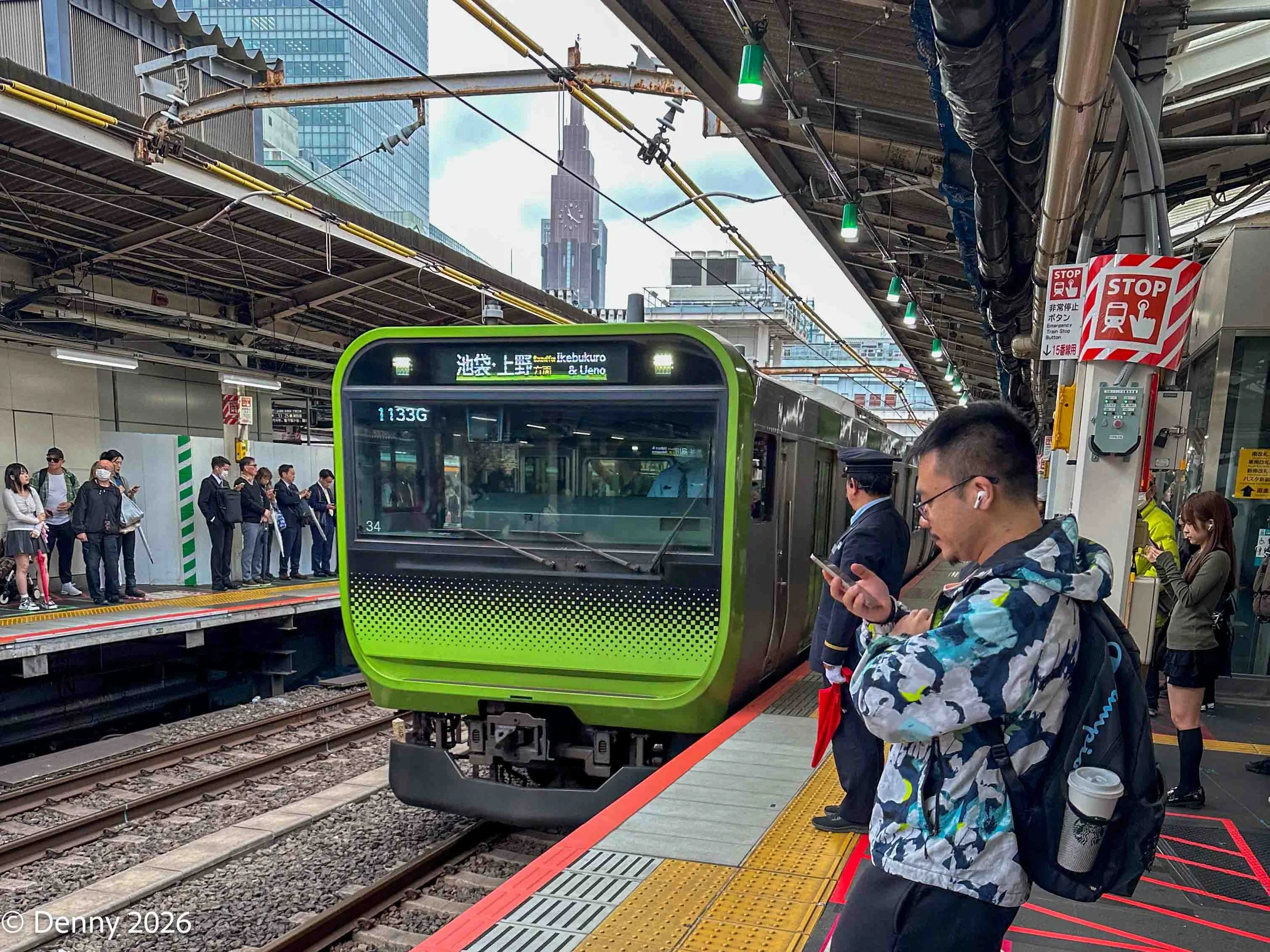
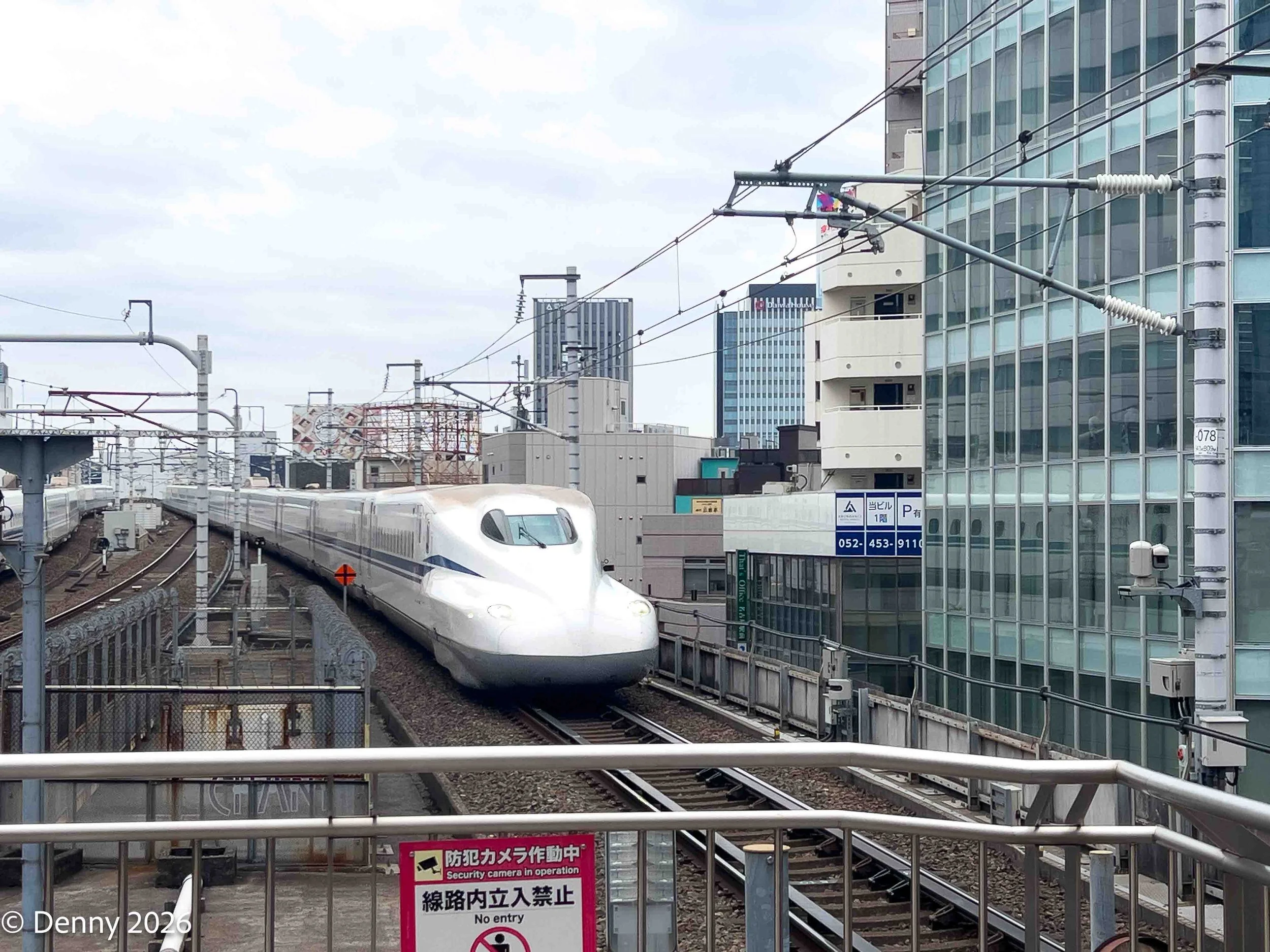
Our train arriving at Shinjuku station

We boarded the train at Shinjuku (Y17) and got off the train at Ueno (Y05) twenty-three minutes later. During the trip I sat next to a lady holidaying from Singapore and she was keen to hear about our experiences at the recent Suzuka GP. She said that we should book accommodation early if we intend to go to the Singapore GP as hotel prices double if not triple during the month prior to the race in mid-March.

On arrival at Ueno we were pleased to find that the predicted rain had yet to appear so we strolled slowly through a corner of Ueno Park. Our pathway led us amongst the cherry blossoms and elms now sprouting new leaves to the National Museum of Nature and Science which is located in the northeast corner of the park.
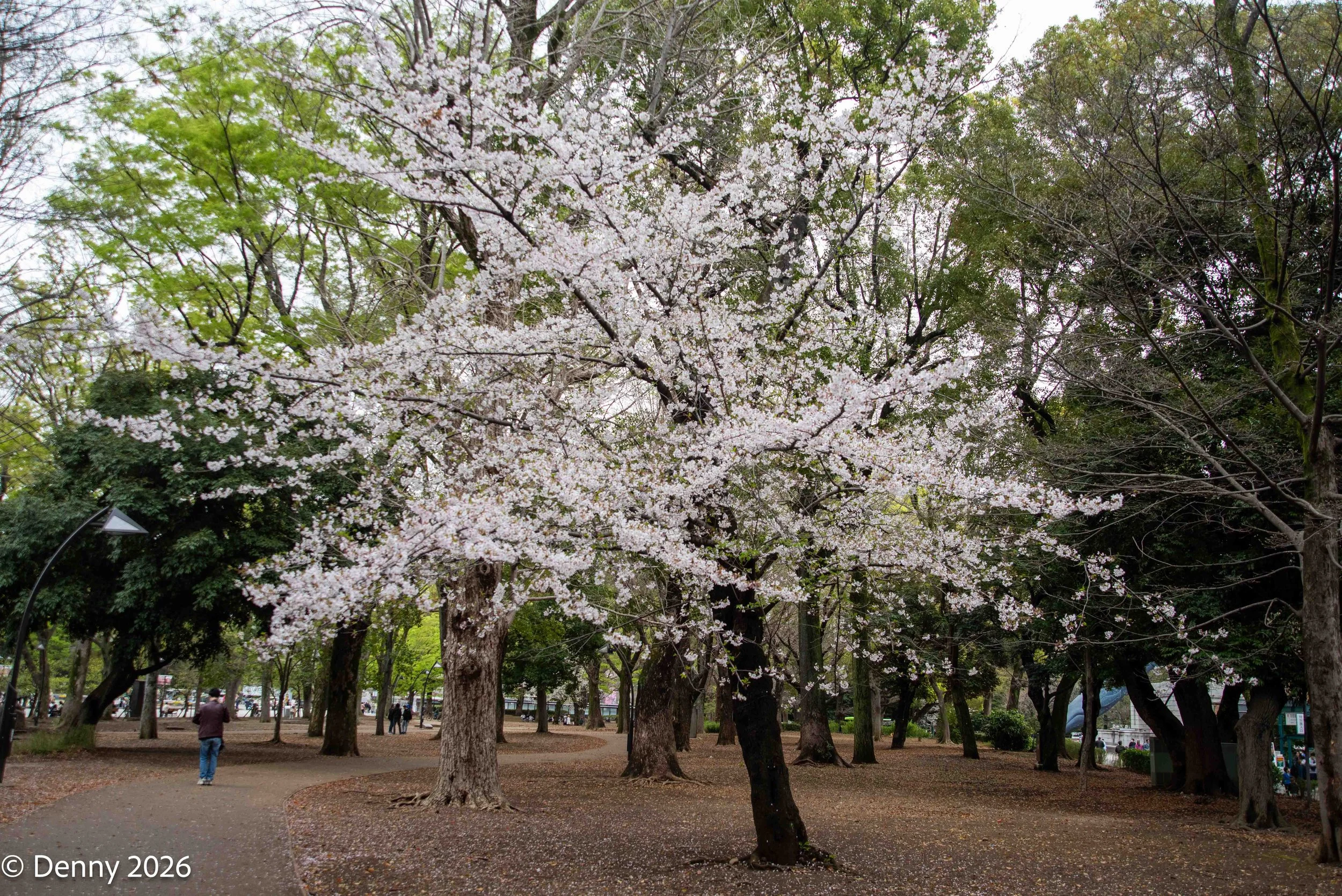
Cherry blossom at Ueno Park

On the way we passed a bronze statue of Dr. Hideyo Noguchi (1876 – 1928) who was a famous Nobel Prize nominated Japanese bacteriologist whose image now appears on the ¥1000 note.
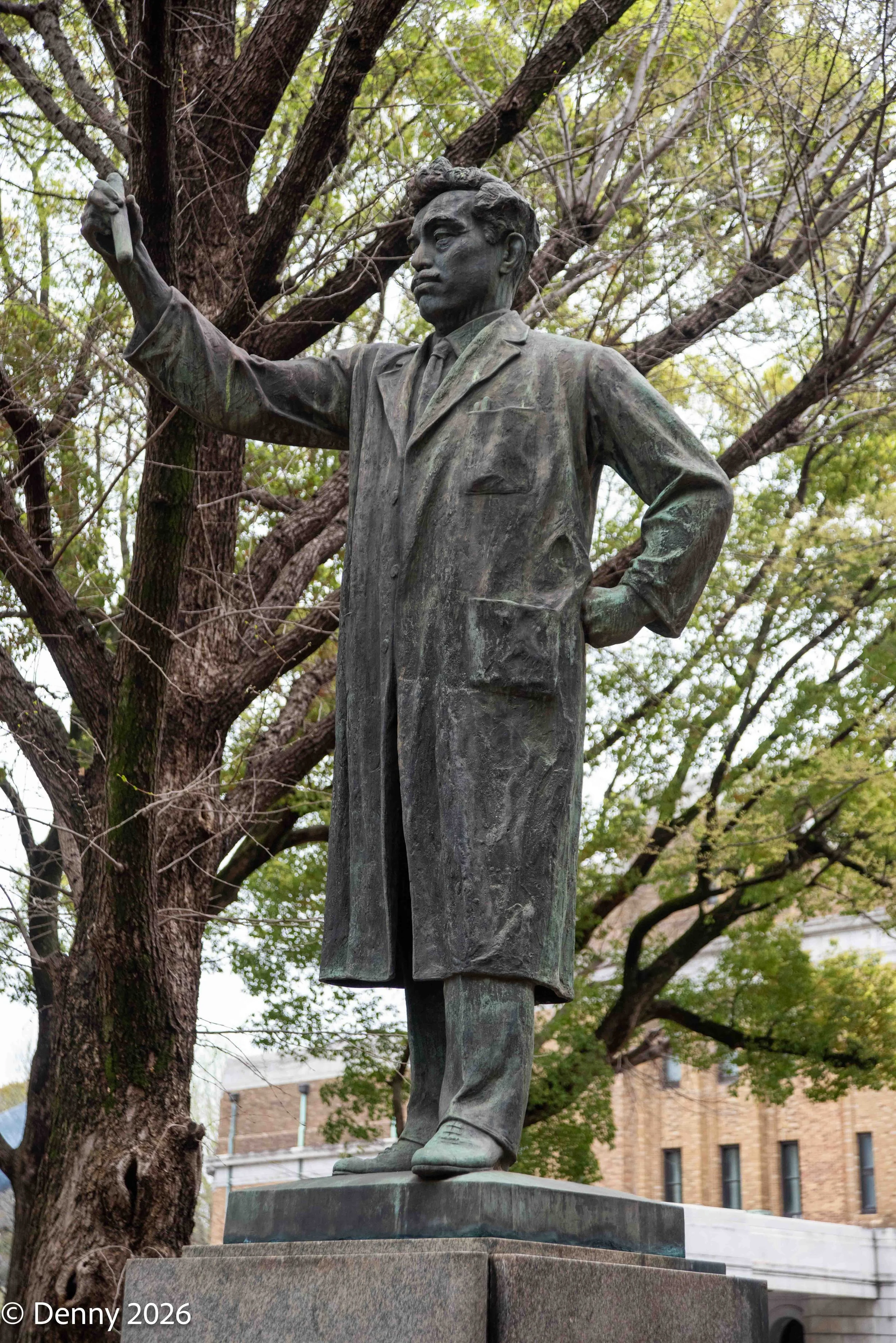
Statue of Dr. Hideyo Noguchi, Ueno Park

Outside the museum’s entry are a beautifully restored steam train (D51231) and a life-sized model of a blue whale.   

National Museum of Nature and Science
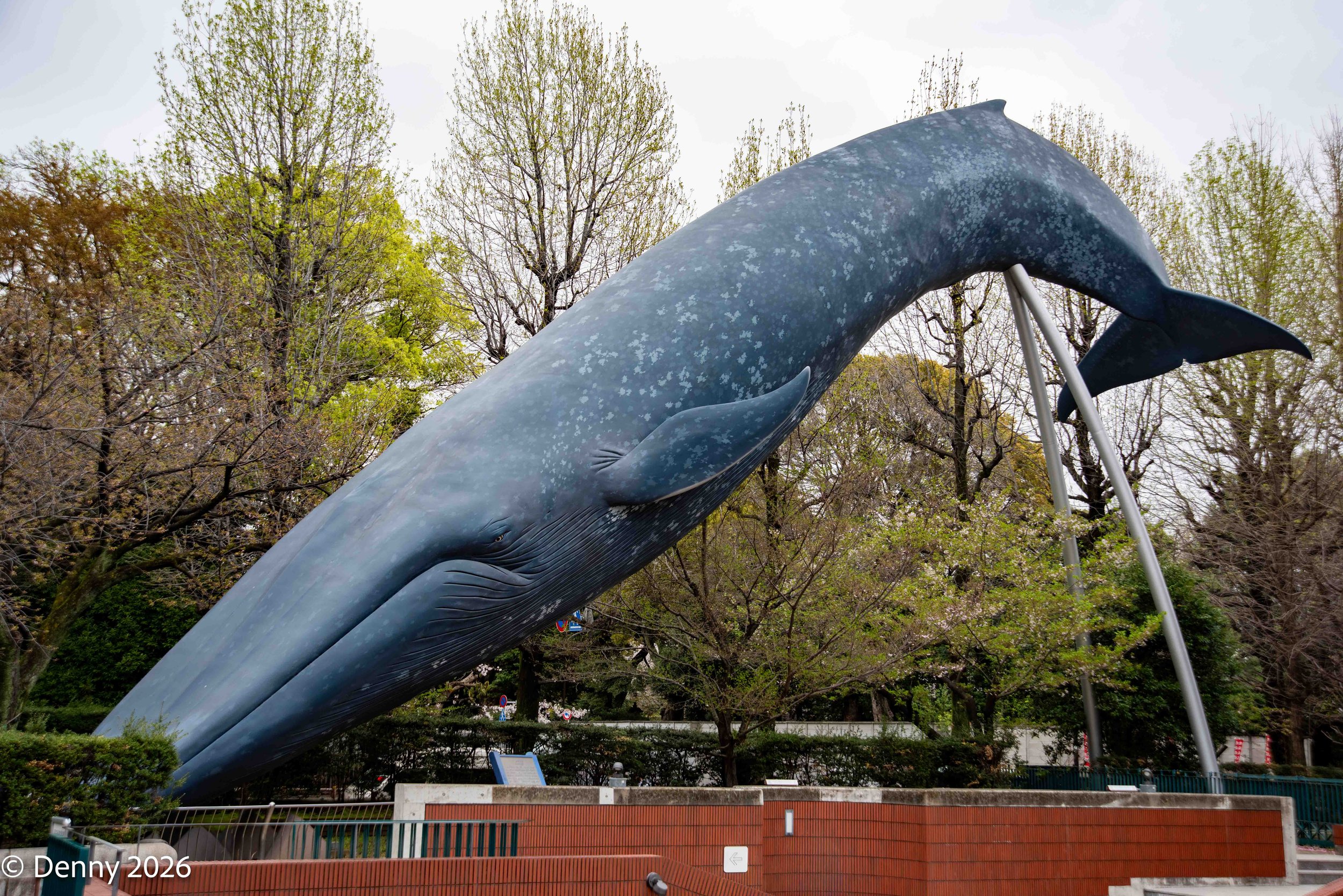
Blue whale model at entrance to National Museum of Nature and Science,
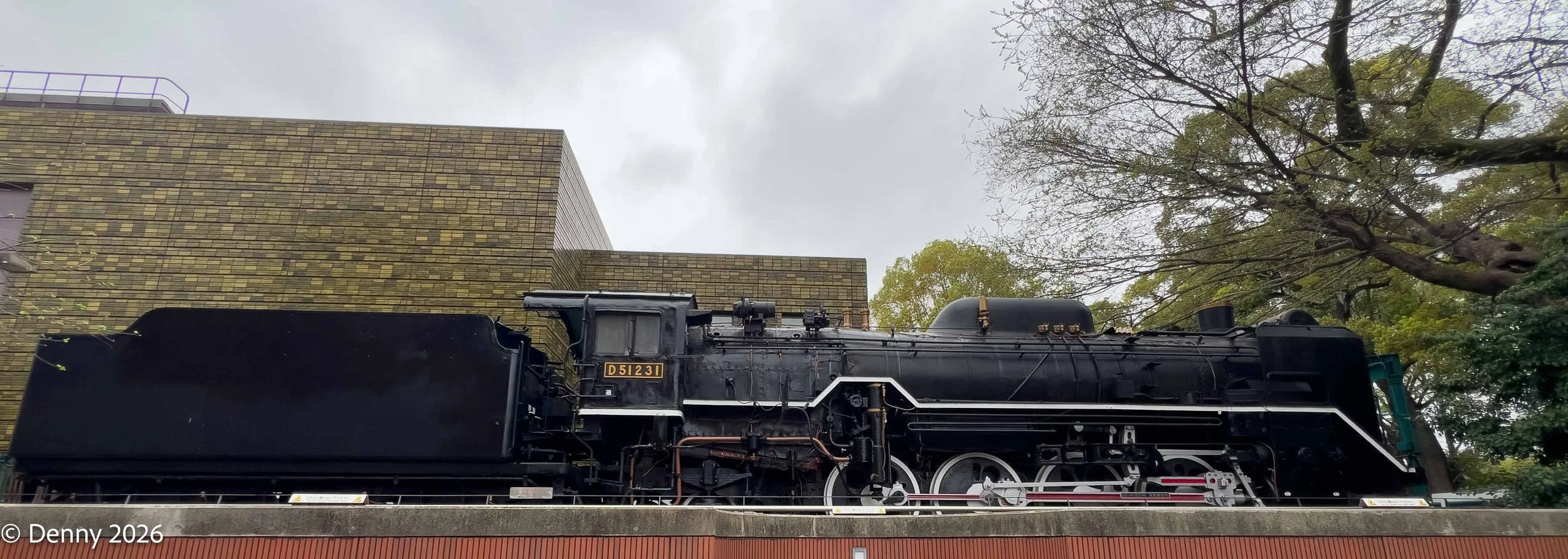
Train outside National Museum of Nature and Science

We were not charged entry to the Museum of Nature and Science as we are over the age of sixty-five. Nonetheless, we were required to show passport evidence of our age.

We then started our visit in the Natural History section. There was an incredible range of exhibits but the fossil collection, especially that of dinosaurs, was particularly impressive. A fossil of a Flightless Gruiform Bird was amazing in detail considering it is around 150 million years old!
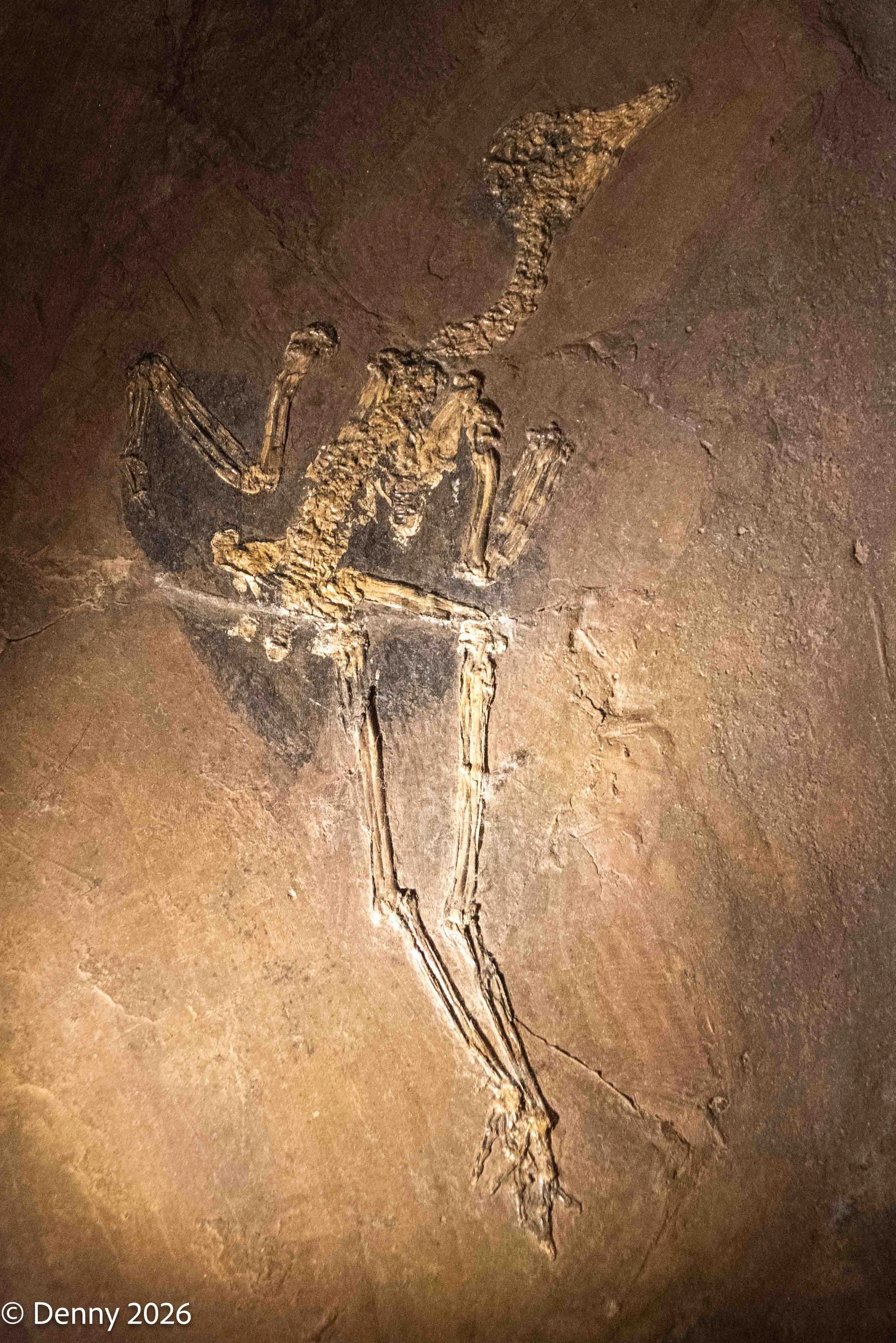
Flightless Gruiform Bird fossil

Notebook of H. Nagaoka (Japanese Physicist)

Freshwater ray fossil

We spent a good deal of time in the life-sciences area where marine life was particularly emphasised. The skeletons of numerous animals were on display but the elephant and the sperm whale were the most prominent. A video showing the highly complex process of assembling the sperm whale’s skeleton was most interesting.

Sperm whale (right hand side)

Sperm whale skeleton (left hand side)

We then moved on to the Science and Technology section which was to be the highlight of the day.

There were lots of displays involving viewer interaction and there was significantly more information in English to explain the functioning of individual exhibits.

The first technological part to catch our attention was a magnetometer which when your mobile phone was moved near it gave 3D (x, y, z axes) readings of the present magnetic field strength in microtessla (µT). These reading varied dramatically as one moved the phone randomly.

Corinne holding mobile phone against magnetometer

A major technology section was dedicated to Japan’s space missions. There was an amazing collection of actual satellites and manned spacecraft on display.

Space Flyer Unit (SFU

Amongst the displays that appealed most to us were the exhibits of historically significant calculating devices and computers.

There was an intriguing 1944 machine for solving simultaneous equations in nine unknowns.
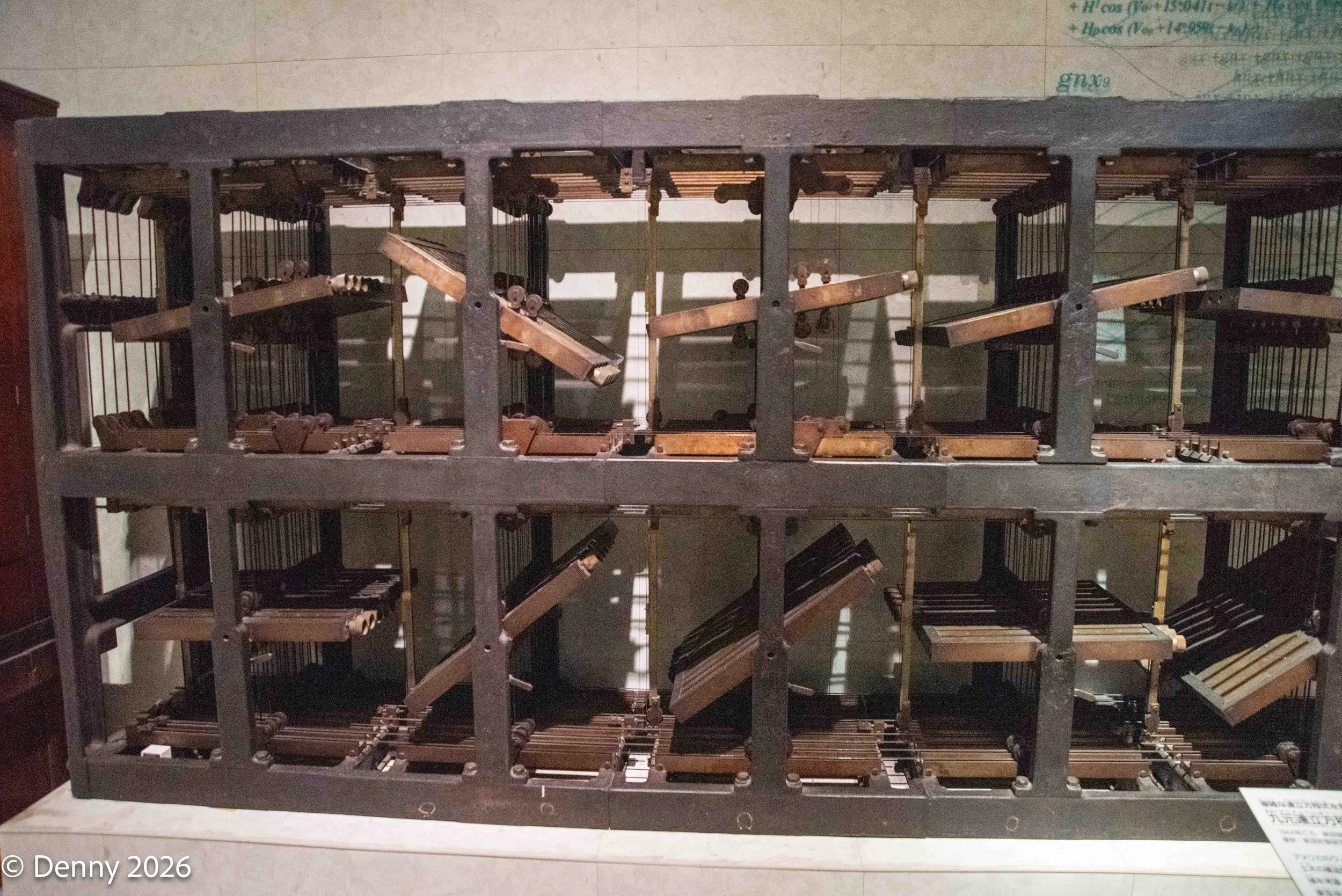
Machine for solving niine simultaneous equations (around 1944)

Next door was a phenomenally complex machine invented by William Thomson Kelvin (Lord Kelvin) for predicting tides. This exquisite computational machine involved nine interconnected pulleys and wires that transformed the complex wave motion of tidal flow into a predictable pattern which was shown on a graph.

Machine for predicting tides

There were computers on display from the early days such as the multi-valved types we had in Tasmania in our 1960s university times.

FUJIC, a vacuum tube digital electronic computer 1956

Another area of special interest was the deep-sea submersibles section. It included deep underwater research units from the small Japanese Hornet to the large three person Shinkai 6500 craft capable of achieving depths of 6,500 m. This incredible submersible has been at the centre of world-wide deep underwater research and has undertaken 1,619 dives.

Shinkai 6500 (Human-occupied research submersible)

At this point we were suffering from excessive ‘museum information input’ and decided to call it quits and head home.

It was now raining quite heavily so on our return to the Ueno Station we took shelter in a busy restaurant/coffee shop where we had hot coffees and shared a pizza.
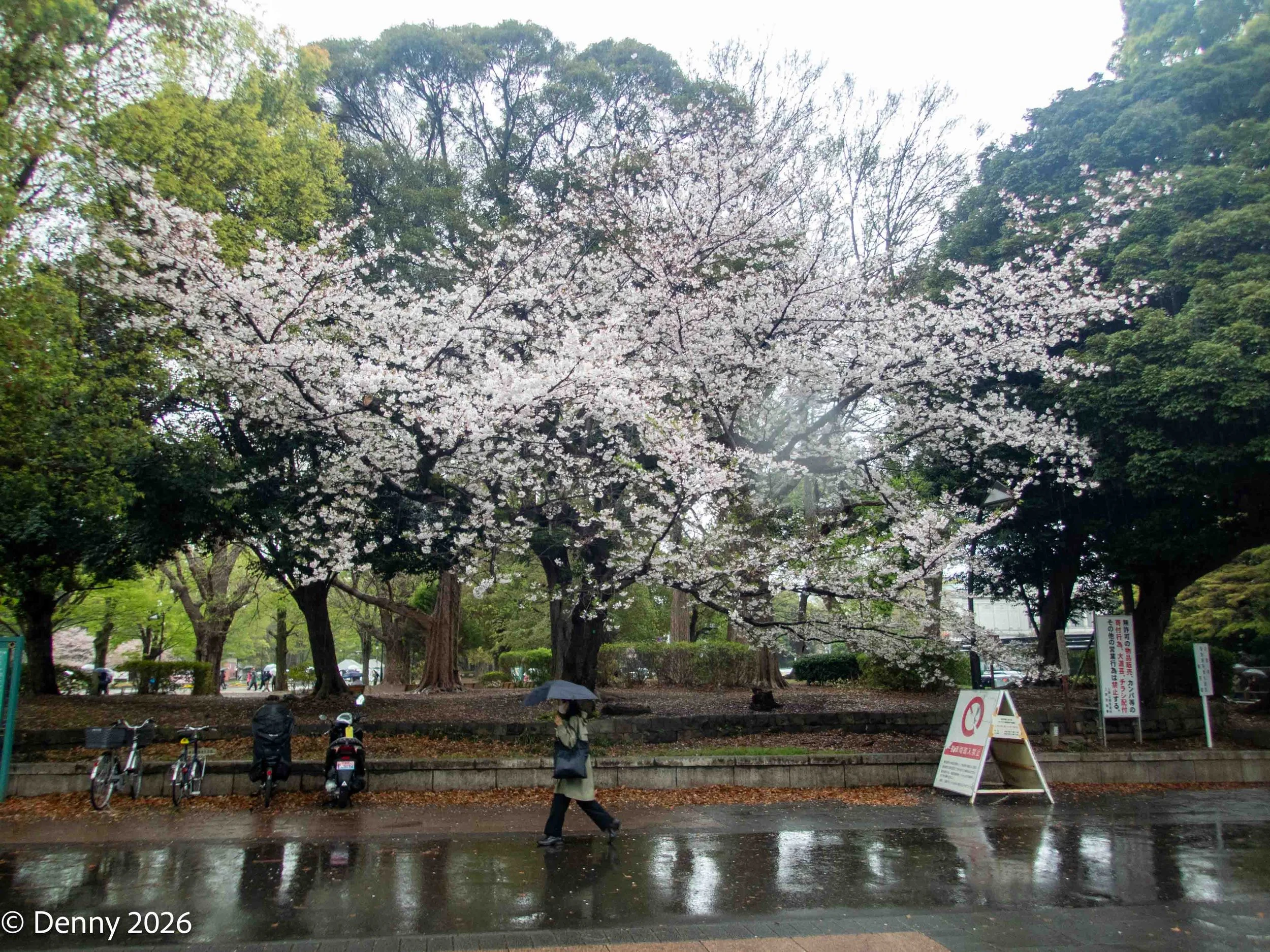
Cherry trees outside National Museum of Nature and Science

Jak walking back to the station from National Museum of Nature and Science

At Uemo we were soon back on the Yamanote Line and after twelve stops we arrived back at Shinjuku Station. We exited by a door that our Apple Maps didn’t locate for quite sometime but eventually we worked things out and navigated our way back at the Gracery Hotel.

We then enjoyed a G&T while resting and summarising our day’s visit.
DAY 21: Thursday 2nd April 2026 TOKYO, JAPAN

The morning’s weather looked to be unpredictable so any thoughts of us doing the planned Takaosan (Mt. Takao) hike were abandoned. As an alternative activity we decided to do a walk within the Shinjuku district to the Tokyo Metropolitan Government Offices where there’s an observation deck on the 45th floor.

Apple Maps were used to set our desired course but due to the number of skyscrapers around us, it takes quite a while to lock onto sufficient satellites to establish our starting location.

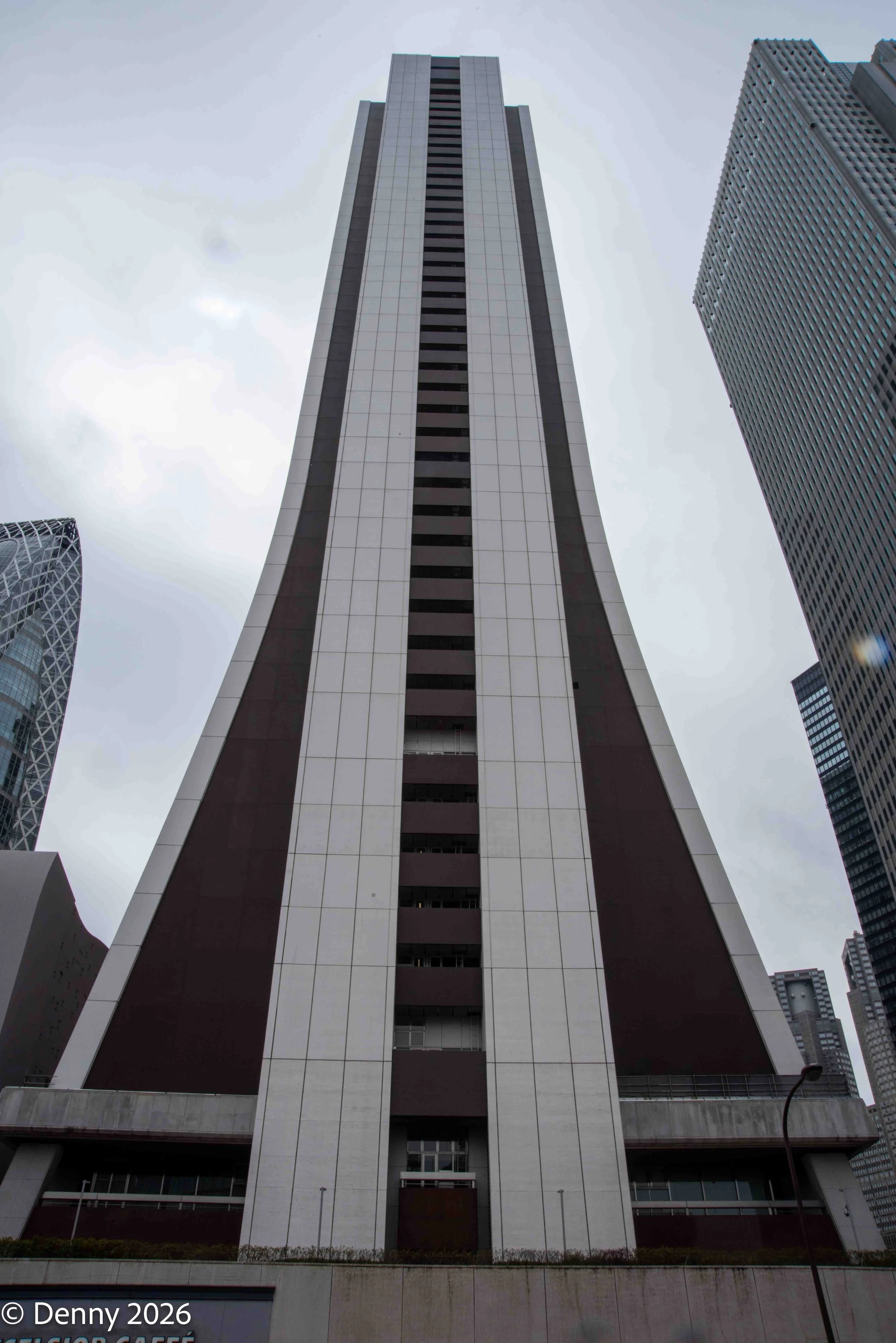
We walked at a leisurely pace in drizzly conditions and were enthralled by the size of the gargantuan buildings around us in every direction. Amongst the many skyscrapers, an immediately recognisable one was the distinctive Sonpo Japan Building with its gracefully curving base.

Sonpo Japan building, Shinjuku

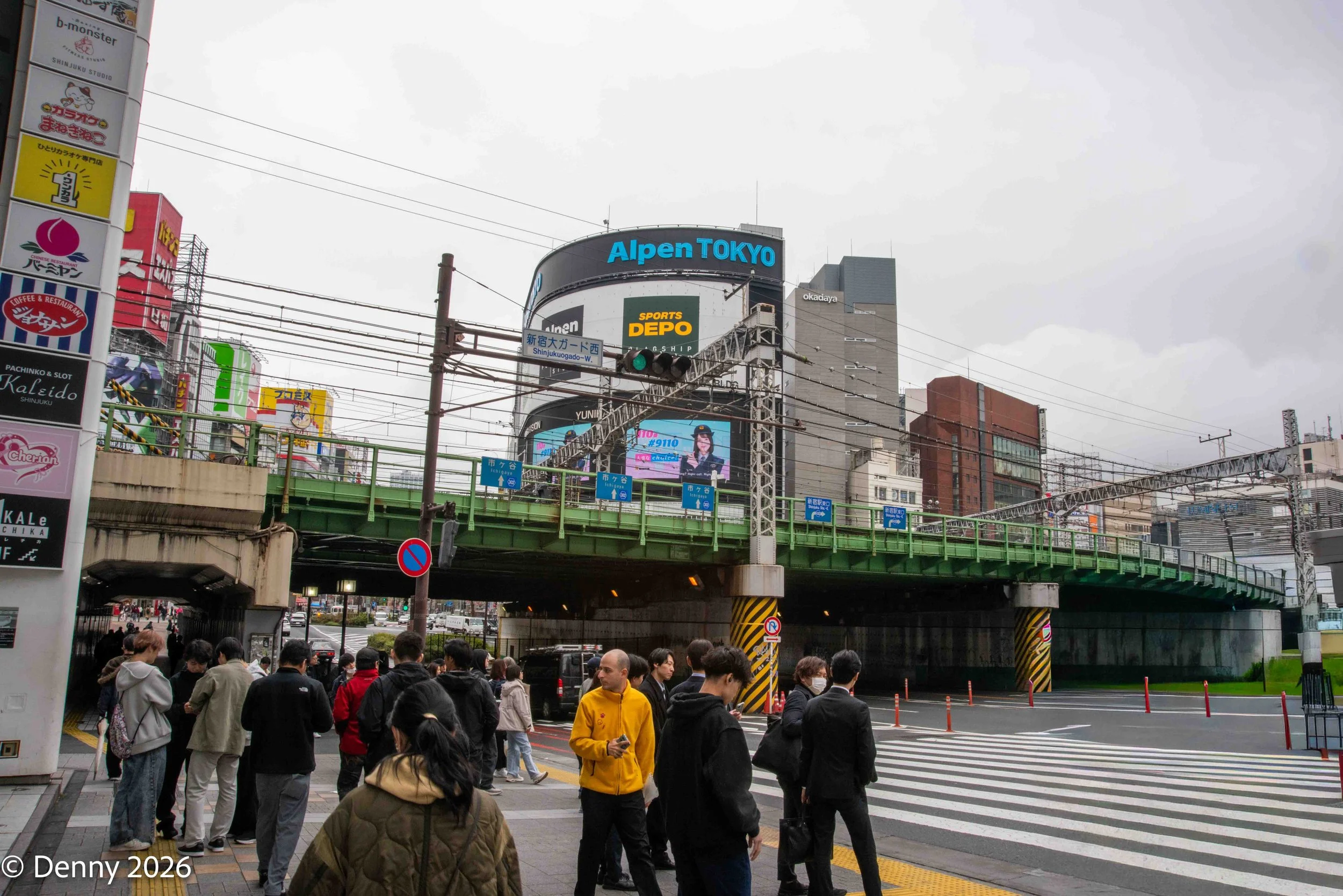
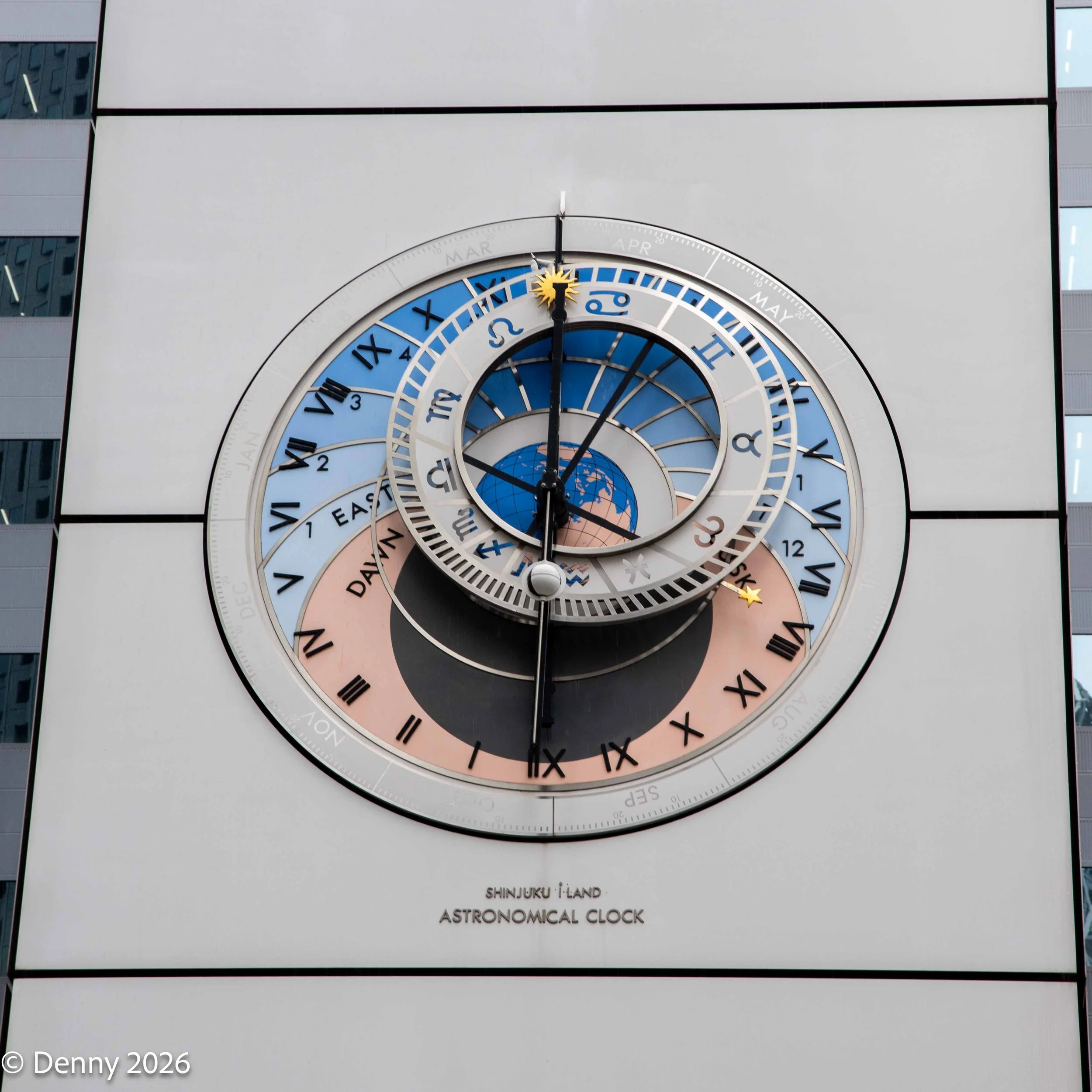
We crossed under the northern major railway bridge leading out of Shinjuku Station and then past an astronomical clock tower. At this point the rain increased making the congested pedestrian walkways hazardous because of the possibility of being poked in the eye by the ubiquitous umbrellas.

Astronomical Clock, Shinjuku

We arrived at the Tokyo Metropolitan Government Offices building and took the lift to the 45th floor.

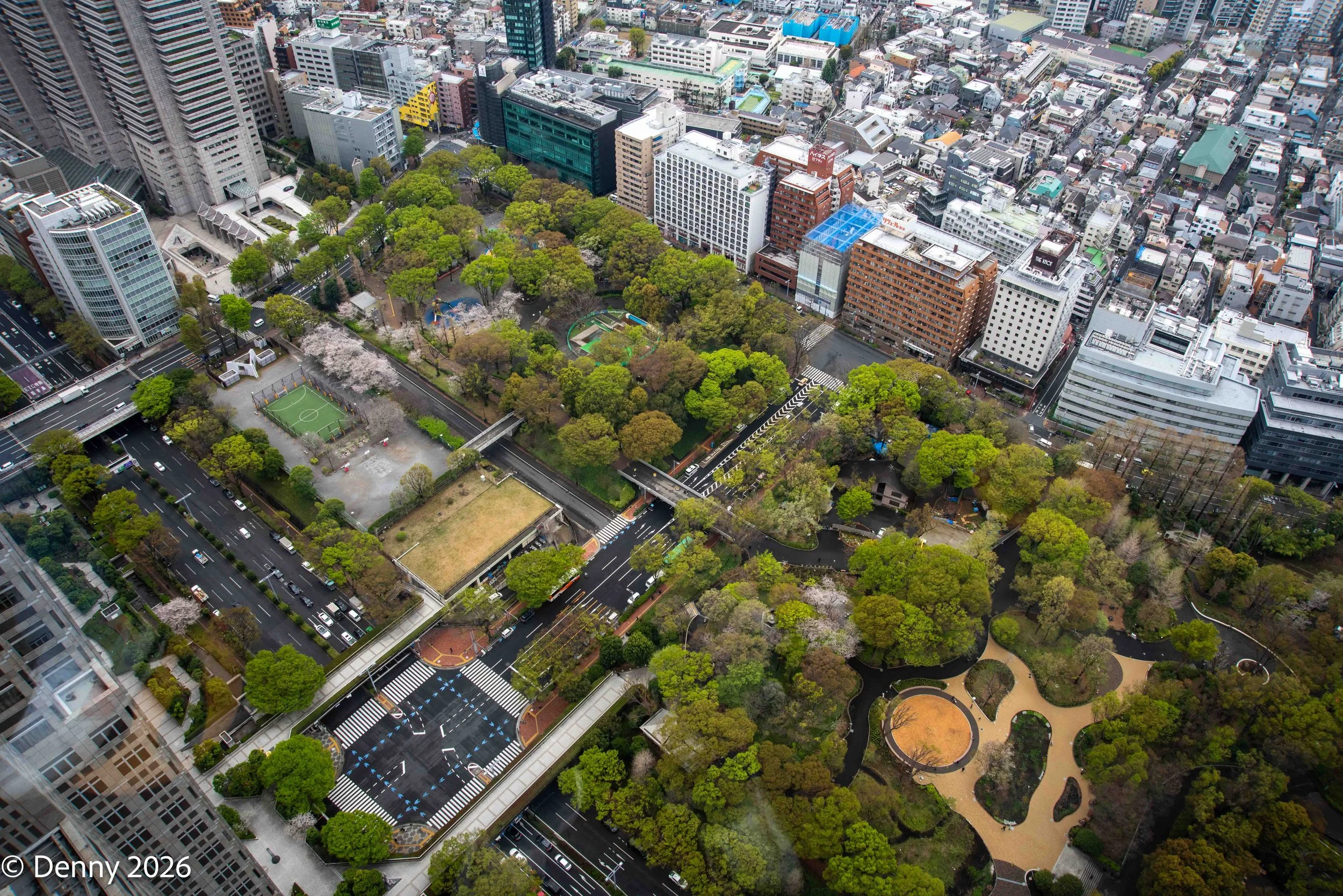
This open and spacious floor level is set out with windows in practically a full 360 degrees. Fortunately, there was not a large crowd present so we had opportunities of photographing Tokyo city in every direction despite conditions being a bit cloudy.

View from 45th floor, North Tower, Tokyo Metropolitan Building

View from 45th floor, North Tower, Tokyo Metropolitan Building

For an hour or more we took lots of photos and then adjourned for a mandatory midday coffee.

Cafe, 45th floor, North Tower, Tokyo Metropolitan Building

We then checked out the tourist souvenirs for sale and Corinne bought a Tenugui which is a multi-purpose traditional cloth about the size of a tea-towel. Tenuguis are highly attractive patterned Japanese dyed cotton with typically images of cherry blossoms and wading birds. There were some traditional, highly appealing Japanese paper fans for sale but we thought of our luggage limitations and avoided any temptation to buy.

Japanes paper fan

By 14:00, the weather had changed and remarkably it was now sunny right across Tokyo. This meant that our previous photos with the mostly drab conditions could now be replaced by much more appealing sunlit images.

View of clock tower, from North Tower, Tokyo Metropolitan Building

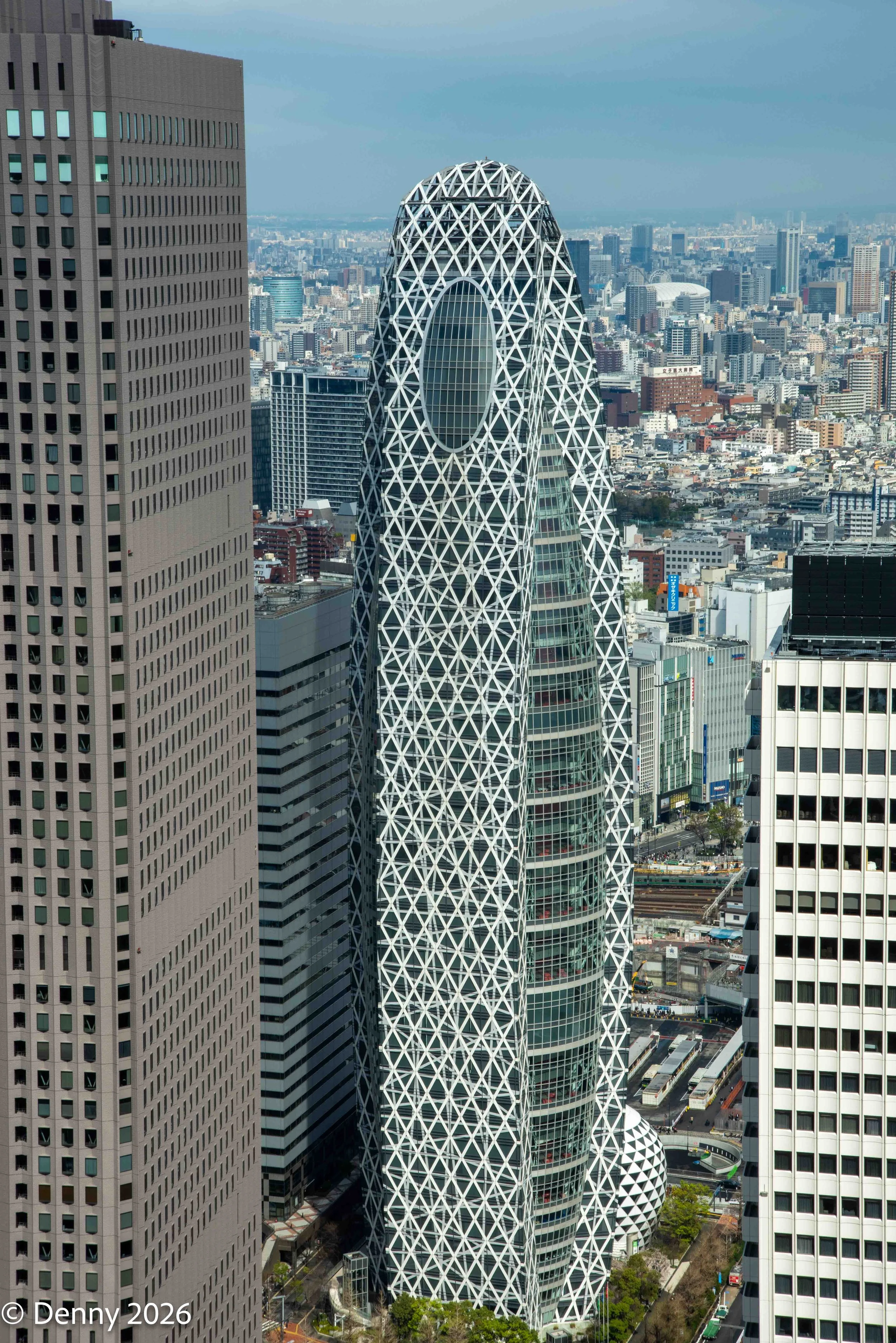
Mode Gakuen Cocoon Tower viewed from 45th floor, North Tower

View from North Tower 45th floor with Mt Takao, Daibosatsu Toge & Kumotori-yama in the background

View from 45th floor, North Tower, Tokyo Metropolitan Building

On descending the tower we arrived at the second floor where, amongst other displays were some memorabilia of the 2020 Tokyo Olympics on display.

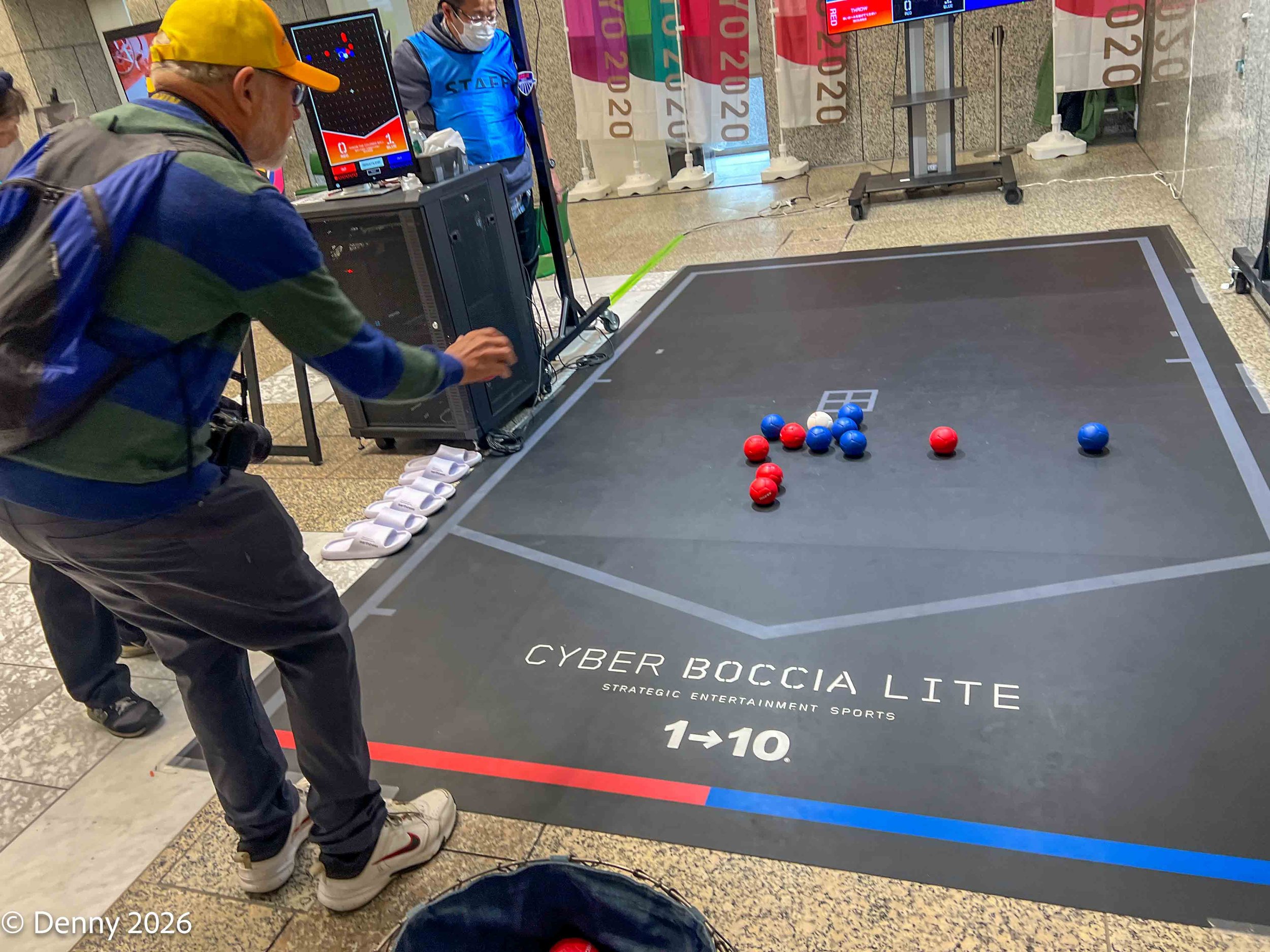
Although unintended, before we knew it, we were next in line to play a game of boccé. The 5 m x 2 m mat in front of us had electronic sensors and the red and blue soft leather balls on landing showed the distance in millimetres from the kitty. We each had ten throws and according to the lady in charge, we were ‘experts’ as we ended up with a fairly tight cluster with Jak winning, ‘one up’ by only 0.25 mm!

Jak playing Cyber Boccia Lite, Tokyo Metropolitan Building, Shinjuku

On our way home we diverted into several small garden parks and photographed the pink and white cherry blossoms that are superb at this time.

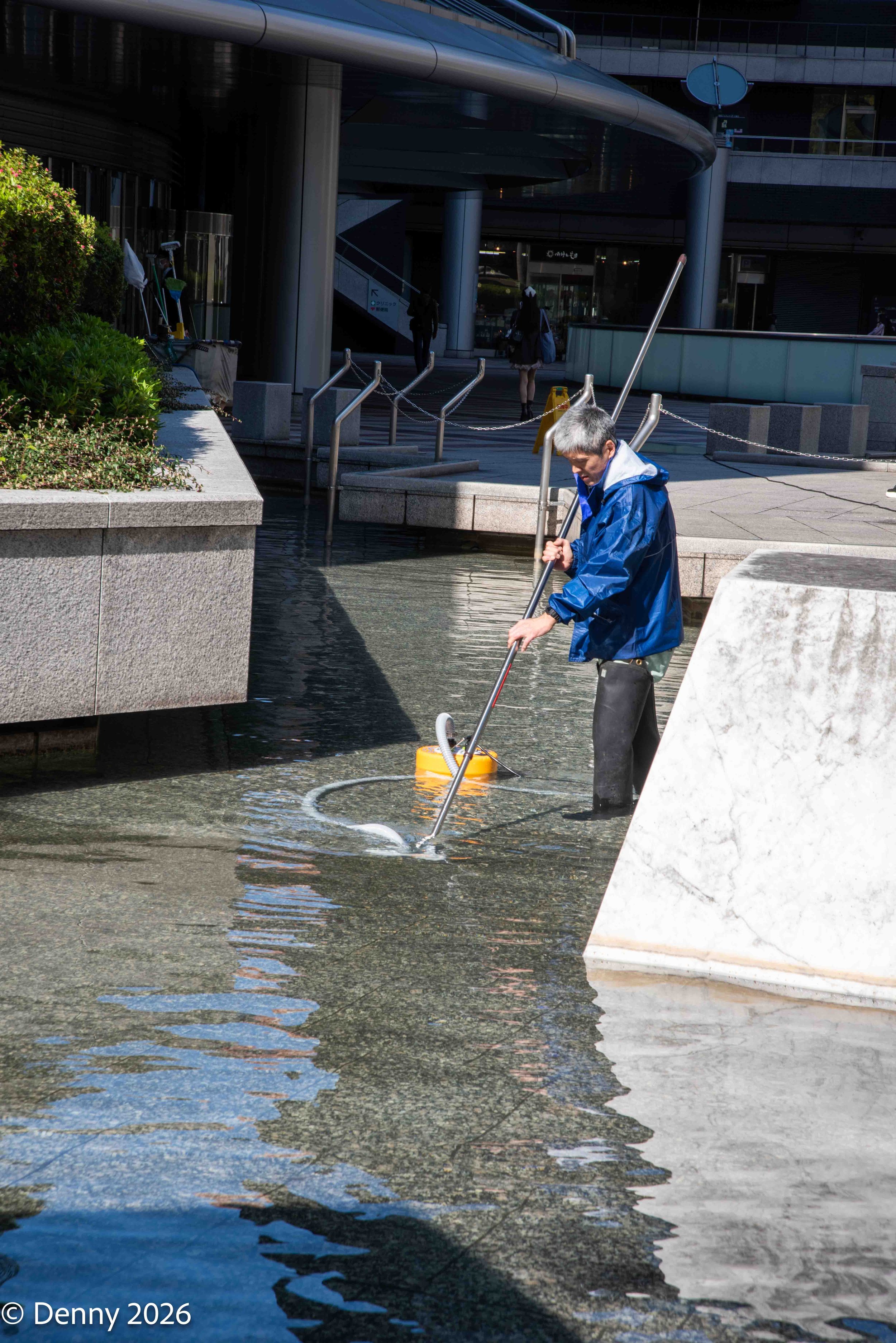
We also photographed a dedicated worker vacuuming the base of a reflection pool who we’d seen toiling away four hours earlier.

Cherry blossom with Sonpo Japan Building in the background

Man cleaning pond, Shinjuku

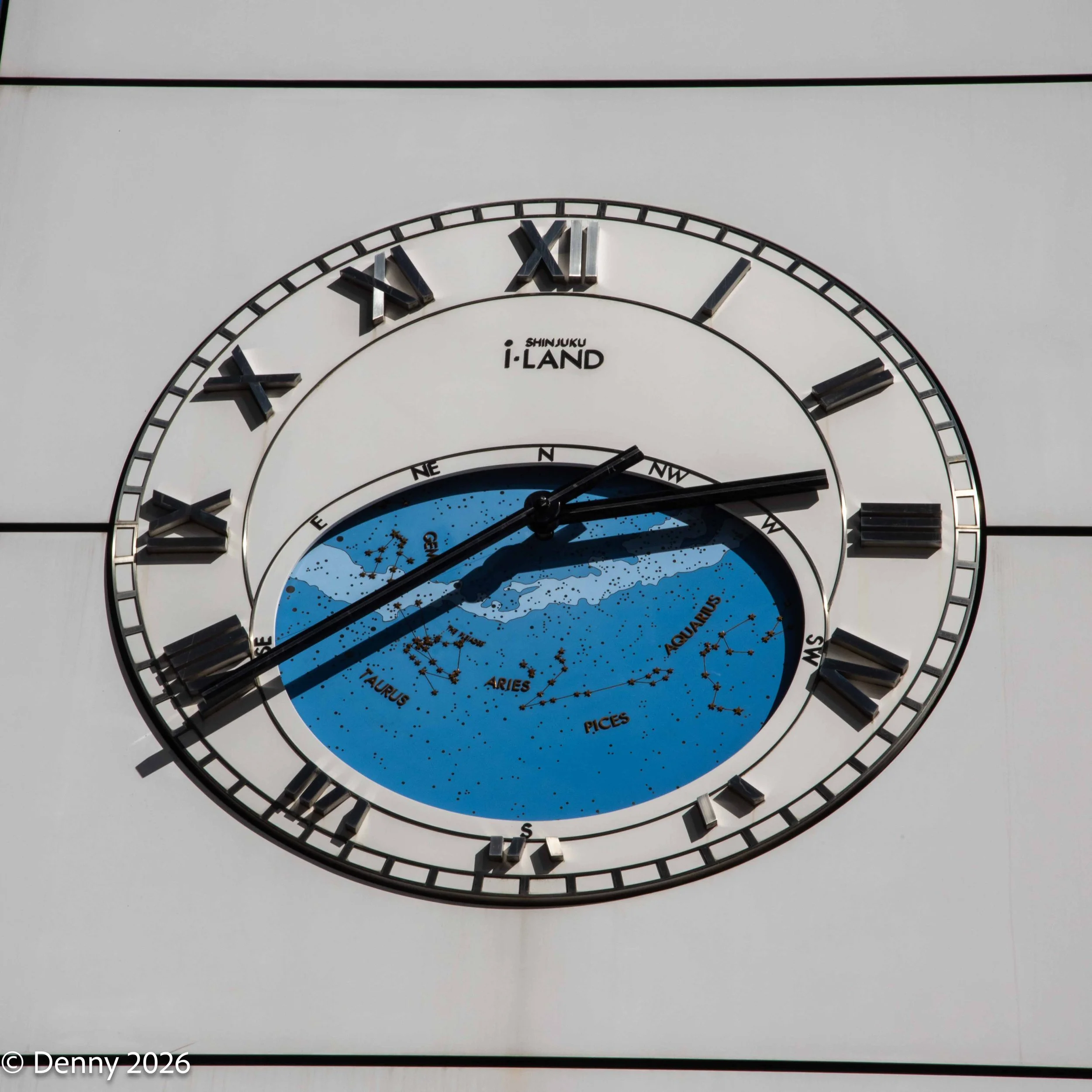
On the opposite side of the astronomical clock we’d photographed earlier this morning, we found another clock with the present positioning of the constellations associated with the signs of the zodiac.  

Astronomical Clock, Shinjuku

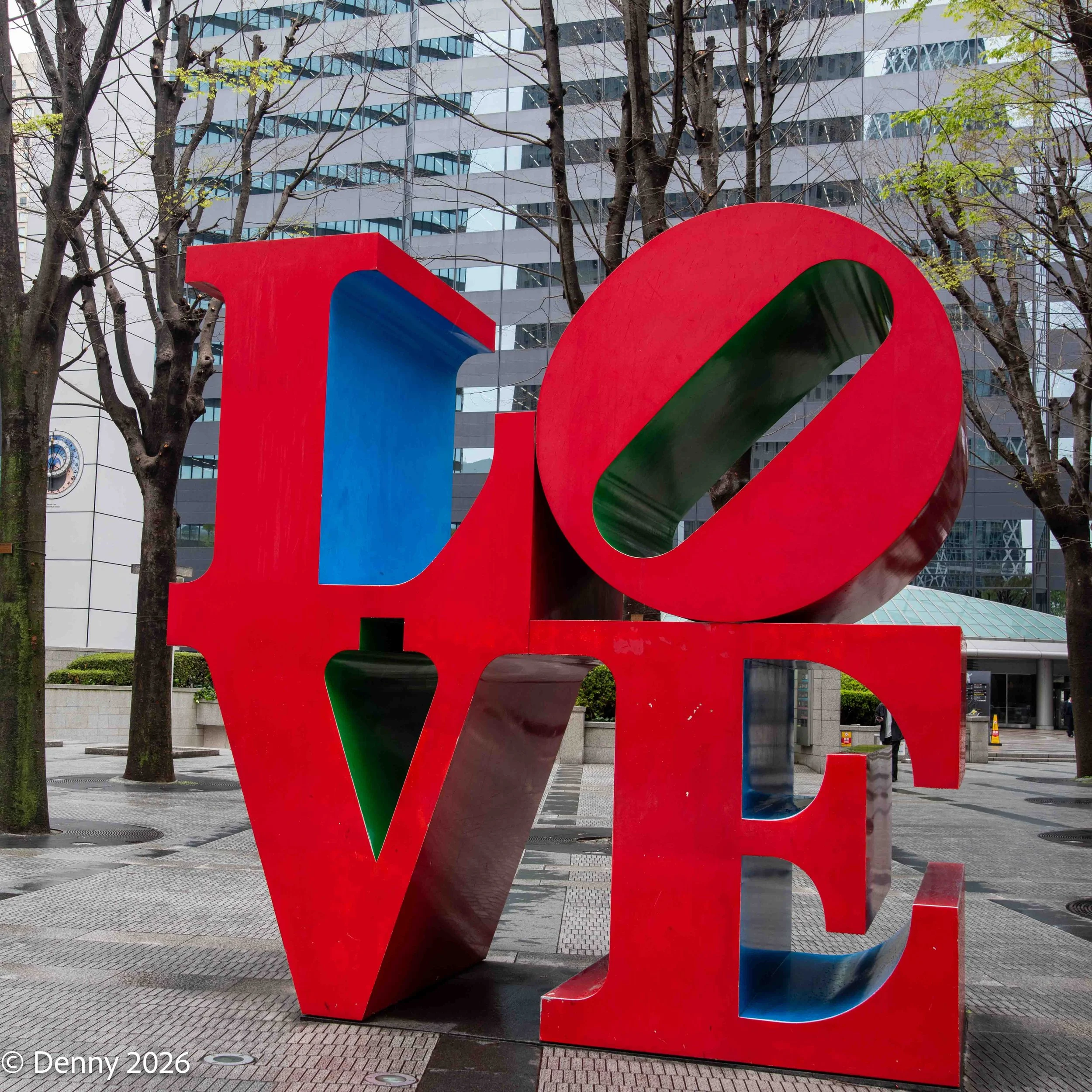
We next stopped at the Robert Indiana ‘Love’ sculpture and took photos of each other through the love-letters.

Robert Indiana LOVE sculpture

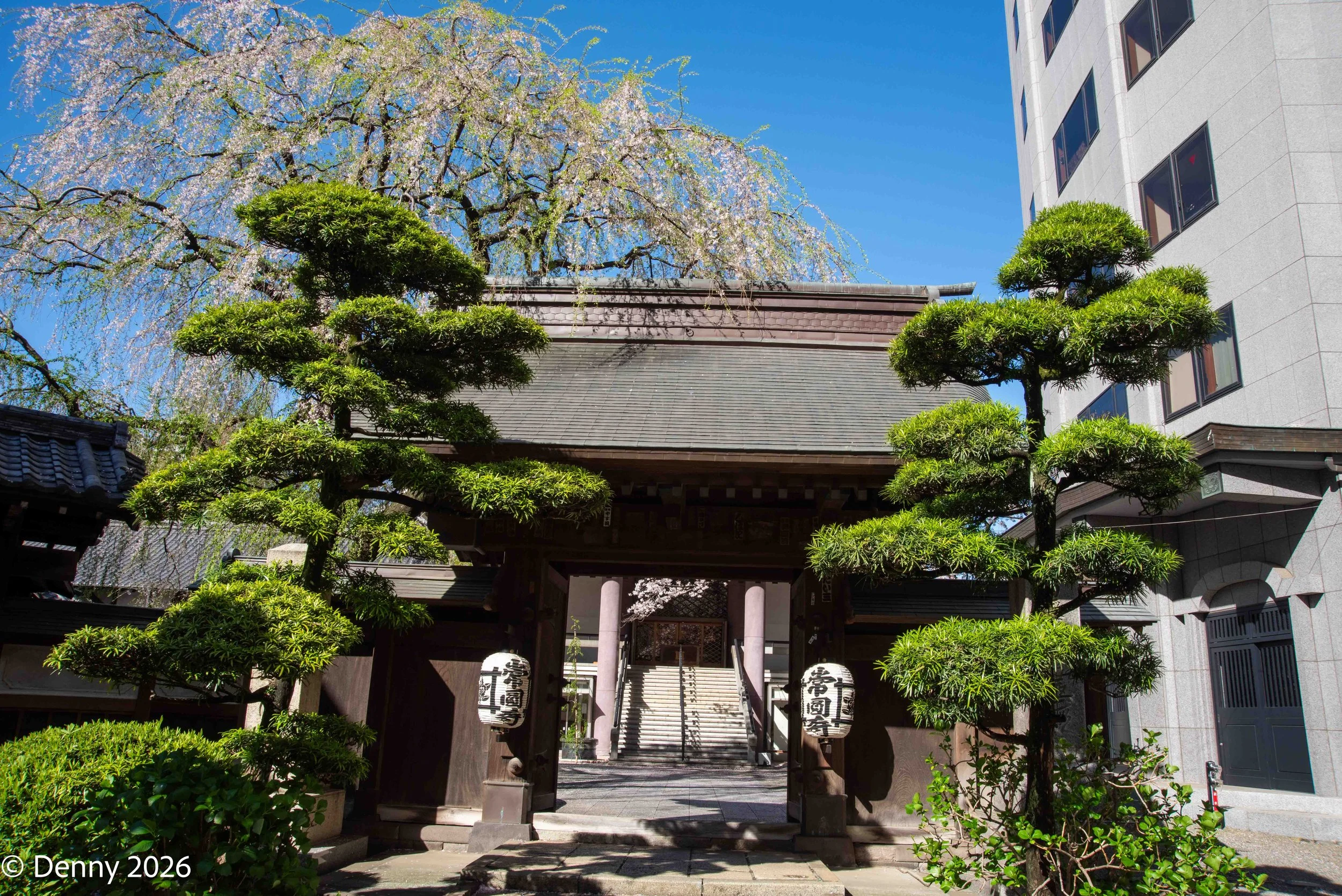
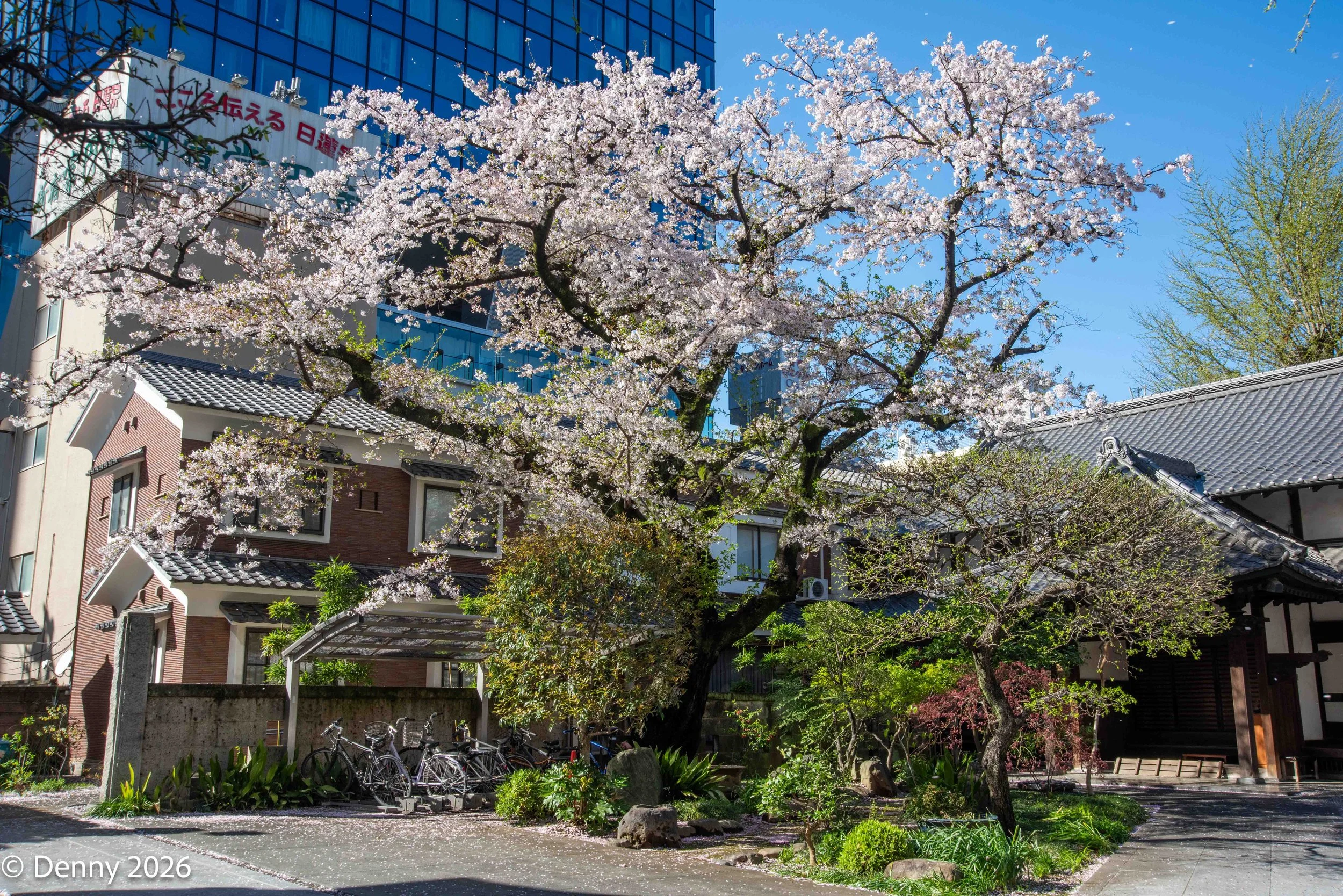
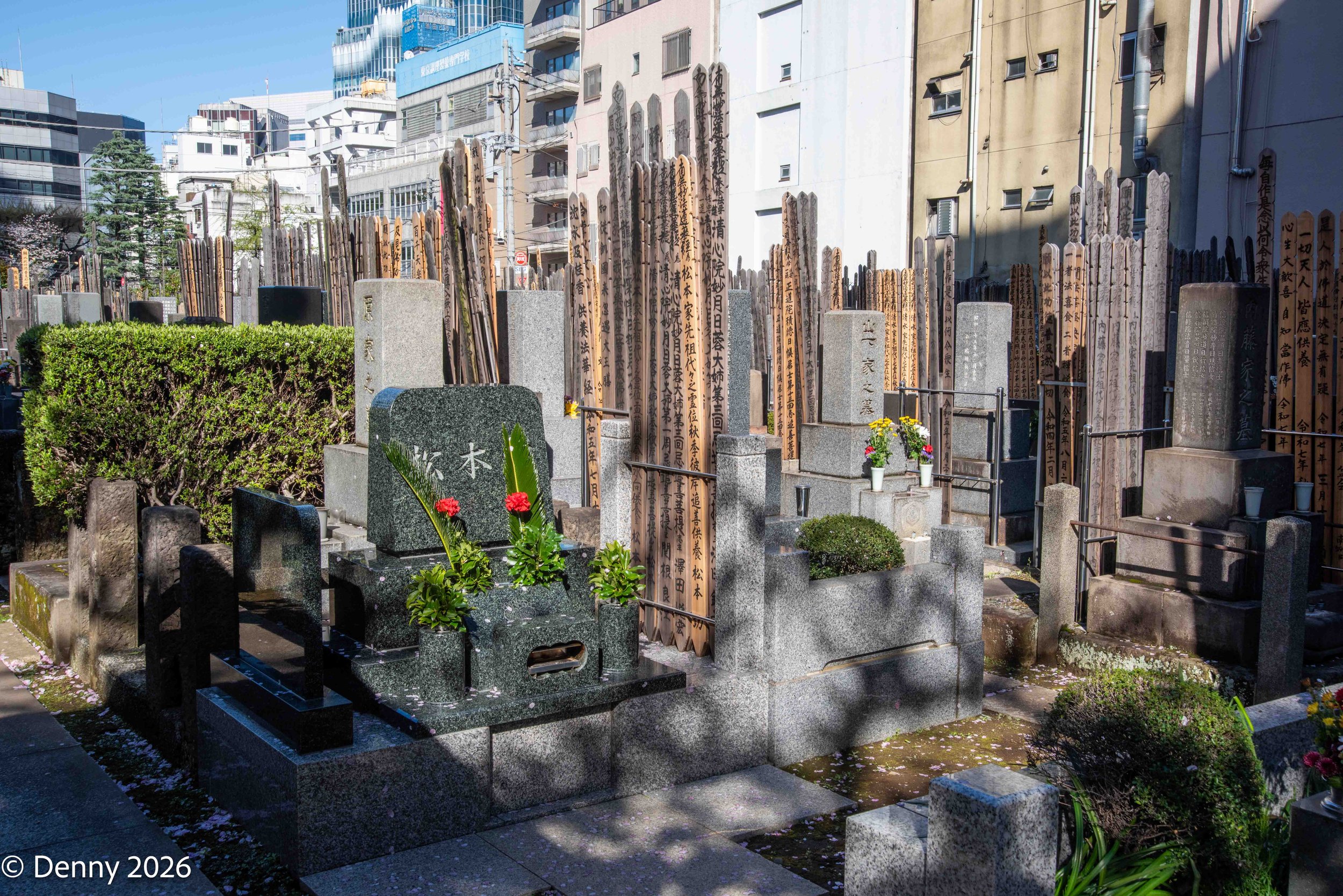
Our next diversion was into the Joen-ji Buddhist Temple. It was originally founded in the 16th century and belongs to the Nichiren-shu sect of Buddhism. The gardens at this ancient temple were beautiful with exceedingly old cherry trees in blossom and topiaried conifers in exquisite shape. There was a graveyard adjacent to the temple and the symbols on headstones, beautiful flowers and bamboo memory sticks displayed at each grave reinforced our understanding of the enormous respect Buddhists have for their forebears.  

Joen-ji-Temple, Shinjuku

Joen-ji-Temple, Shinjuku

Graveyard, Joen-ji-Temple, Shinjuku

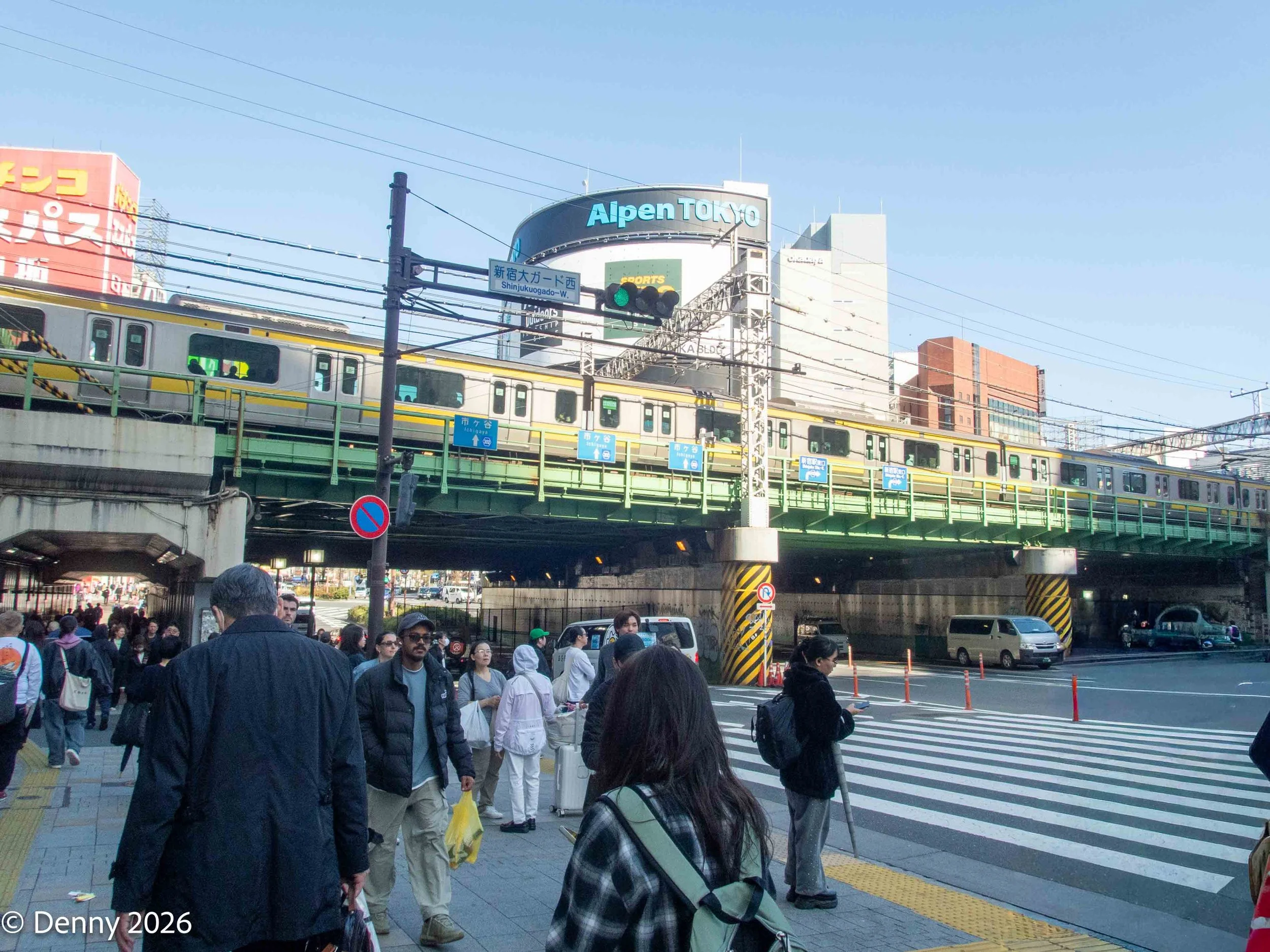
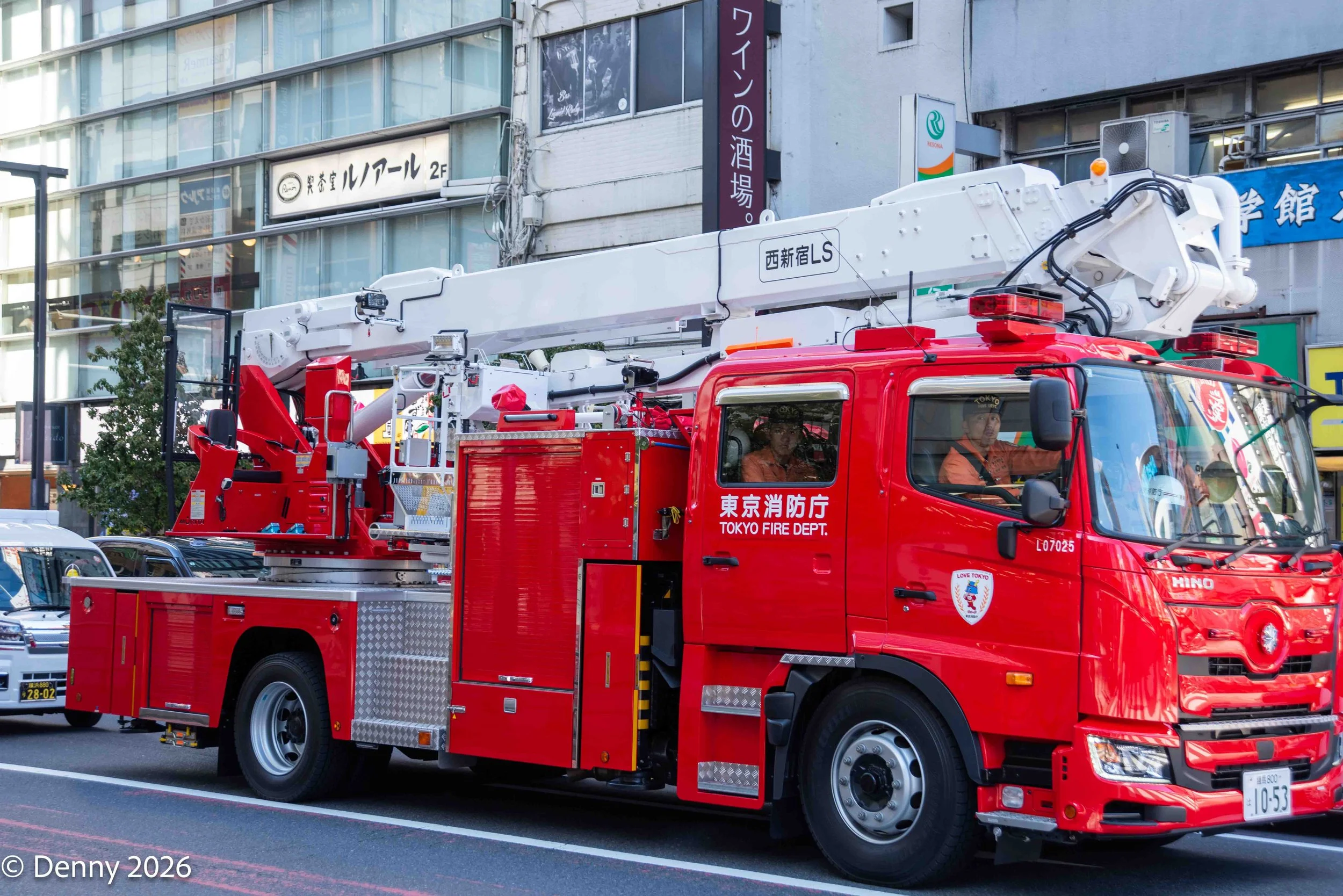
On the final part of our return journey we photographed trains on the overpass and a fire-engine underneath. To our amazement we passed a small shop claiming to be a ‘vape-studio’!

Railway overpass, Shinjuku

Fire truck, Shinjuku

We had need of a bottle opener last night and it was opportune on the way home to buy one at a local mini-market. A ‘Can-Do’ store had one plus a corkscrew and knife for a mere ¥110 ($1). The charming young shop assistant was most helpful when the payment system didn’t offer English prompts.

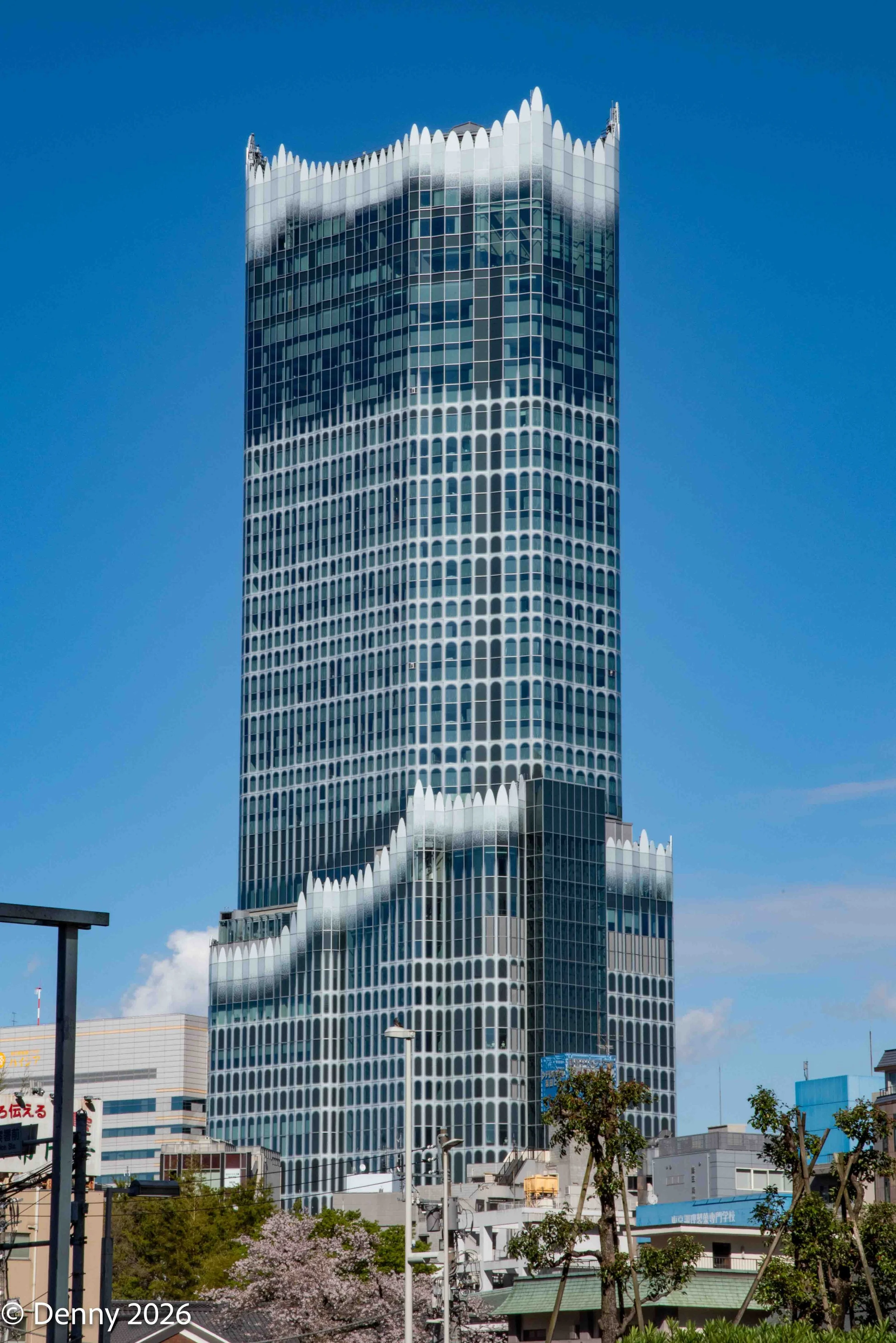
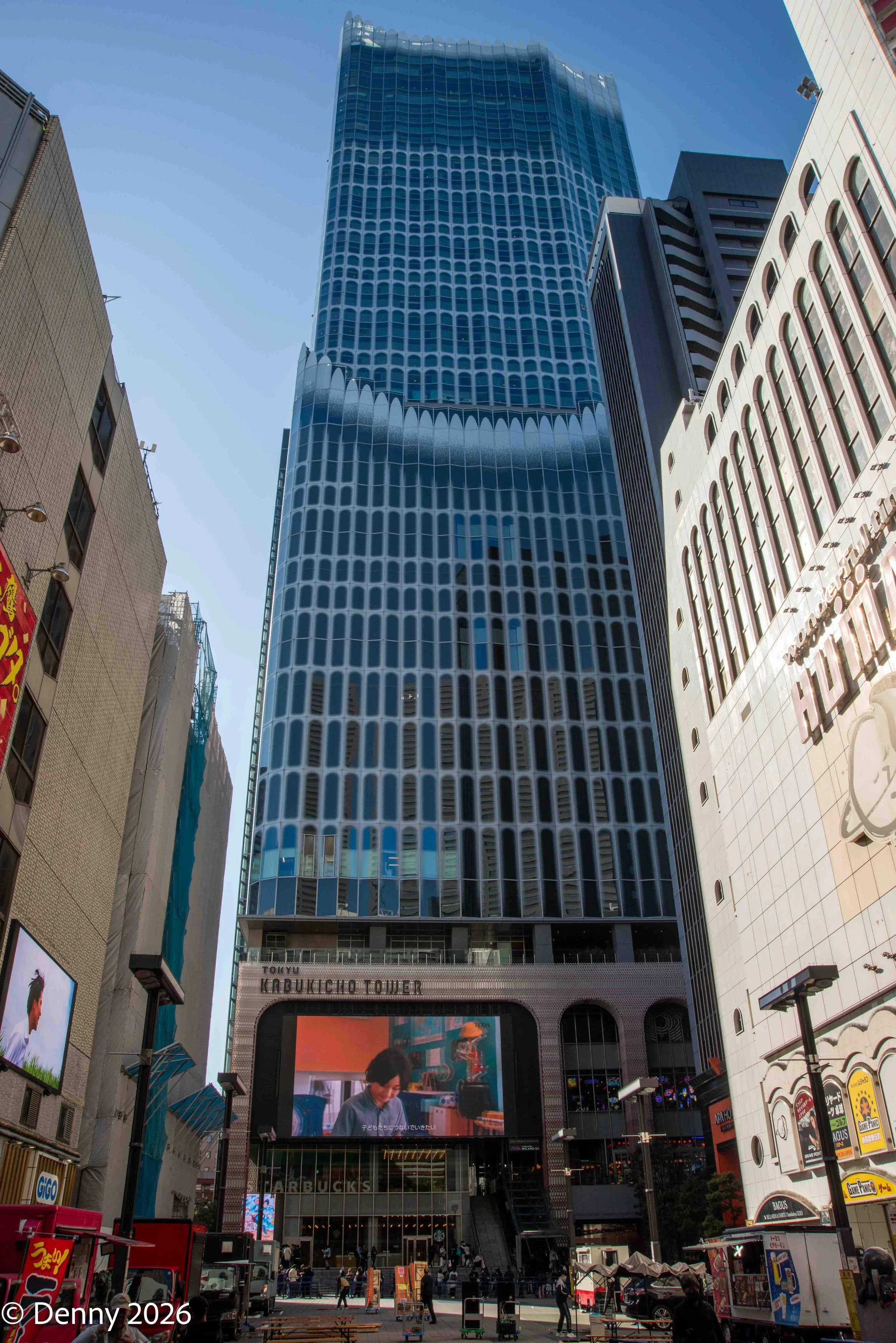
The very impressive skyscraper we’d observed from the Tokyo Metropolitan Government Offices with its upper storeys in a crown formation turned out to be right next to our hotel and yet we’d not realised its proximity.  

Tokyu Kabukicho Tower, Shinjuku (photo taken earlier in the day)

Tokyu Kabukicho Tower, Shinjuku (photo taken from the foyer of our hotel)

 Now back at the Gracery Hotel we relaxed and spent time recording the principal delights of our day’s meandering. At the local 7-Eleven I bought a 180 mL bottle of Black Nikka (sic) Whisky for ¥600. Its equivalent to Chivas Regal!

Later we went out for our evening meal and had very tasty noodles, vegetables and dumplings complemented with beers.

At 20:00 we gathered with the local crowds out in the street to see the giant Godzilla high on our hotel let out some terrifying sounds and light effects. With anticipation, we all waited for the appointed ‘on the hour’ spectacular Godzilla scream but then to our dismay an official intervened and told us ‘sorry, not happening tonight, Godzilla is broken!’

Godzilla on Hotel Godzilla adjacent to Hotel Gracery

Godzilla on Hotel Godzilla adjacent to Hotel Gracery

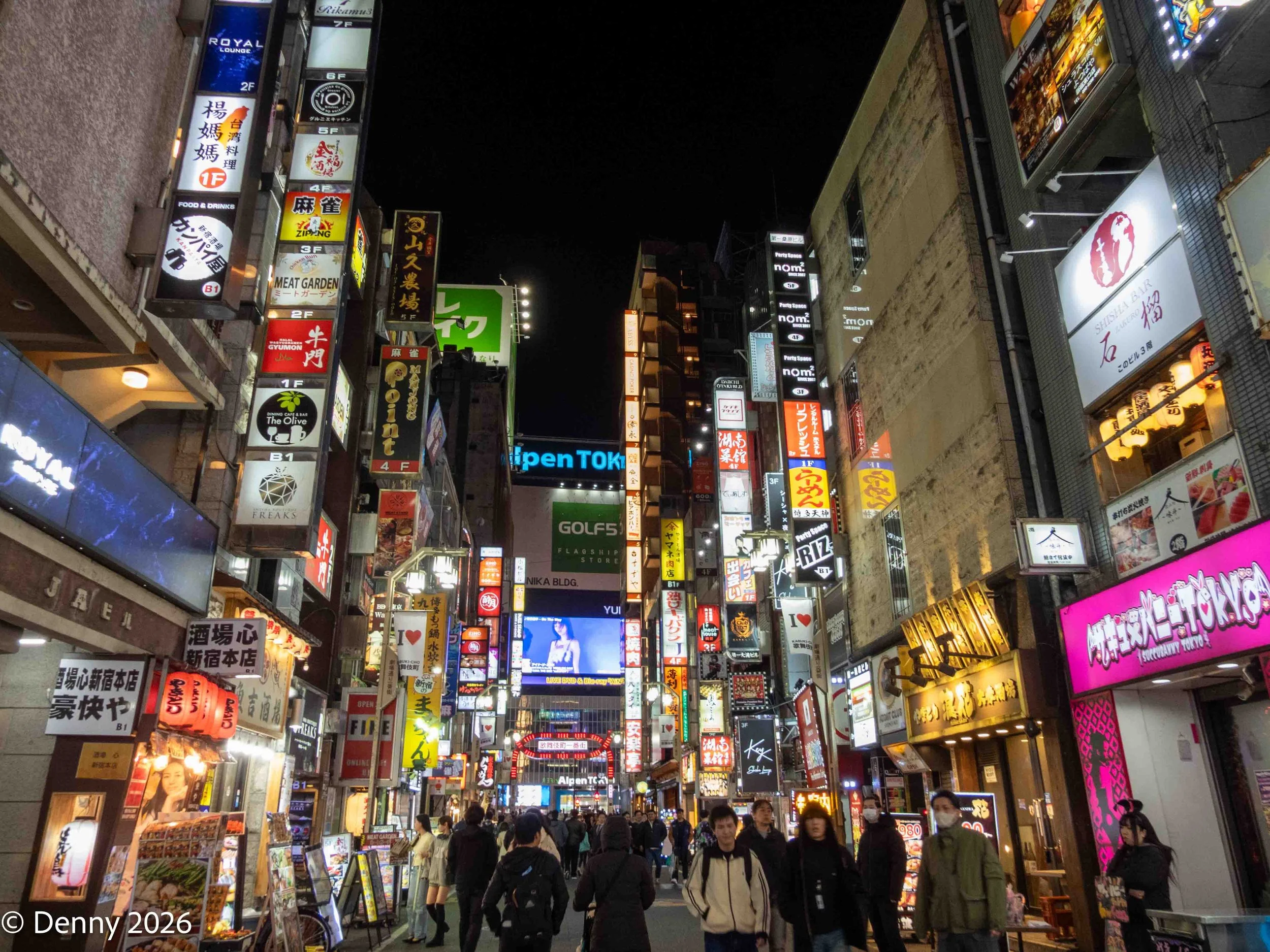
Night time, Shinjuku

With this anticlimax we decided it was time to call it a day and we headed for our room for the final night in Shinjuku.

Night view from our hotel room, Shinjuku,

Tomorrow we move to the Grand Nikko Tokyo Daiba Hotel in Minato City which is on the waterfront of Tokyo city.

DAY 22: Friday 3rd April 2026 (Easter Good Friday) TOKYO, JAPAN

We awoke to bright sunshine and a blue sky morning, quite different from the last few days of generally unsettled and drizzly weather.

As we don’t have to checkout of our hotel until 11:00 we were in no great rush, so breakfast was a leisurely repast of fresh fruit, yoghurt and orange juice whilst sitting on the bed in our petite hotel room.

Today we commence our ‘Japan Discovery’ tour with Bunnik, the same tour company who arranged our highly enjoyable South Korean eleven day tour.

To meet up with the travelling group we need to transfer to another Tokyo hotel called the Grand Nikko Tokyo Daiba in Minato City near the waterfront.

With our luggage in tow, we walked to the Shinjuku Station and found the desired JR line with the [JA] Commuter Rapid leaving from platform 1. The train arrived and was jammed packed with passengers but even so we still managed to find a spot to stand with our bags. Incidentally this was at 11:26 which is supposedly after the early morning ‘rush hour’.

At the train’s third stop at Osaki (not to be confused with Osaka!) the train line changed name to the Rinkai Line but unperturbed we ventured on for four more stops to arrive at our desired destination of Tokyo Teleport.

Train stations from Shibuya to Tokyo Teleport

With a sigh of relief that things had all gone exactly according to plan we stopped for a while at the station and had an excellent coffee at a Tulleys Coffee shop.

Tully's Coffee at Tokyo Teleport railway station

From Tokyo Teleport station we had a 900 m walk to our hotel and for reassurance a very friendly female station guide pointed us in the right direction to Grand Nikko Tokyo Daiba Hotel.

Corinne with friendly station assistant who helped us at Tokyo Teleport railway station

Although it was before 15:00 we were permitted to check in early. We have a room on the 17th floor with a stunning panoramic view out over the harbour towards Japan’s Narita International Airport.

View from our room at Grand Nikko Tokyo Daiba Hotel

Once we’d settled in, we went for a walk in the waterfront area called Odaiba adjacent to our hotel. Our attention was immediately captured by a 12.25 m tall replica of the Statue of Liberty. This was not directly modelled on the U.S. statue but on a French statue located on Paris’ Ile au Cygnes. It was installed in the year 2000 to commemorate lasting Franco-Japanese ties.

Statue of Liberty on waterfront at Odaiba

The setting for the statue is idyllic being surrounded by flower gardens with dozens of tulips and pansies and many cherry trees presently in blossom.

The statue which is actually 1/7th the size of the New York ‘Liberty’ is set against the stunning backdrop of the magnificent Rainbow Suspension Bridge.

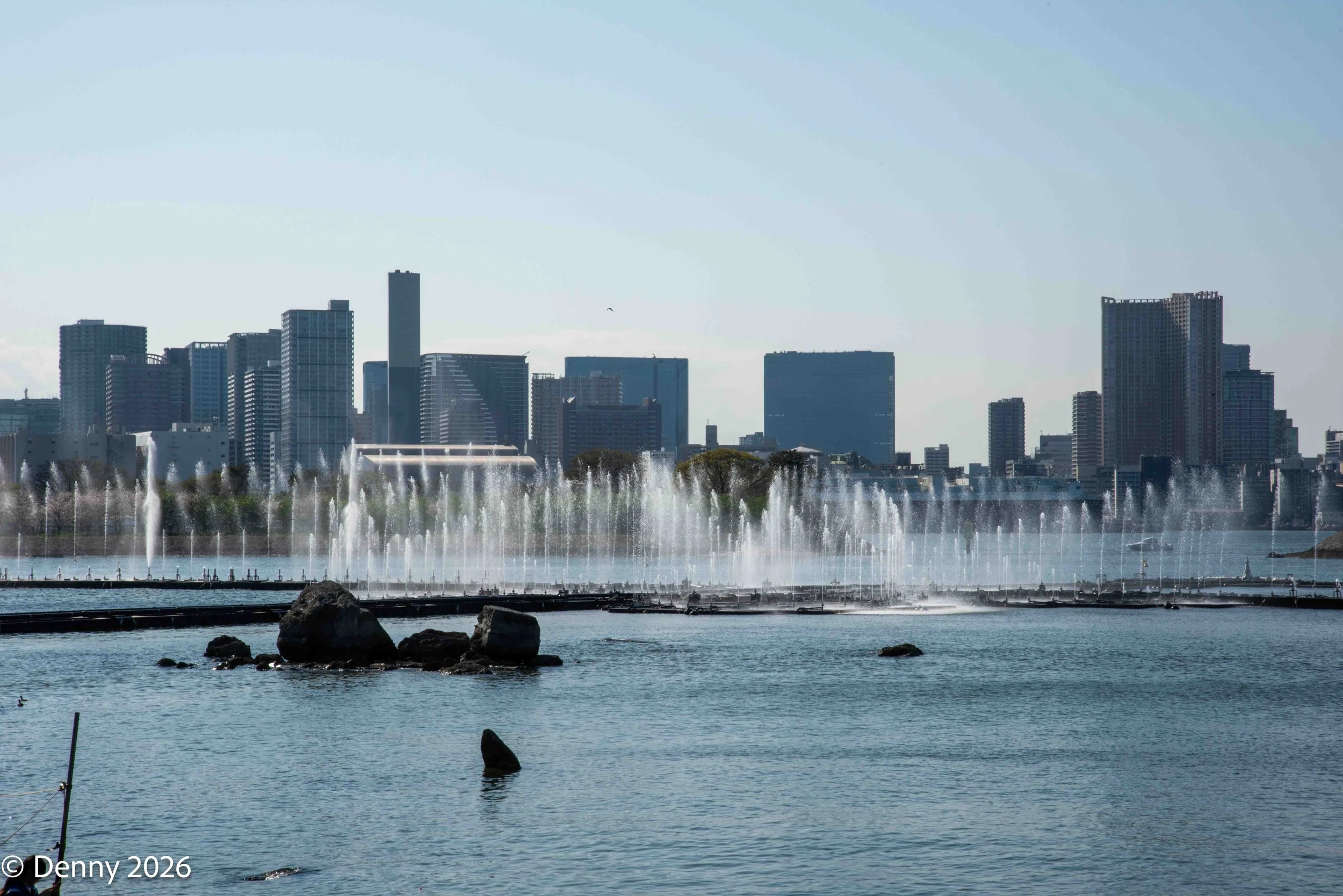
To our great joy, at precisely 16:00 the massive harbour water fountain burst into action accompanied by classical and traditional Japanese music.

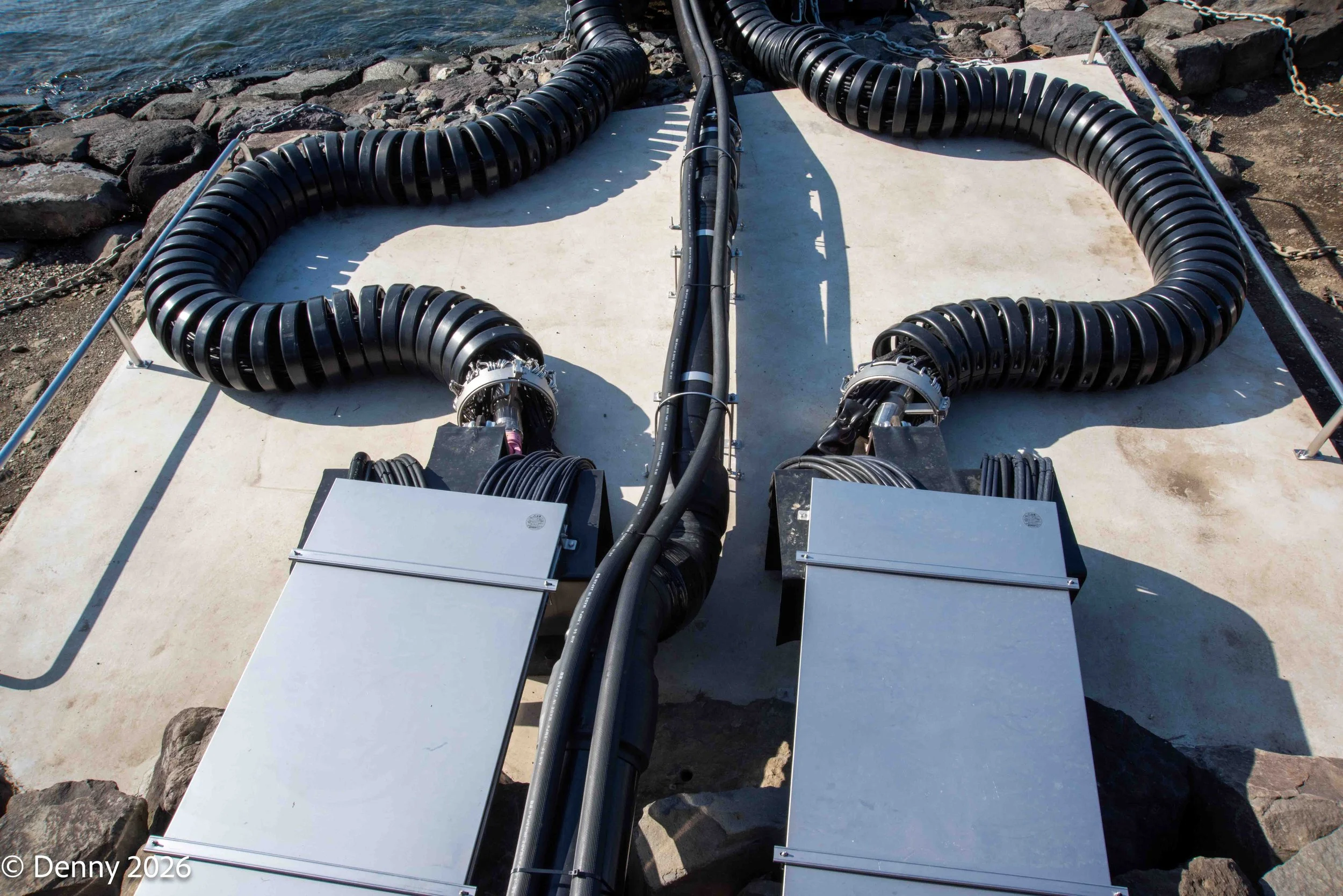
The fountain is ‘T’ shaped with the longest section being about 500 m in length. The thousands of vertical, transverse and spiralling water jets were choreographed with the music and the effect was most impressive. Small explosions occurred occasionally and accompanied the ejecting of water to the maximum height. The huge number of pipe-lines and hydraulic pumps needed to operate this ‘water spectacular’ was difficult to comprehend. 

Water fountain display on waterfront at Odaiba

Water fountain display on waterfront at Odaiba

Water fountain display on waterfront at Odaiba

Fountain hydraulic system, waterfront at Odaiba

Water fountain display on waterfront at Odaiba

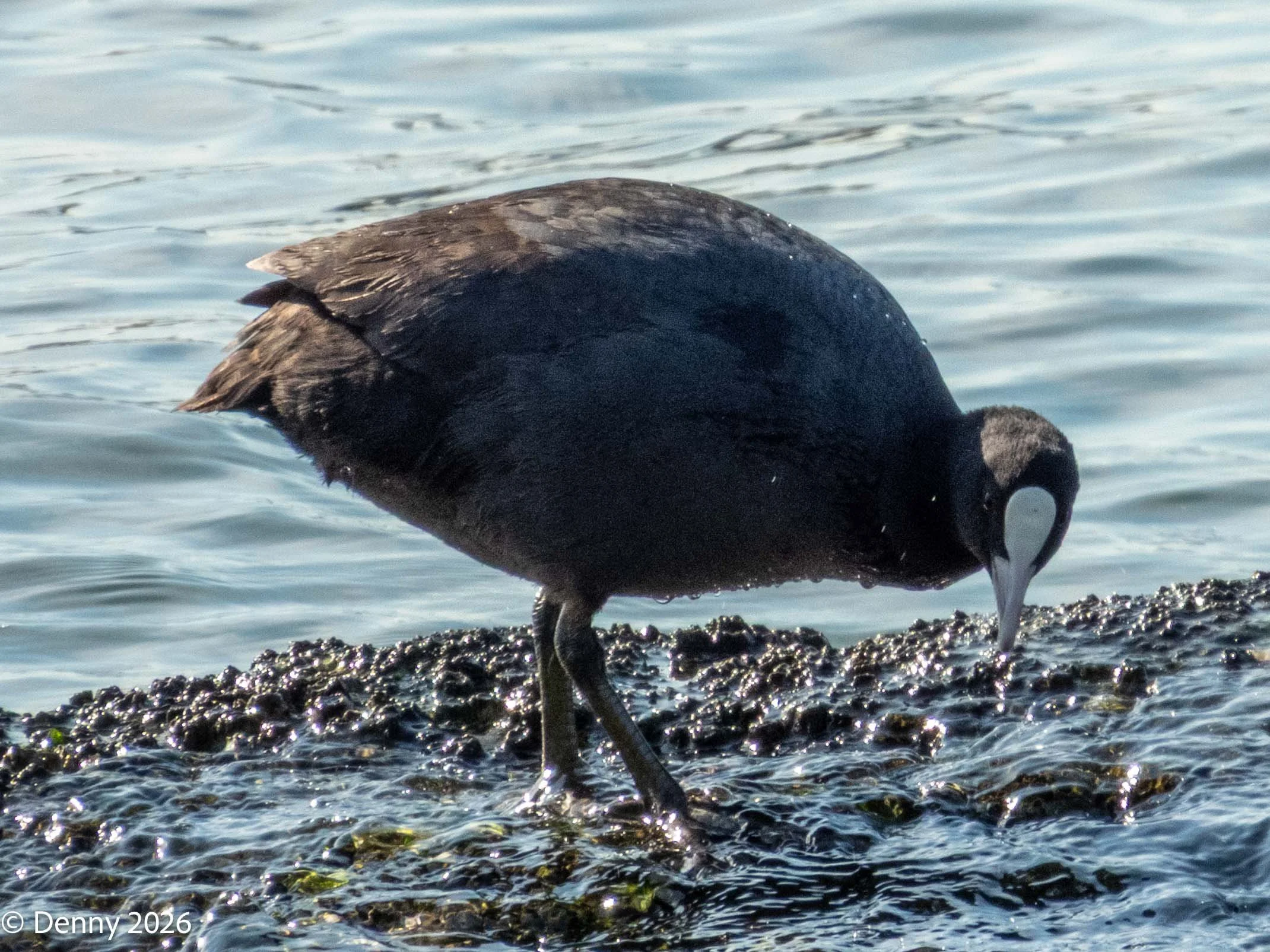
Along the waterfront there were ancient steel remnants of mooring chains, admiralty anchors and a number of wading birds.

Water fountain display and ancient steel remnants of mooring chains on waterfront at Odaiba

Greater Scaup on waterfront at Odaiba

Coot on waterfront at Odaiba

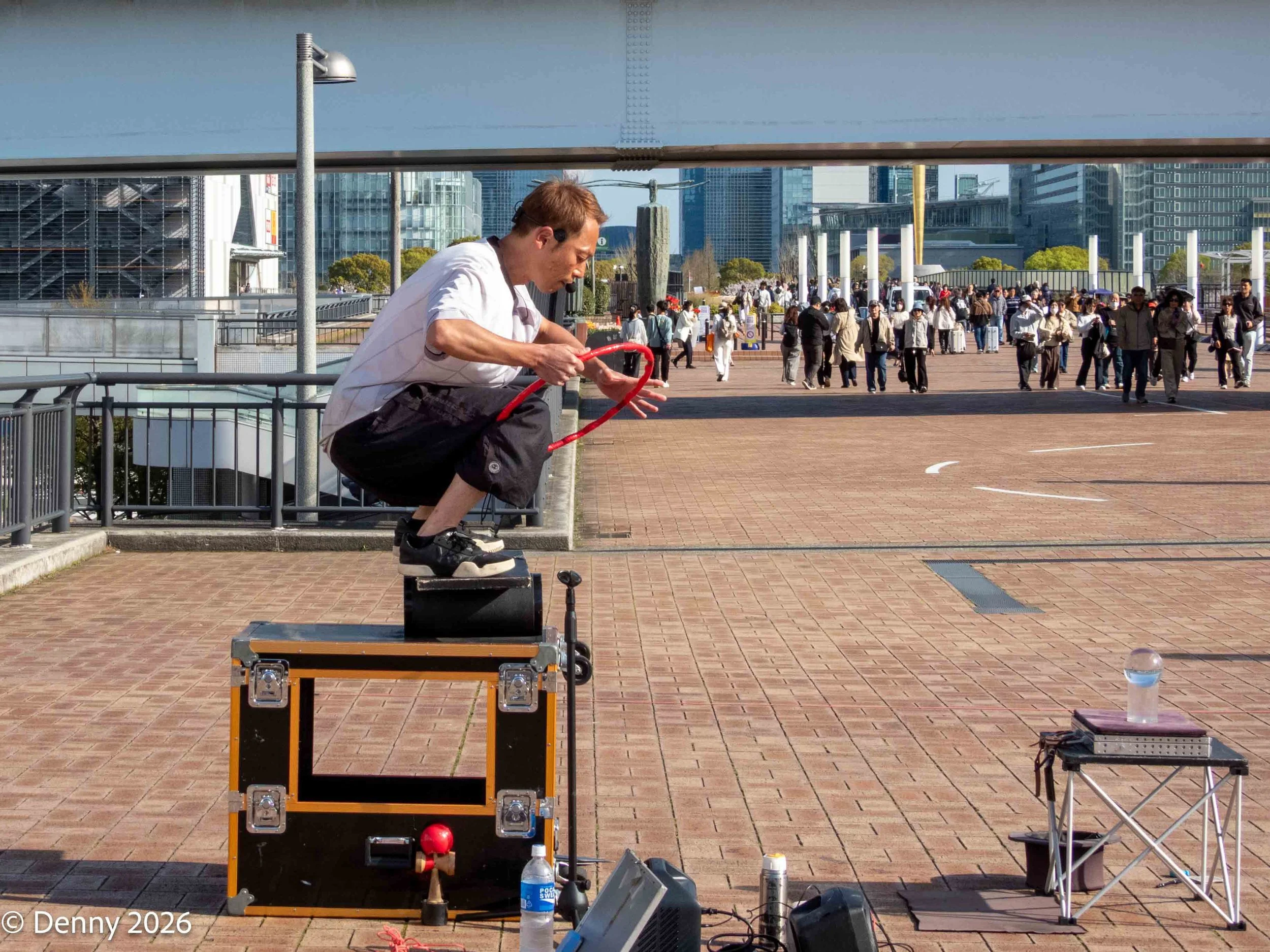
We also came upon a hyperactive busker who was performing magic coin and card tricks together with balancing acts whilst juggling knives.

Magician on waterfront at Odaiba

Back at our hotel we showered and at 18:20 gathered with fellow Bunnik travellers for our introductory meeting and evening buffet meal.

Our tour leader is Michiyo Hamada who likes to be called ‘Mitzie’ and our group comprises seventeen people, all from Australia.

We’re looking forward to meeting people and learning names tomorrow when our ‘Japan Discovery’ tour begins in earnest.

DAY 23: Saturday 4th April 2026 TOKYO, JAPAN

We had to wait for a short time in a queue for breakfast this morning as the hotel seems to be saturated with travelling groups like ours. Word has it that there are four separate Bunnik’s tours visiting Tokyo at present and all staying in the Grand Nikko Tokyo Daiba Hotel.

Our group then boarded a bus at 09:00 and we were driven to the Imperial Palace which is pretty much in the heart of Tokyo. On the way, Mitzie explained some of the complexities of travel within this 27 million people metropolis. To illustrate the dilemma that Tokyo residents face when moving from place to place she showed us a map of the intertwining rail networks that cover the city. It’s quite amazing!

Map of rail networks in Tokyo

The Imperial Palace is the residence of the Emperor of Japan and is a modern building and yet has Japanese architectural features and style.

Following the Meiji Restoration in 1868, Japan’s imperial family moved from Kyoto to Tokyo and Edo Castle, the former home of the Tokugawa shoguns was commandeered by the emperor and renamed as the Imperial Palace.

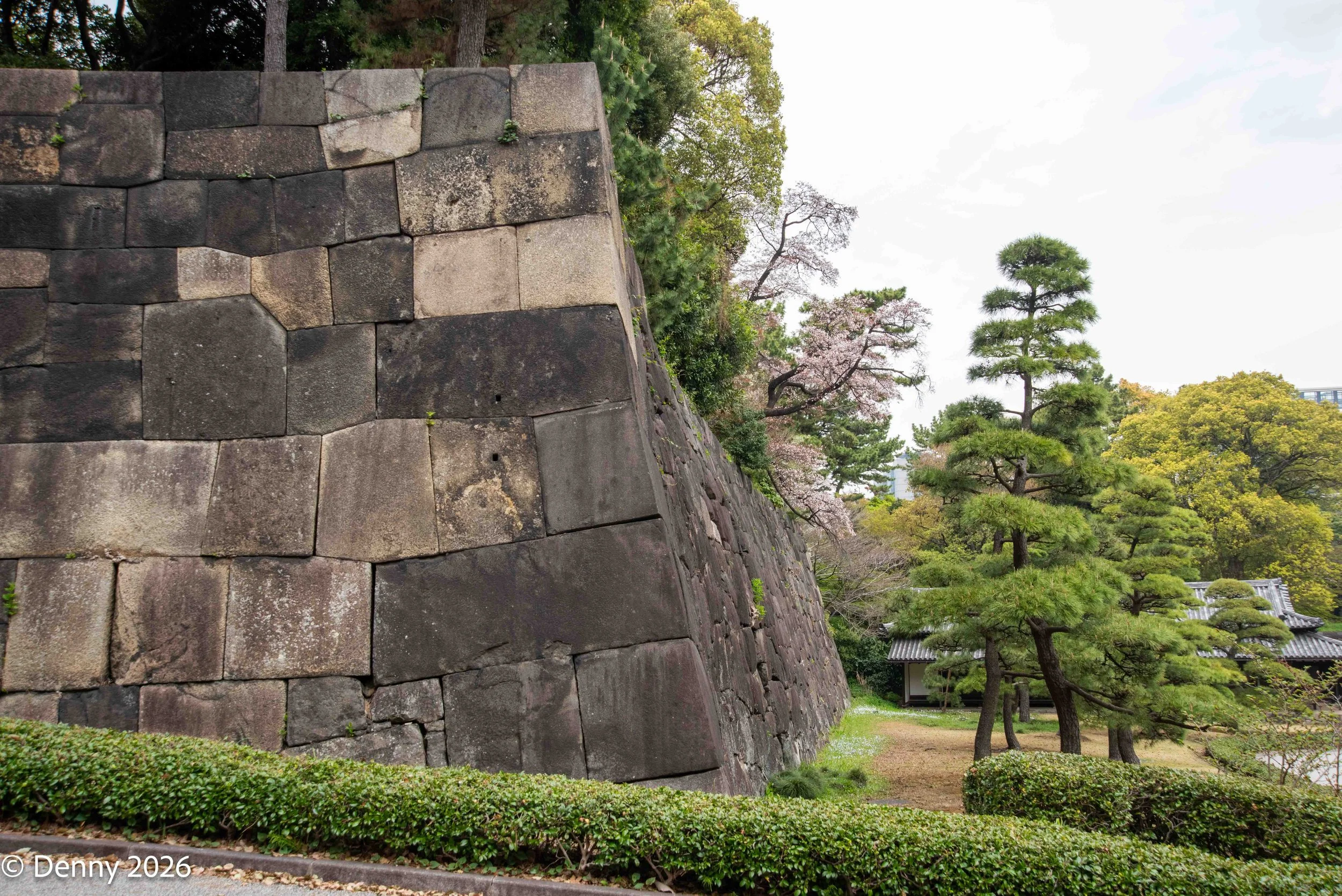
Practically nothing of the main original palace remains but the surrounding stone walls, moats, entrance gates and guardhouses bear testament to the past days of shogun domination and feudal warfare.

Rock wall at entrance, Imperial Palace East Garden

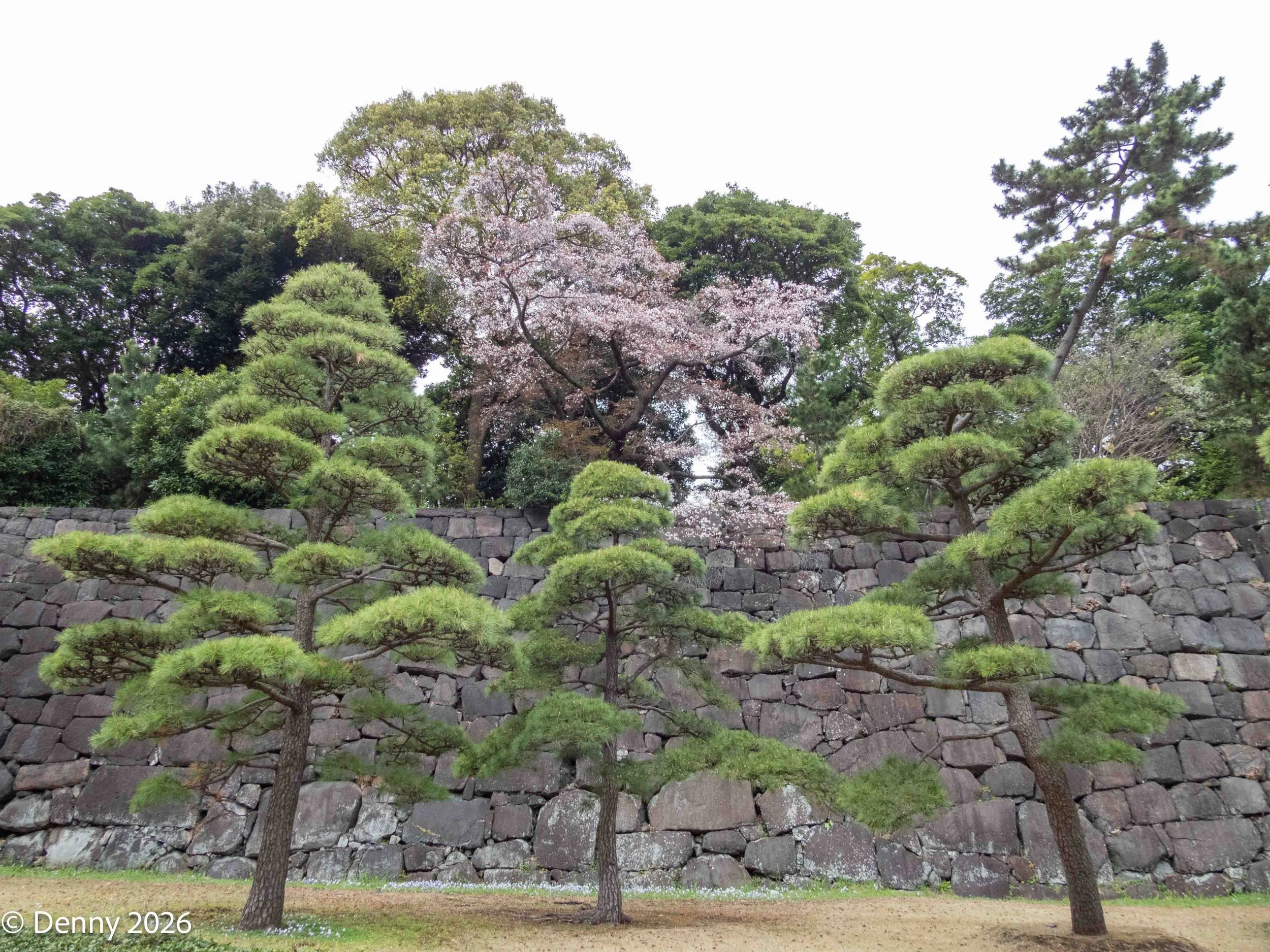
Rock wall and conifers, Imperial Palace East Garden

Rock wall, Imperial Palace East Garden

Most of the palace was destroyed during World War II but it has been rebuilt in the original style.

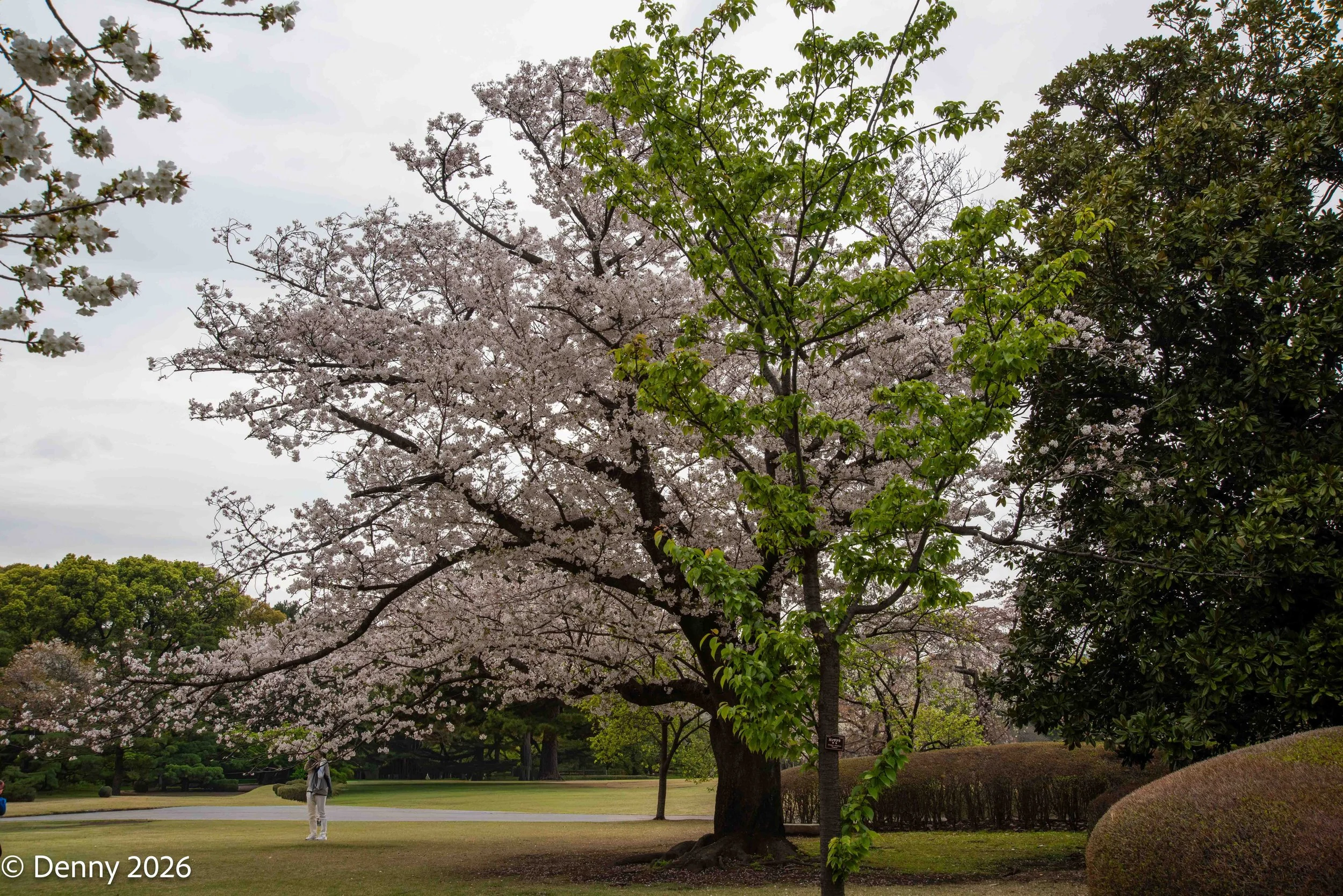
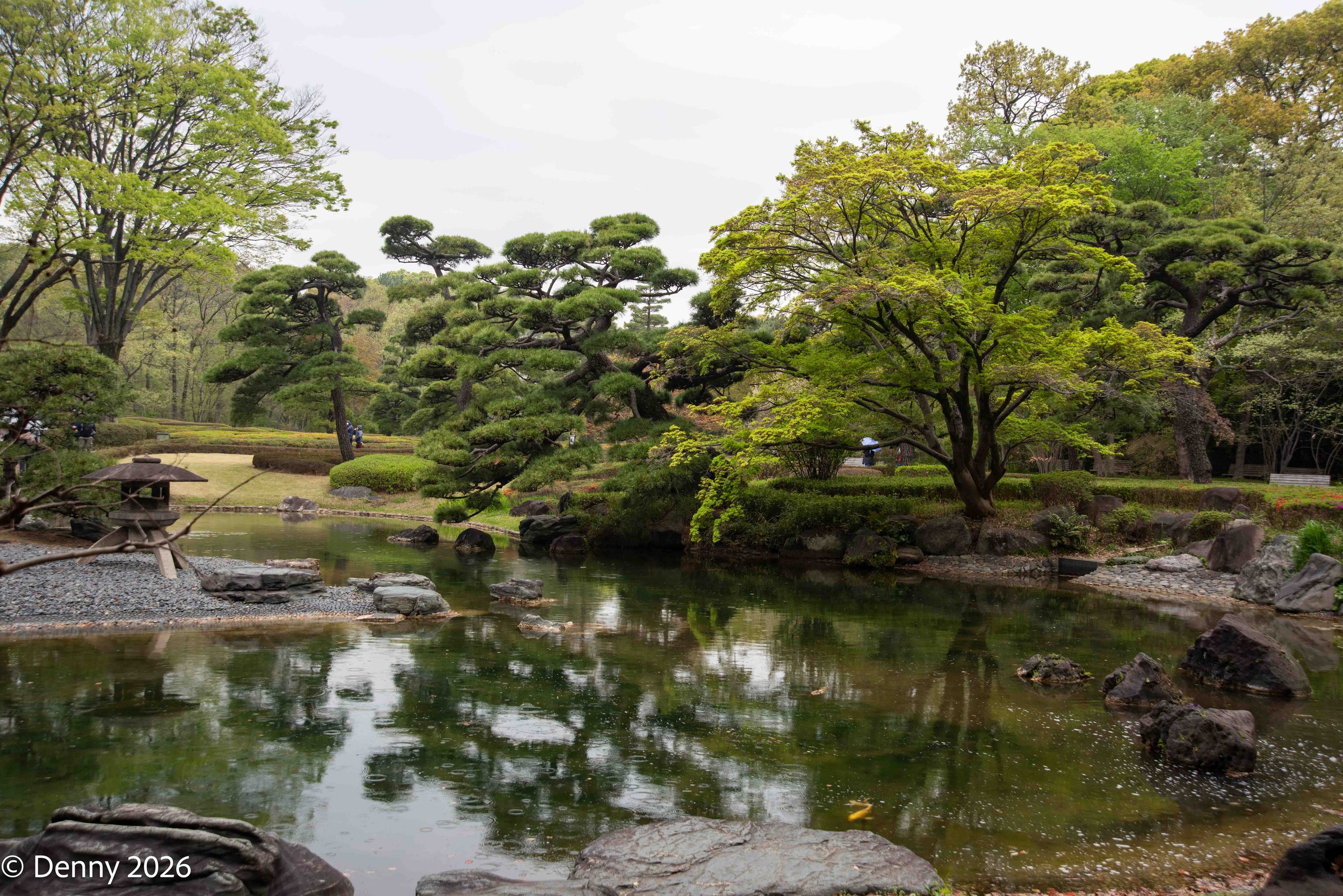
We wandered for an hour or so through the palace gardens where the cherry blossoms were at their best. The lawns, ponds and delicately pruned conifers set a truly ‘typical’ Japanese scene although a rainy period then intervened and spoilt the effect to a slight extent.

Cherry tree with remains of the old palace in background, Imperial Palace East Garden

Cherry blossom, Imperial Palace East Garden

View from Shiomizaka Slope, Imperial Palace East Garden

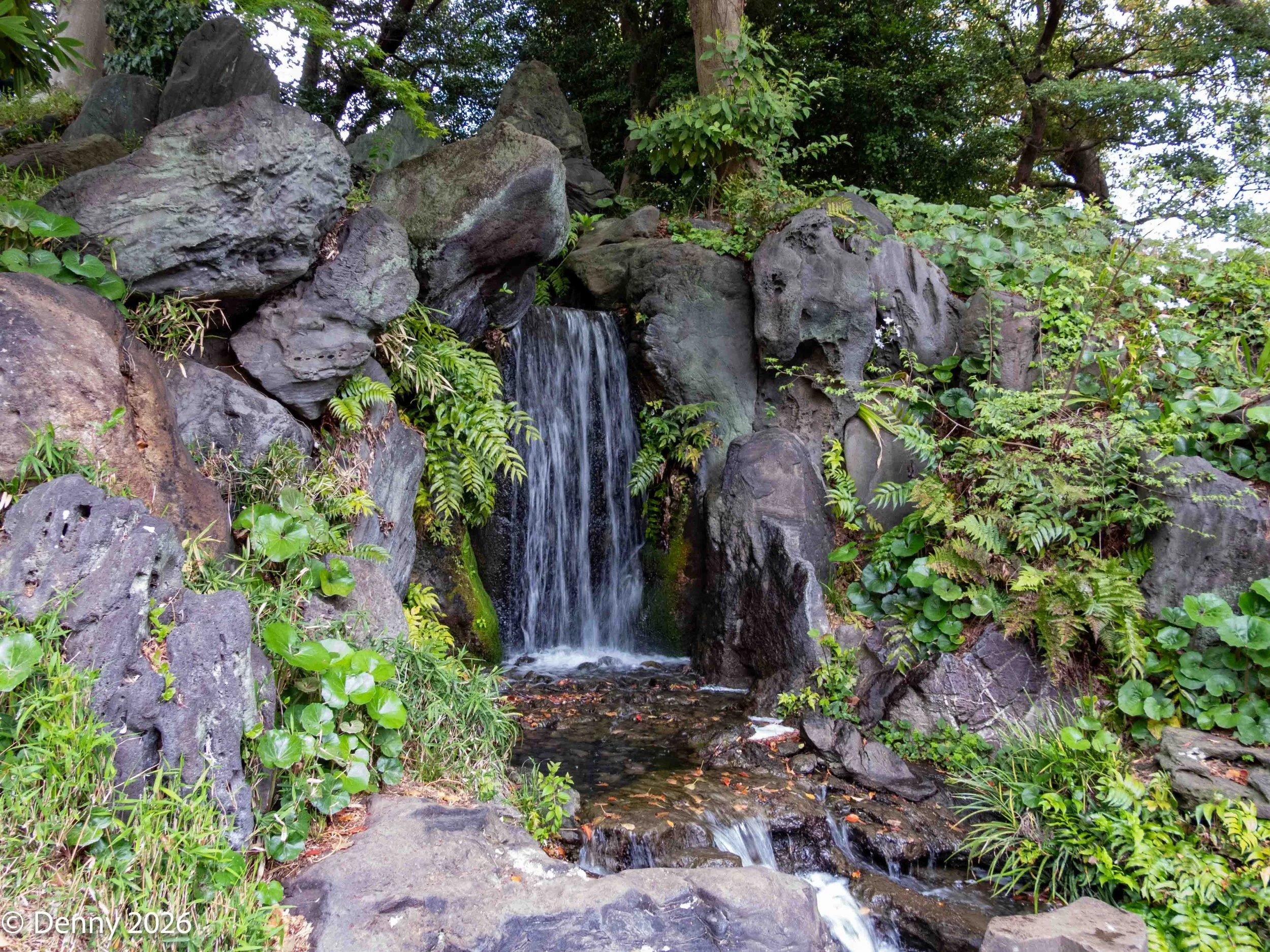
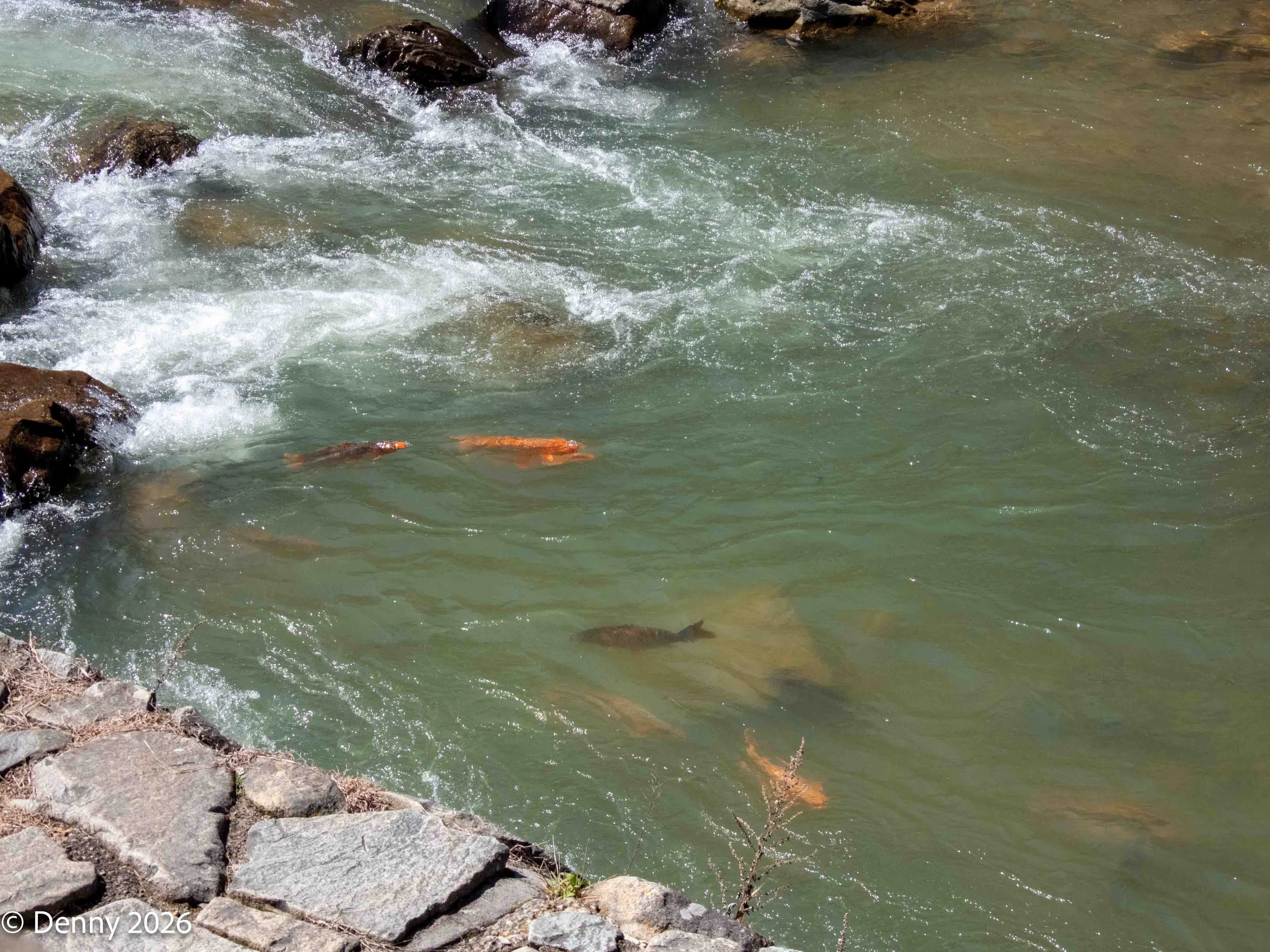
We continued on, despite the less than ideal weather conditions and found a pretty little waterfall cascading into a pond home to a number of large orange and white carp.

Waterfall, Imperial Palace East Garden

Pond, Imperial Palace East Garden

Carp in pond, Imperial Palace East Garden

Our Bunnik tour group, Imperial Palace East Garden

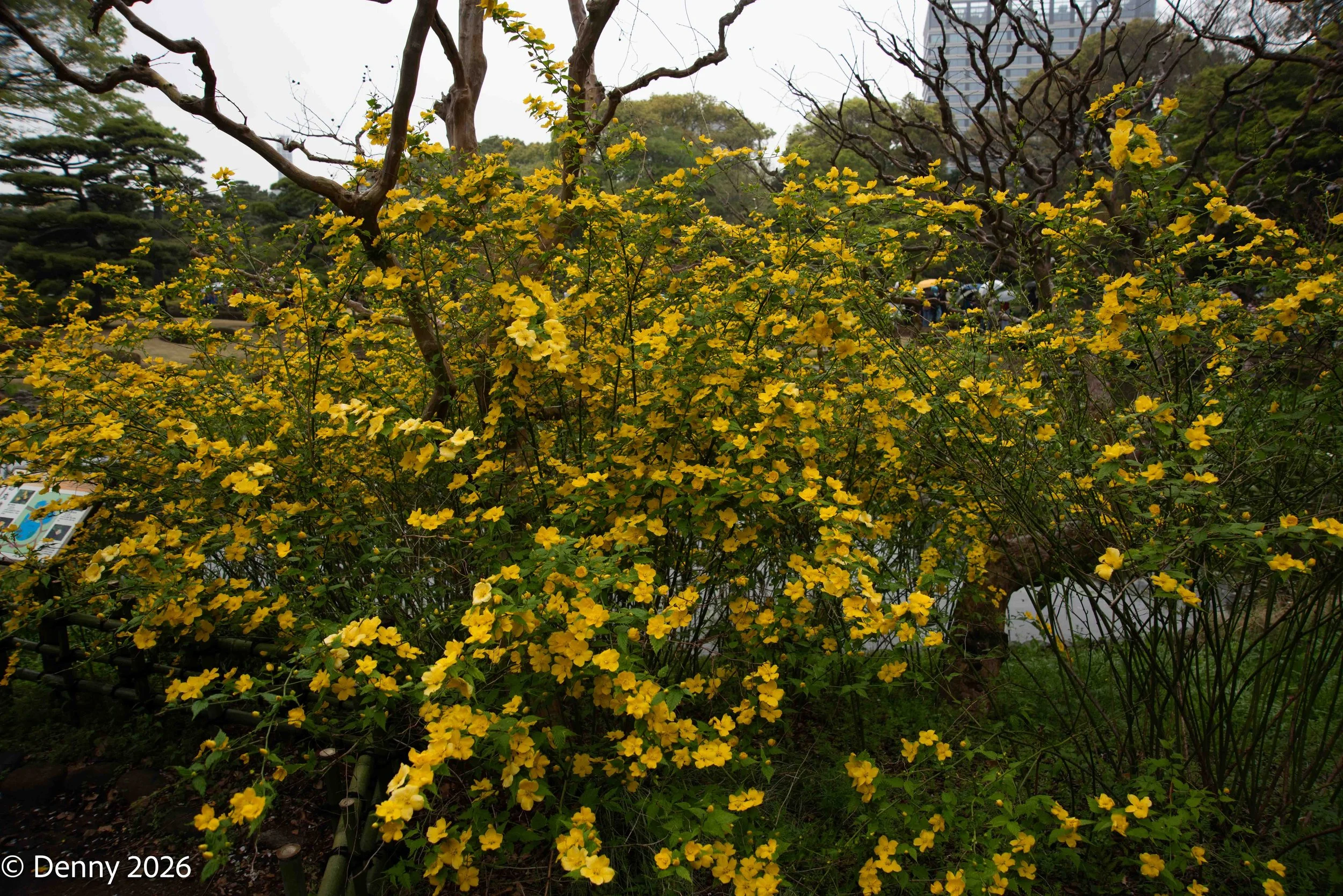
Apart from the cherry blossom trees, some of which are even more than 650 years old, we found an area with azaleas, rhododendrons, irises and kerria plants in flower. 

Kerria japonica, Imperial Palace East Garden

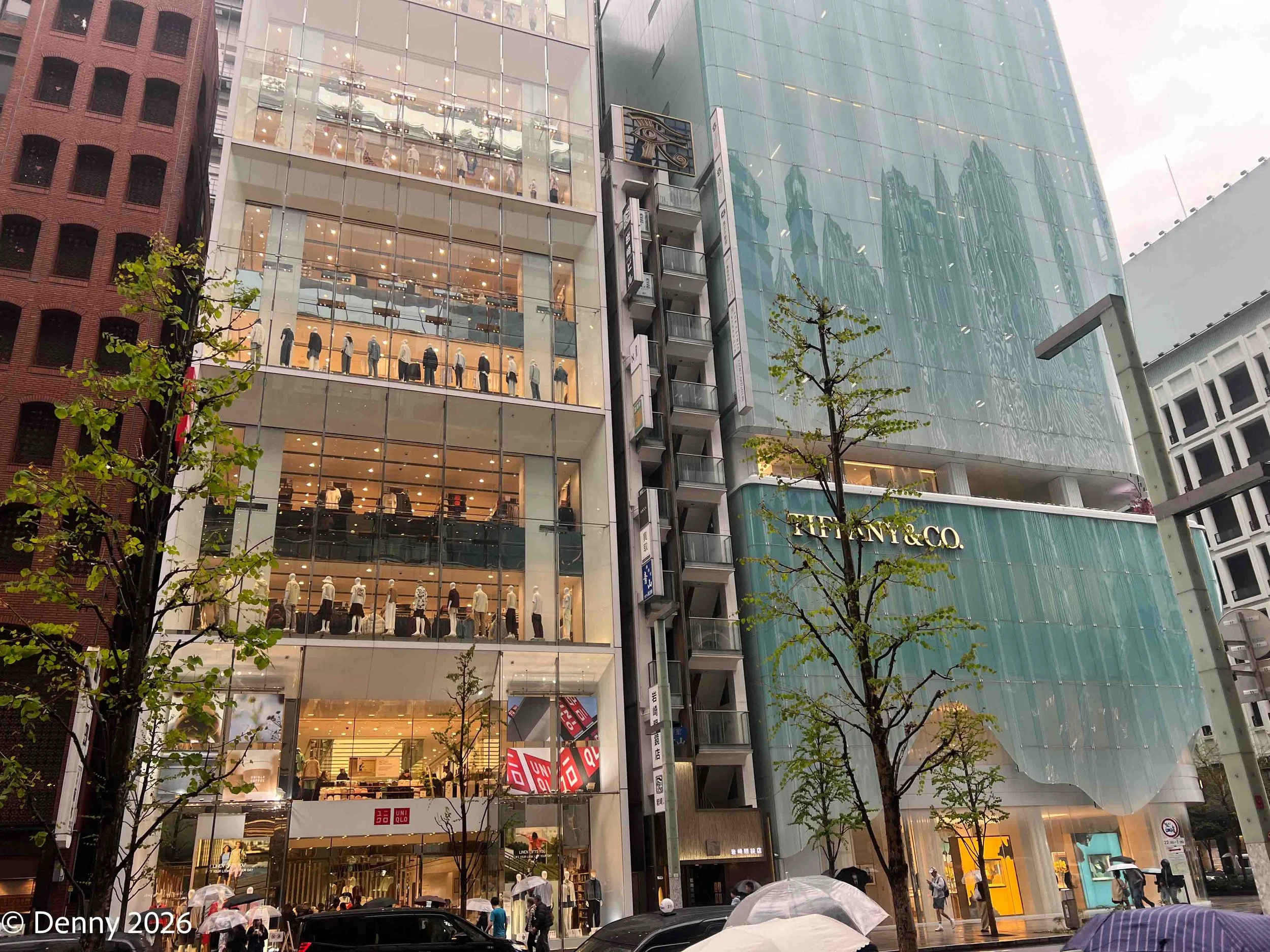
We departed the palace grounds and our bus driver then drove us to Ginza which is one of the principal up-market shopping areas of Tokyo. As Mitzie described it, it’s the Oxford Street of Tokyo and as ‘Monopoly’ aficionados will recall, things here are glitzy and equally super expensive.

Tiffany & Co, opposite our meeting place at Ginza 5

We spent over two hours in the street’s department stores and were flabbergasted at the prices of some items for sale.

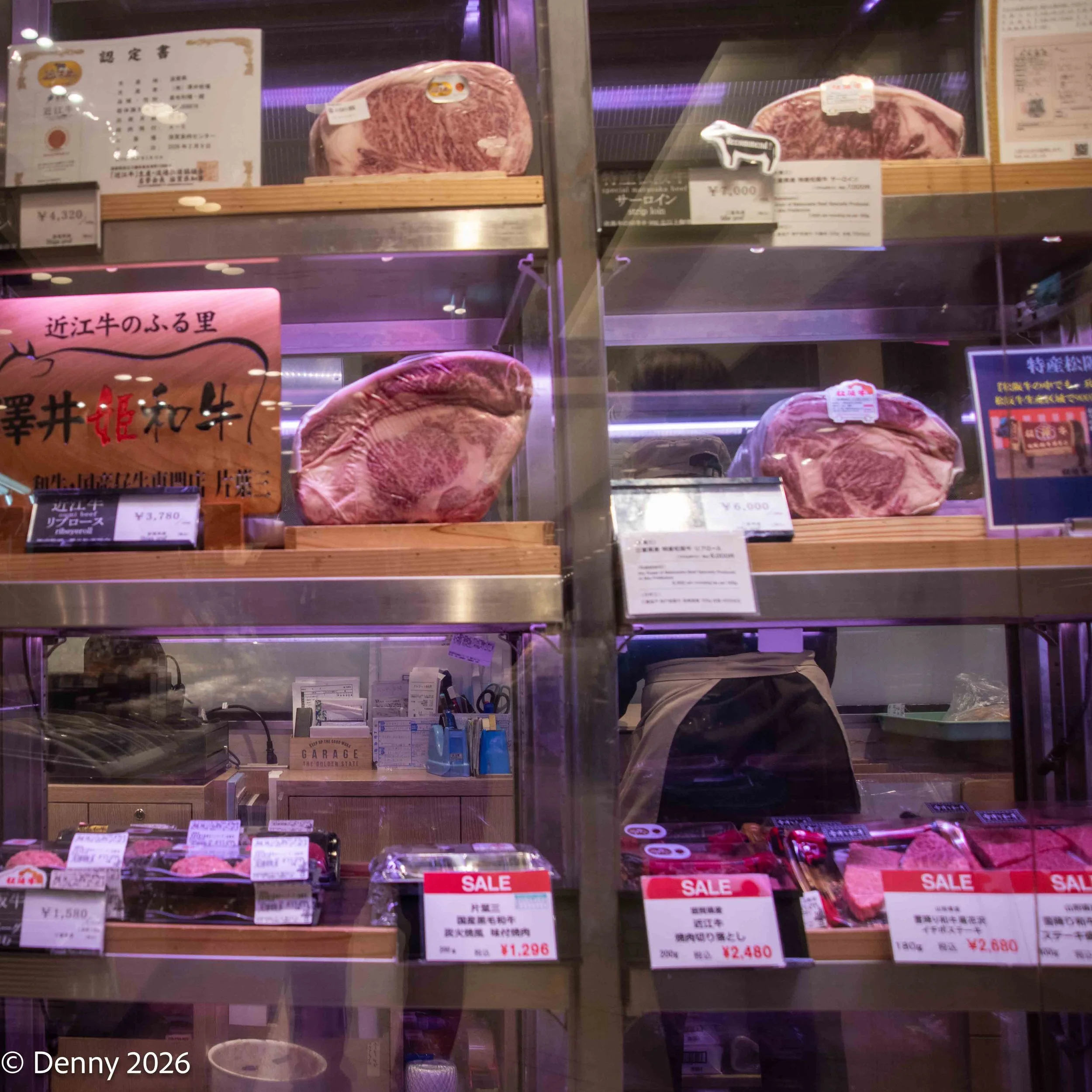
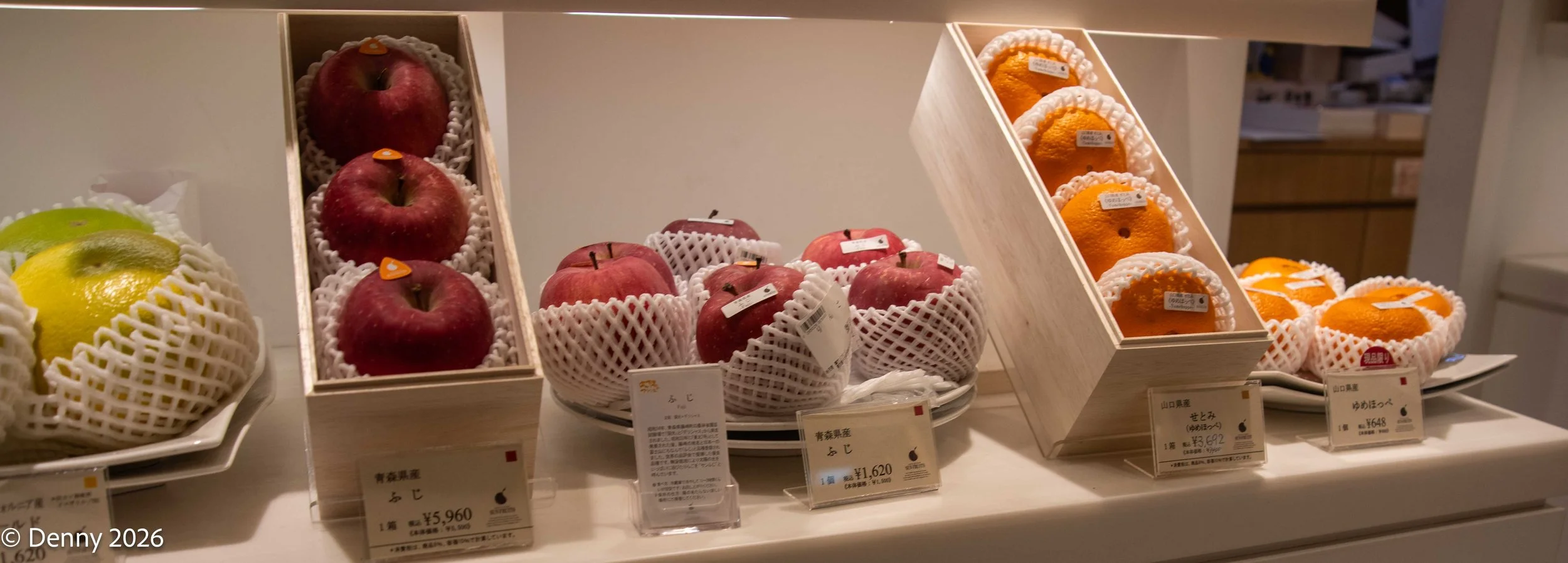
The first jaw-dropping sight was at a butcher’s market selling wagyu beef. The most expensive cuts cost ¥7,000 per 100 grams or approximately AU$650 per kilogram. Nearby we saw large apples for sale individually in neatly packaged polystyrene wraps for ¥1,620 or about $16.

Wagyu beef, Ginza

Fruit (apples and mandarins), Ginza

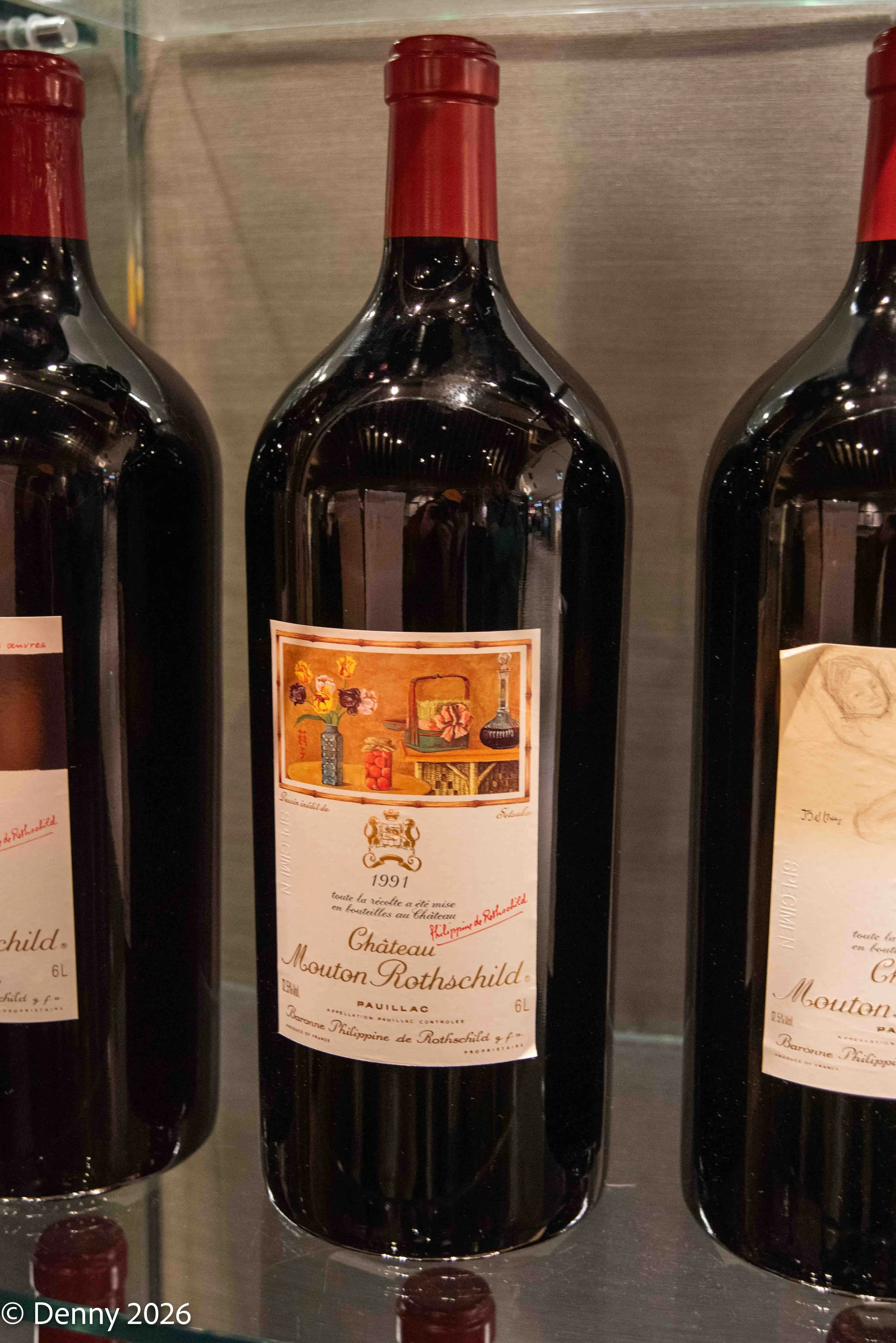
The Enoteca wine shop had an impressive selection of French wines including many in Jeroboam (3.0 L), Rehoboam (4.5 L) and Imperial (6.0 L) volume bottle sizes. Although not shown, one can only guess at the eye-watering price of the six litre bottle of 1991 Chateaux Mouton Rothschild on sale. A selection of vintage wines was available from the 1990s to more recent times.

Château Mouton Rothschild, Ginza

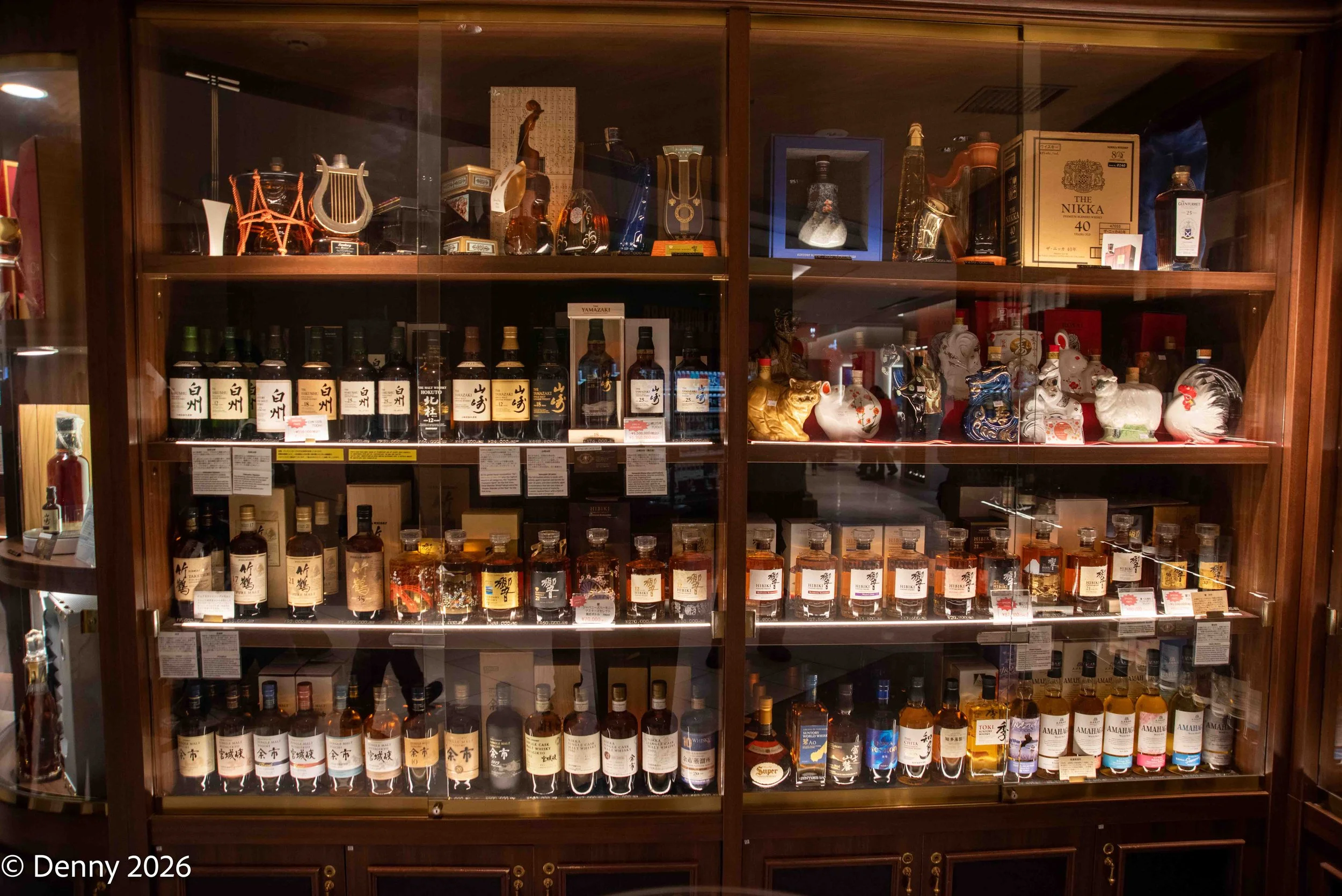
Around the corner from the wine shop was a whisky shop and the range of Japanese and exotic whiskies was extraordinary.

Whisky shop, Ginza

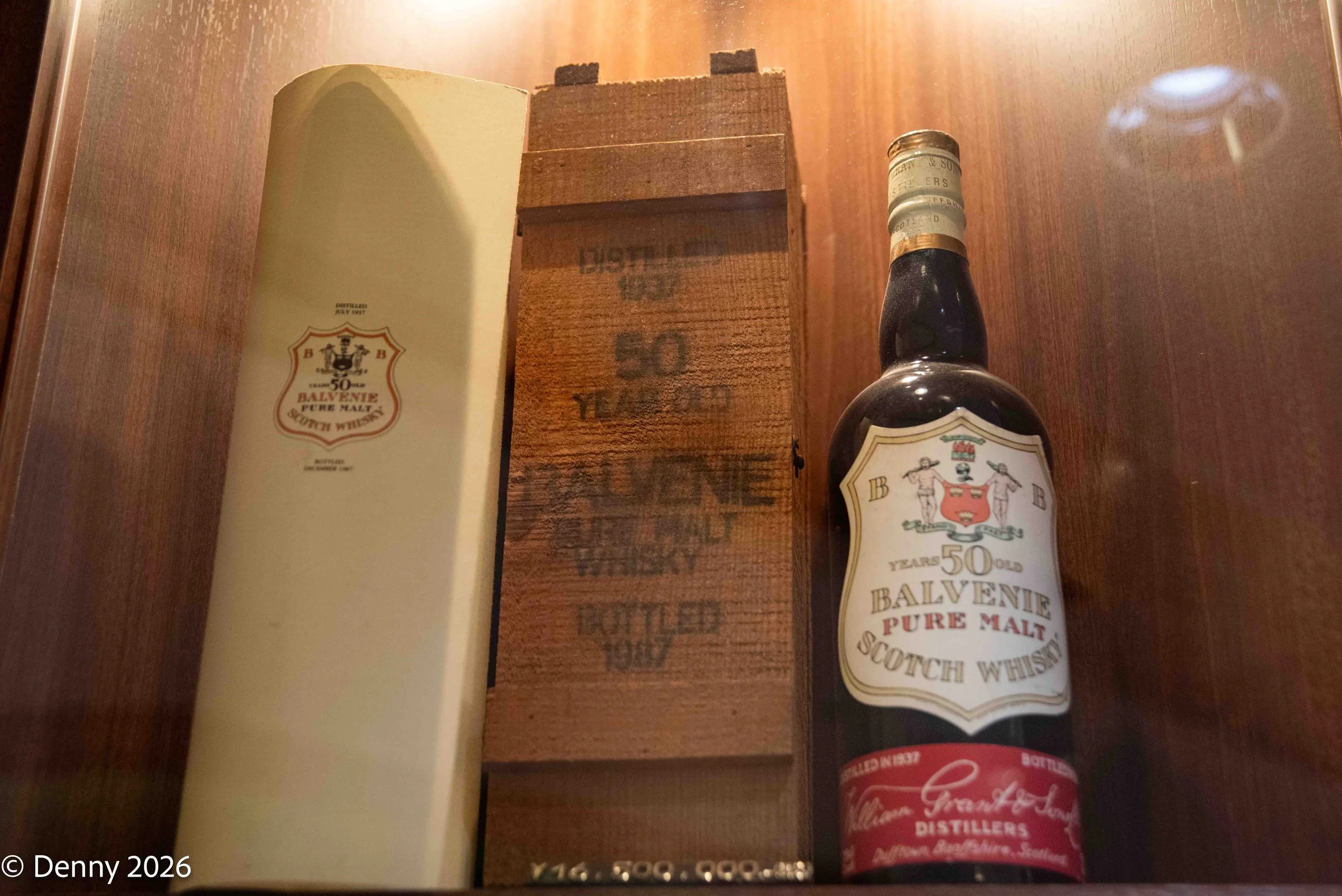
The oldest one I could see was a 50 year old 700 mL Balvenie single malt bottled in 1987 on sale for ¥16,700,000 or let’s say $150,000 Australian.

Balvenie Pure Malt whisky, Ginza

After a much needed coffee break at Blue Bottle Coffee Ginza Café, we ventured to the sixth floor of one department store where the whole floor was effectively a book shop called Tsutaya Books. The books on sale were mostly in Japanese and ranged from novels, to textbooks to very large and highly elaborate art books.

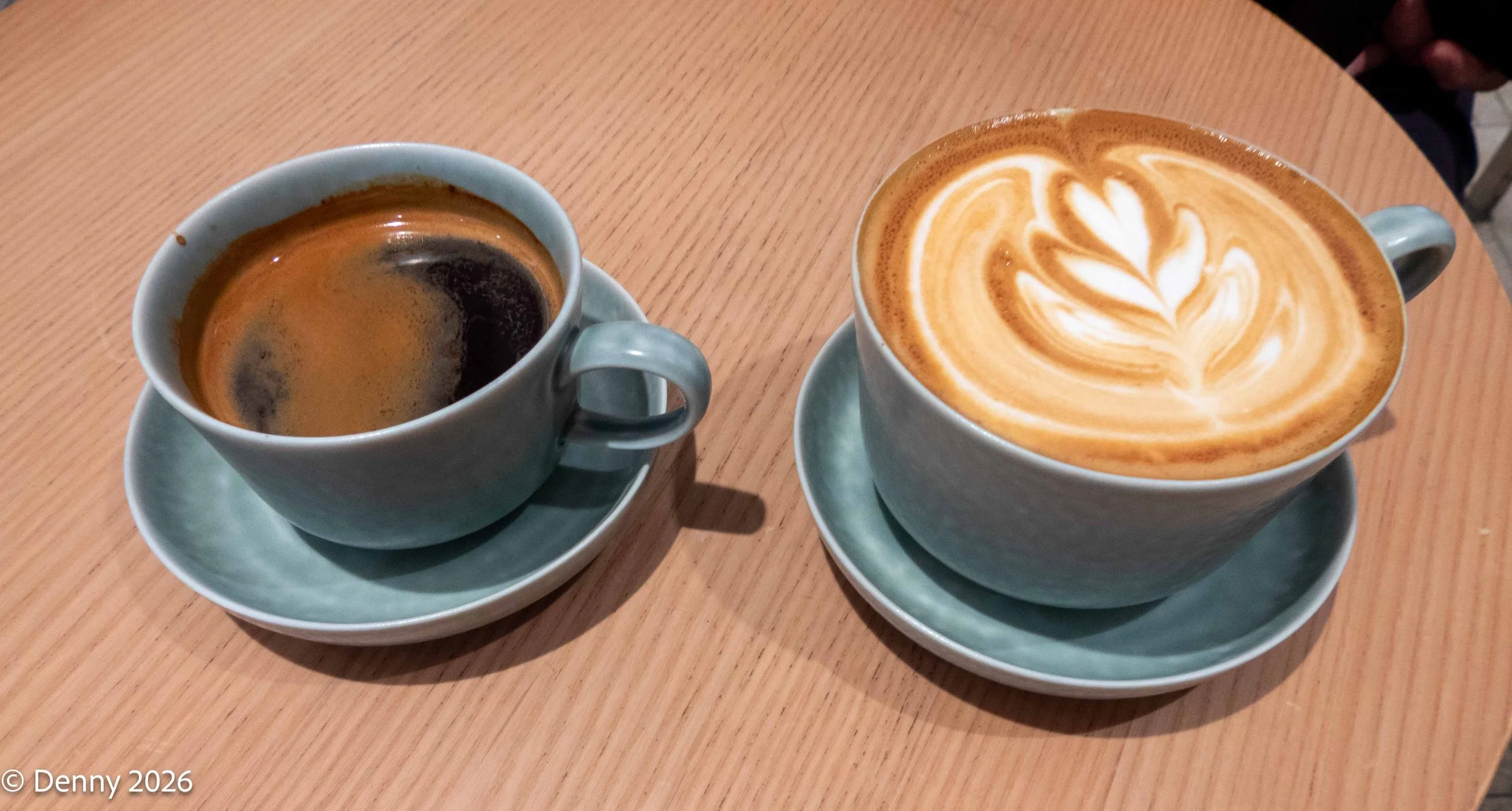
Coffee at Blue Bottle Coffee Ginza Café, Ginza

In one corner was a section that specialised in samurai swords. The swords on display were works of art with fancy inscriptions on the shining steel blades and had sheaths of equal artistic quality.

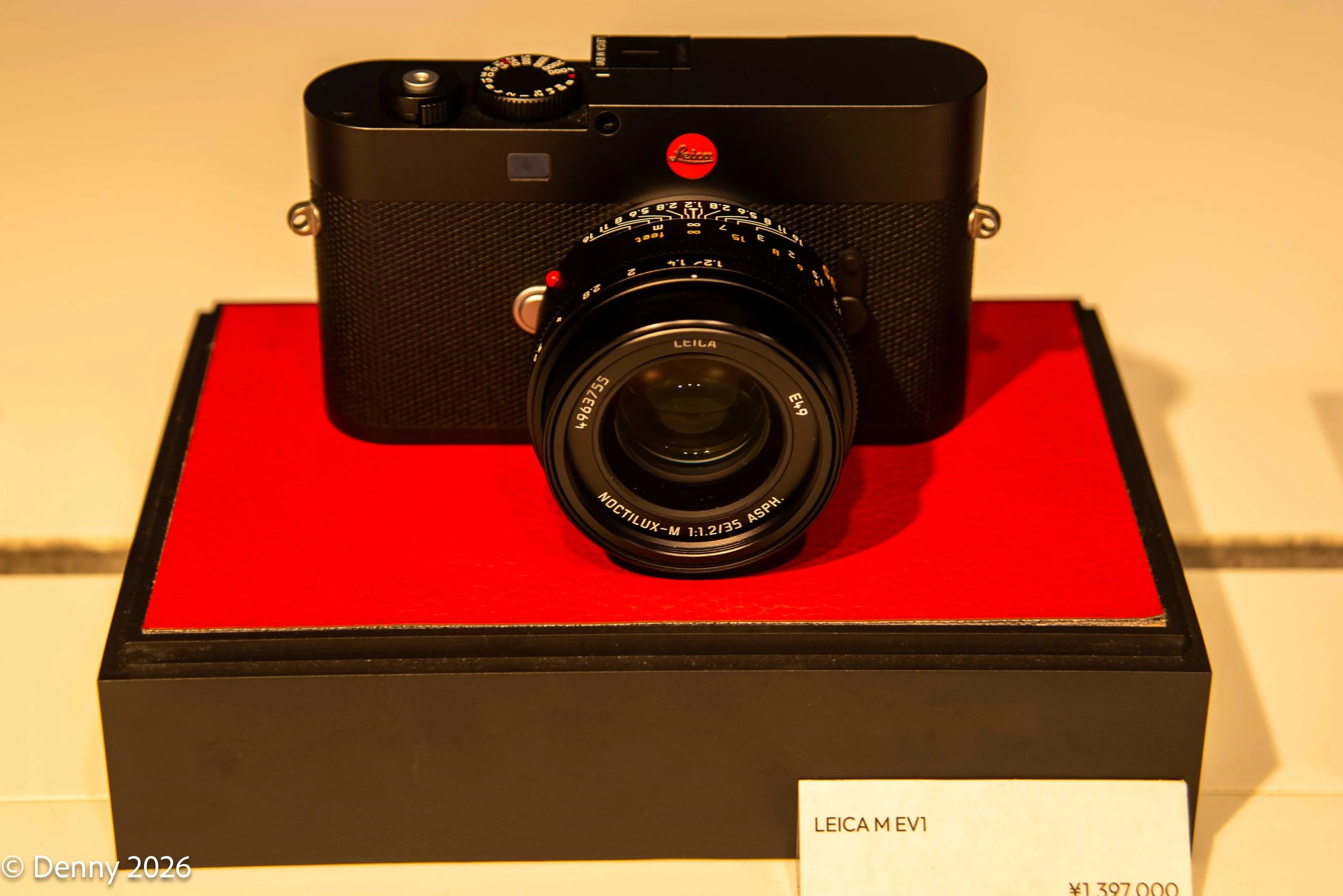
A camera shop nearby was dedicated only to Leica cameras. We made conversation with the shop person and she showed us some of the more popular Leica cameras presently in vogue.

My favourite was a Leica EV1 35 mm F1.2 for sale at a bargain price of a mere  ¥1,397,000 (AU$12,500).

Leica camera, Ginza

With this exposure to consumer excesses, we moved on to another suburb of Tokyo, namely Shibuya. Our visit here was brief but in the half hour we found why this location is world famous.

At Shibuya Crossing there is a multidirectional zebra crossing and at pedestrian peak hour times, in one period of the green ‘walk’ light, over three thousand people cross the complex intersection.

During our visit it was easy to imagine that even more than three thousand people crossed the road. In fact the density of humans was practically enough to induce a sense of claustrophobia.

People crossing the road at Shibuya Crossing

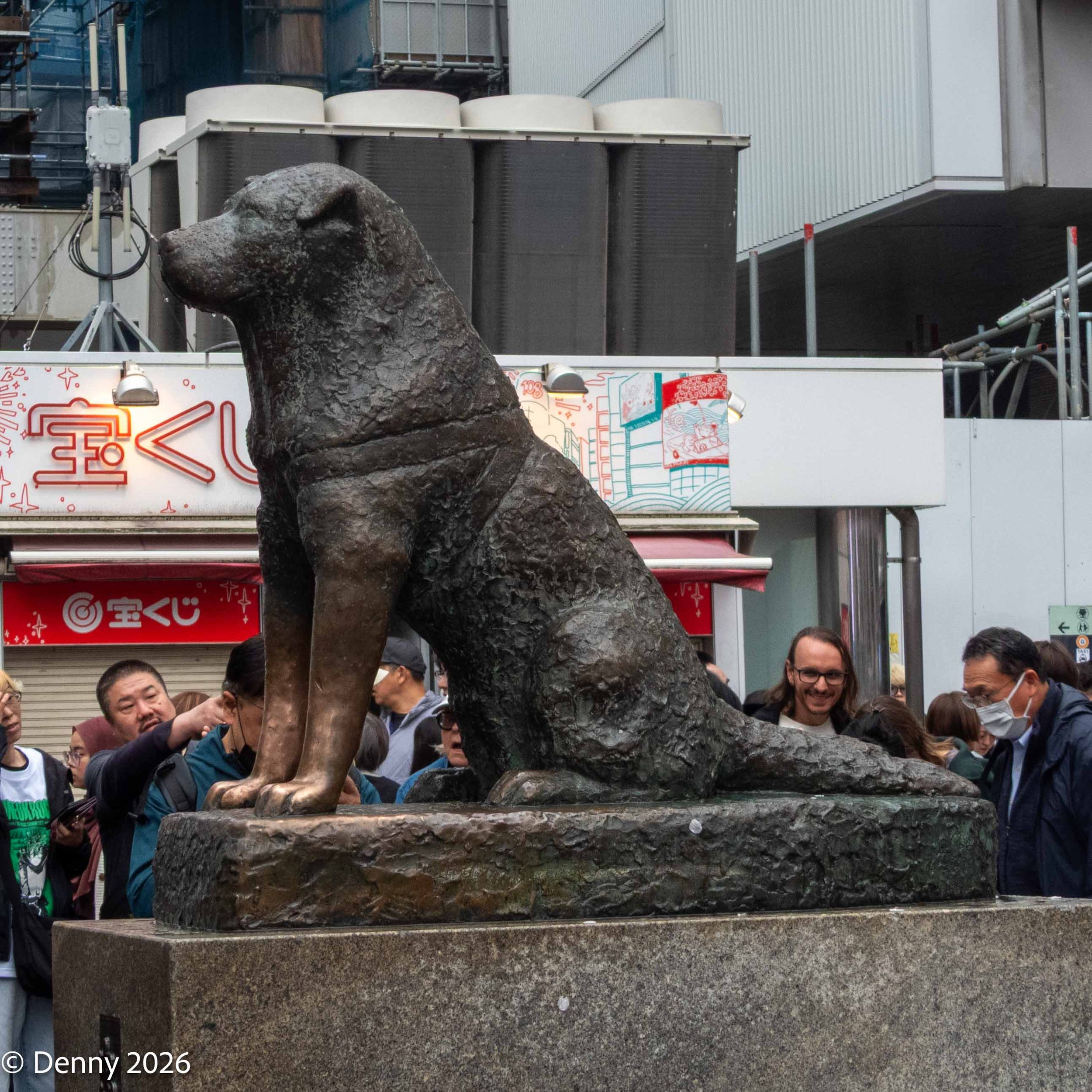
At the edge of the square, close to the Shibuya Crossing is a bronze statue of a famous dog called Hachiko. This 1934 statue commemorates a faithful dog who waited for his master at the station every night for more than a decade after his master’s death.  

Dog at Shibuya Crossing

Although we weren’t aware of it, this Shibuya Crossing is also famous as it featured prominently in the movie ‘Lost in Translation’ with stars Bill Murray and Scarlett Johansson.

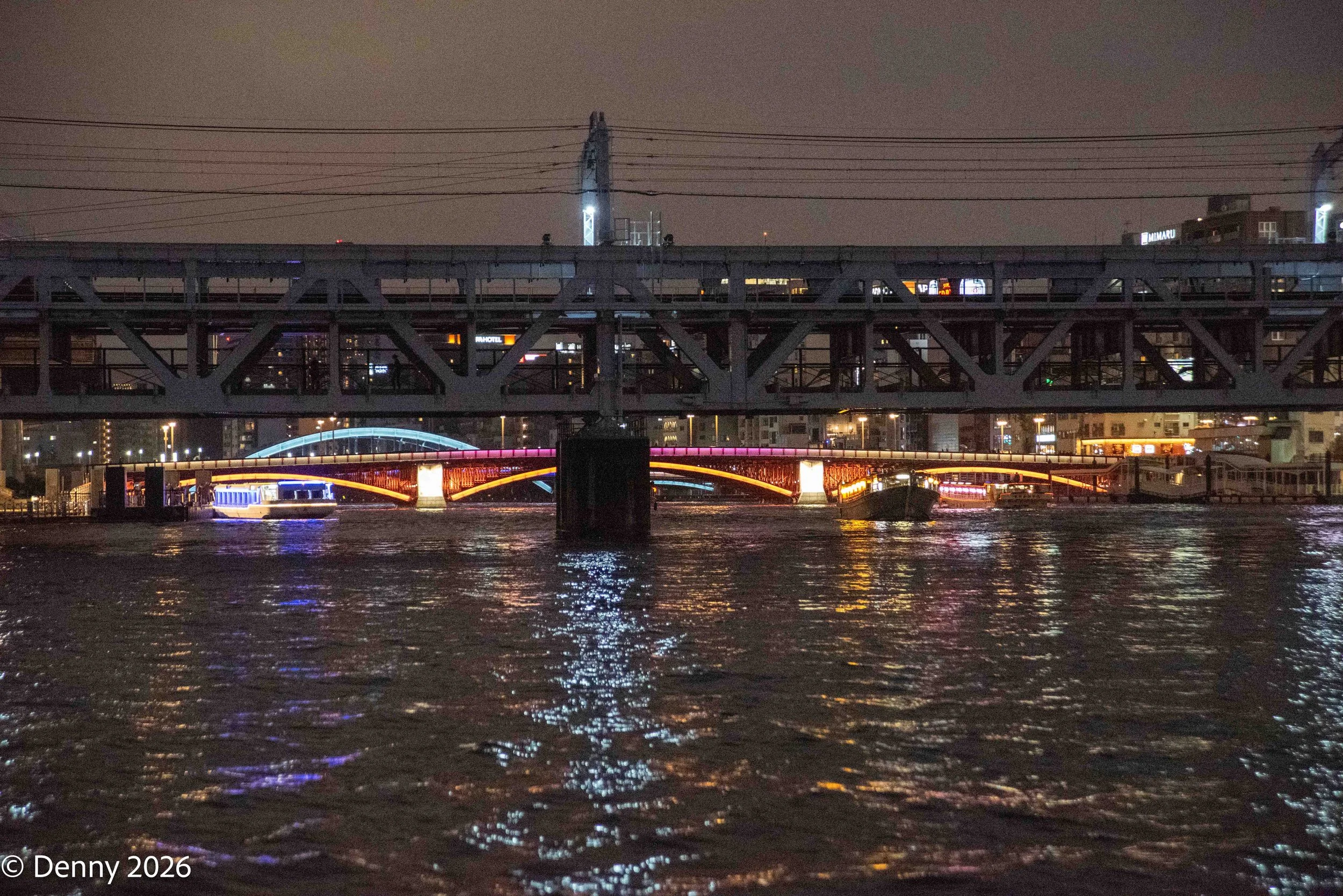
To finish the day, we spent a most enjoyable two hours having a river cruise on a yakatabune or a traditional Japanese house boat. We cruised on the Tokyo Bay and river inlets. We passed under the spectacular Rainbow Suspension Bridge and travelled upstream eventually reaching a point quite close to the Tokyo Skytree tower.

Jak, river cruise on a yakatabune (traditional Japanese house boat)

Jak on Yakatabune (traditional Japanese house boat) going under bridge

Bridge from Yakatabune (traditional Japanese house boat)

Tokyo Skytree from Yakatabune (traditional Japanese house boat)

Rainbow suspension bridge crossing northern Tokyo Bay between Shibaura Pier and the Odaiba waterfront development in Minato, viewed from from Yakatabune (traditional Japanese house boat)

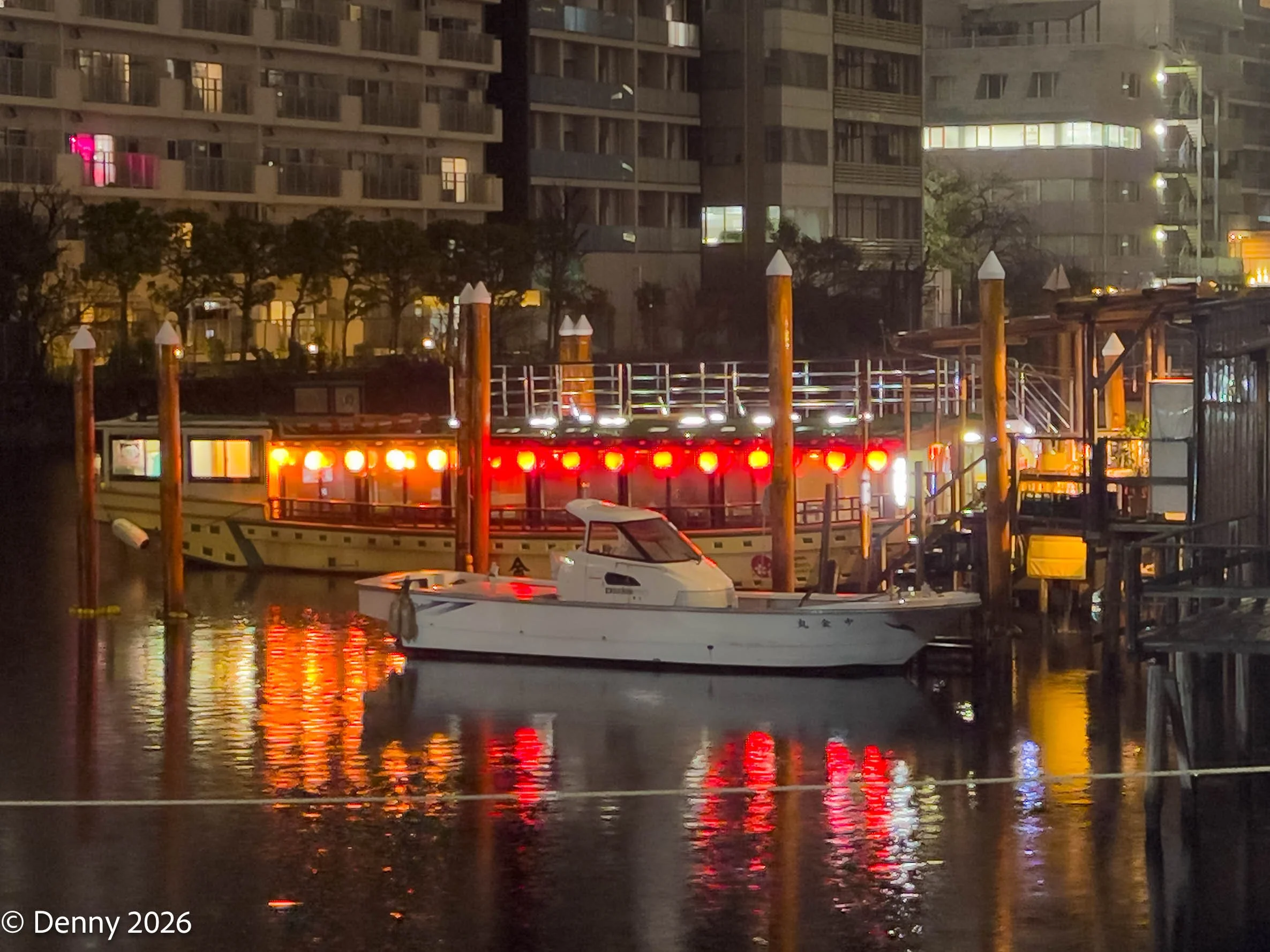
Our Yakatabune (behind white boat)

During our boating travels we were served a most enjoyable meal comprising a broad variety of Japanese culinary specialties.

We returned to our hotel at around 20:00 after a day entailing a diverse range of activities and sights.

Tomorrow, amongst other things we will see some sumo wrestlers in action; this sounds exciting!

DAY 24: Sunday 5th April 2026 TOKYO, JAPAN

In an attempt to avoid yesterday’s problem of having to queue for breakfast, we decided to go quite a deal earlier but even at 07:15 there was a line-up although we didn’t have too long to wait before a breakfast table was available.

Our transport for today was only on trains and our first venture was to board the monorail at the nearby (U7) Daiba Station and head towards (U1) Shimbashi Station. At Shimbashi we transferred to the Ginza Line where our train took us through to Asakusa where we visited the Senso-Ji Temple area in the Shitamachi district often referred to as Tokyo’s ‘old town’.

To get to the temple we entered the Kaminari-mon or ‘Thunder’ Gate and walked along a densely packed tourist avenue called Nakamise-dori. There were souvenir shops on both sides but the crowd density made the thought of stopping to look, totally unrealistic.

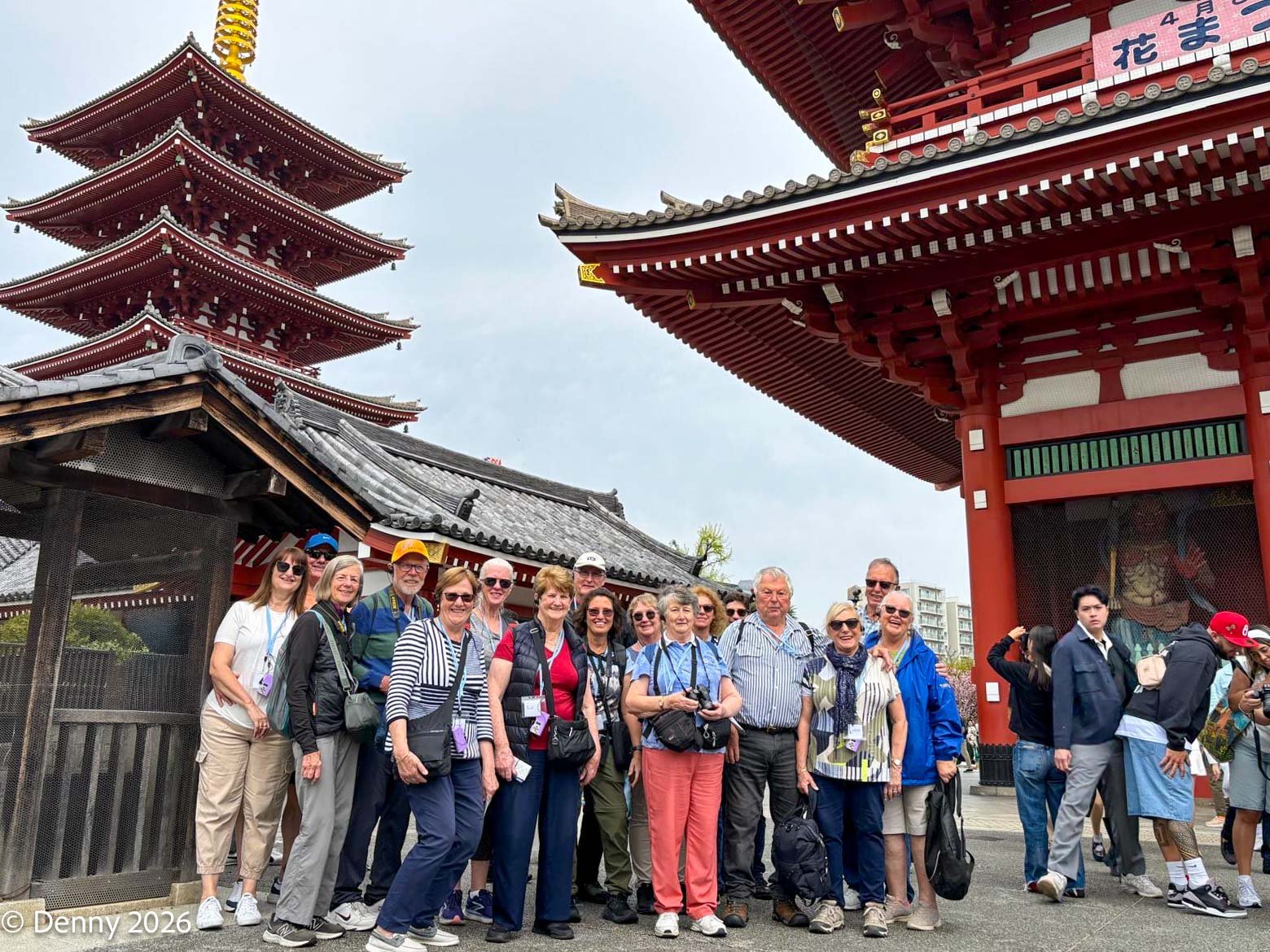
Our group, Shitamachi district (Tokyo's 'old town')

The temple is popularly known as the Asakusa Kannon and is Tokyo’s most sacred and spectacular Buddhist Temple as well as its oldest.

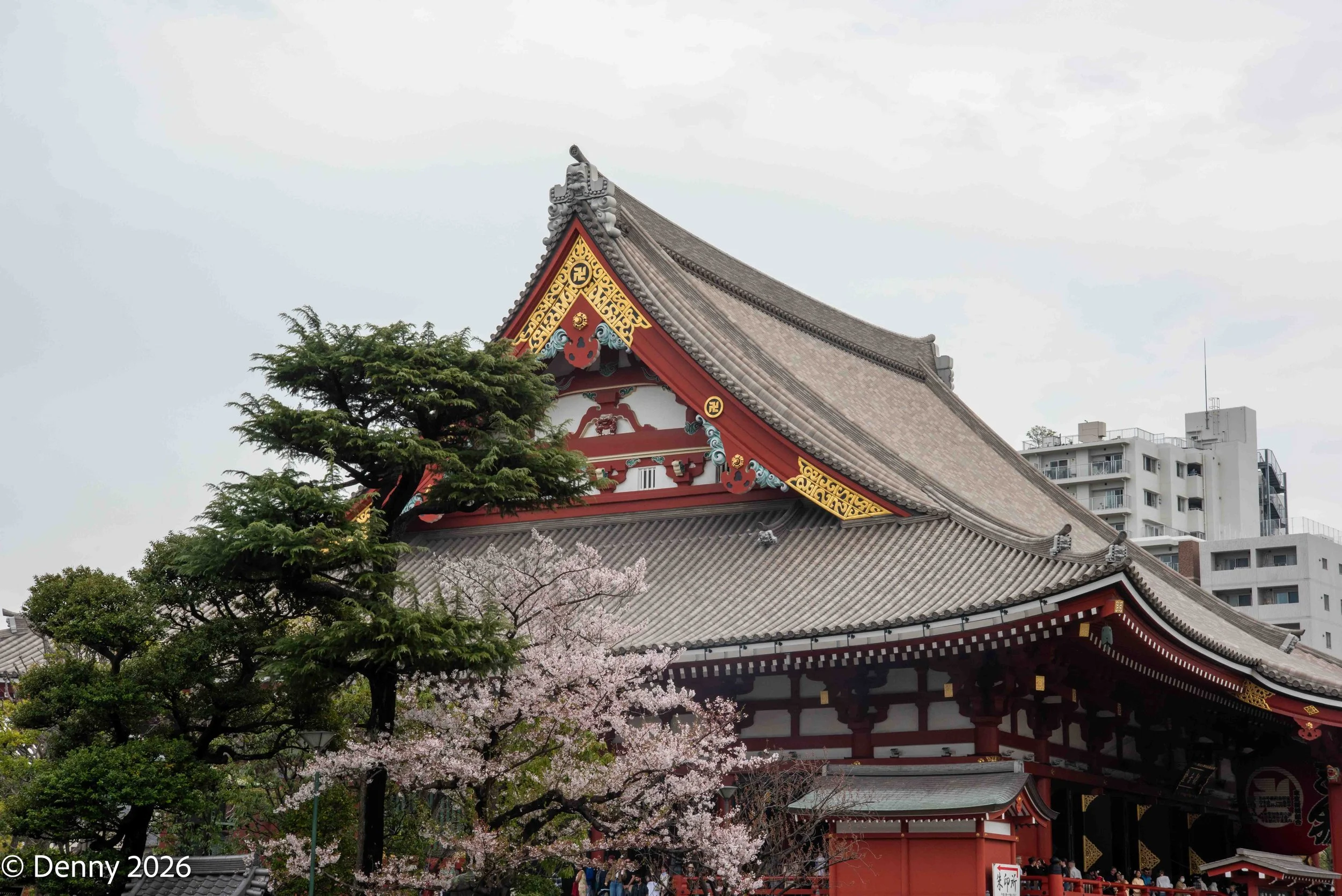
Senso-ji Temple (oldest temple in Tokyo), Shitamachi district (Tokyo's 'old town')

According to legend, in 628 AD two fishers pulled up from the Sumida River a small golden statue of Kannon, the Buddhist goddess of mercy and in 645 AD a holy man Shokai had Senso-Ji Temple built to celebrate this remarkable event.

Since those early times more buildings have been added and fortunately the structures all survived the Great Kanto Earthquake of 1923. Some temple buildings were destroyed during the Allied bombings of World War II but have now been resurrected.

Our Bunnik group at Senso-ji Temple

The main gate is called the Hozo-mon Gate and has three arches each with a suspended, elaborate and massif lantern as a decorative feature.

Hozo-mon Gate, Senso-Ji Temple

Lantern, Hozo-mon Gate, Senso-Ji Temple

To the right of the main walkway is an aesthetically appealing five storey pagoda with a multi-disc golden spire. Despite it being a 1973 replica of the original pagoda, we are assured the pagoda contains the ashes of Buddha.

Five storeyed pagoda with a multi-disced golden spire

With an hour and a half of free time to explore the temple grounds, we wandered slowly through the laneways and gardens that cover a substantial area. Apart from the main Senso-Ji Temple we encountered several other small and beautiful temples including the Awasima-Do Temple and the Hashimoto Yakusi-Do Temple. We passed the Yogo-do Hall which houses eight Buddha Statues but was not open to tourists.

Temple garden

Temple garden

Temple

Wise monkey statue

Near the Yogo-do Hall we met and chatted with a mother and her daughter, Laura from Spain. The mother was originally from Bogata in Colombia and was keen to hear of our travels in South America. They were wearing beautiful kimono style dresses and were only too happy for us to photograph them.

Spanish girl and her mother wearing traditional costume

The main Senso-Ji Temple building was so crowded, it was difficult to take any photos although we managed to photograph part of the temple’s ceiling.

Crowd inside entrance to Senso-ji Temple

Ceiling panel, Senso-ji Temple

Outside the temple was a large incense burner making the atmosphere smoky and non-ideal for photos. Near this burner is one of the oldest remaining temple buildings called the Asakusa-Jinja built in 1649. This temple is dedicated to the two fishers who found the Kannon Statue fourteen hundred years ago.

Crowd and smoke outside Senso-ji Temple

It was time to move on and our group then walked for ten minutes down Nakamise Street to the Asakusa Sumo Club for two hours of pure entertainment.    

We were seated in a small, one hundred person theatre with tiered seats either side of a central circular wrestling ring.

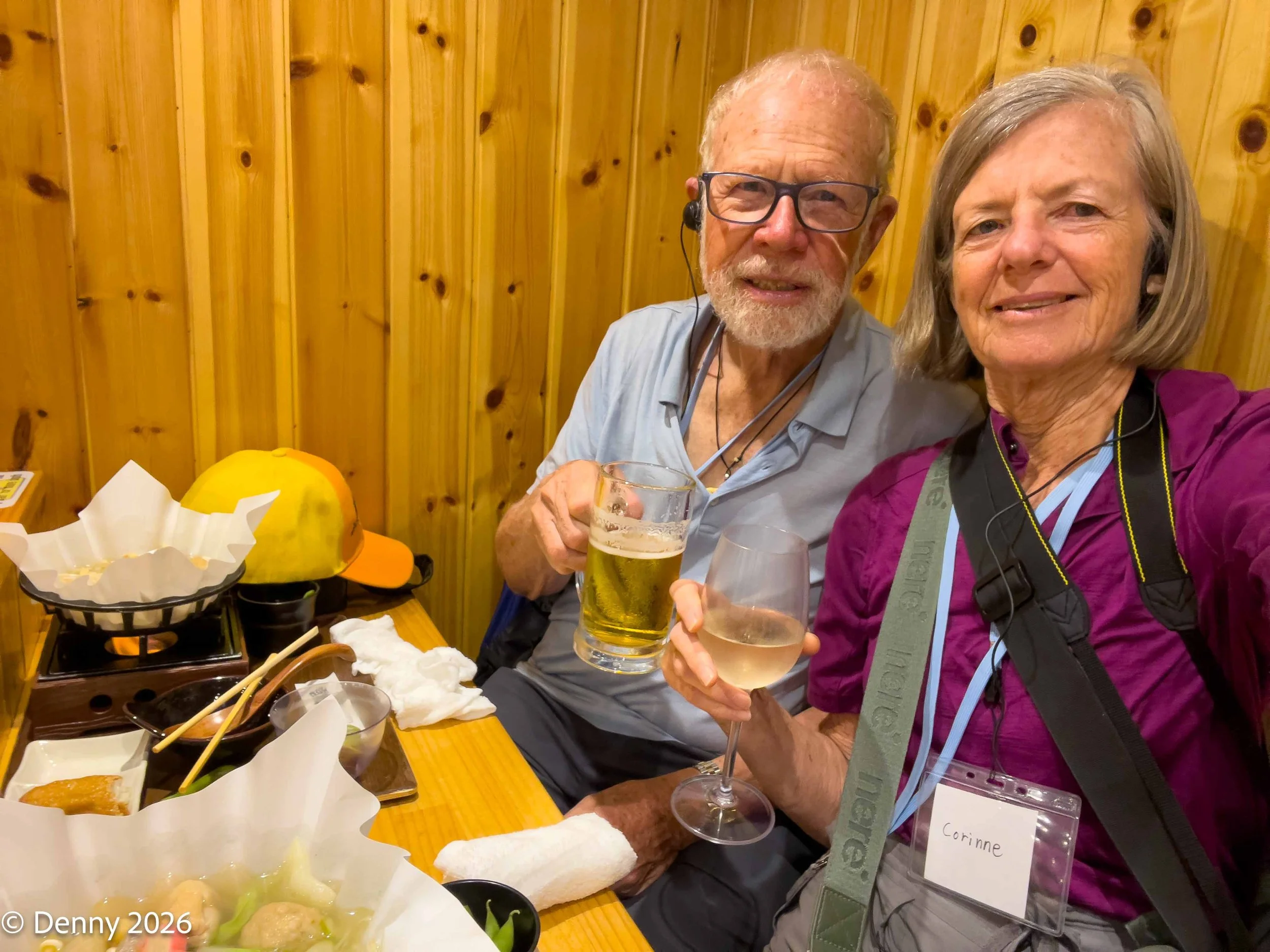
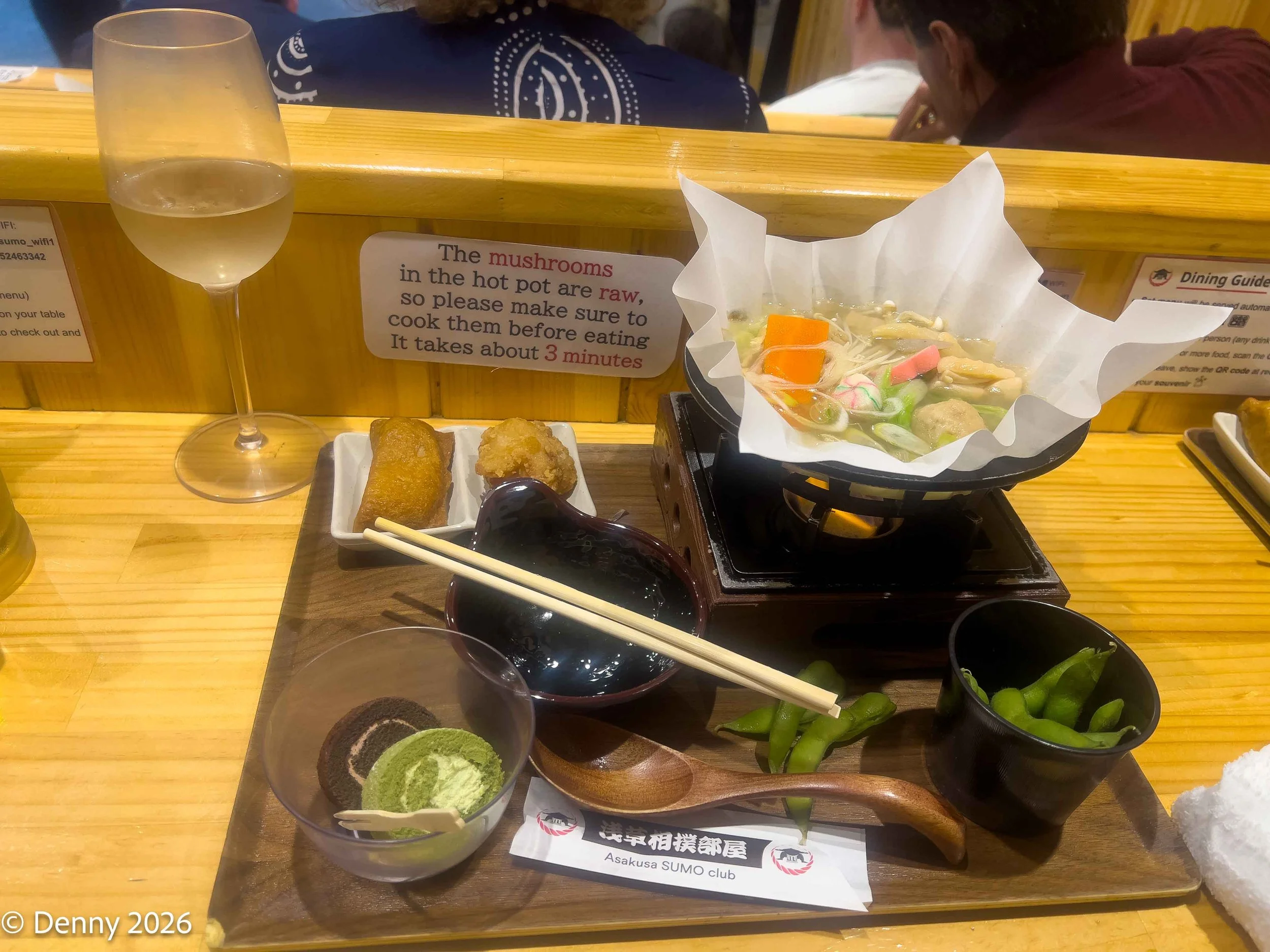
Before any activity started, we were provided with a prepared meal where the food, including fungi had to be cooked for several minutes in a broth heated in a hot-pot with our own individual fuel burner. This is a traditional Chanco-Nabe sumo lunch.

Jak and Corinne, lunch at Asakusa Sumo Club

Our meal, Asakusa Sumo Club

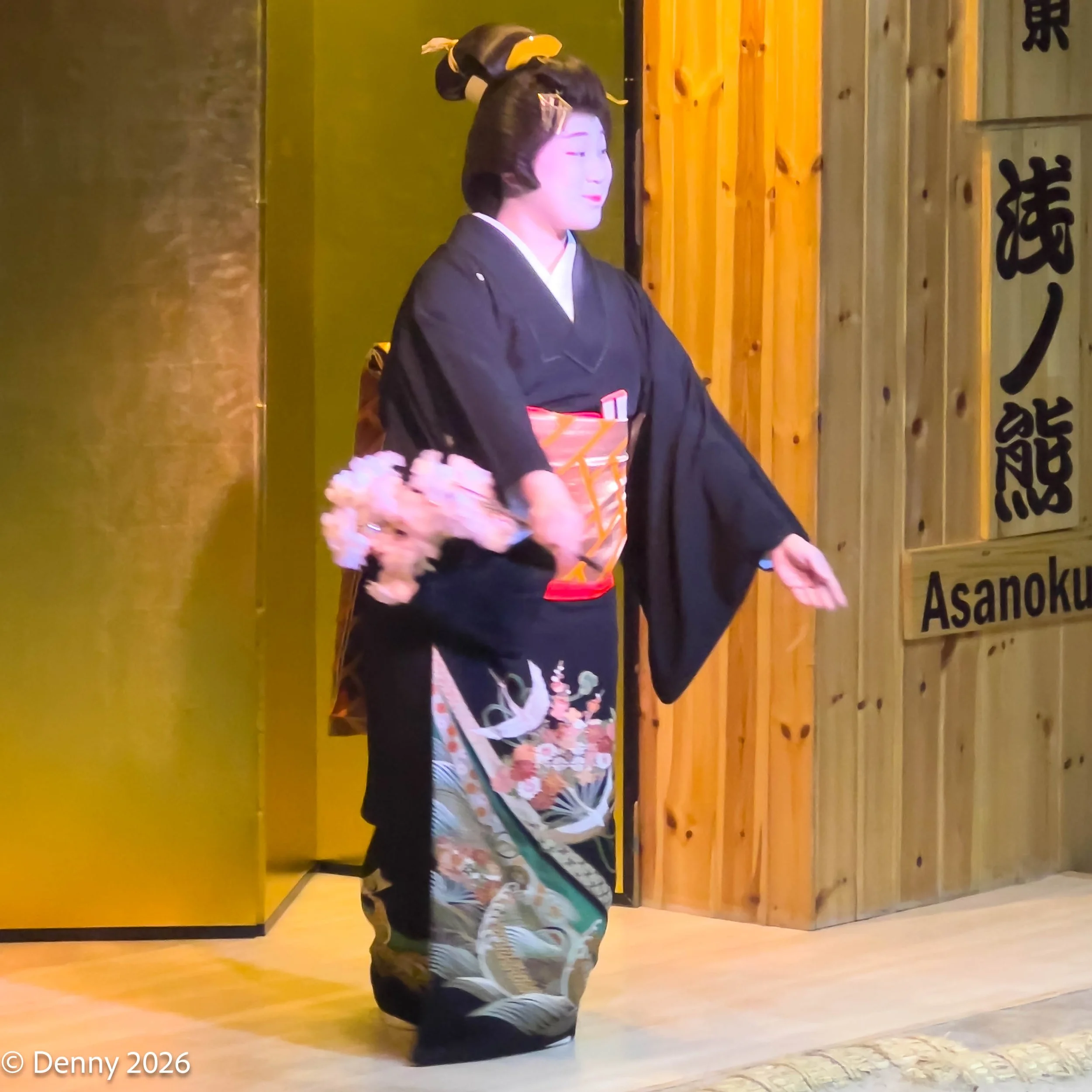
The master of ceremonies introduced the first act which was a Geiko girl who performed a very elaborate dance in her traditional kimono costume. We were informed that the term ‘Geisha’ is definitely inappropriate these days as it infers prostitution whereas Geiko translates to a ‘woman of art’.

Geiko girl, Asakusa Sumo Club

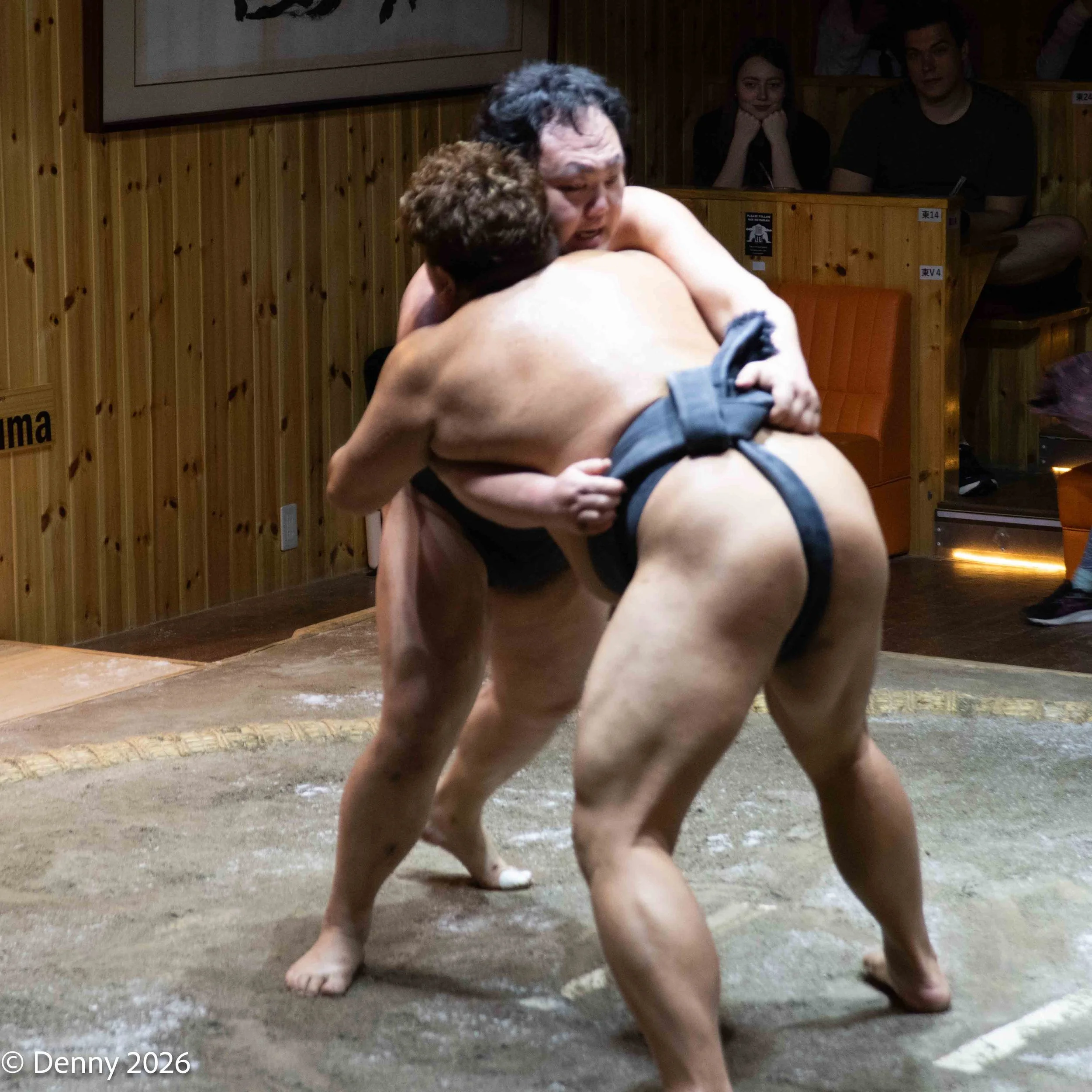
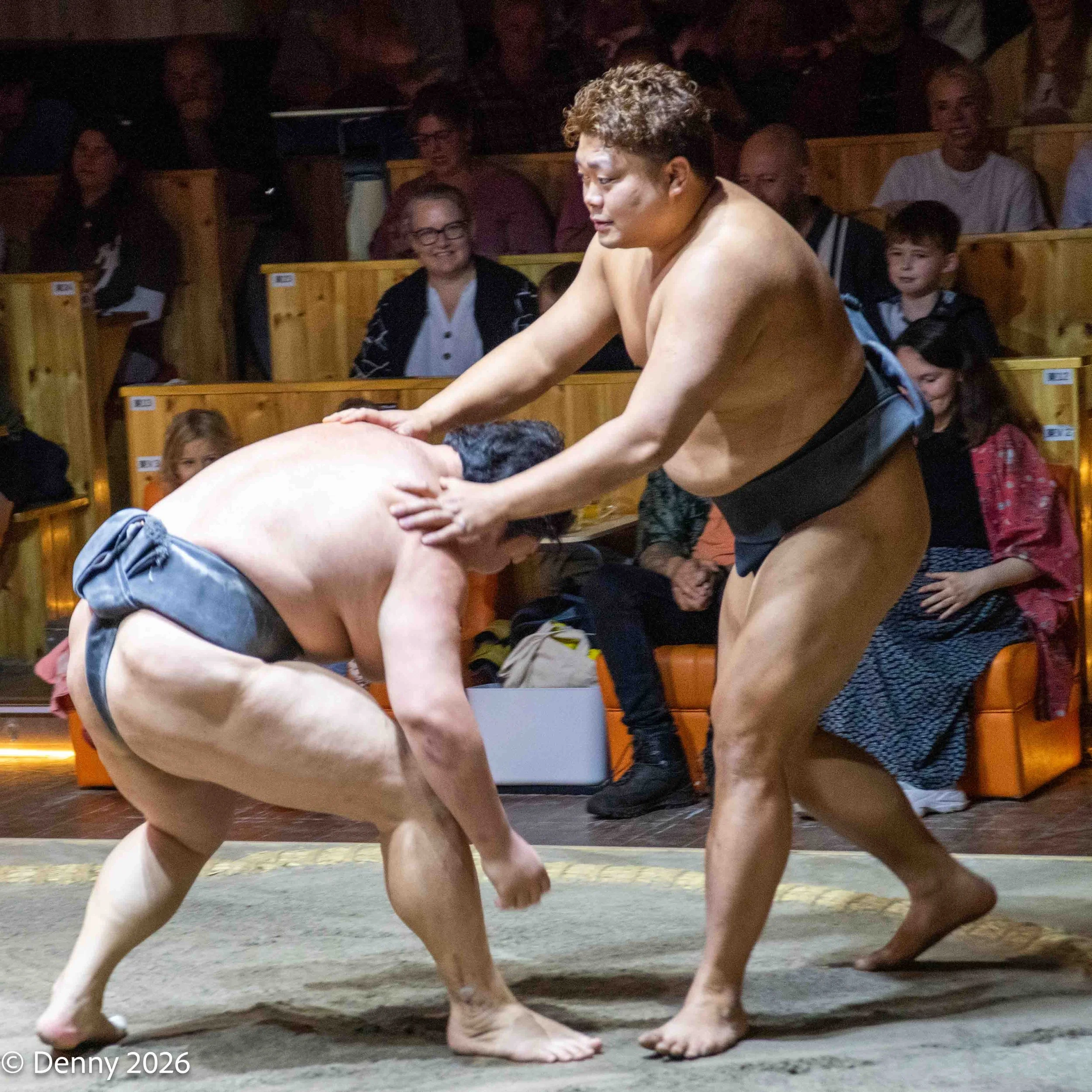
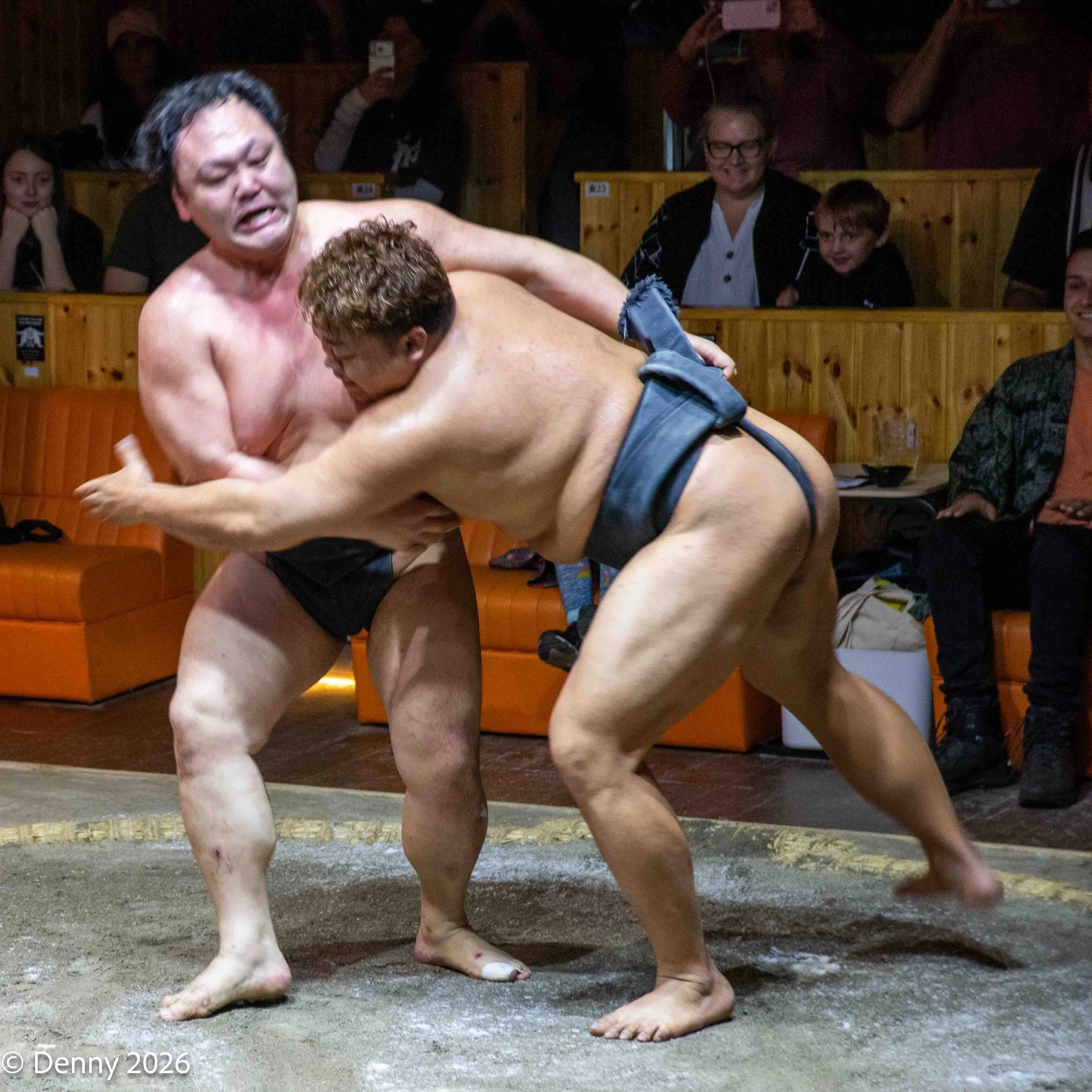
The two sumo wrestlers were introduced with much cheering and table banging and the MC directed them to demonstrate a series of moves involving rules and rituals of this 1500 year old national sport. 

It was not to be just a serious wrestling competition but more of a theatrical performance with comedy and audience participation high on the agenda. The two wrestlers were consummate performers and had the crowd enraptured with their strength and agility.

Sumo wrestlers, Asakusa Sumo Club

Sumo wrestlers, Asakusa Sumo Club

Sumo wrestlers, Asakusa Sumo Club

To end the most enjoyable session, nine people from the audience were invited to compete against the sumos. The totally dominant Japanese wrestlers were never going to be beaten but in some instances they feigned a defeat much to the amusement of the audience.

Linda, from our Bunnik group was the only female participant in the competition against the sumo wrestlers. Linda wore an air inflated costume that made her appear to be 200 kg and she defeated the sumo!

Linda from our group with Sumo wrestlers, Asakusa Sumo Club

It was now mid-afternoon so we then returned to our hotel to experience some relaxing time away from the frenetic activity and noise of the morning’s visit.     

Sunset from our room, Grand Nikko Tokyo Daiba, Tokyo

Tomorrow we leave Tokyo and our destination is the scenic mountain town of Hakone.

DAY 25: Monday 6th April 2026 TOKYO – HAKONE, JAPAN

The breakfast queuing problem mentioned yesterday was even worse this morning but we did manage to get breakfast and make it in time to the bus for a 08:45 get-away.

The south-westwards drive out of Tokyo initially followed the waterfront where numerous large industrial businesses were close to wharf areas. We passed the Haneda International Airport and then oil refineries, a steel works, general factories and several car and truck manufacturing operations including Nissan.

Harbour en route from Tokyo to Fukasawa

Nissan vehicles in car yard en route from Tokyo to Fukasawa

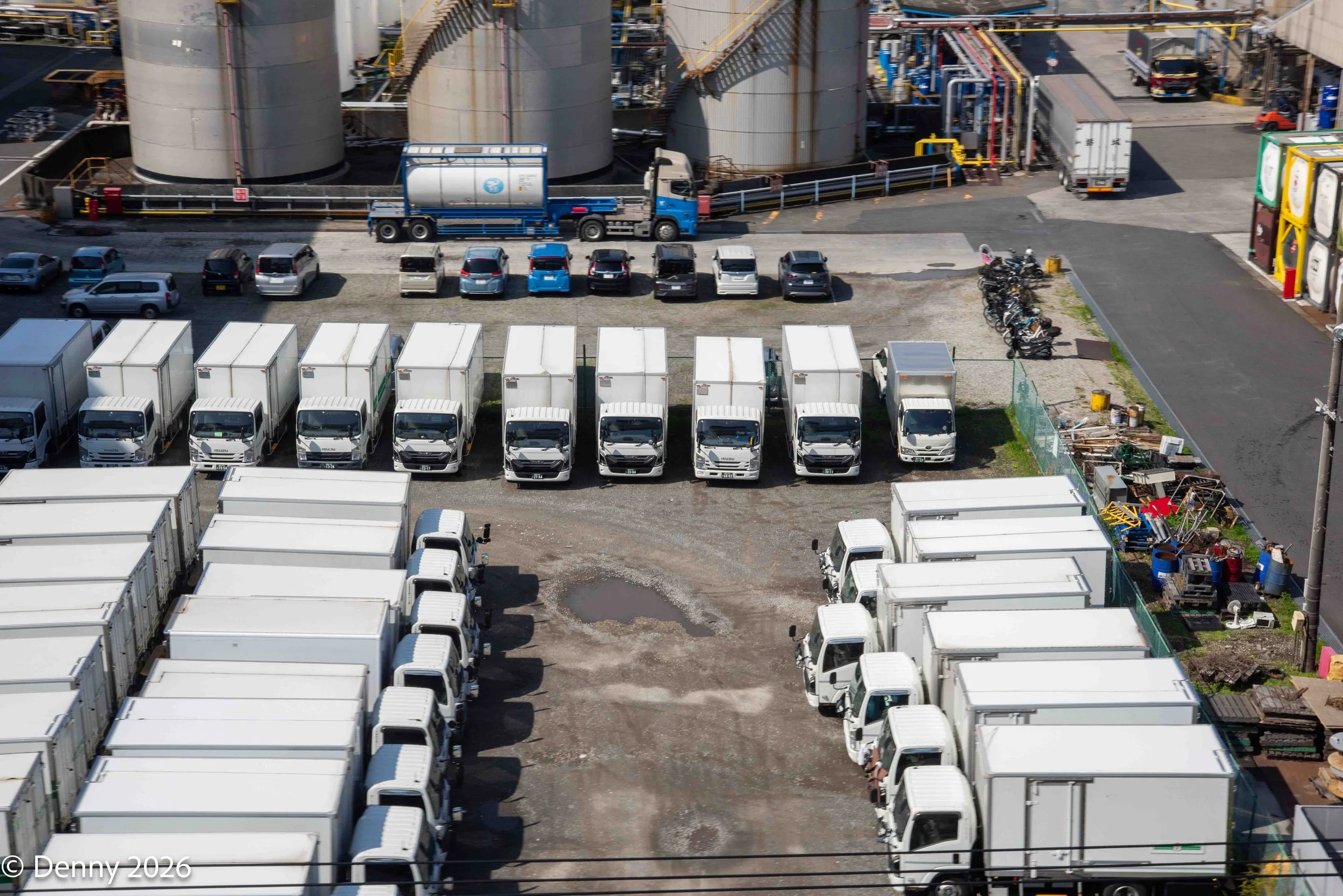
Trucks in yard en route from Tokyo to Fukasawa

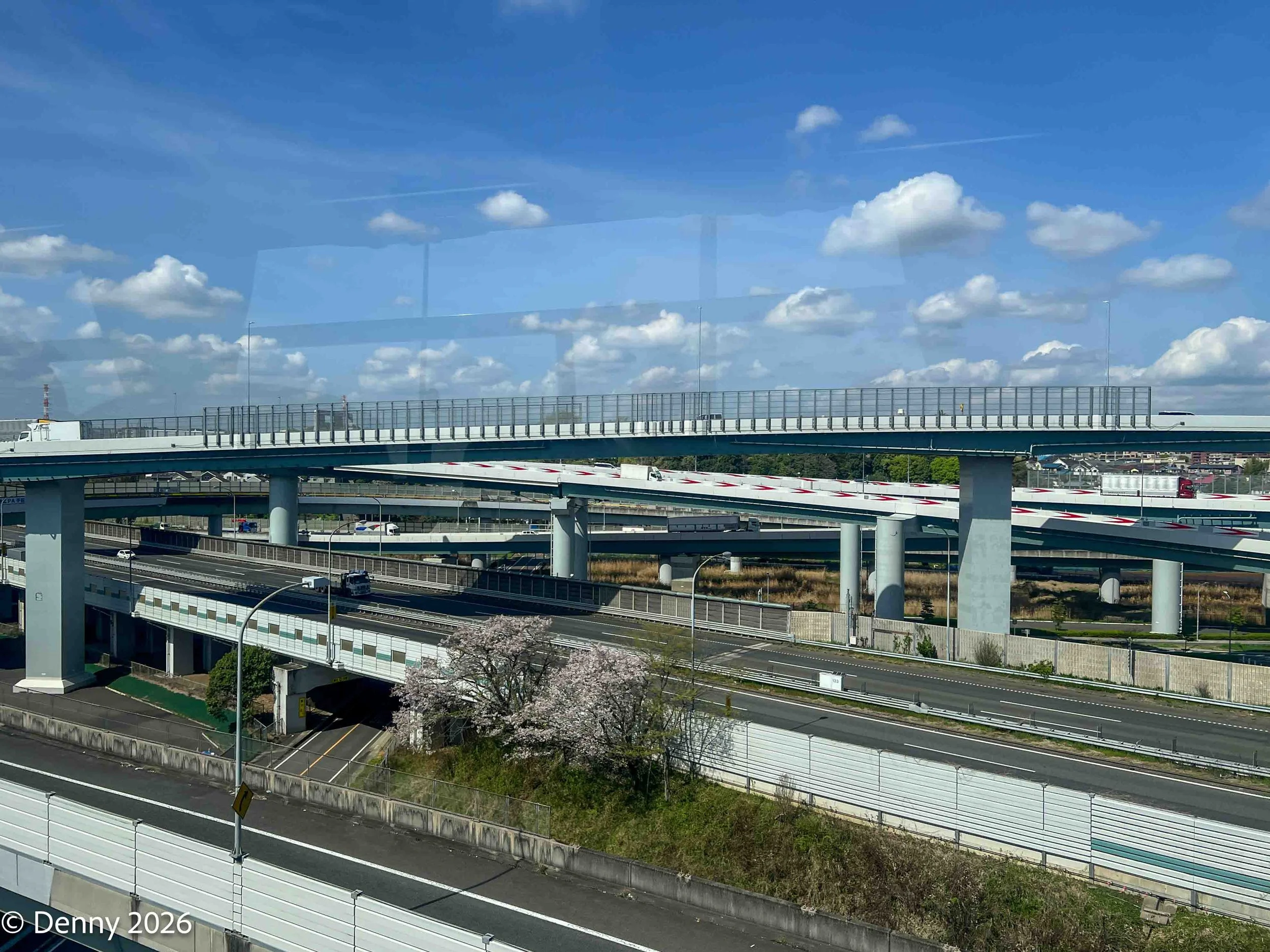
Clover leaf roads (note chery blossom) en route from Tokyo to Fukasawa

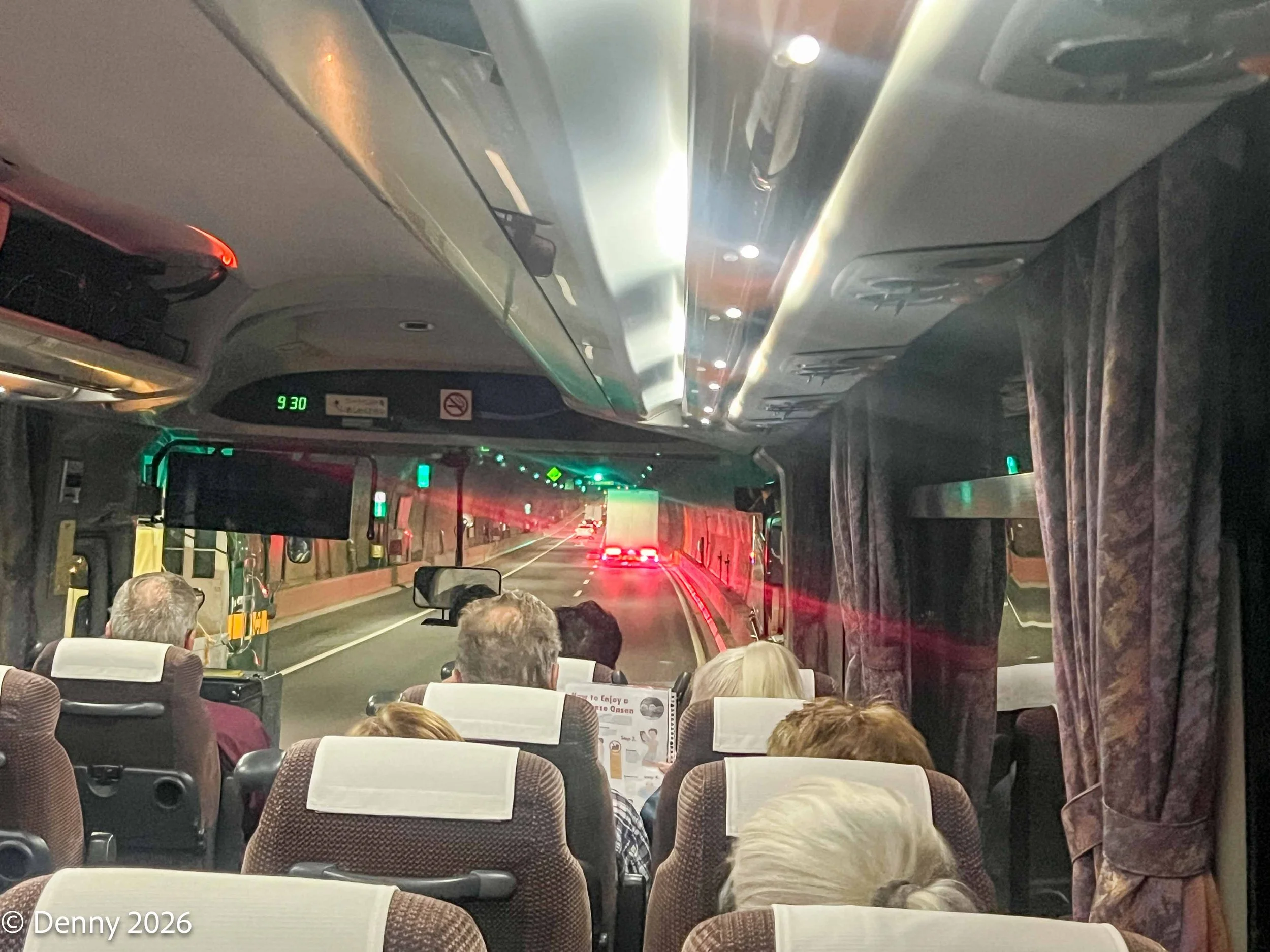
Our route involved many tunnels, some quite long. Mitzie informed us that Japan has over 11,000 road tunnels, the longest of which is the Seikan Tunnel between Honshu and Hokkaido being 53.85 km.

Inside our bus inside tunnel en route from Tokyo to Fukasawa

Farmland en route from Tokyo to Fukasawa

Bridge en route from Tokyo to Fukasawa

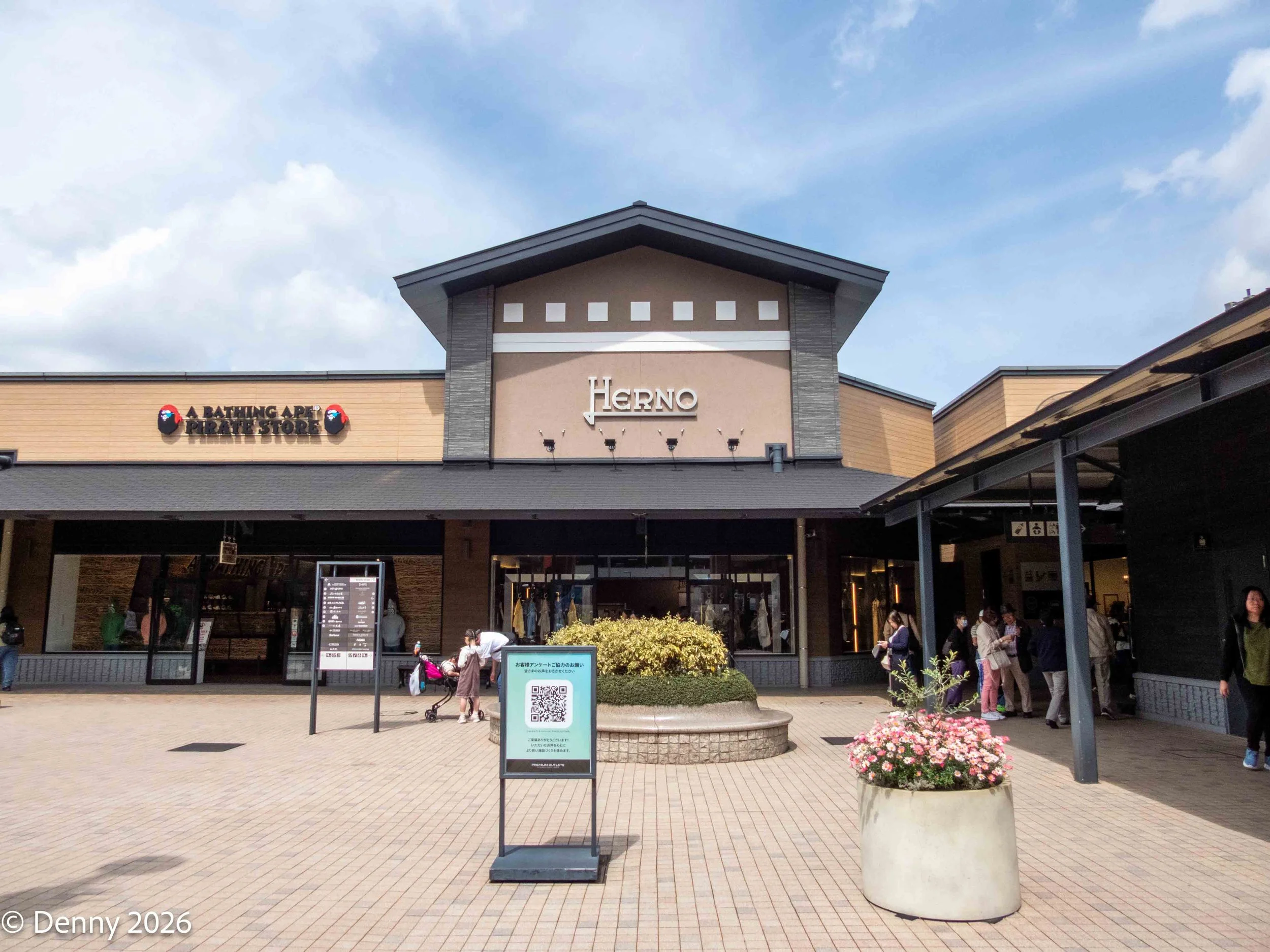
After an hour passing through more agricultural areas, we stopped for a brief drinks break before continuing on for a further hour to the town of Fukasawa where there is a very large shopping complex called ‘Gotemba Premium Outlets’.

Gotemba shopping precinct, Fukasawa

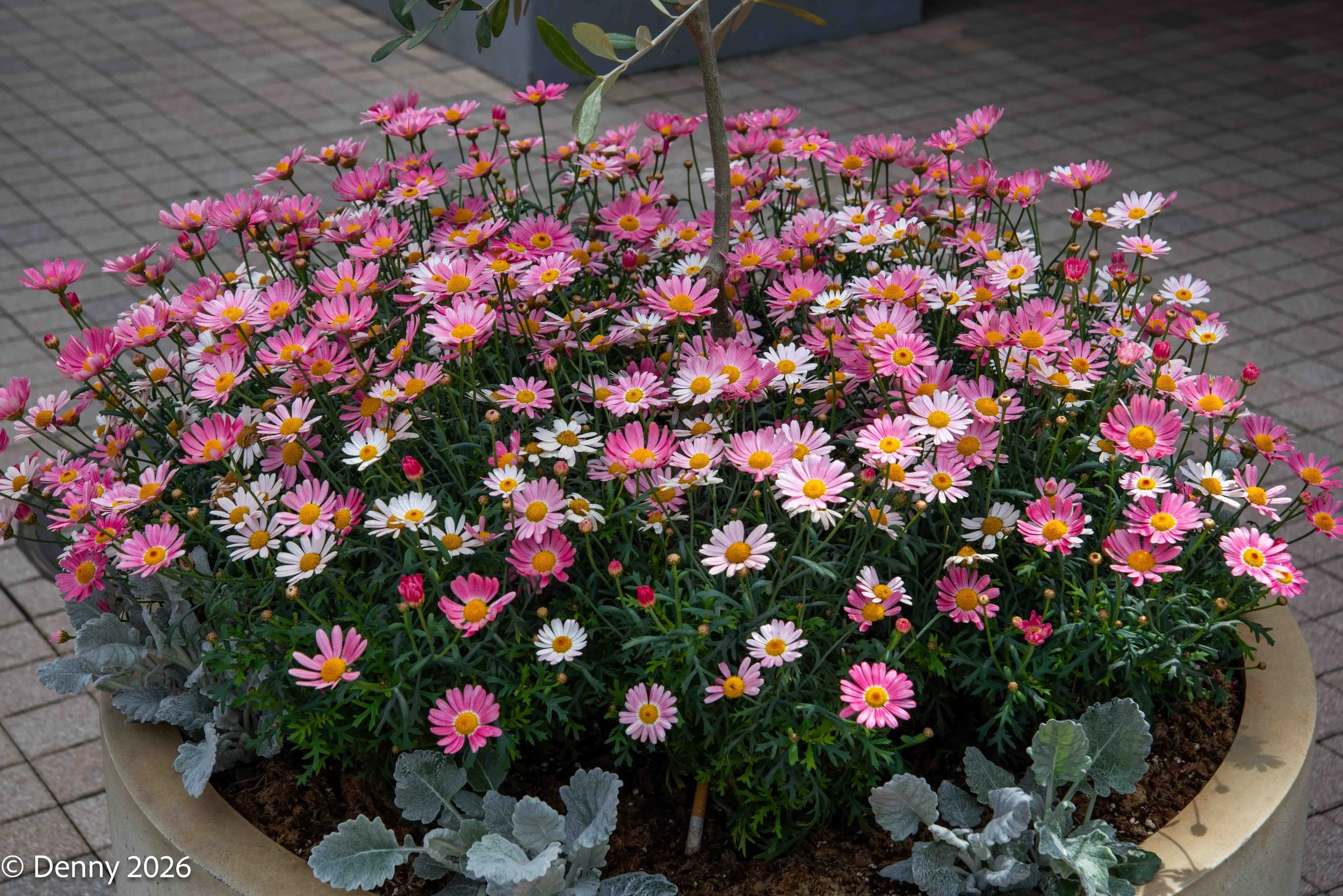
Daisies, Gotemba shopping precinct, Fukasawa

In this three zoned shopping village there are countless outlets claiming to offer special ‘bargain price’ deals, presumably due to this more rural location meaning the shops have significantly lower rental costs than those in the big cities like Tokyo.

It was a pleasant surprise to be in a comparatively uncrowded location and we wandered aimlessly amongst a few of the outlets selling clothing, fashion goods, shoes, cosmetics, technology items, jewellery, expensive watches, sports gear and food from little cafés and larger restaurants.

We found a quiet coffee shop and relaxed whilst waiting expectantly for the cloud to lift so we might see Mt. Fuji which is in the distance but potentially visible from Gotemba.

We managed to get some photos of Mt. Fuji but none was anything much more than a partial glimpse through partly broken cloud.

Our first view of Mt Fuji from Gotemba shopping precinct, Fukasawa

Our shopping visit now over, we returned to our bus when ‘presto’, the cloud lifted and we all managed to get a clear shot of this iconic mountain peak.

Mt Fuji from Gotemba shopping precinct, Fukasawa

The peak of Mt Fuji from Gotemba shopping precinct, Fukasawa

Our driver kindly waited while the photo opportunity was at its best and then we departed for Hakone.

Hakone is a scenic mountain town which has been popular with the Japanese since the 9th century due to the many nearby mineral hot-springs thought to have   therapeutic health benefits partly due to the exposure to sulfur, the odour of which is certainly evident in the air.

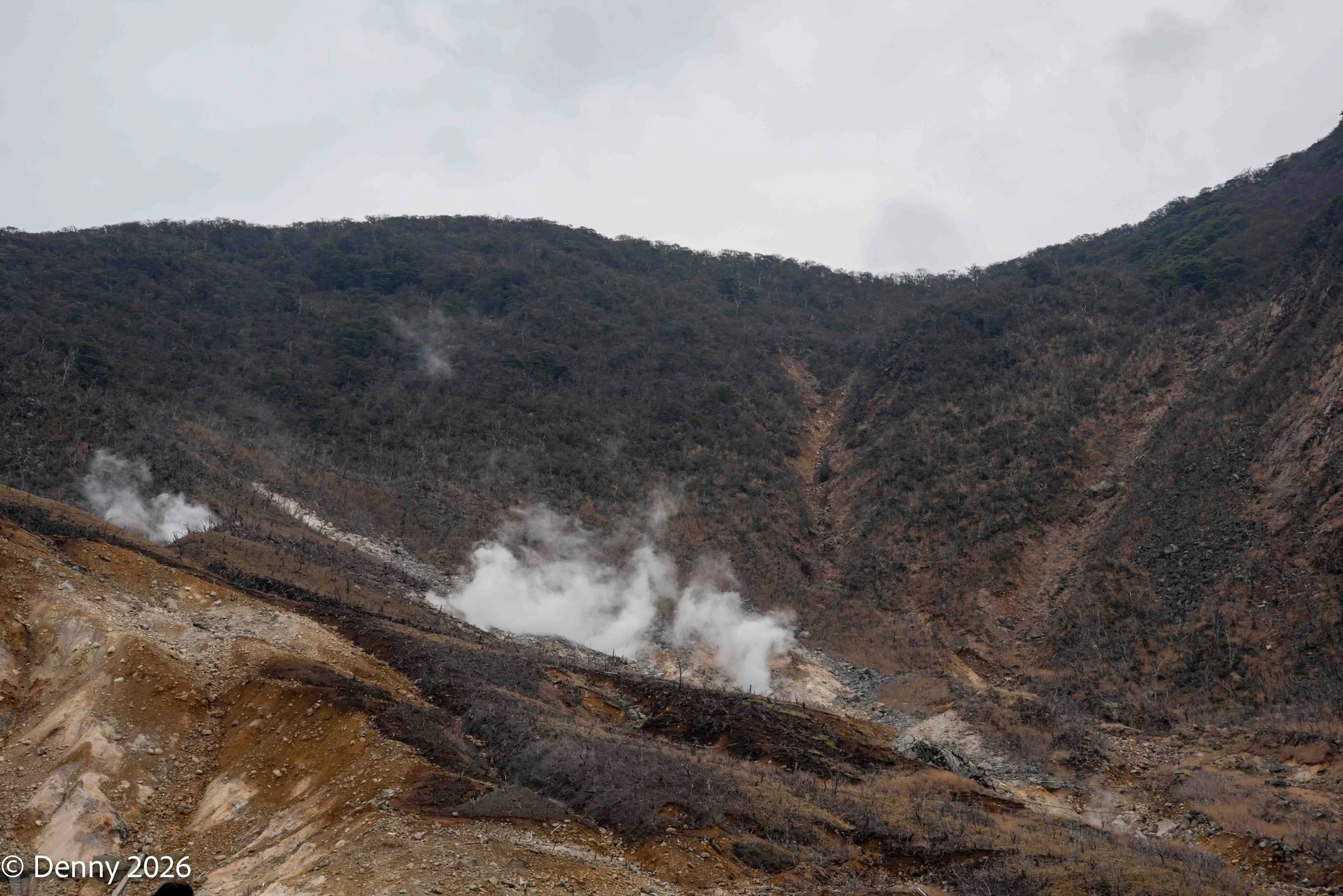
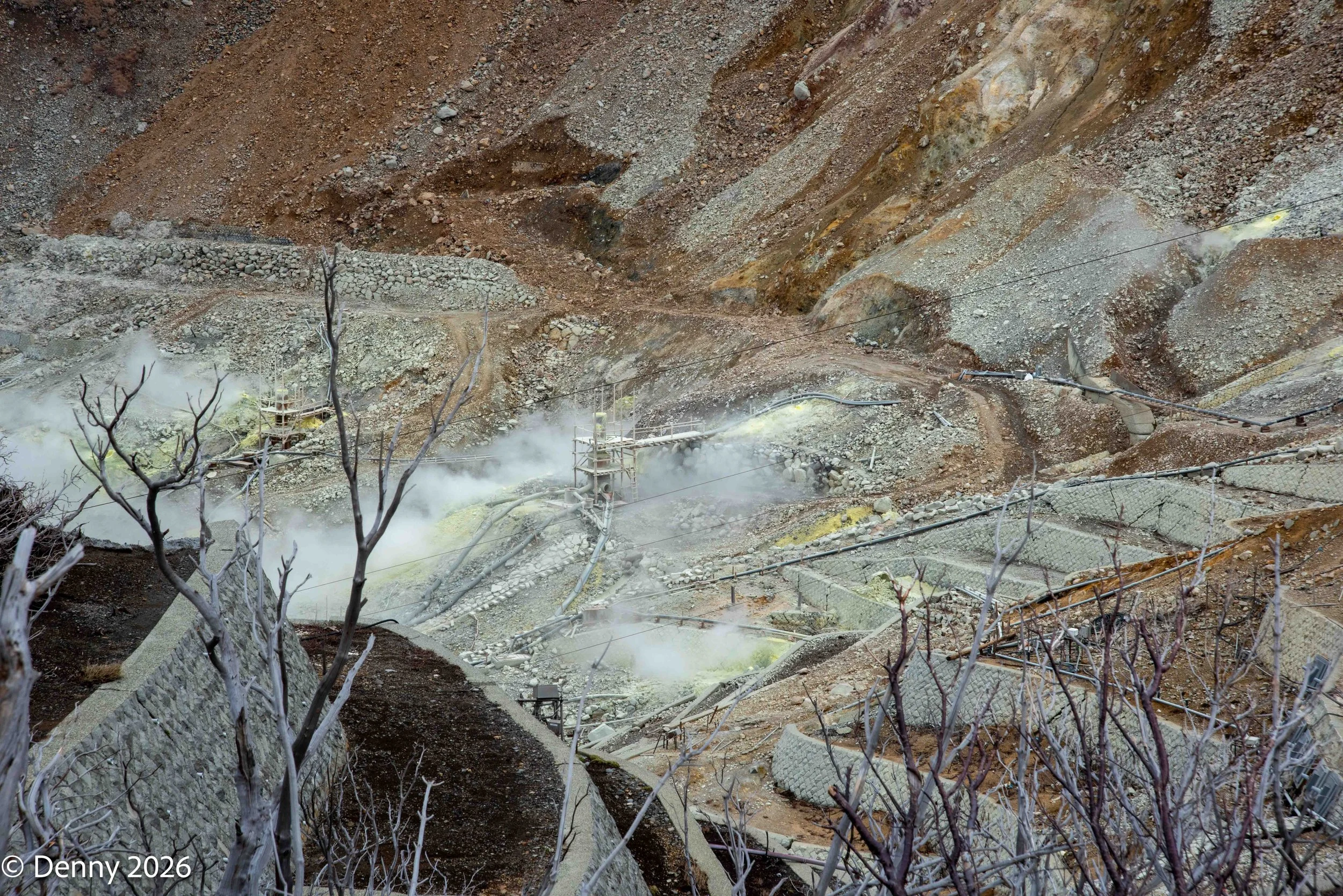
The Hakone area extends across the collapsed remains of a huge volcano which was active until about 3000 years ago. This volcanic origin explains the geothermal activity present today with the hot springs, steam vents and of yellow sulfur covering some rocks on the hillside.  

The mountain pathway we followed was a twisty road and our young driver managed to cope with the ‘S’ bends with ease even when other buses were approaching. The homes along the road had hundreds of cherry trees in blossom which Mitzie said is quite unusual for this early in April.

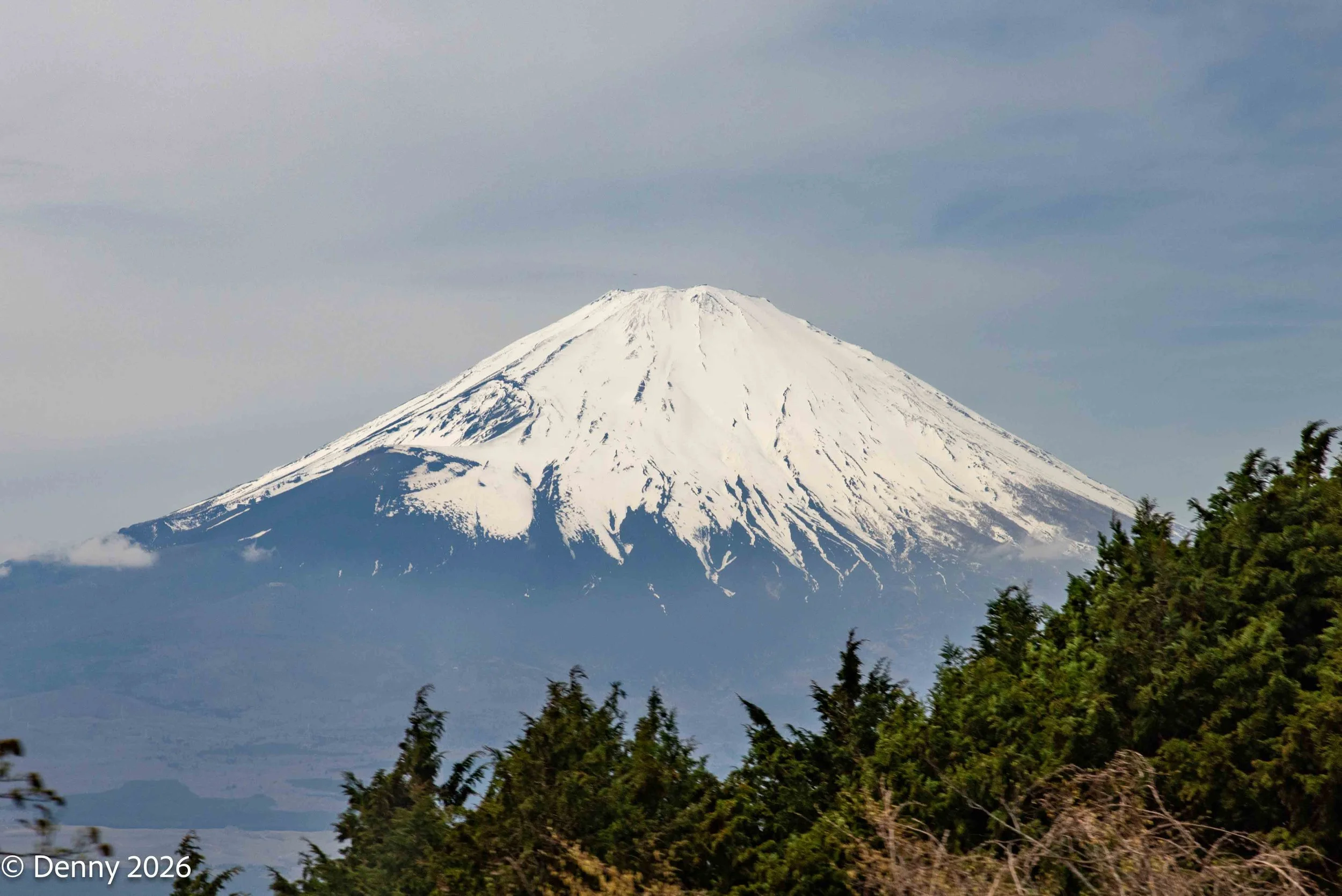
Mt Fuji from the bus en route to Hakone

We arrived at Togendai at an altitude of 741 m and joined a very long queue to eventually board the Hakone Ropeway cable-car.

Wait time for Hakone Ropeway (cable car)

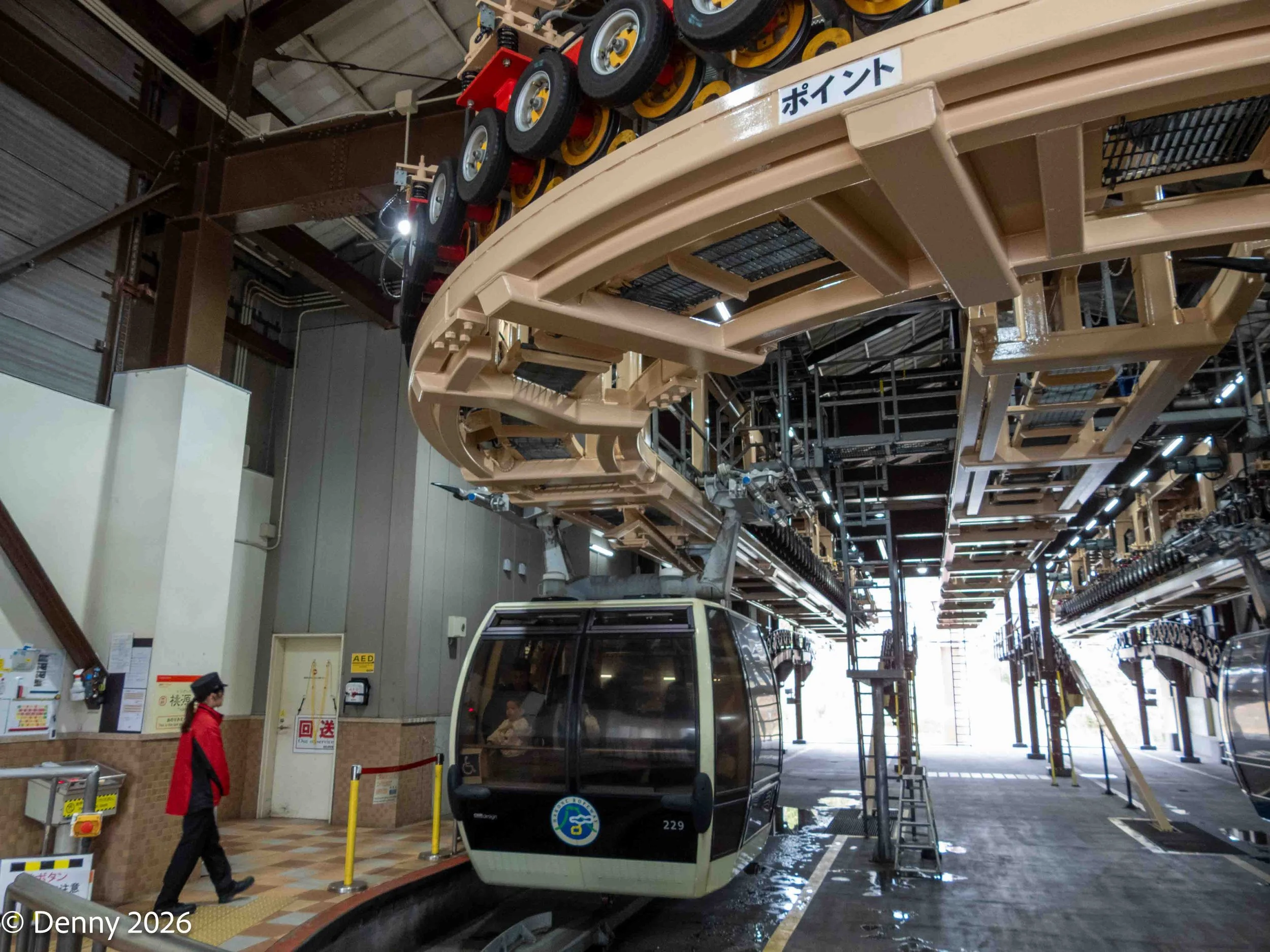
Hakone Ropeway (cable car)

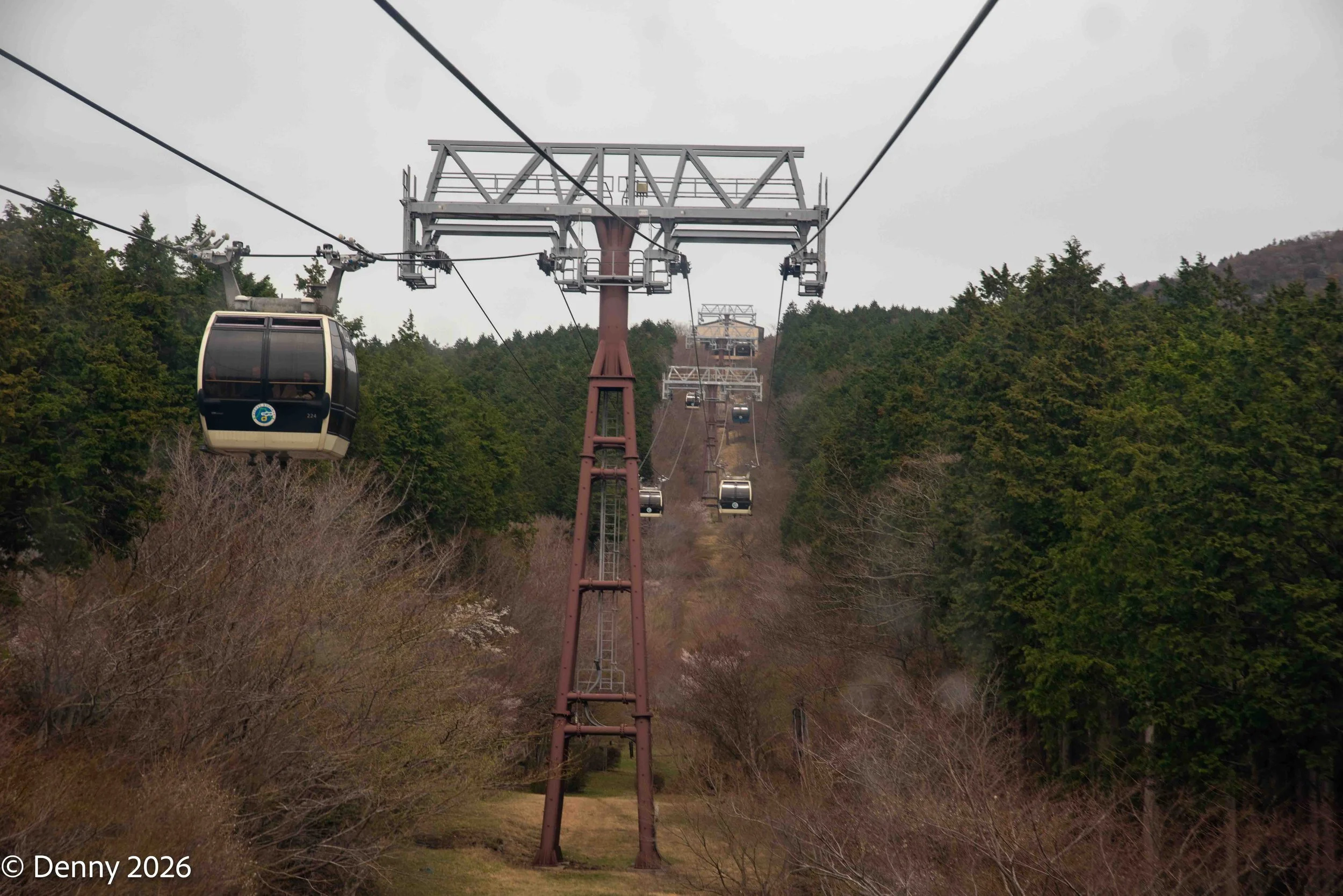
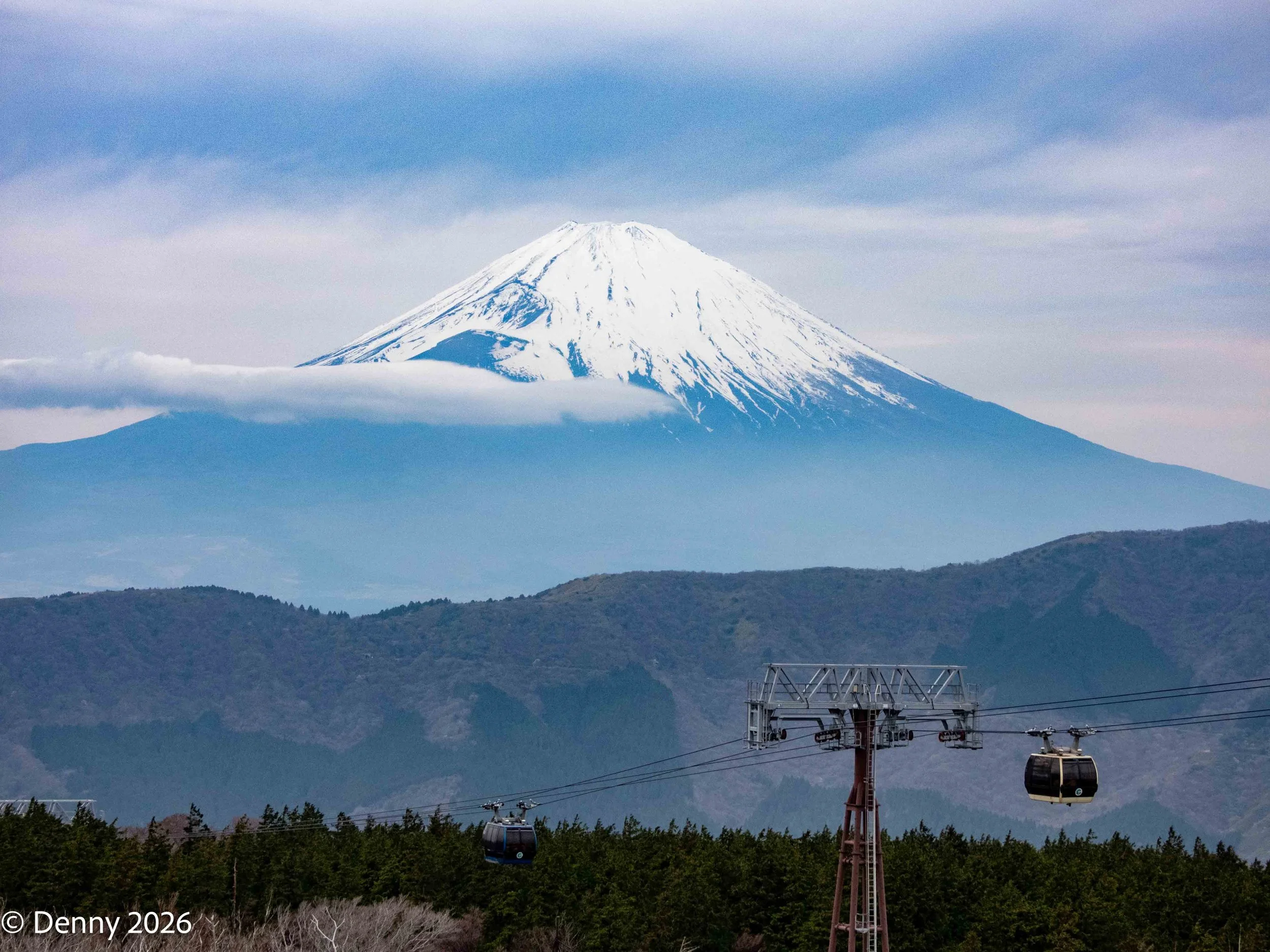
All eighteen of us managed to squeeze into the one carriage and we were transported above a pine forest and grassy slopes to the terminus Owakudani at 1042 m.

Hakone Ropeway (cable car)

Jak with some of our group on Hakone Ropeway (cable car)

On leaving the cable car, we found the outside conditions to be cold and very windy so we spent minimal time taking photos and soon sought shelter.

Steam vent, Hakone

Steam vent, Hakone

Jak & Corinne with Mt Fuji in the background

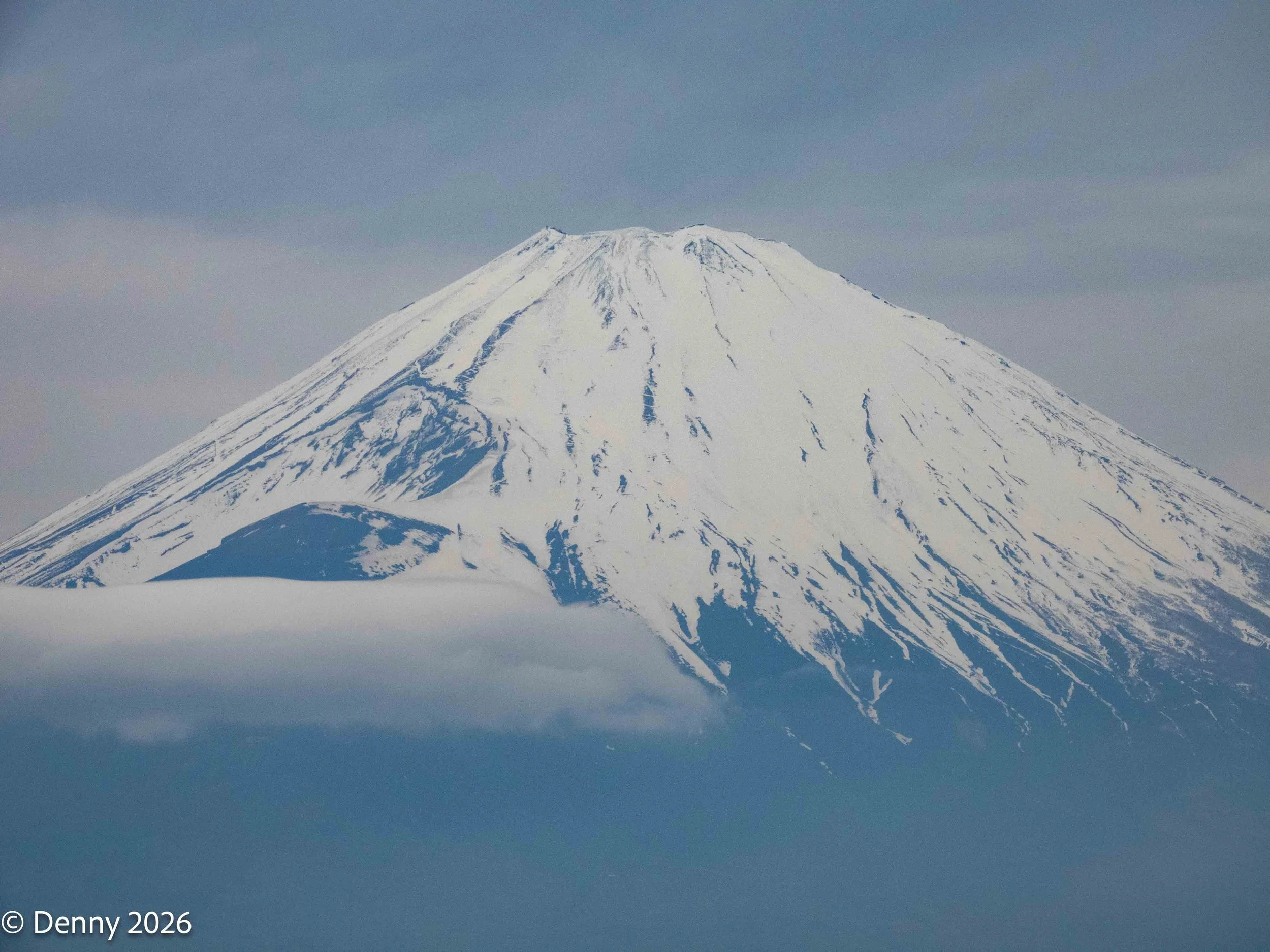
Mt Fuji, Hakone

Mt Fuji & cable cars, Hakone

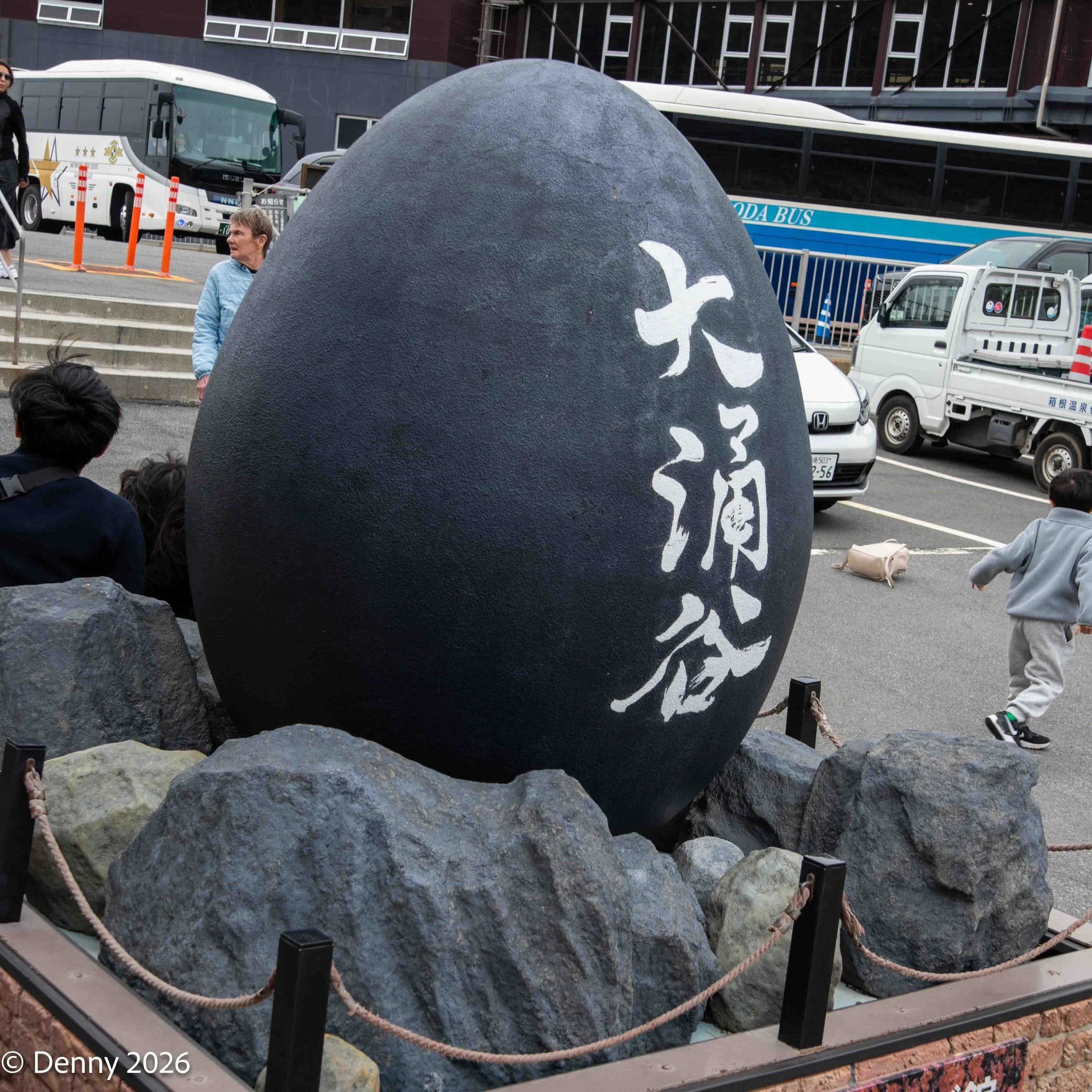
In one of the Owakudani shops they were selling black eggs or kuro tomago. These are normal eggs that have been boiled in water from hot-springs with black dye added. We didn’t try one but legend says that eating them brings good luck and greater longevity. 

Black egg (kuro tomago) display, Hakone

Corinne sitting on black egg (kuro tomago) seat, Hakone

Mt. Fuji was still visible but from this high point it was quite misty and not like the earlier clear sights we’d been fortunate to experience.

Our final drive for the afternoon was to our Prince Hotel in Hakone. This hotel offers traditional ryokan guesthouse accommodation with a natural mineral hot-springs bath called an onsen on the lower floor. We didn’t participate in the joys of naked bathing where the men and women have separate bath areas. 

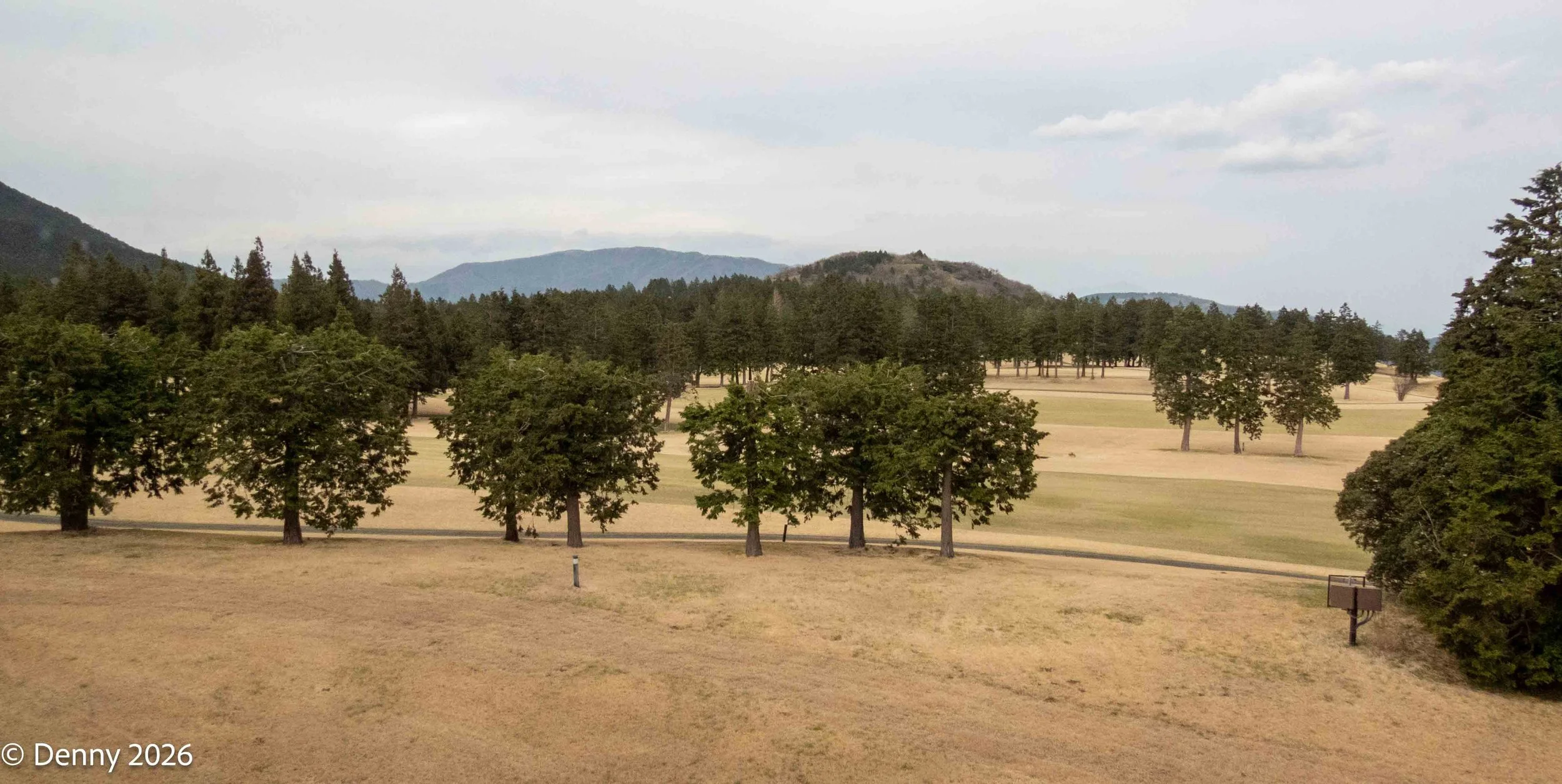
Outside our bedroom window and beyond is an 18 hole Hakone Yu-no-Hana golf course which appears to be very well maintained although the fairways are showing obvious signs of needing rain. A Japanese wild Seka deer (Cervus nippon) scurried across the fairway in front of us with its spotted coat and distinctive white bottom.

View over 18 hole Hakone Yu-no-Hana golf course from our room at Yunohana Prince Hotel, Hakone

Sika deer (Cervus nippon) on Hakone Yu-no-Hana golf course viewed from our room at Yunohana Prince Hotel, Hakone

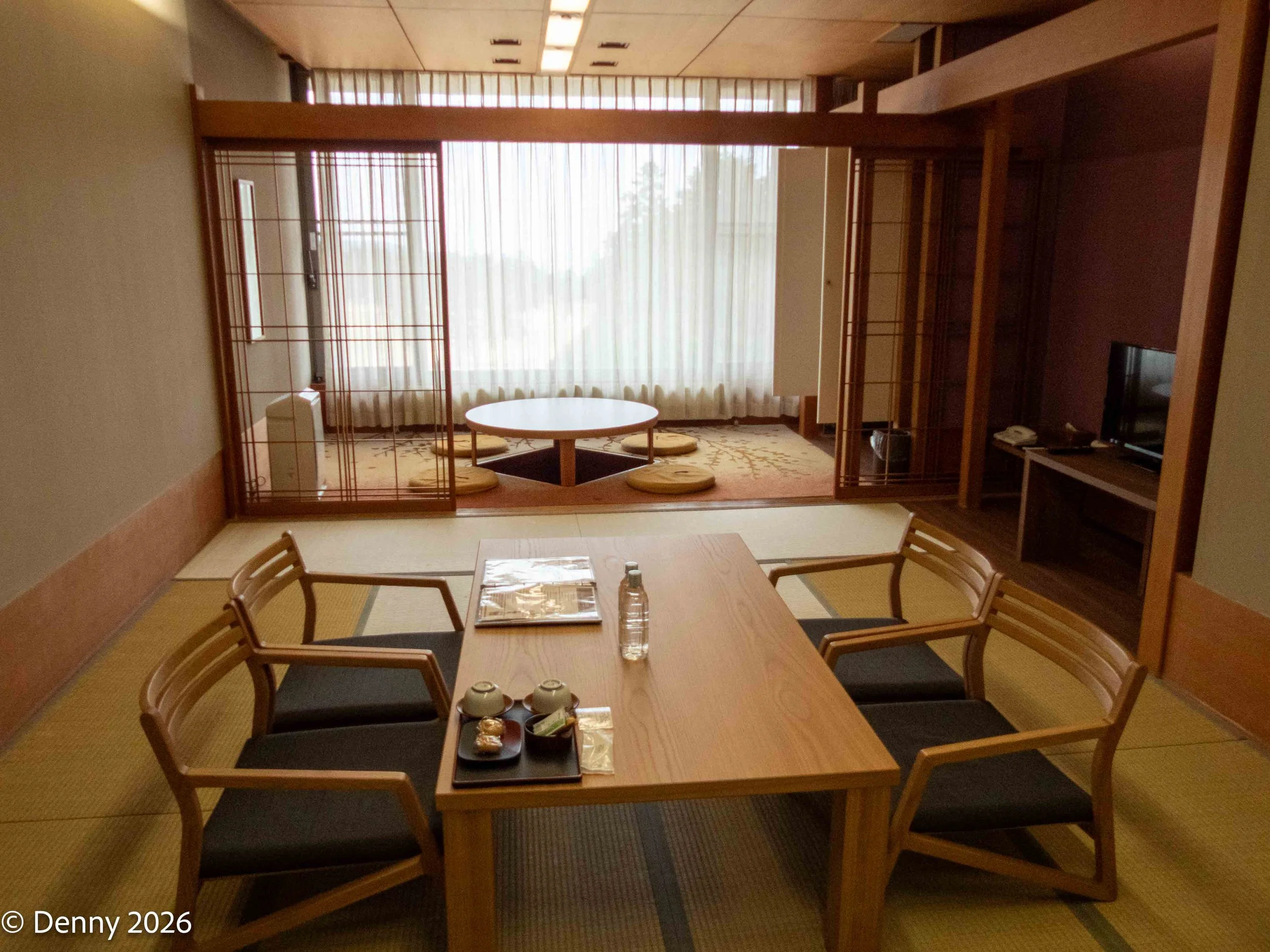
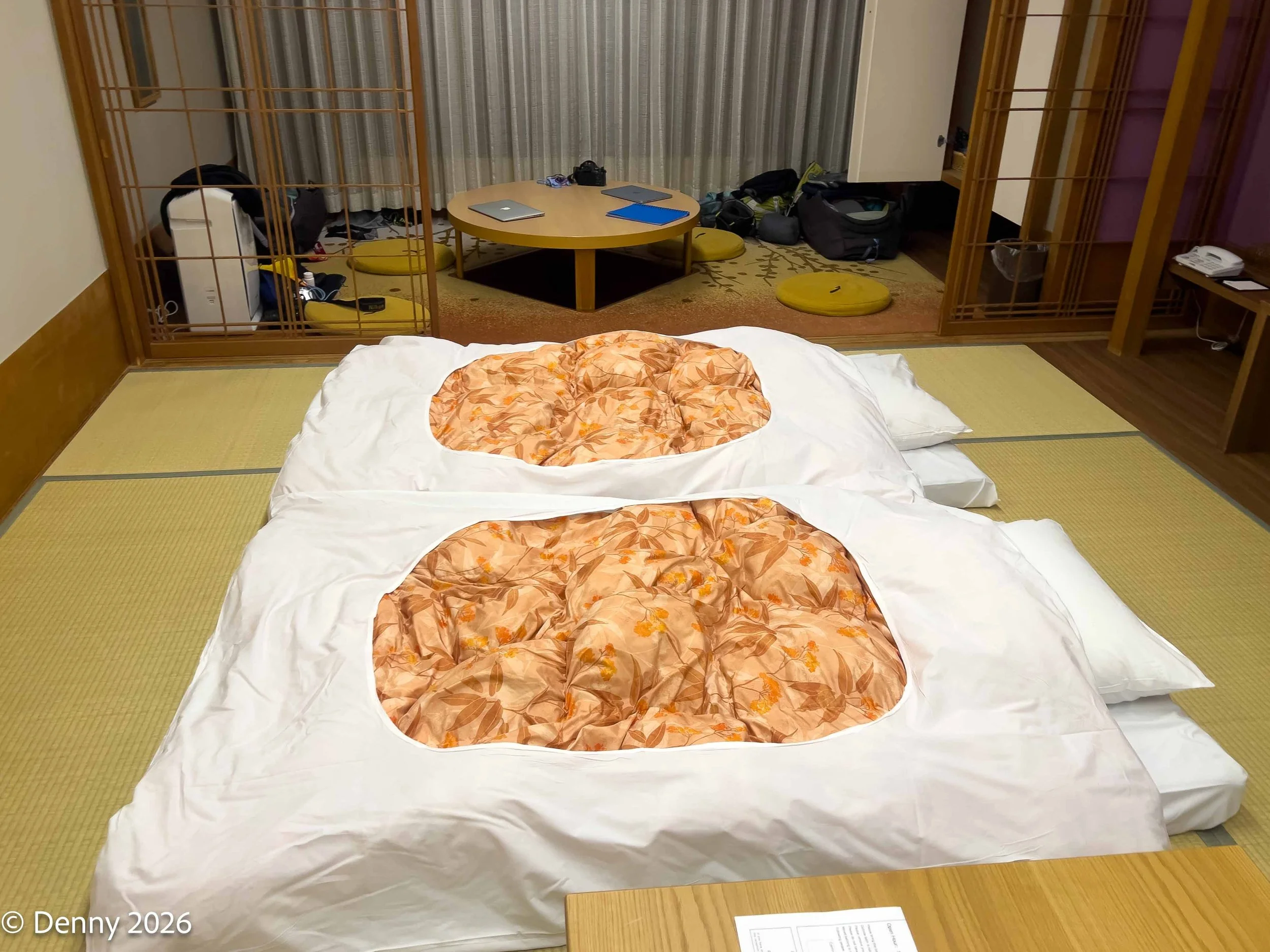
The hotel room has woven mats for floor covering and our beds are on the floor.

Our room at Yunohana Prince Hotel, Hakone

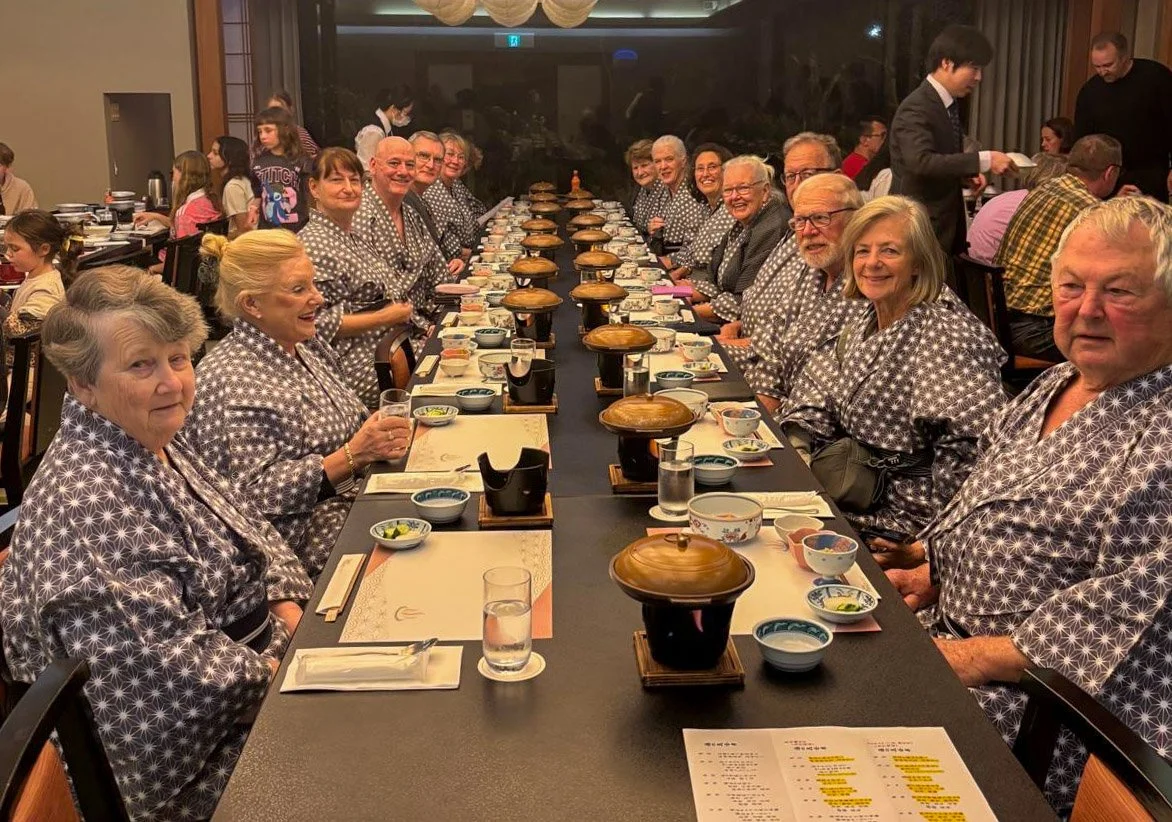
For our evening meal we dressed in a yukata or casual kimono and had a wide selection of Japanese dishes some of which were cooked in a hot-pot.

Group at dinner at Yunohana Prince Hotel, Hakone

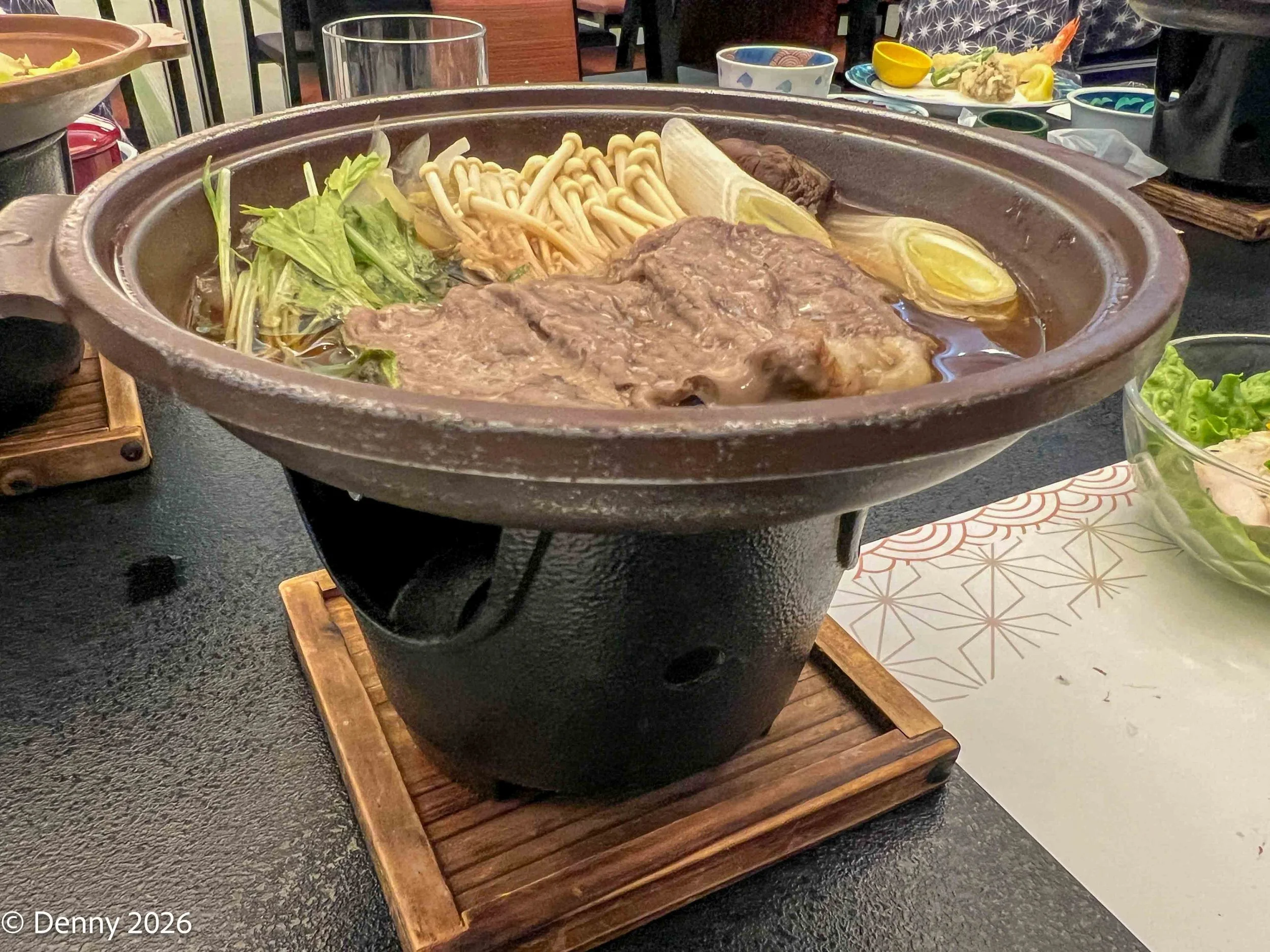
The sashimi tuna and salmon dipped in soy sauce and spiced further with wasabi was a delectable treat. The thinly sliced beef pieces cooked in the hot-pot with vegetables, noodles and mushrooms were very tender and tasty.

Dinner at Yunohana Prince Hotel, Hakone

Dinner at Yunohana Prince Hotel, Hakone

Dinner at Yunohana Prince Hotel, Hakone

At 21:00 we returned to our bedroom to find our beds now set out for us on the floor.

Our room ready for bed at Yunohana Prince Hotel, Hakone

Tomorrow morning we will be travelling by shinkansen (bullet train) to Nagoya and then connecting with a local regional train service to Takayama. As the shinkansen has limited luggage space, our big bags need to be transported by bus to Kyoto where we’ll be in three days time. Consequently, for the next two nights we have to carry an overnight bag with the bare essentials.

DAY 26: Tuesday 7th April 2026 HAKONE – TAKAYAMA, JAPAN

We awoke to a very windy dawn with rain threatening. Breakfast at our Prince Hotel comprised a set offering of thinly sliced beef, two cocktail sausages, cold French fries, a tiny green salad, two small bread rolls, a croissant and a meagre serving of scrambled egg. Orange juice and hot coffee were appreciated inclusions.

Before we departed the hotel at 08:20 we had our big bags set aside for collecting in Osaka when we arrive on Thursday afternoon. We took some photos of the hotel’s gardens which included an attractive pond and small waterfalls.

Garden at Yunohana Prince Hotel, Hakone-machi Hakone

Our bus driver then took us from our hillside hotel in Hakone down to the coastal city of Odawara and dropped us off at the railway station in preparation for our train travel to Takayama.

Our bus driver, Yunohana Prince Hotel to Hakone railway station

Right outside the station is a large and most impressive bronze statue of Suon Hojo who was a powerful warlord during Japan’s Sengoku period in the mid to late 15th century.

Bronze statue of Suon Hojo at Hakone railway station

Our group then boarded the shinkansen bullet train to Nagoya, a trip lasting seventy minutes with a maximum speed of just under 300 km/h.

Shinkansen bullet train arriving at Hakone railway station

Shinkansen bullet train arriving at Hakone railway station, Hakone

At Nagoya we then transferred quickly to a regional express train that took us on a two and a half hour northerly journey to Takayama.

The first hour of our train trip was through a suburban landscape that changed to a more rural scene where rice paddies were common in amongst the numerous small villages.

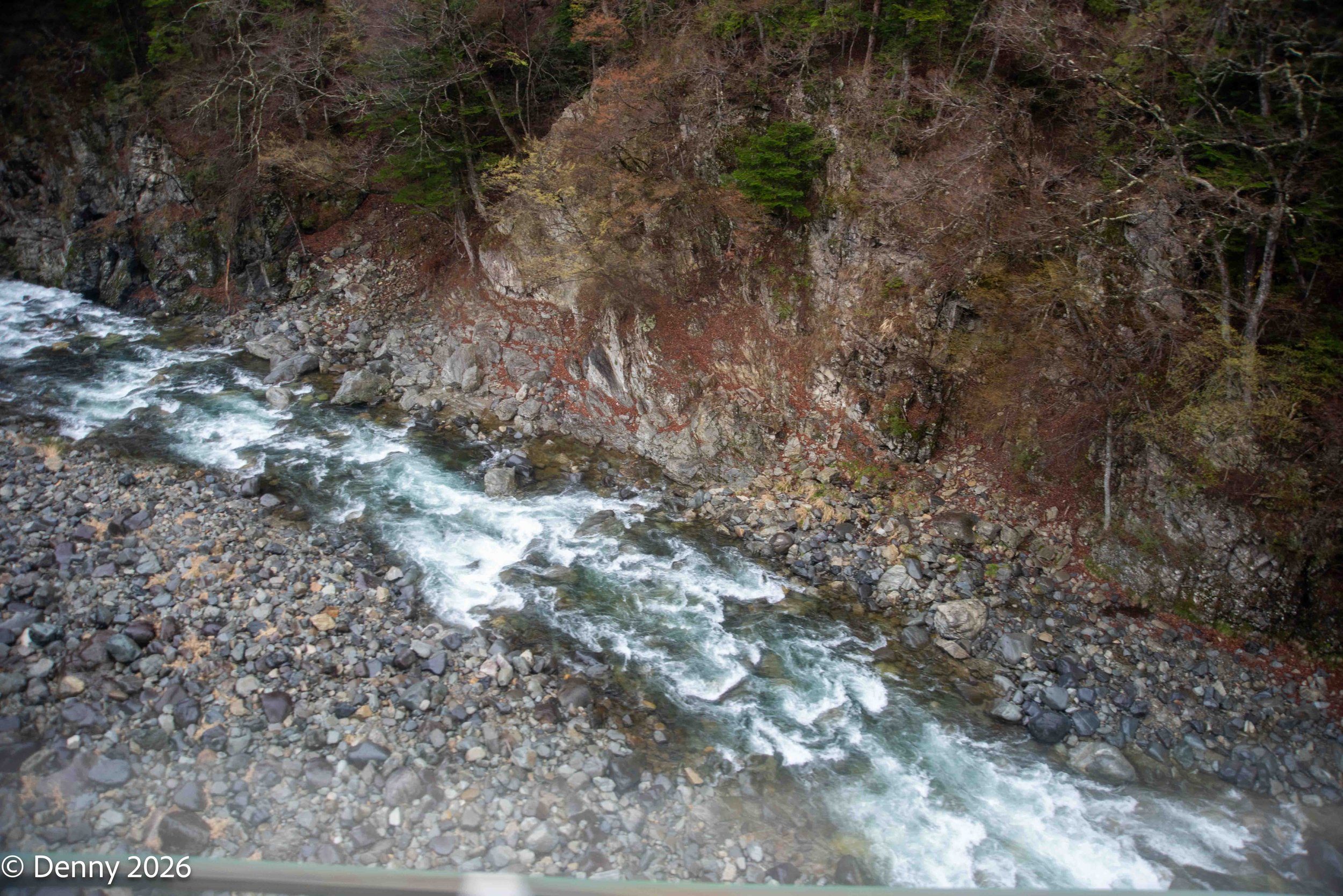
The second half of the trip to Takayama was mostly following along the spectacular Hidagawa River gorge with many cherry blossom trees in flower.

Hidagawa River from fast express train

Hidagawa River from fast express train

Hidagawa River gorge viewed from fast express train, Nagoya to Takayama

Hidagawa River gorge viewed from fast express train, Nagoya to Takayama

Hidagawa River gorge viewed from fast express train, Nagoya to Takayama

We were unaware until this time that the cherry blossom trees are native to Japan. This is evident by seeing remote mountain hillsides far away from roads or people having cherry trees in bloom interspersed amongst the other forest trees.

Cherry blossom viewed from fast express train, Nagoya to Takayama

Unfortunately, the weather had now deteriorated and rain developed making this magnificent gorge and its cascades a good deal harder to see and appreciate. 

On arriving at Takayama (formerly called Hida) we deposited our overnight bags at the Tokyu Stay Hida Hotel and went for a walk into the ‘Old Hida Village’.

Takayama is an isolated mountain city which is agriculturally poor but rich in timber giving it a centuries old tradition of producing skilled carpenters and wood carvers. The pure mountain water that abounds in this valley is deemed to be perfect for the production of sake and craft beers. Not surprisingly Takayama has become a tourist mecca with millions visiting each year especially for its internationally famous, twice a year Takayama Festivals.

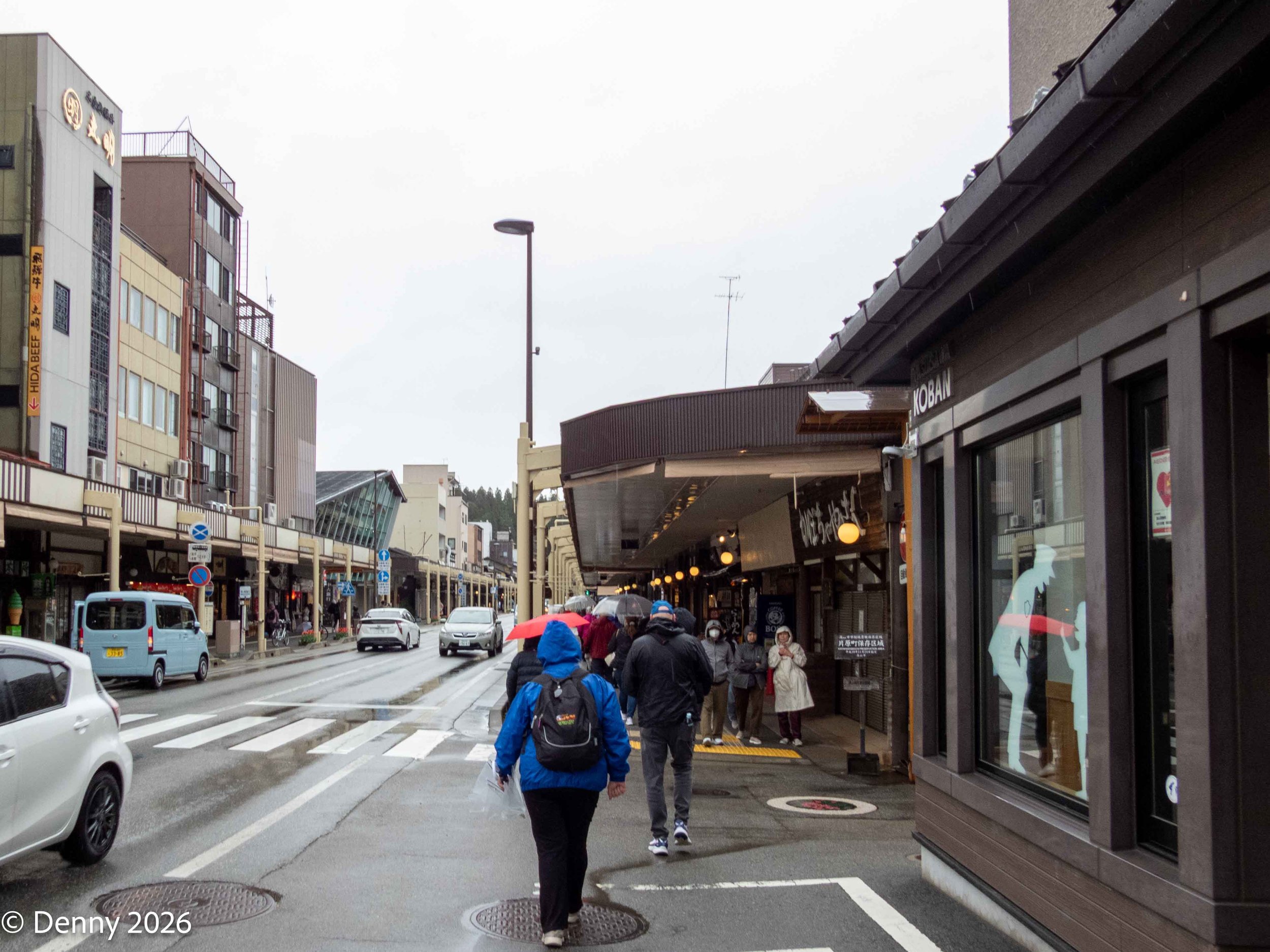
We strolled in very cold and wet conditions down through the old town’s Sanmachi Street but our enthusiasm was affected by the adverse weather.

Group walking in the rain, Takayama

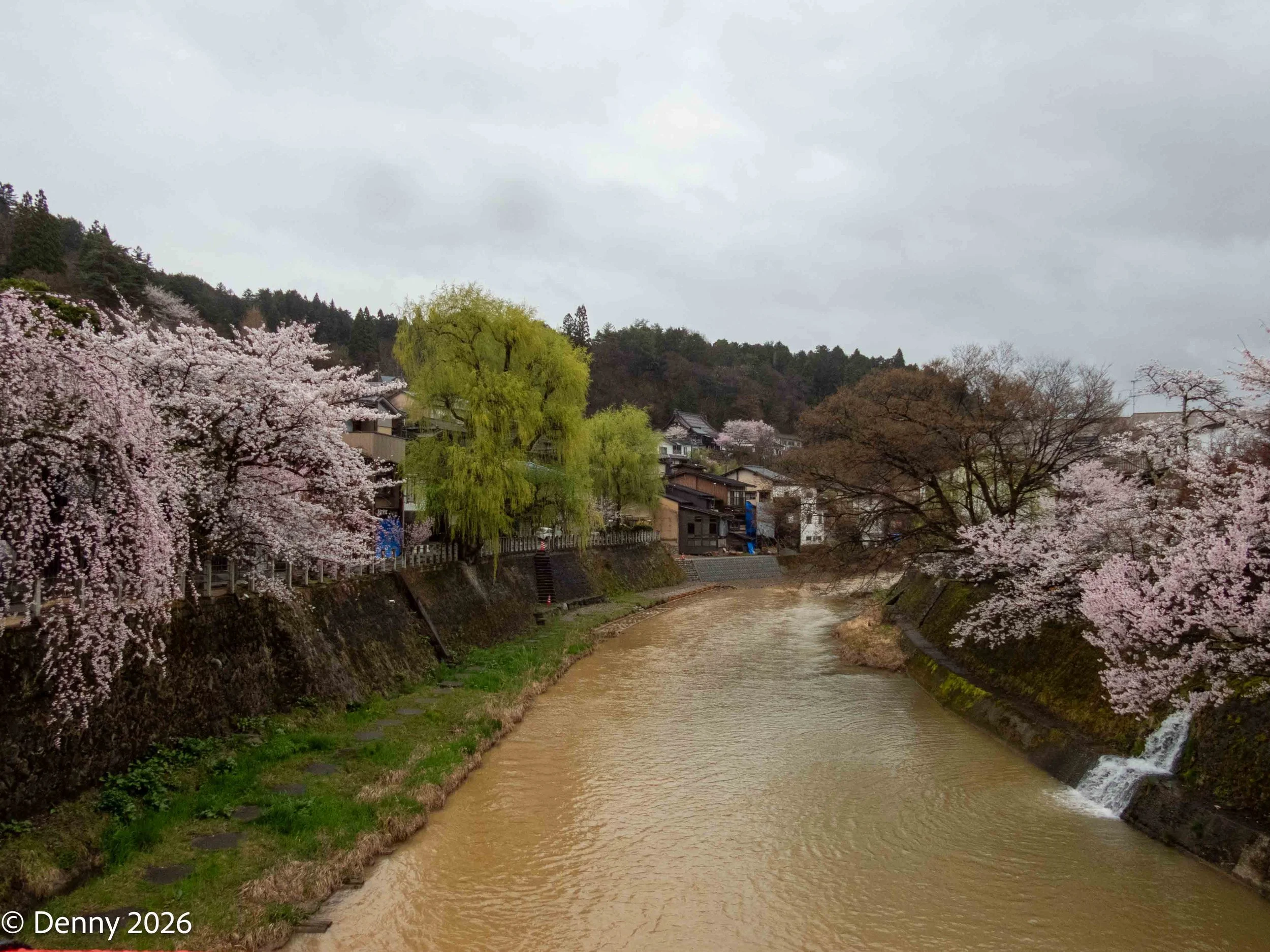
Cherry blossom, Miyagawa River, Takayama

Shop in main street, Takayama

To get out of the rain we visited the Takayama Jinya National Historic Site.

Entrance to Takayama Jinya National Historic Site

Takayama Jinya was a branch office of Edu Bakufu (government) from 1692-1868. The warrior government of the Tokugawa Shogun ruled supreme for 265 years and this site exhibits precious historical equipment and documents from that period.

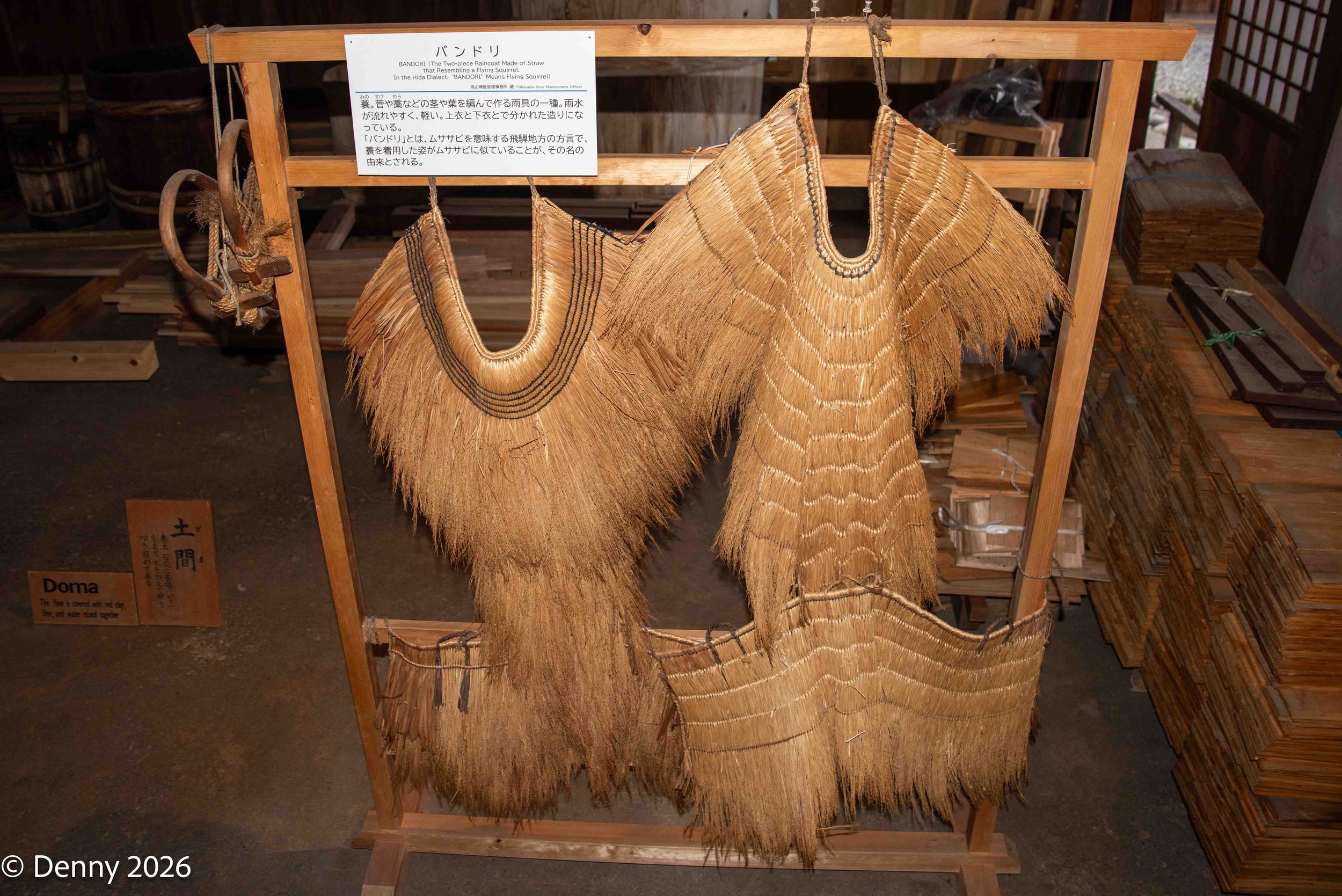
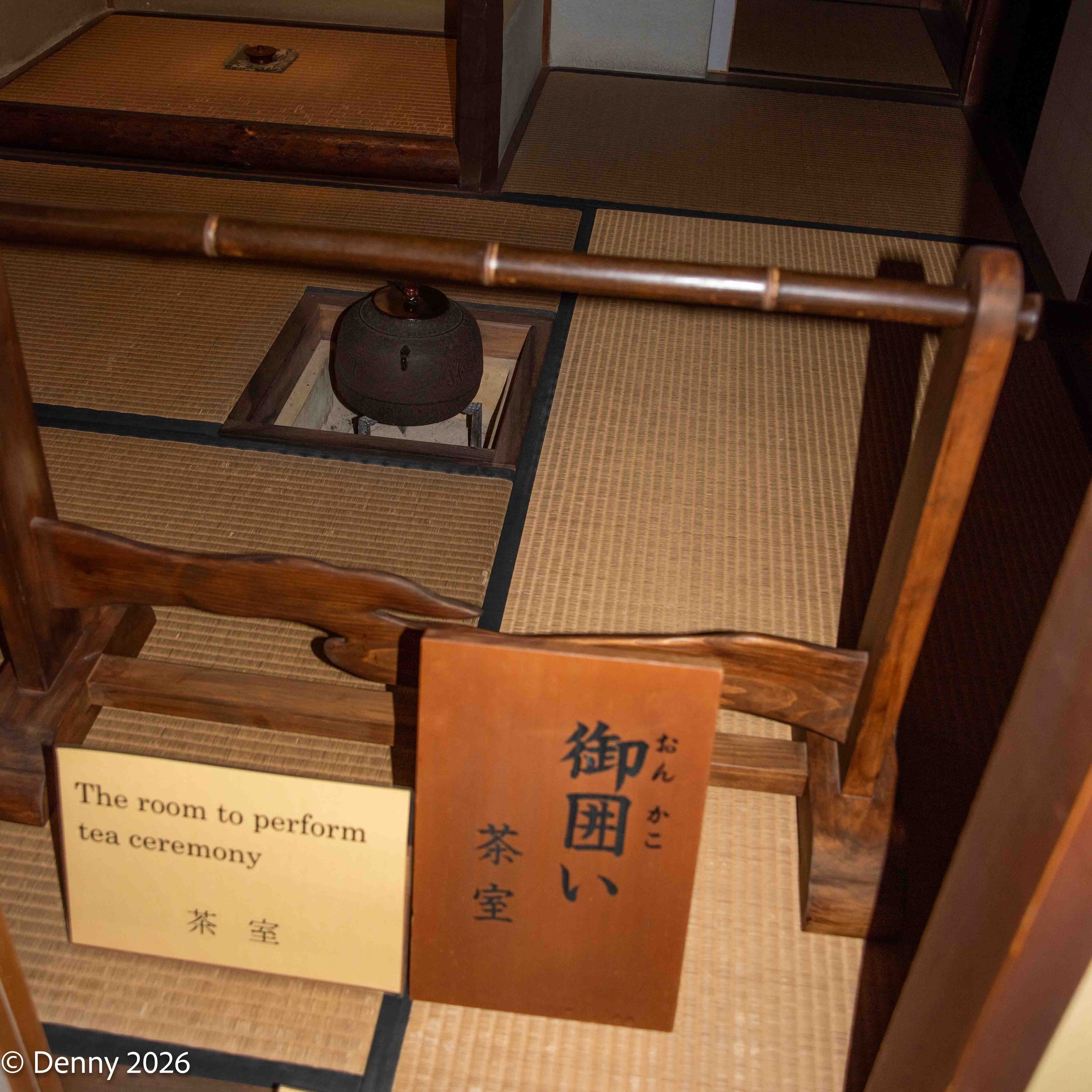
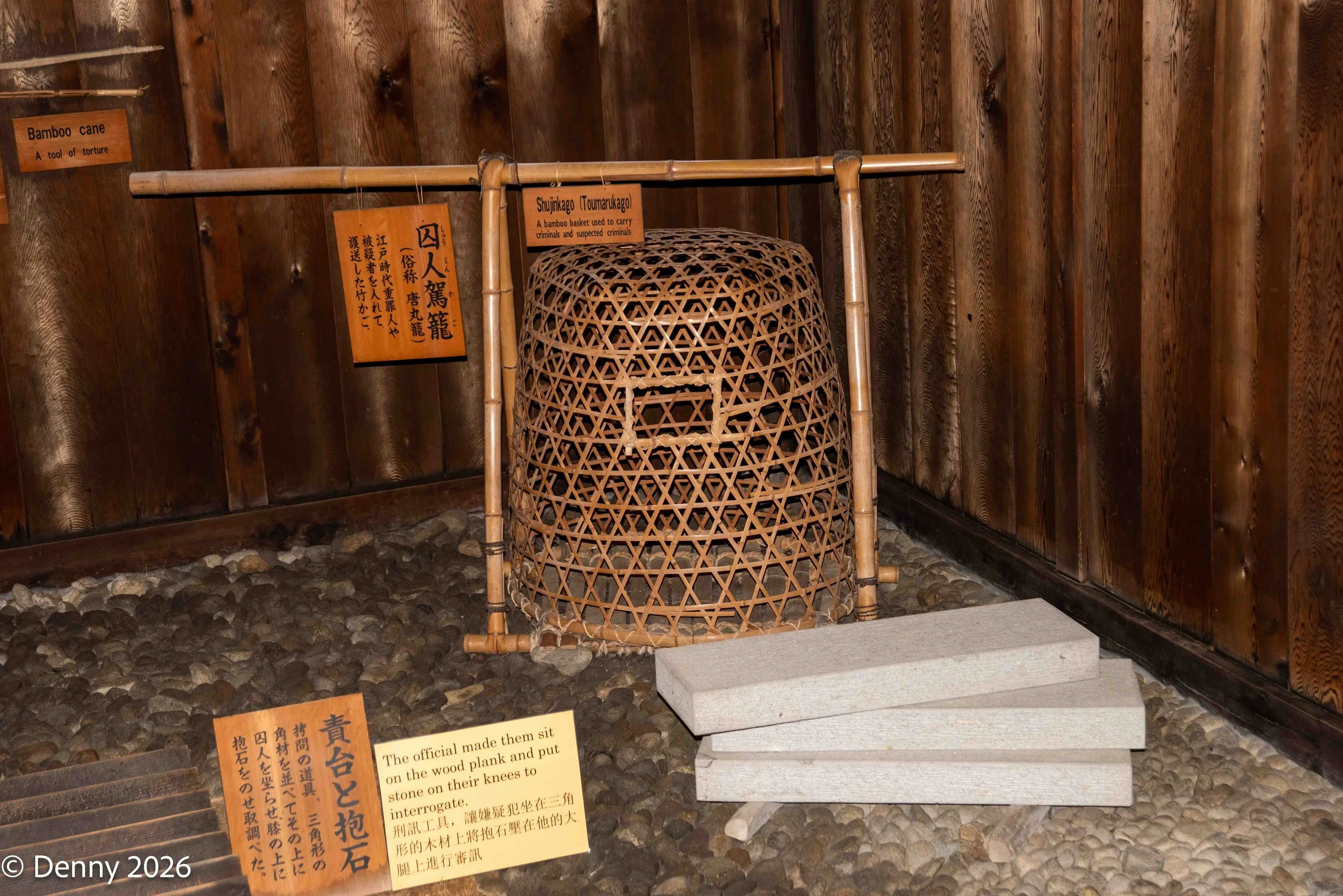
The more captivating displays included raincoats made of straw, various wooden barrels, a tea ceremony room, woodworking equipment and an interrogation room.  

Raincoat made of straw, Takayama Jinya National Historic Site

Tea ceremony room, Takayama Jinya National Historic Site

Glory box, Takayama Jinya National Historic Site

Wooden barrels, Takayama Jinya National Historic Site

Woodworking equipment, Takayama Jinya National Historic Site

Our group, Takayama Jinya National Historic Site

Interrogation Room, Takayama Jinya National Historic Site

The farmers of this time were heavily taxed and were forced to pay their taxes. As a reaction to this government pressure they sent rice stuffed into 60 kg straw sacks to the Edu Bakufu. Rice in these times was used as a financially negotiable commodity.

Straw rice sacks for tax, Takayama Jinya National Historic Site

A most interesting exhibit was that of a 1.5 m high shogun dressed in full armour and helmet. George Lucas, the director of Star Wars visited this museum and specifically used this shogun model as the basis for his character Darth Vader!

Shogun warrior (Darth Vader model), Takayama Jinya National Historic Site

We left the historic site and headed back to our hotel for warmth and rest but on the way dropped into a local store for provisions.

Cherry blossom, Takayama

Cherry tree at “Nakabashi” Bridge that spans across the Miyagawa River., Takayama

Tomorrow we’ll explore this town and two others nearby, hopefully in more appealing weather conditions.

DAY 27: Wednesday 8th April 2026 TAKAYAMA – SHIRAKAWA-GO - TAKAYAMA, JAPAN

After yesterday’s rainy and cold afternoon it was a delight to awake to sunshine and not a cloud in the sky.

We were not in a big rush this morning so breakfast was a leisurely event and we then took a quick walk to the nearest convenience store to buy some sandwiches and muesli bars for our lunch later today.

We had a new bus and driver today and we left Takayama at around 10:00 and parked at a nearby Buddhist monastery with beautiful cherry blossoms and conifers.

Entrance to Buddhist monastery, Takayama

Bell tower, Buddhist monastery Takayama

Cherry blossom at Buddhist monastery, Takayama

Original houses, Takayama

From here we walked to the local market which was a collection of handicraft stalls set along the right bank of the Miyagawa River.

Miyagawa Morning Market, Miyagawa River, Takayama

In glorious sunshine we strolled for an hour past produce made principally by local women. There were lots of interesting handicraft items and jewellery for sale but the most unusual was coffee sold in a cup that could be eaten after finishing the drink!

Lady selling plants, Miyagawa Morning Market

Coffee in a cookie, Miyagawa Morning Market

In the Miyagawa River were some large fish, probably carp and an elegant grey heron was wading nearby.

Carp, Miyagawa River

Gray Heron (Ardea cinerea, known as aosagi in Japan), Miyagawa River, Takayama

Eastern Spot-billed Duck, Miyagawa River

Cherry blossom, Miyagawa River

Cherry blossom, Miyagawa River

Cherry blossom, Miyagawa Morning Market, Miyagawa River

On returning to our bus, we went north-west for about an hour and a half heading for the town of Shirakawa-go. The route was principally through mountainous terrain with steep hillsides and many streams and rivers flowing through the valleys and rocky gorges.

The road to Shirakawa-go involved passing through numerous tunnels with the longest being over 10 km long. It seemed like a quarter of our total travel time was in tunnels.

Tunnel en route from Takayama to Shirakawa-go

Snow capped mountains en route from Takayama to Shirakawa-go

Village en route from Takayama to Shirakawa-go

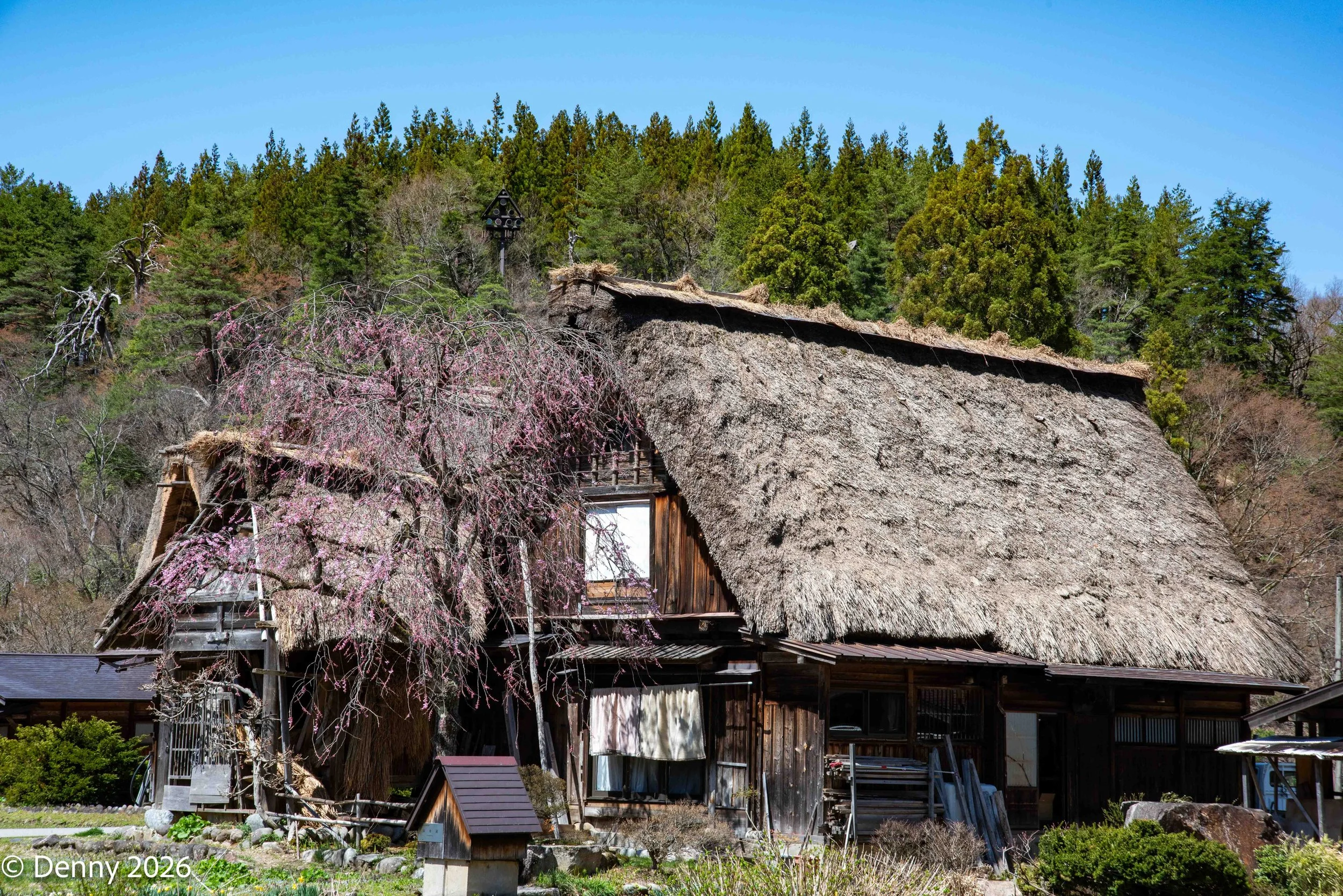
Shirakawa-go is an UNESCO World Heritage listed site and is a delightful village famous for its thatched roof houses. This is a mountain region subject to the extremes of winter and these amazing ‘gassho-zukuri’ houses have their steep thatched roofs designed to cope with heavy snowfalls. The exceedingly thick thatches are made from pampas straw and provide a very effective thermal insulation although there were lots of warning signs concerning the dangers of fires.

The word gassho means ‘hands pressed together in prayer’ and with a little imagination that’s what the roofs looked like.

Thatched roof buildings at entrance to Shirakawa-go

We crossed the suspension bridge walkway above the greenish waters of the Shirakawa River and commenced our tour by visiting the village museum.

Our group crossing the suspension bridge at Shirakawa-go

Shirakawa River viewed from the suspension bridge

This village museum building is a three storey thatched timber structure filled with a vast array of historical artifacts.  

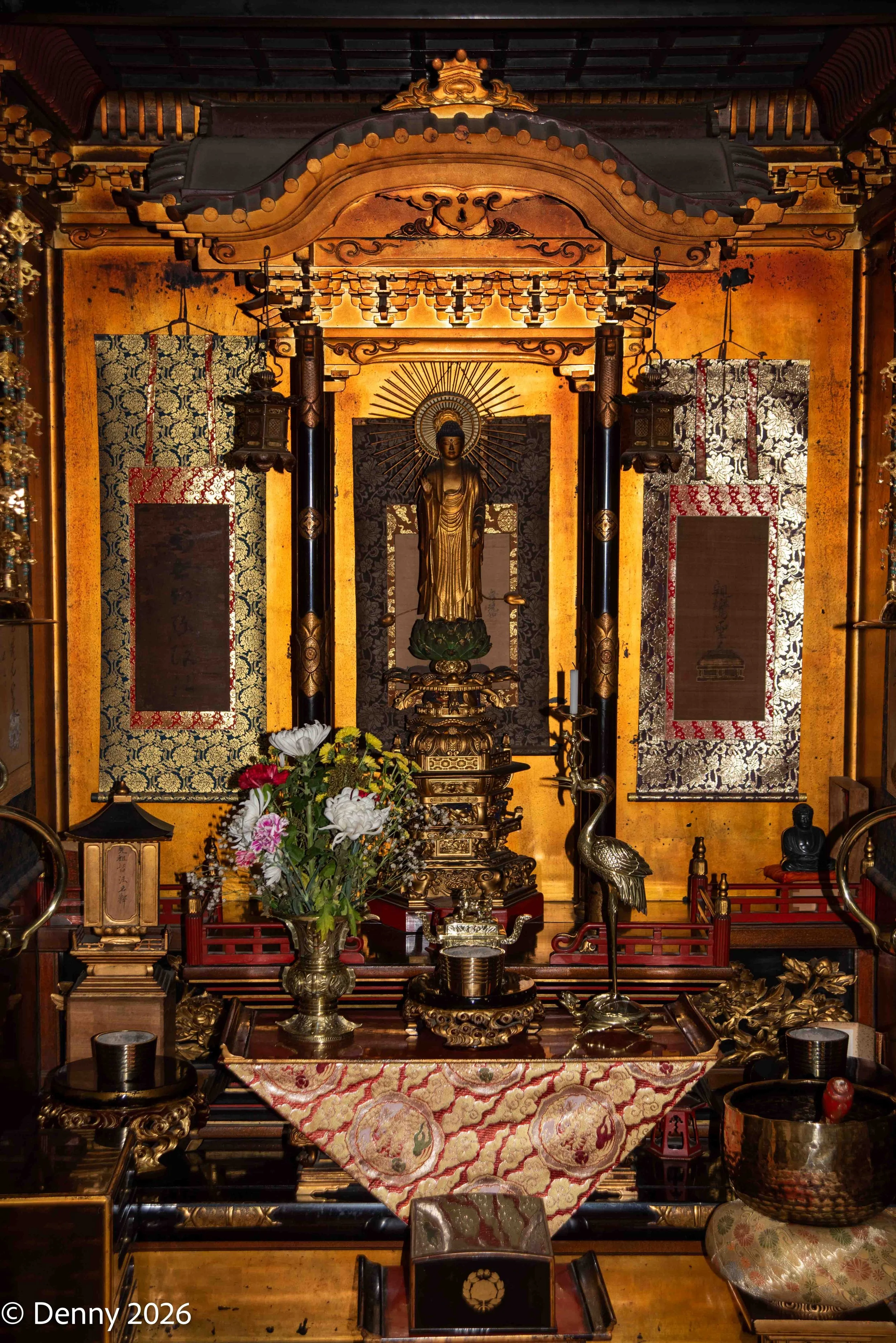
Amongst the displays that caught our attention was an elaborate family shrine where deceased family relatives were respected and honoured.

Shrine inside museum, Shirakawa-go Gassho-Zukuri Village

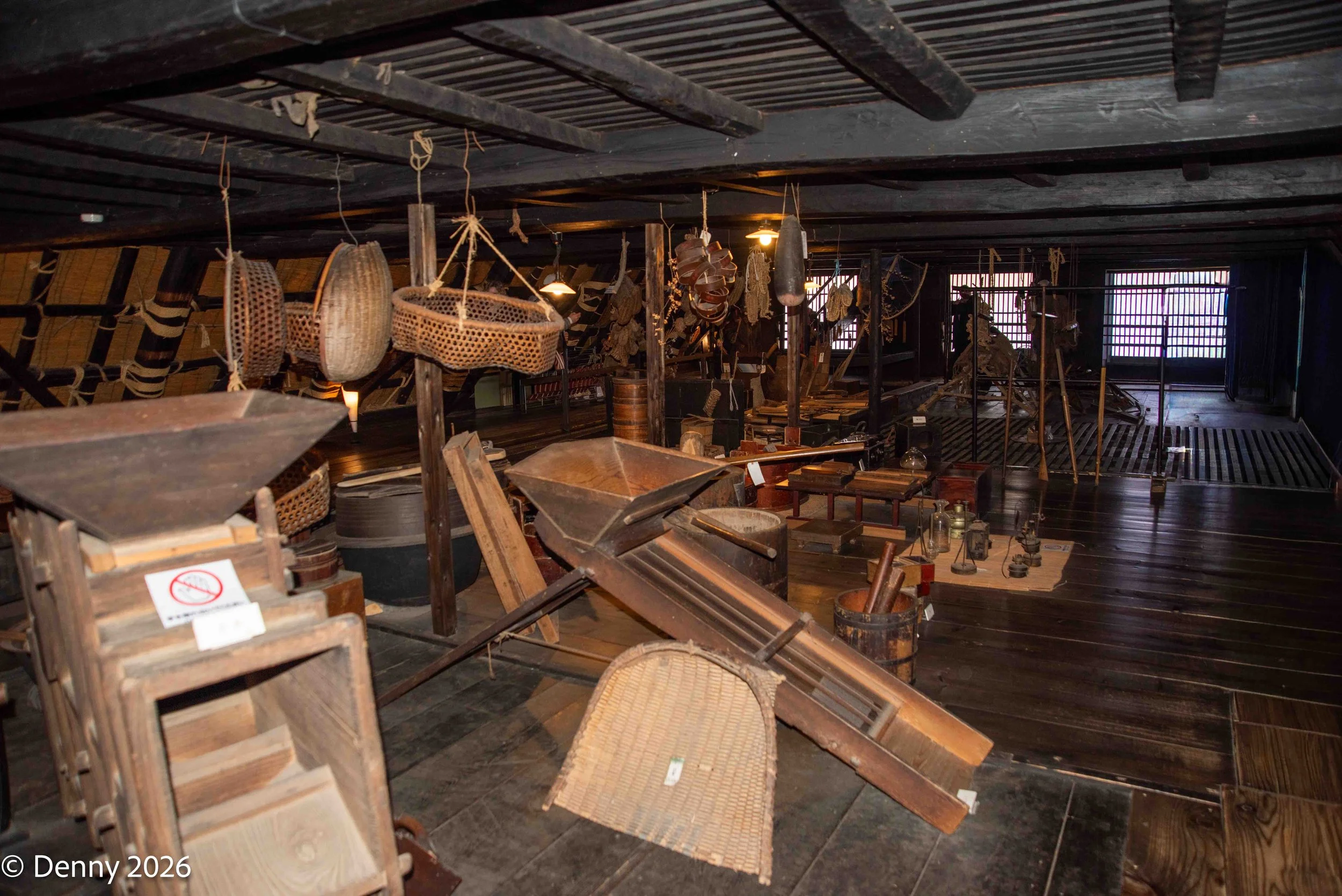
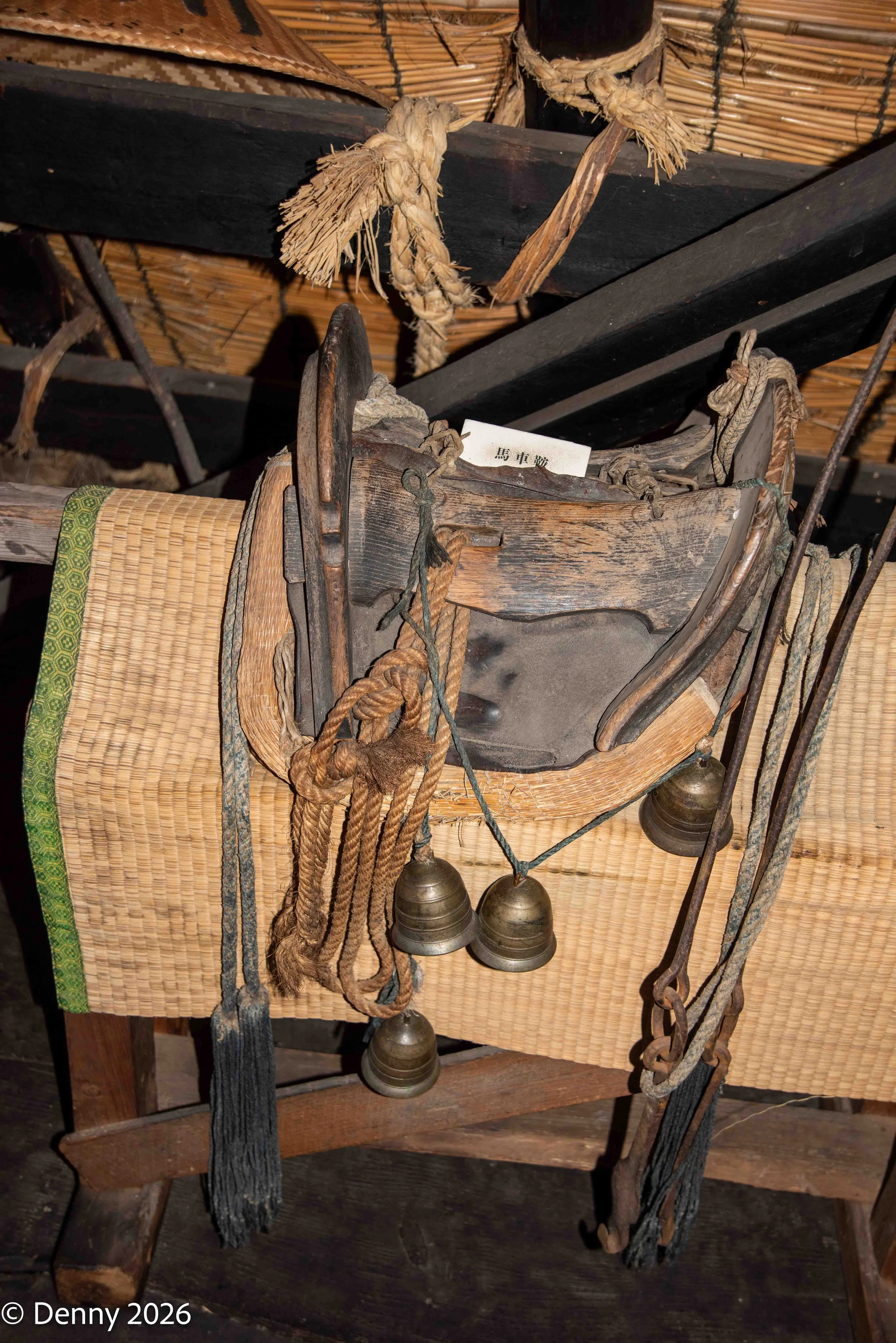
Other things of interest included antique pots, lacquerware, carpentry tools, farm implements, sledges and an ancient saddle. We were informed that many of the households were involved in silk production and had silkworm ‘farms’ in the upper storeys where it was warm. Presumably there are lots of mulberry trees in this village but at present it’s the pink and white cherry blossoms that are most apparent.

Artefacts inside museum, Shirakawa-go Gassho-Zukuri Village

Ancient saddle inside museum, Shirakawa-go Gassho-Zukuri Village

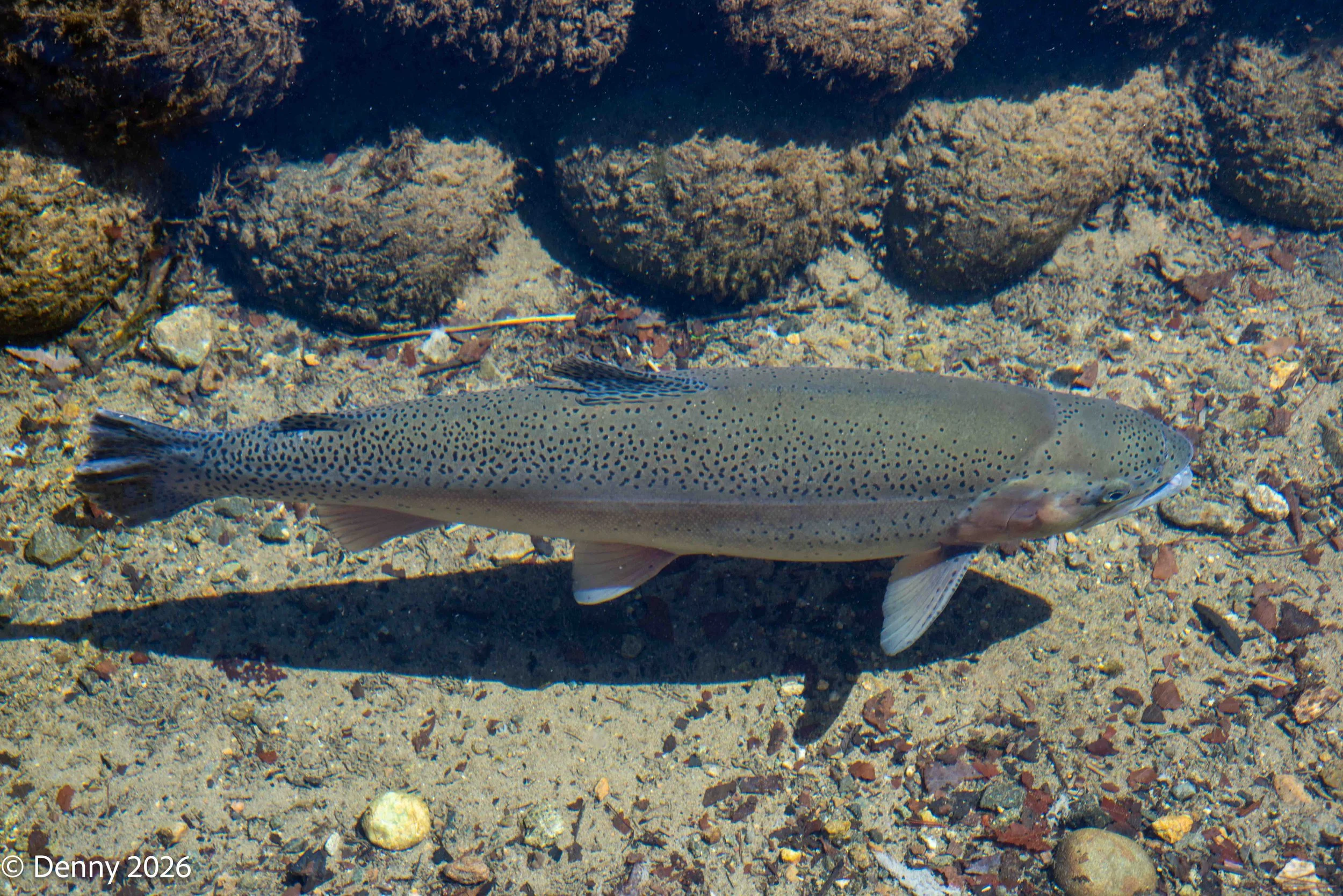
We spent the next hour in glorious weather just wandering through this stunning village observing not just these fabulous houses but the ponds, waterways and fish, including large trout in streams along-side the footpaths.

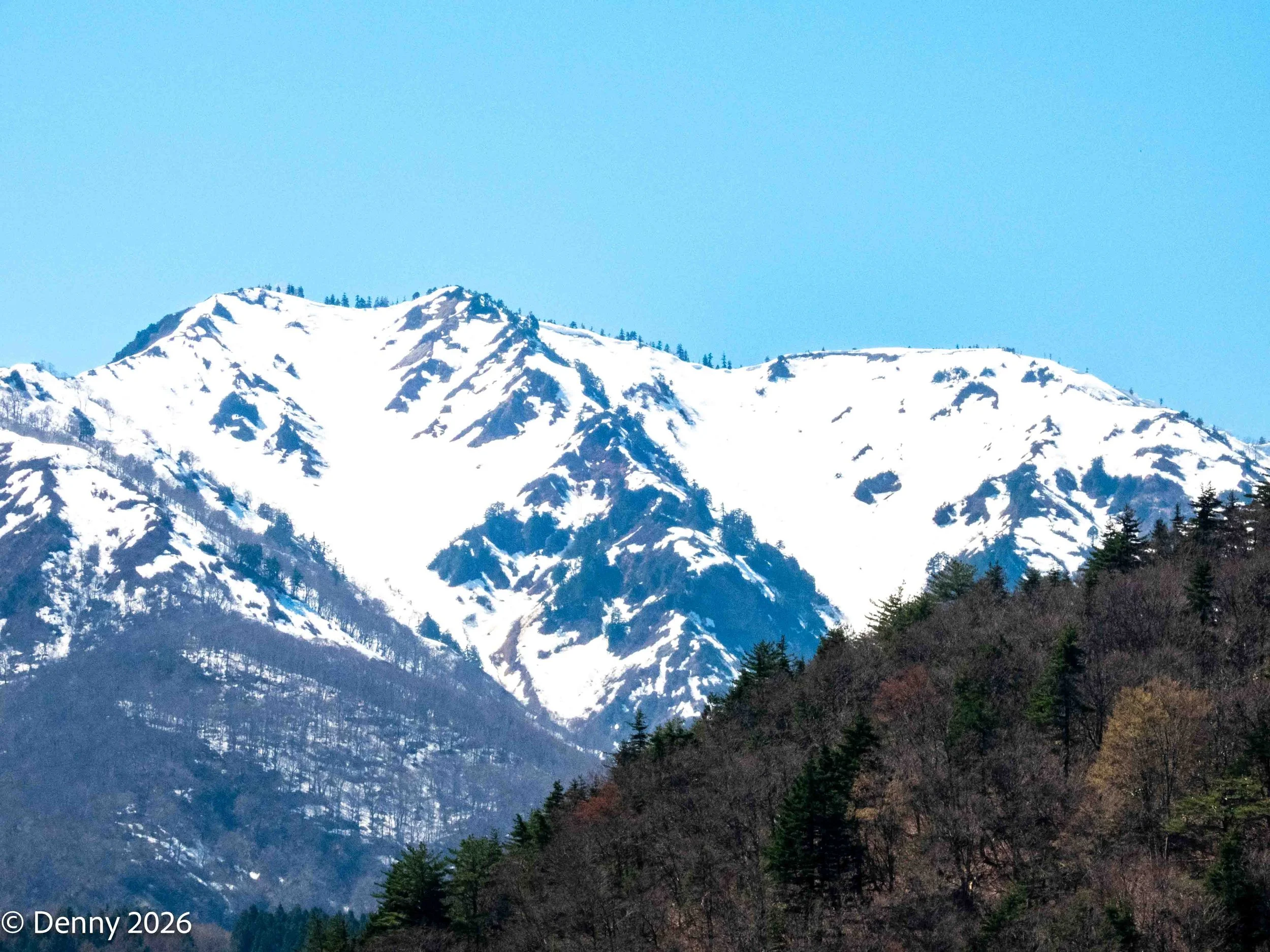
Mountain from Shirakawa-go Gassho-Zukuri Village

House, Shirakawa-go Gassho-Zukuri Village

View from the village, Shirakawa-go Gassho-Zukuri Village

Cherry blossom, Shirakawa-go Gassho-Zukuri Village

Building, Shirakawa-go Gassho-Zukuri Village

We bought coffees and had our lunch in a quiet playground area away from the general crowd. The backdrop to the village is a mountain range where the higher peaks are still snow covered. This is a popular ski-resort area during winter.

Lunch in the playground, Shirakawa-go Gassho-Zukuri Village

Cherry blossom, Shirakawa-go Gassho-Zukuri Village

While having lunch, a yellow breasted grey wagtail joined us briefly to drink in the stream near us. We managed to get a nice photo of this beautiful bird.

Grey Wagtail (Motacilla cinerea, Japanese/ Kisekirei)

Trout in stream, Shirakawa-go Gassho-Zukuri Village

This visit to Shirakawa-go was an absolute joy with the perfect weather giving the best possible conditions to gain a small clue to the way of life in this serene Japanese mountain village.  

We departed Shirakawa-go at 14:00 and were then driven to the small township of Gokayama which is also a UNESCO World Heritage listed site with thatched roof houses very much like Shirakawa-go.

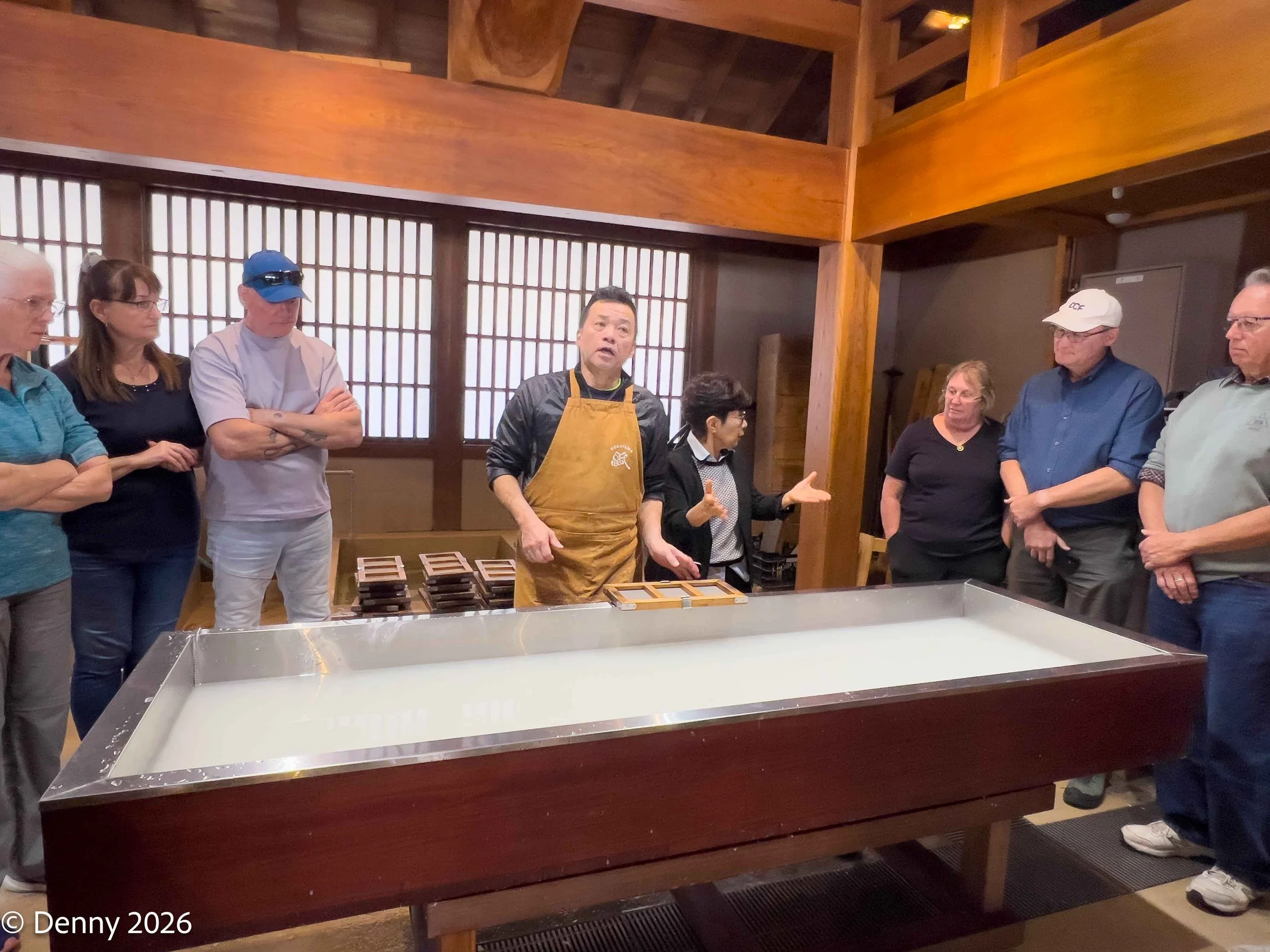
The main purpose of visiting Gokayama was to visit the Japanese Paper Village to learn something of traditional paper making in Japan.

We were given an introductory ten minute video summary of the paper making process. Japanese paper making or ‘washi’ is a centuries old craft using long natural fibres principally from kozo (mulberry) and gampi (genus Wilkstroemia) to create strong and highly durable paper. We were informed that this Japanese paper is used especially as a medium in the restoration of ancient documents and art work. Both the British and the Louvre Museums purchase paper from this factory.

Paper making demonstration, Gokayama

Corinne making paper, Gokayama

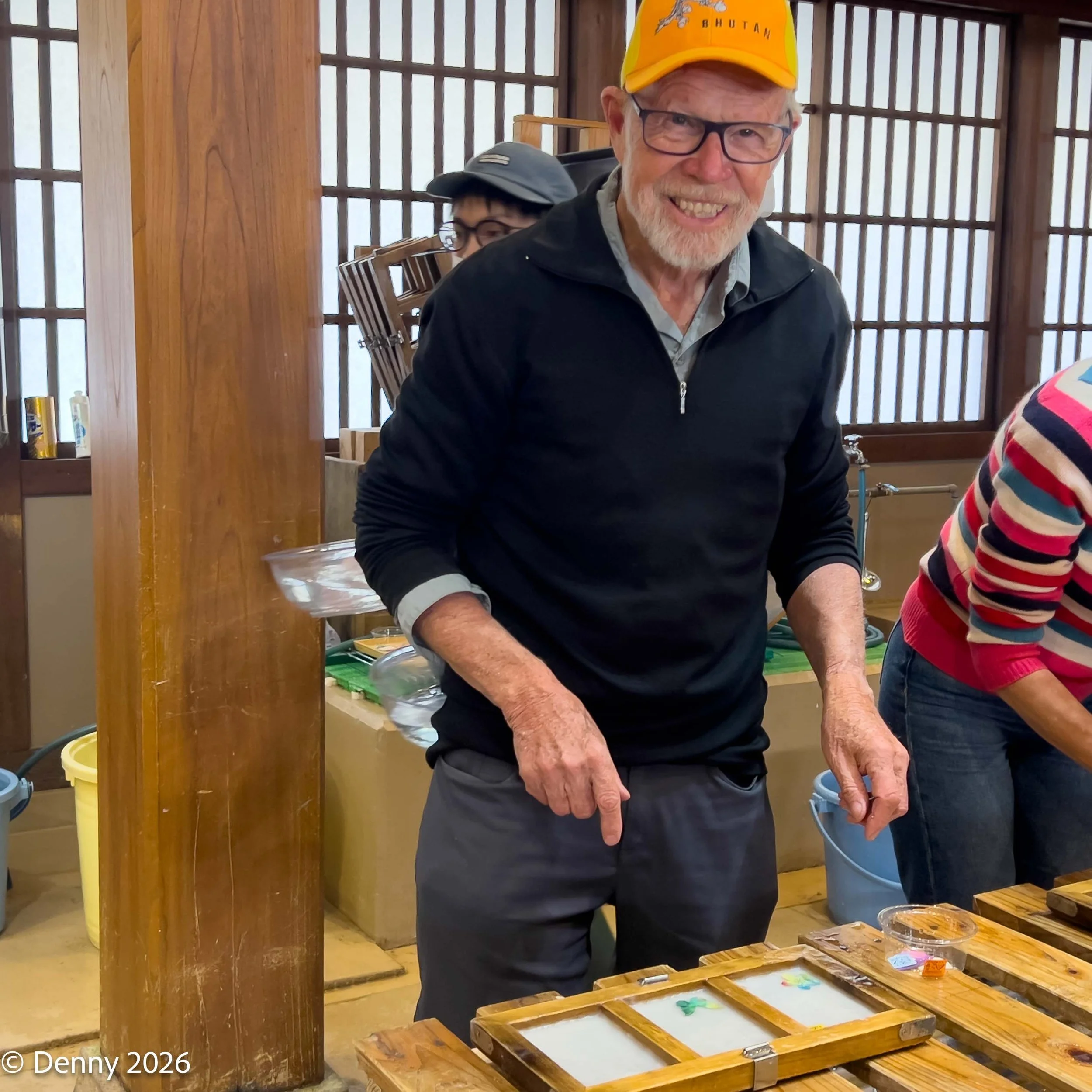
Jak making postcards, Gokayama

The paper making process involves steaming the kozo wood, boiling it and then stripping the bark before cleaning it. The clean bark is then mixed with water and ‘neri’ which is a kind of mucilage then macerated to finally produce the pulp. This pulp is then hand screened to form sheets that are pressed and then air dried.  

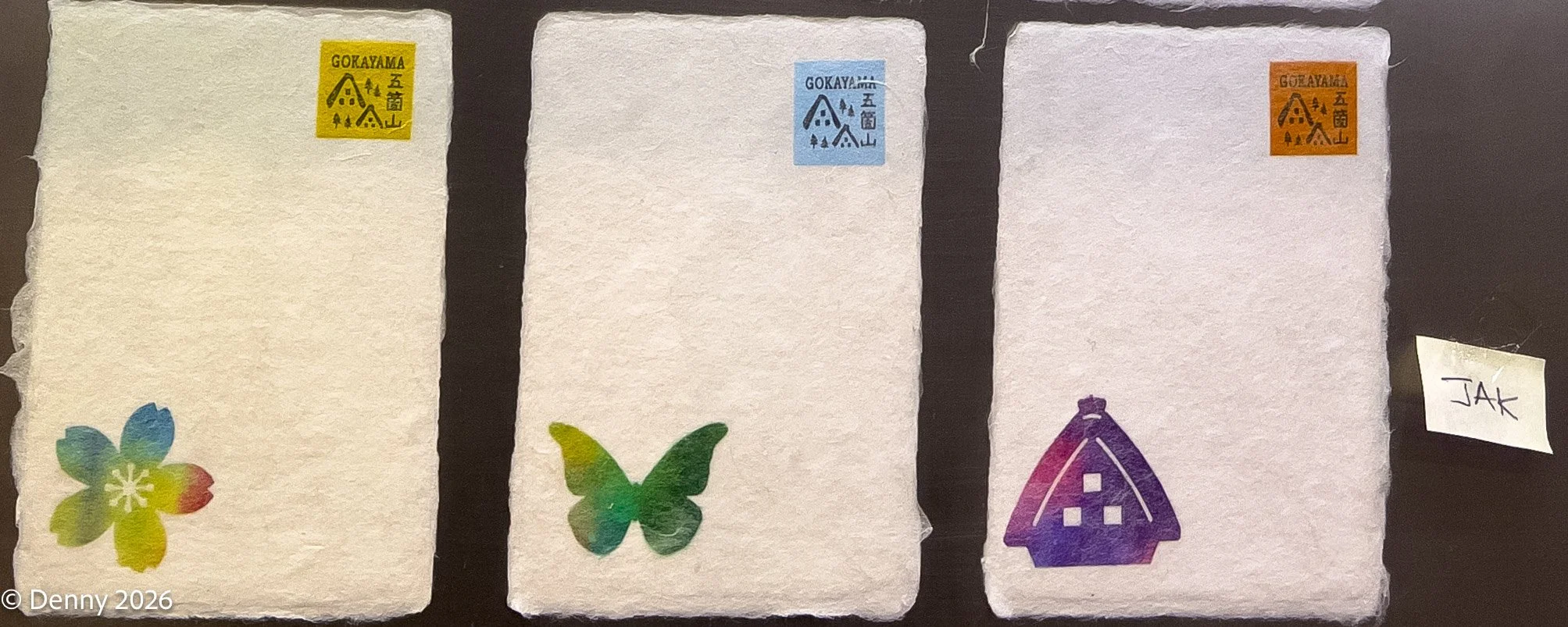
We all participated in the final process parts, individually doing the screening and ultimately making three small paper post-cards. The whole exercise was great fun and we were all very pleased with our resulting cards.

Jak’s postcards, Gokayama paper making

To end this most interesting interlude, we spent time in the paper factory’s shop and bought a wall hanging of irises representing Spring.

On our return to Takayama, the extended periods of darkness spent in tunnels meant that many of us had a ‘nanny nap’ on the way home.

Our evening meal in the Tokyu Stay Hotel was a most enjoyable buffet dinner which included four slices of hida-gyu which is premium Black Wagyu especially from the Gifu Prefecture. This beef has intense marbling caused through a cattle feeding regime covering a period of fourteen months.

Dinner with Black Wagyu beef at Tokyu Stay Hotel

It was delicious, super tender and thoroughly enjoyable.

This has been a fabulous day with lots to see, do and learn about and all this on top of the best weather imaginable.

Tomorrow we spend a good deal of time on trains as we move down to the more southern metropolis of Kyoto.

DAY 28: Thursday 9th April 2026 TAKAYAMA – KYOTO, JAPAN

A glorious morning greeted us as we prepared for a lengthy train trip to Kyoto, the former capital of Japan.

The first leg of our journey involved the Limited Express Hida #6 that departed Takayama precisely at 09:36 bound for Nagoya. This was to be a two and a half hour trip in the opposite direction to our train trip on Tuesday, but whereas Tuesday’s trip was in rainy conditions, todays was in sunshine.

Staff wishing us a great journey from the plaform at Takayama

The pink and white cherry blossoms adjacent to the railway line as well as high on the gorge hillsides were resplendent and very obvious, contrasting against the deep green of the cypress and cedar (sugi) conifers. Although we were too slow to get a photo, we passed one famous cherry tree quite close to the railway line that is purported to be over a thousand years old.

Cherry blossom in village beside railway from Takayoma to Nagoya

Cherry blossom on hillside from fast express train, from Takayama to Nagoya

Farmland viewed from fast express train, from Takayama to Nagoya

Cherry blossom on hillside from fast express train, from Takayama to Nagoya

Cherry blossom on hillside from fast express train, from Takayama to Nagoya

On arrival at Nagoya, we made a quick dash to the shinkansen line for our bullet train trip to Kyoto.

Our bullet train to Kyoto arriving at Nagoya

Station attendant for our bullet train tfrom Nagoya to Kyoto

This high speed train had us arriving at Kyoto just thirty five minutes later. Mitzie did a fantastic job getting all our group together and through the station crowds to our waiting bus which was parked quite close to the Kyoto Railway Station.

Our afternoon’s activities commenced with a visit to the Kizakura Sake Brewery where just outside the brewery entrance was the first yellow cherry blossom tree we’d seen.

Yellow cherry blossom outside Kizakura Sake Brewery, Kyoto

Yellow cherry blossom outside Kizakura Sake Brewery, Kyoto

The tour started with a brief video summarising the brewing of sake.

Apparently, the quality of sake is principally determined by the type of rice grain used and the characteristics of the water. The rice that’s regarded as the best for sake production is Yamada Nishiki rice. The brewery uses only the famous Fushimi (‘hidden’) spring water drawn from underground wells in southern Kyoto as it has the right balance of minerals and allows the fermentation process to occur at low temperatures.

Produce at Kizakura Sake Brewery

We sampled two different types of Kizakura sake. One was called Perle that was a bit nondescript and the second was called S Junmai Daiginjo and it had a much more interesting taste which may have been partly due to it having a 15% alcohol content versus Perle’s 8%.

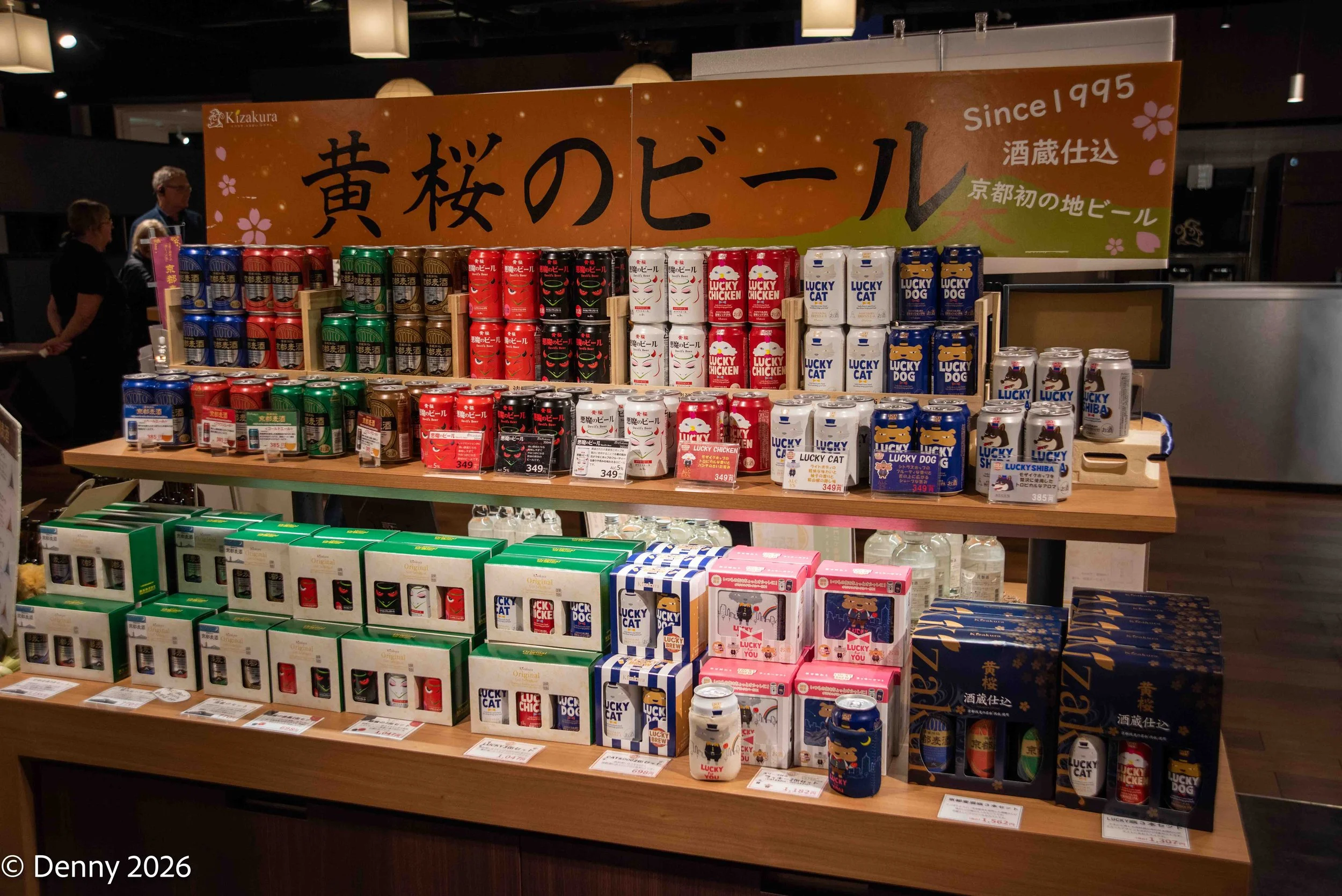
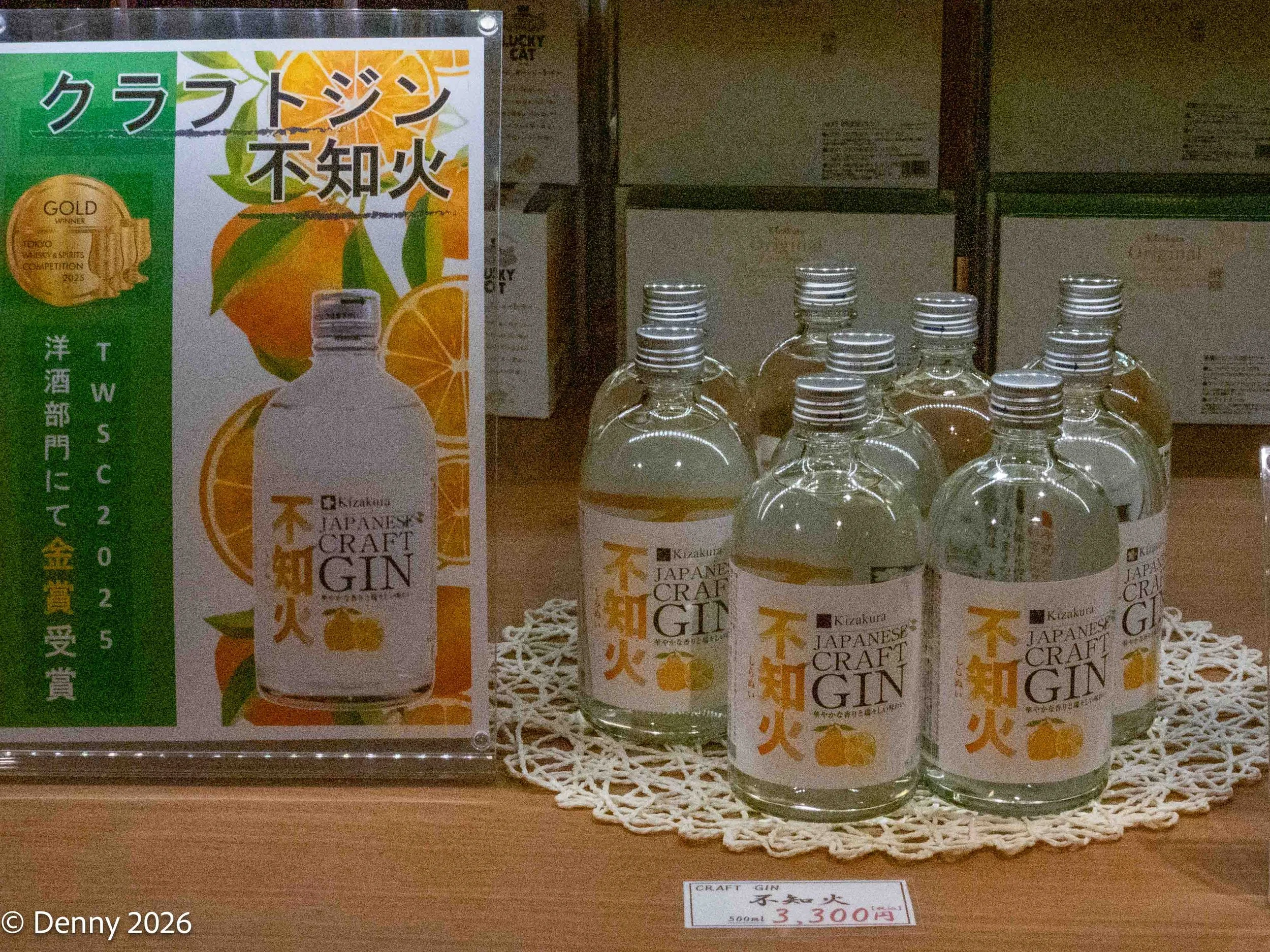
The Kizakura Brewery produces other beverages based on its expertise in processes involving fermentation. There were a number of craft beers on sale and most appeared to be prepared from rice or even non-grain bases such as fruits and vegetables. Some types of gin were on sale too.

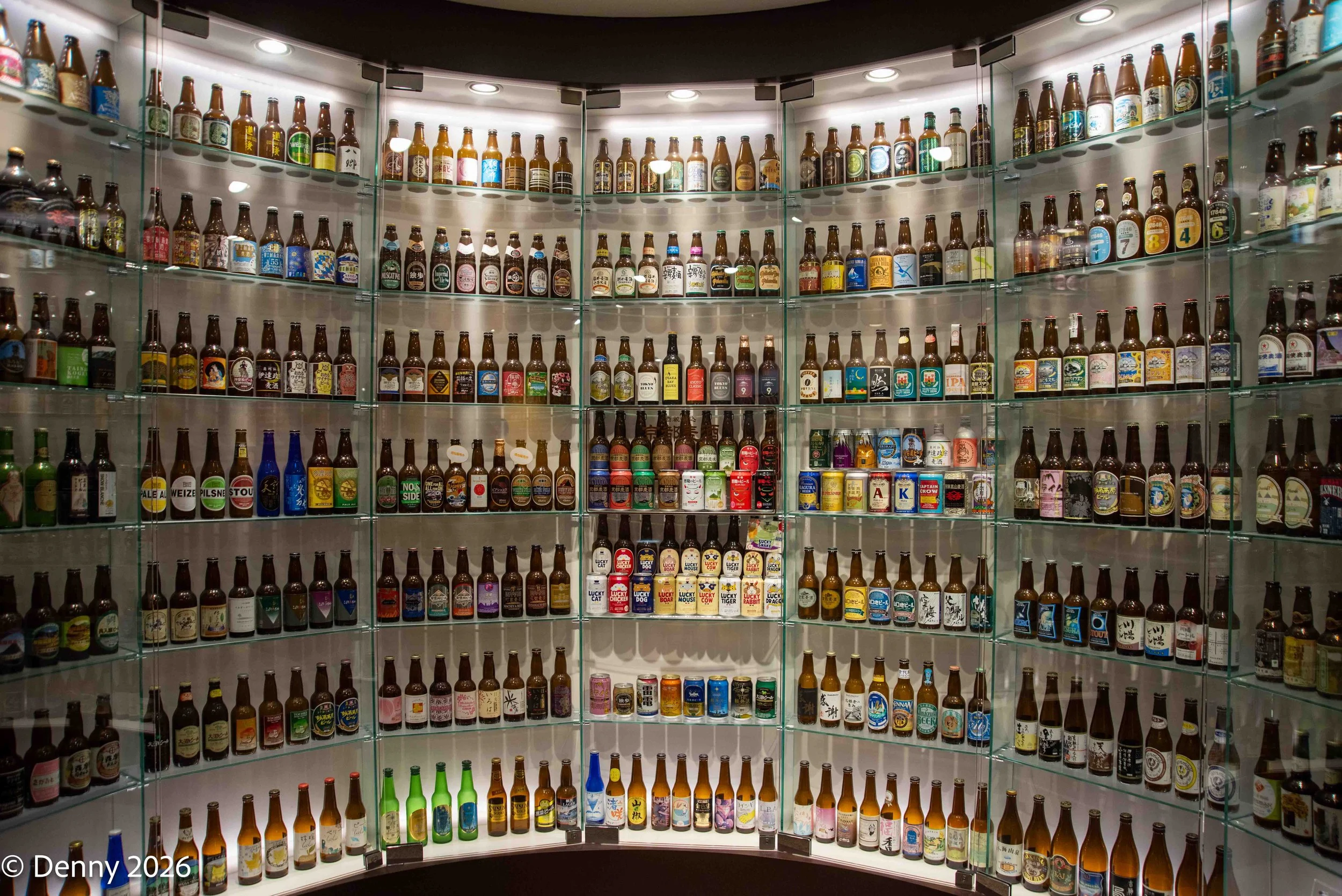
Selection of beers for sale in the shop, Kizakura Sake Brewery

Japanese Craft Gin for sale in the shop, Kizakura Sake Brewery

From the visitors’ observation area we could look down and see bottling and canning operations occurring on two highly efficient production lines.

Sake production from the visitors' obsevation area, Kizakura Sake Brewery

The brewery had a wide range of products on sale in its shop but we were not tempted to make any purchases.  

Premium grade sake, Kizakura Sake Brewery

Our final activity for the day was to visit the hillside Fushimi Inari Shinto Shrine which is a major tourist attraction in Kyoto gauging from the number of buses and hordes of people in the parking area.

This ancient Shrine is said to predate the founding of Kyoto and is dedicated to Inari, the Shinto god of rice and sake.

The shrine is sometimes referred to as the ‘thousand torii’ shrine. A torii is an entranceway or gate with two high pillars with ornamental crosspieces. The function of a torii is to mark the boundary between the everyday and the sacred.

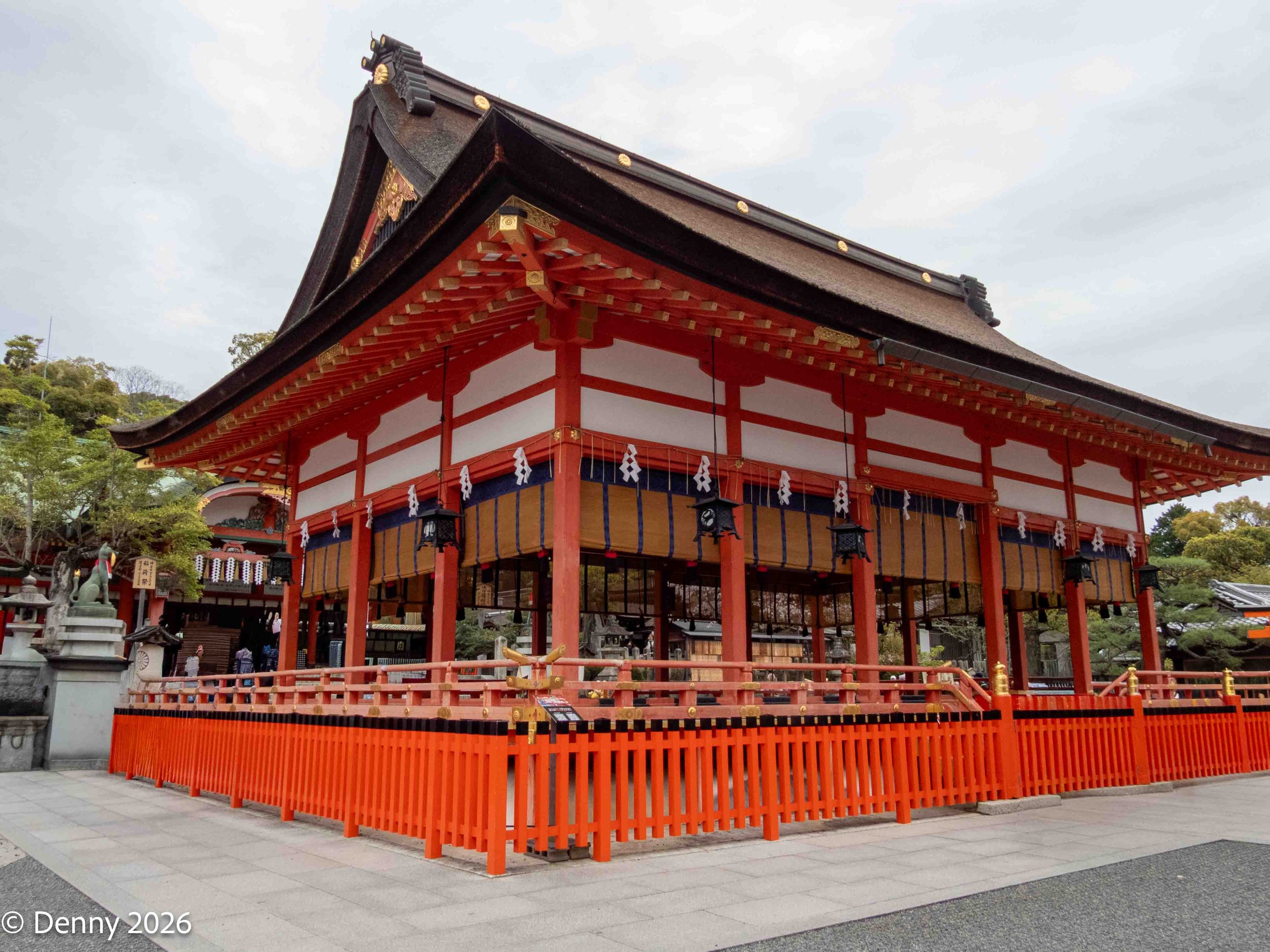
We first arrived at the main shrine where the Shinto monks were identifiable as they wear white robes. There is also an impressive pavilion covering a stage used for dance performances during yearly rituals.

Pavilion, Fushimi Inari Shinto Shrine

Shinto monks in white robes, Fushimi Inari Shinto Shrine

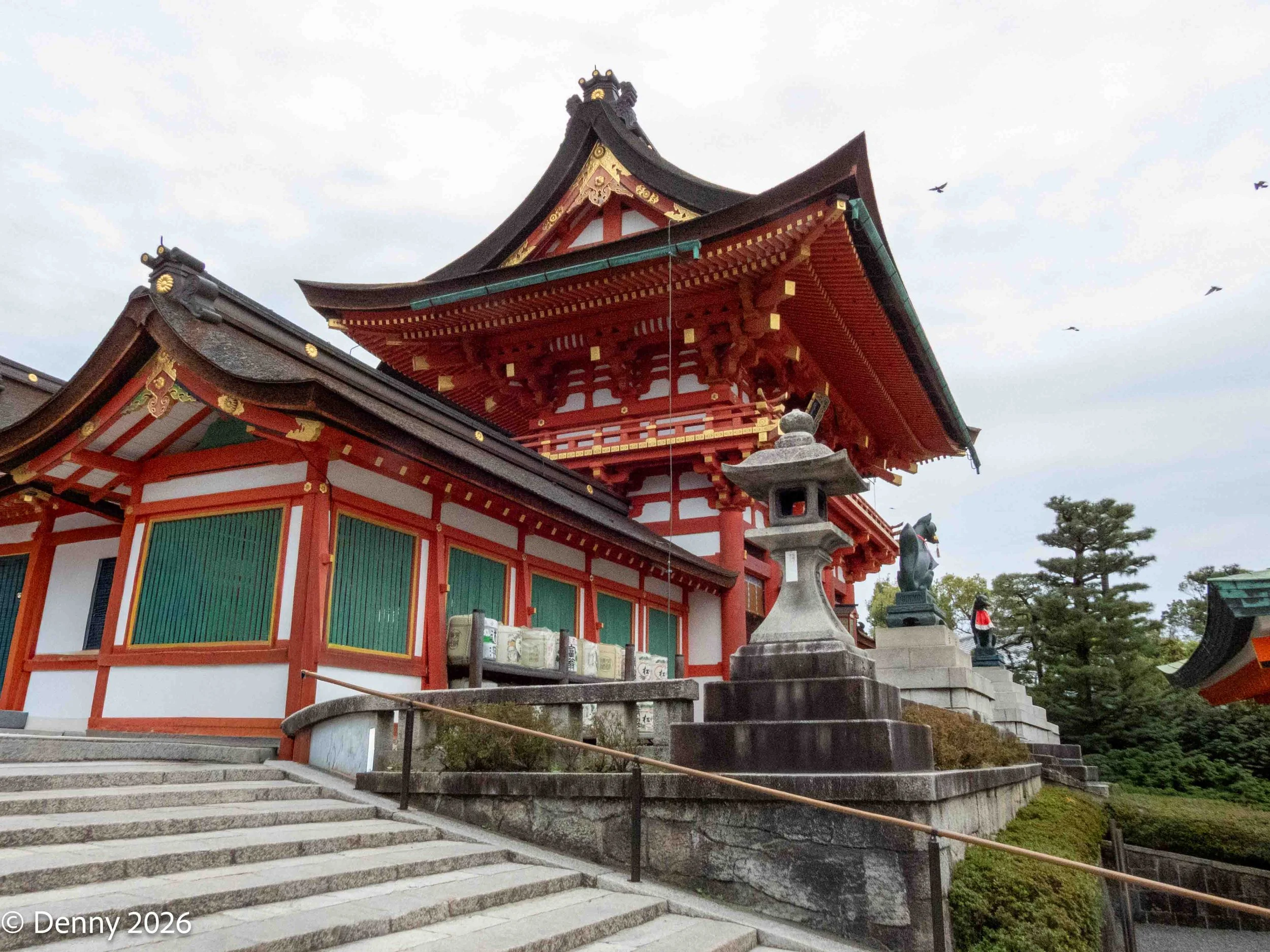
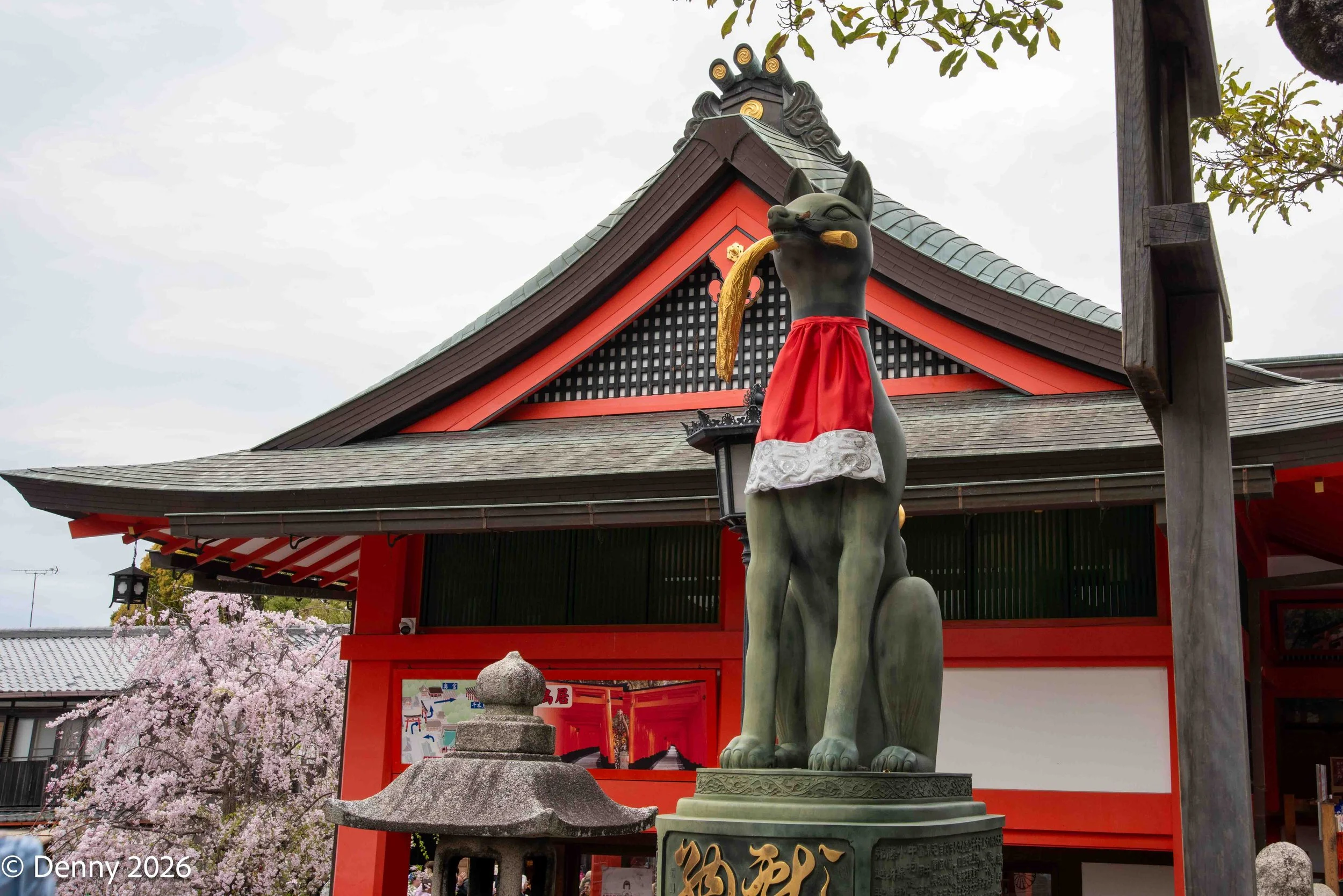
The interesting feature that immediately caught our attention was the number of  large statues of foxes around the shrine area.

Main shrine, Fushimi Inari Shinto Shrine

Foxes were believed to be one of Inari’s messengers and were revered because it was thought that foxes ate sparrows and sparrows were the primary thieving menaces when it came to rice production. In relation to this bird problem and yet to our amazement, we noticed one of the food stall vendors in the main tourist street was selling barbecued sparrows!

Fox, Fushimi Inari Shinto Shrine

Barbecued sparrows on path to Fushimi Inari Shinto Shrine

Along with hundreds of others, we then took a walk along the pathway formed by the thousands of vermilion painted torii. We didn’t do the full four kilometre walk due to time limitations and the crowd density.

Some of our group amongst the crowds approaching the torii, Fushimi Inari Shinto Shrine

Some of our group amongst the crowds within the torii walkway, Fushimi Inari Shinto Shrine

The torii are donated by individuals or companies as it’s thought that this will lead to desired outcomes and success in business pursuits. The names of donors and the dates of donation are shown on the back of each individual gate.

Larger torii can cost as much as a million yen to dedicate and the most impressive one is the giant Romon Gate near the main shrine, donated in 1589 by Toyotomi Hideyoshi a feudal warlord responsible for the unification of the country.

Descending through the torii walkway, Fushimi Inari Shinto Shrine

Kyoto Tower viewed from parkland, Fushimi Inari Shinto Shrine

On our return walk to the bus we stopped at a shop that specialised in Japanese knives most designed for use as kitchen chopping, slicing and filleting utensils.

Kitchen knife shop on path to Fushimi Inari Shinto Shrine

Top quality Japanese knives are internationally renowned for their long term sharpness as well as their elegance. In this same shop were a number of samurai swords for sale. With their artistic engraving on the blades, these too were works of art and the prices were correspondingly impressive.

Samurai swords on path to Fushimi Inari Shinto Shrine

The crowd density made it hard for buses to move in the parking bay but eventually our bus collected us and then dropped us off at our Miyako Hotel where we’ll stay for the next three nights.

Our luggage from three days ago had arrived and we then made arrangements for our evening meal.

View from our room at Miyakohotel-Hachijo, Kyoto

Tomorrow we will participate in some calligraphy lessons and later partake in a traditional Japanese tea ceremony. We’ll also do a tree lined canal walk which has the intriguing name of the ‘philosophers’ walk’. 

DAY 29: Friday 10th April 2026 KYOTO, JAPAN

As predicted, today was to be a rainy day across most of Japan and Kyoto was no exception. Fortunately, we were to spend most of the morning indoors.

After breakfast, our group was driven to a local arts centre where we were introduced to the ancient Japanese ritual of the ‘tea ceremony’ which has its origins with 12th century Kyoto’s Zen Buddhists.

The tea ceremony or ‘chado’ is a well orchestrated series of events involving greetings, washings, multi-step preparation of the tea and then tea drinking.

Demonstration of Japanese tea ceremony at local arts centre, Kyoto

The tea is made from powdered matcha which is finely ground green tea shoots.

Because it has an astringent taste the tea is usually served after eating a sweet snack. We had red-bean curd wrapped in sticky rice which was excessively sweet.

The water is heated in a steel kettle or ‘kama’ to boiling and then allowed to cool to 80C. It is then poured on top of the brightly coloured green powdered matcha in an earthenware bowl called a ‘chawan’. The mixture is then stirred vigorously with a small bamboo whisk called a ‘chasen’ until a froth forms on the surface.

Whisk, Japanese tea ceremony at local arts centre, Kyoto

Red-bean curd wrapped in sticky rice (sweet snack eaten prior to drinking tea), Japanese tea ceremony

Matcha tea, Japanese tea ceremony

Even the drinking step involves strict rules. After greeting your guests and bowing, the chawan is held with the right hand and placed in the palm of the left hand before rotating it ninety degrees clockwise.

We each made our own matcha drink by carefully following our tutors’ instructions.

The ritual suggests the tea should be consumed in three gulps but most of us decided that one sip was sufficient to check the taste, but no more. 

Our group at Japanese tea ceremony at local arts centre

The women demonstrating this ceremony did a great job explaining the complex etiquette and Zen ideals and Mitzie translated the tutors’ information very well which made the event most interesting. The deep meaning behind the ceremony has been summarised through Buddhist philosophy as “one lifetime, one meeting”. 

We stayed in the same art centre building but then moved to the room next door for our brief lesson in calligraphy or shodo.

Shodo involves an ink-dipped brush being used artistically to create Chinese kanji and Japanese kana characters, skills that have their origins as far back as 220 AD in China and 6th century AD in Japan. In those days shodo was an essential part of the education of the elite and ruling class families.

Nowadays, most Japanese use ballpoint pens and pencils but the shodo art is still practised by many and is admired especially when used to write birthday and New Year’s greeting cards.

Mitzie and our instructor at Japanese black ink calligraphy session

We commenced by using tracing paper to write the character ‘ei naga’ or long time. The brush stroke action and brush pressure on the paper are the keys to creating desired characters. Even one’s posture affects the outcome.

We then attempted this again without a template and then had a third try. Some efforts were better than others but we were all given lots of encouragement by our teachers. My second ei naga was described by a very kind and generous lady as ‘very good’ and yet Corinne’s was classified as ‘excellent’.

Jak at Japanese black ink calligraphy class

We also wrote our names in kanji and kana.

Our attempts at writing our names below our work at Japanese black ink calligraphy class

The session was enjoyed by all and there was much merriment when we compared our ‘entry level’ calligraphy work.

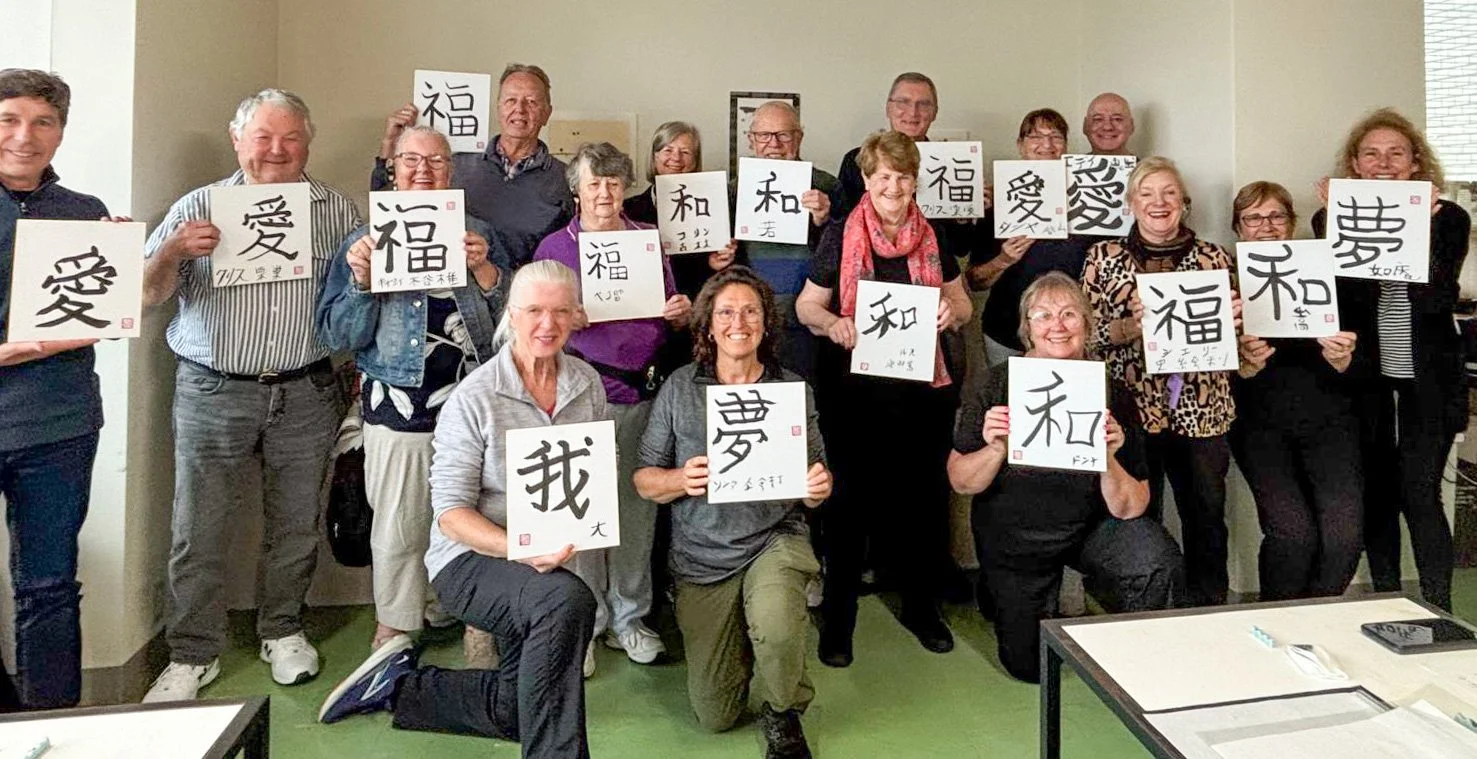
Our group showing our work at Japanese black ink calligraphy class

Before leaving the art centre we spent time in the centre’s souvenir shop where there were many beautiful Japanese paintings of all sizes for sale. In addition, there was a selection of jewellery, especially pearls and hand painted dishes with gold foil. An impressive range of kimonos were on display too as well as a number of beautifully dressed Japanese dolls. 

Japanese doll, souvenir shop, local arts centre, Kyoto

It was still raining slightly when we left the art centre and were driven to the ‘Philosopher’s Walk’ in northern Kyoto.

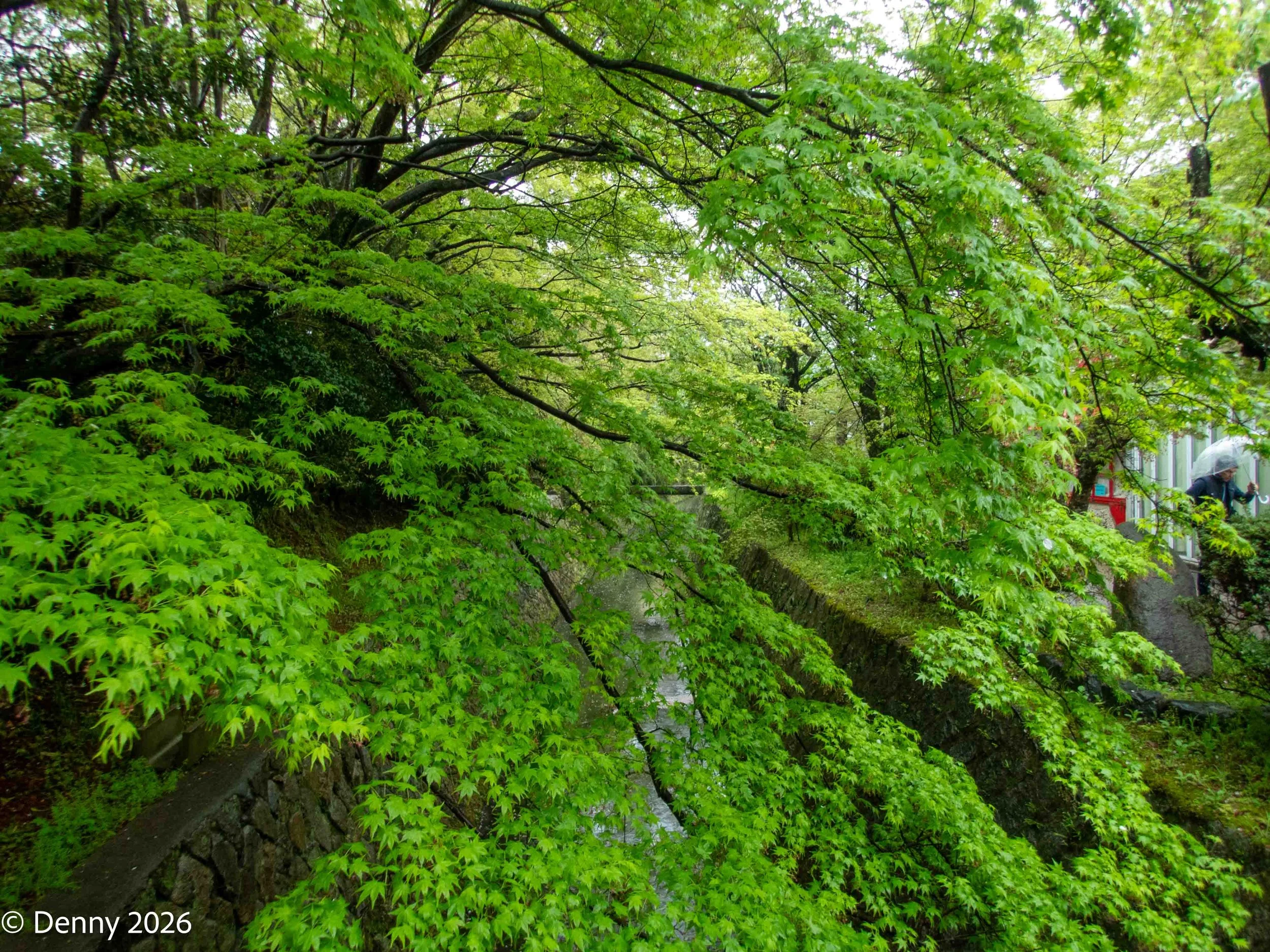
With umbrellas in hand we walked on a stone path along the side of a narrow canal lined with cherry, maple and ginkgo trees. The cherry trees were past their best with the blossoms now being replaced by new leaves that glistened in the drizzly rain.

Our group walking along ‘Philosopher’s Walk’ in the rain

The walk is named after a Kyoto University philosopher who walked it daily deep in thought and these days it has become a place to seek peace and tranquility in amongst the avenue of beautiful trees.

Cherry blossom along ‘Philosopher’s Walk’

Tulips in garden, ‘Philosopher’s Walk’

Lily of the valley bush, commonly known in Japan as Asebi (Pieris japonica), ‘Philosopher’s Walk’

Small-leafed maple trees, often dwarf Acer palmatum cultivars, ‘Philosopher’s Walk’

We ventured into a little coffee shop on the edge of the canal and had a hot drink that was much appreciated, it being great coffee as well as an ideal hand warmer.

Coffee time watching the rain from inside a warm, dry cafe, ‘Philosopher’s Walk’

We returned to our bus and headed back to our Miyako Hotel. It was now approaching 13:00 and we have the afternoon as free time.

We took the opportunity of having no commitments to spend time catching up on our blog and labelling photos. Jacquie phoned and it was lovely to hear news of the Purden family’s recent holiday trip to Brisbane. It sounds as if the Sydney University physiotherapists’ reunion was a rip-roaring success.

We showed our daughter Jacquie the scene from our hotel window and she was interested to see the number of shinkansen trains passing through Kyoto Station which is directly opposite. A ‘bullet’ train is sighted about every four minutes!

After sunset with the rain now gone, we went to the Aeon Mall next door to our hotel. This is a five-storey collection of every imaginable shop apart from one selling the power-point adapter we needed to replace the plug we lost recently. We trapsed around for an hour or more and then crossed the road to look for a restaurant for tonight’s evening meal.

Nothing much appealed at first and then, eventually we found something to our liking. Unfortunately, there was a considerable queue outside waiting for a table so we abandoned the restaurant idea and took take-away meals and a (AU$5.50) bottle of Chilean Quinta Las Cabras chardonnay back to our hotel room. As there is no excise on alcoholic drinks in Japan, beer, wines and spirits are remarkably cheap. Incidentally, Japanese drivers are very upset as there have been recent price rises for fuel. Unleaded petrol is presently selling for about AU$1.55 a litre, up from $1.40.

We had a relaxing evening in preparation for a forecasted sunny day tomorrow when we visit Kyoto’s Golden Pavilion and later see how tofu is prepared.

DAY 30: Saturday 11th April 2026 KYOTO, JAPAN

In the past week we seem to have alternated between rainy days and then sunny days. This day was to be very pleasant with a maximum temperature of 24C reached in the mid-afternoon.

We had the full day in Kyoto starting with a visit to the Kinkaku-ji Temple which is in the north-western quarter of Kyoto.

The Kinkaku-ji Temple is also commonly referred to as the ‘Golden Temple’. It was first built by the third Ashikaga shogun (Yoshimitsu) in the 14th century.

The shogun relinquished his official titles, but not his hold on power and entered the priesthood at the age of 37.

The temple initially served as his retirement villa and being a fervent follower of Zen, he directed that the villa become a temple after his death.

The approach to the temple is a one-way path starting along a magnificent tree lined avenue of Japanese maples. We then turned a corner and emerged into a vast garden area surrounding a small lake with tiny islands having decorative miniature conifers.

Japanese maples on approach to the Kinkaku-ji (Golden Pavilion)

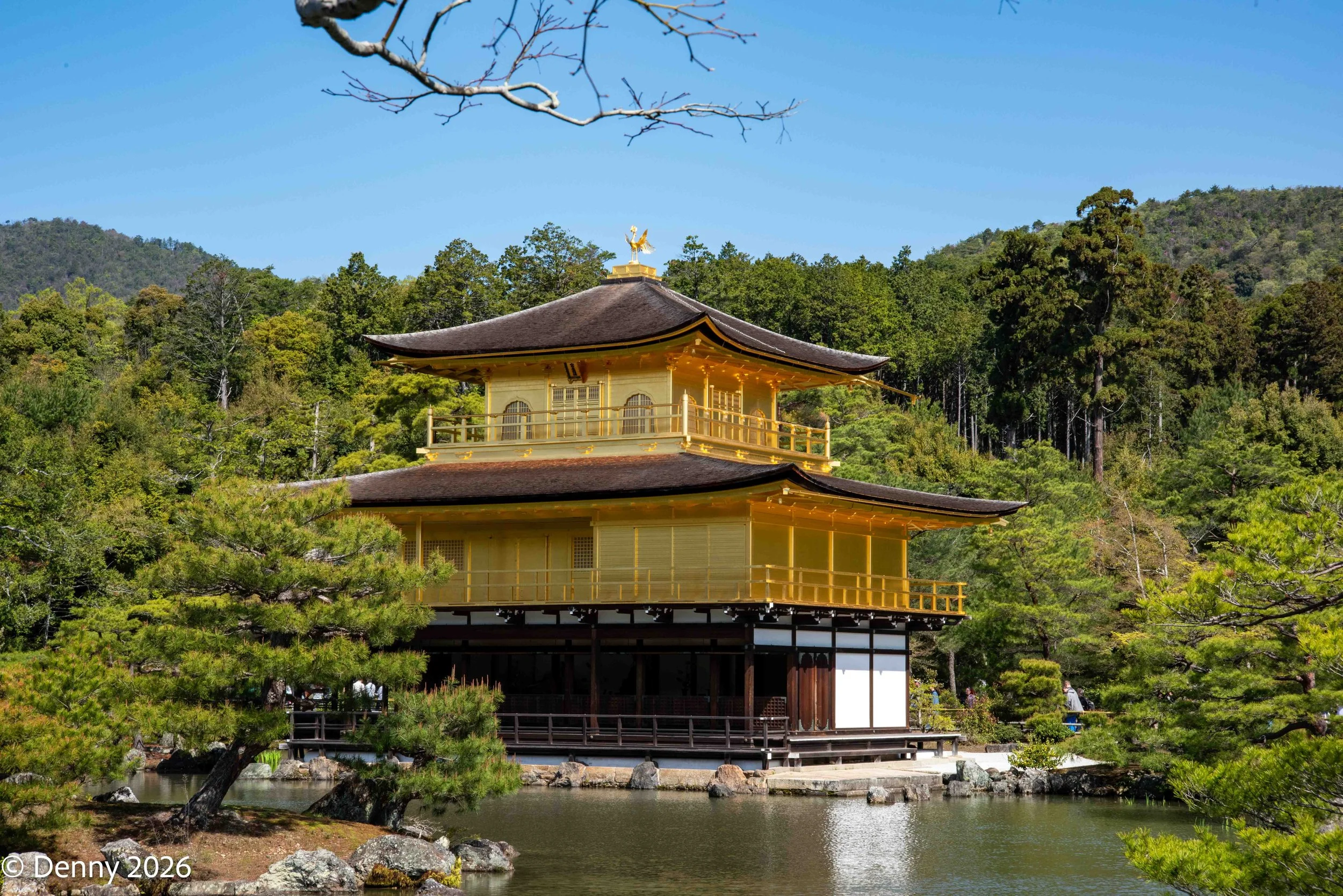
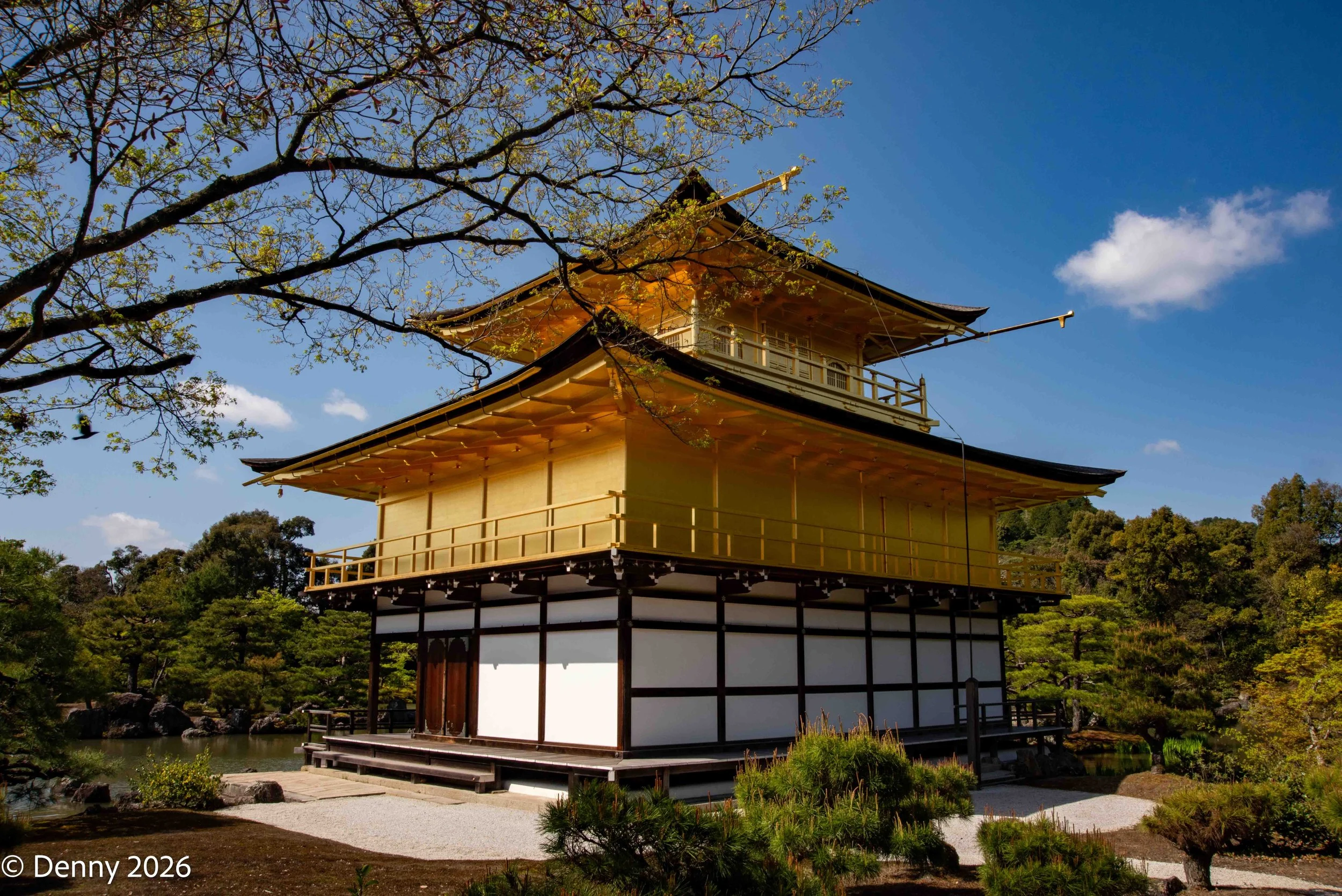
Across this lake we could now see the Golden Temple shining resplendently in the early morning sunshine.

Kinkaky-ji (Golden Pavilion)

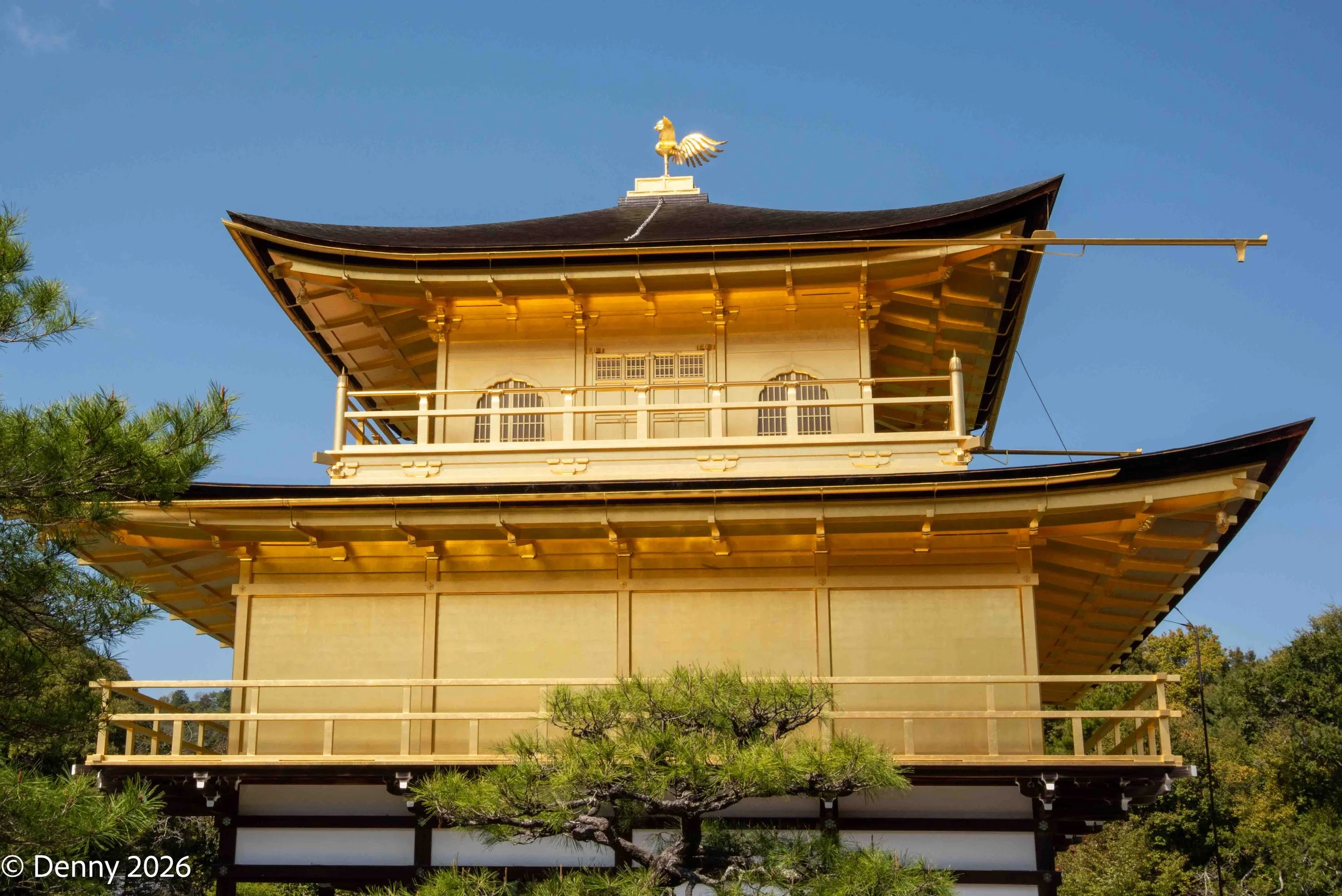
The top two stories of the temple are covered in pure gold leaf with the total weight of gold being about 20 kg. The gold is applied over a lacquered wooden surface and at the top of the temple is a bronze phoenix covered with gold-leaf.

Kinkaky-ji (Golden Pavilion)

Phoenix on top of Kinkaky-ji (Golden Pavilion)

Bell on corner of Kinkaky-ji (Golden Pavilion)

We were informed that the Buddhist priests polish the golden surfaces as part of their pre-dawn labours.

While the temple has historical roots from 1397, the current structure was rebuilt in 1955 after being burnt down by a monk in 1950.

The Zen temple looked glorious with the morning sunshine and it’s not surprising that it is now listed as a UNESCO World Heritage site.

Kinkaky-ji (Golden Pavilion)

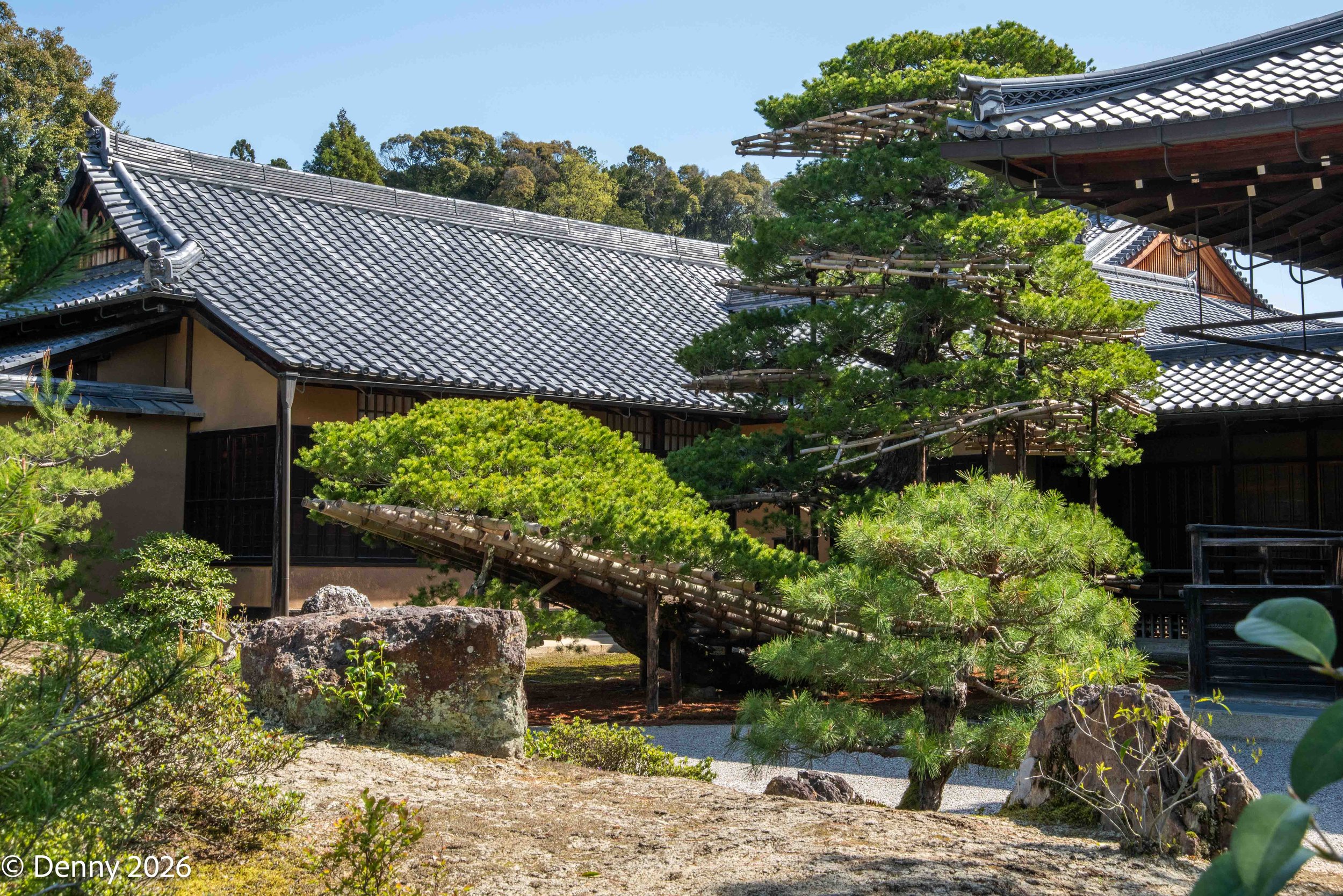
Visitors to the Kinkaku-ji Temple follow a one kilometre pathway though beautiful gardens, waterways and avenues of ancient trees. One conifer in the garden is famous as it has been shaped as a bonsai tree to represent a boat. The shogun was to use this as his transport to heaven.
Bonsai pine tree representing a boat, Kinkaky-ji (Golden Pavilion) complex

Mallard duck (Anas platyrhynchos) in pond, Kinkaky-ji (Golden Pavilion)

Gray Heron (Ardea cinerea), Kinkaky-ji (Golden Pavilion) complex

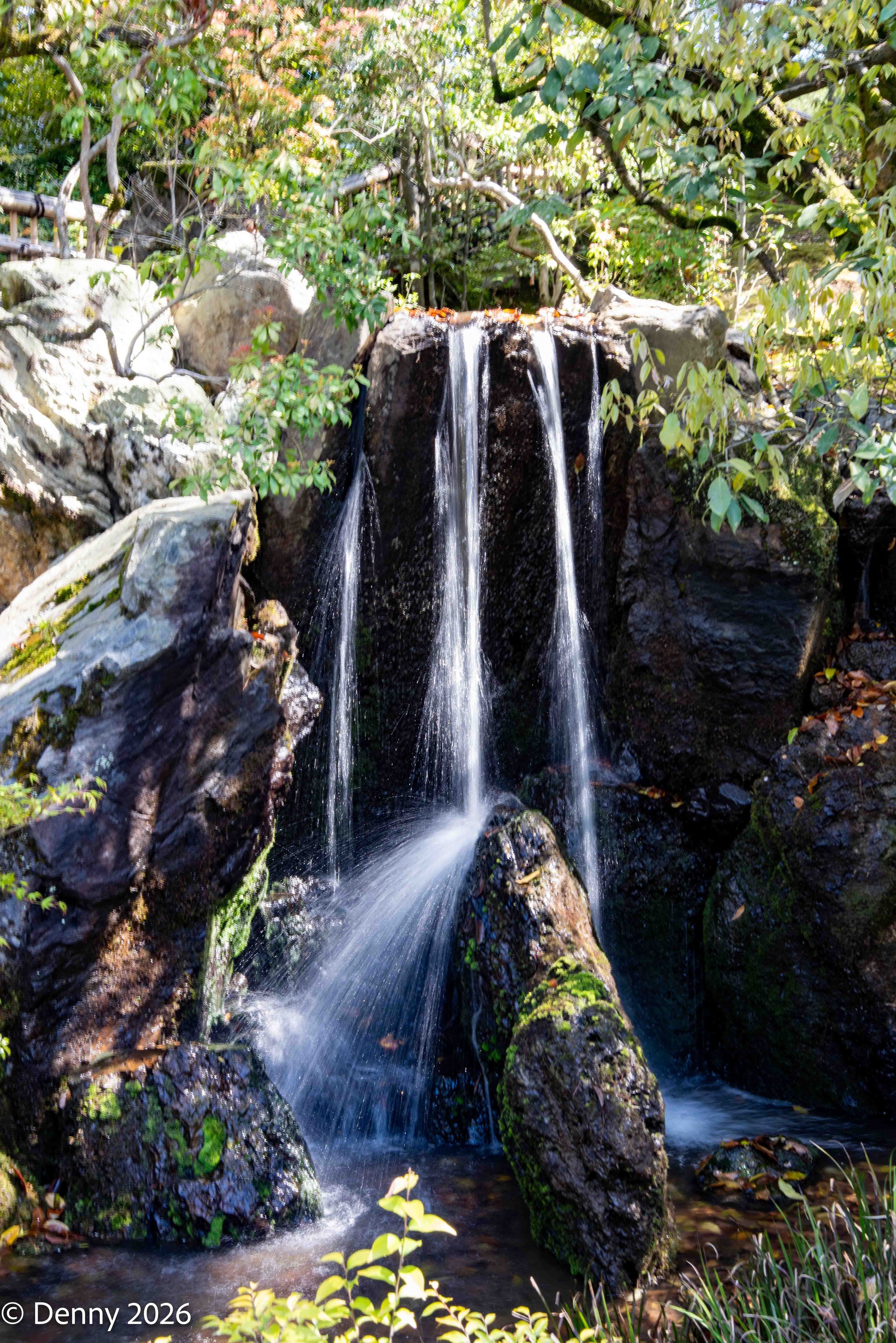
Waterfall, Kinkaky-ji (Golden Pavilion) complex

Garden, Kinkaky-ji (Golden Pavilion) complex

Garden, Kinkaky-ji (Golden Pavilion) complex

Following this inspiring temple experience, we then changed to a very different mindset visiting a tourist centre that offers an insight to the production of tofu.

Condiments ready to make our shichimi (Japanese seven-spie blend)

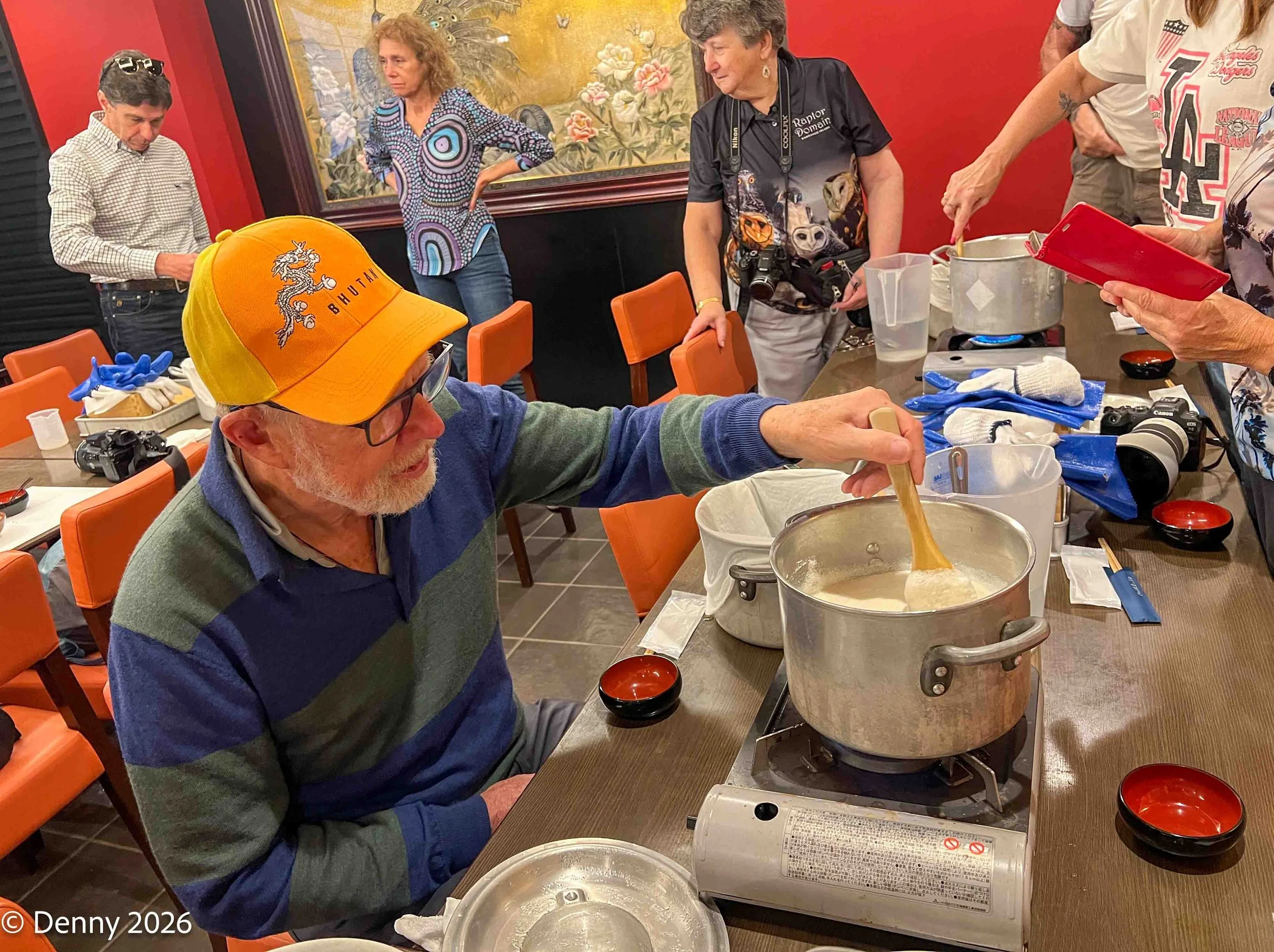
We were put into small groups and started by boiling a soy milk mixture which was made by blending beans that had soaked overnight.

Jak preparing tofu, local restaurant

The boiling hot mixture was then strained through muslin and the solid curds discarded. To the whey we added a small amount of liquid bittern which is a coagulant and then heated the mixture to just 75C.

After a few minutes we had a semi-solid material that was hand compressed leading to a rectangular block of tofu about the size of a standard envelope.

Our host assisting us with preparing tofu

With our tofu product in hand, we then moved to the dining area where we had a mini-barbecued lunch with lots of Japanese food specialties as well as our tofu.

Table set up for our lunch, local restaurant

The tofu tasted nice and was especially enjoyable as we’d all worked through the comparatively complex preparation process. Mitzie, with obvious experience in eating tofu, made very positive comments about the general quality of our morning’s work!

Lunch, including the tofu we had made

The building where the tofu was made has a souvenir shop and a museum gallery upstairs exhibiting an amazing range of art work done using hand embroidery. Some of the larger works were apparently ones that took their artists years to complete.

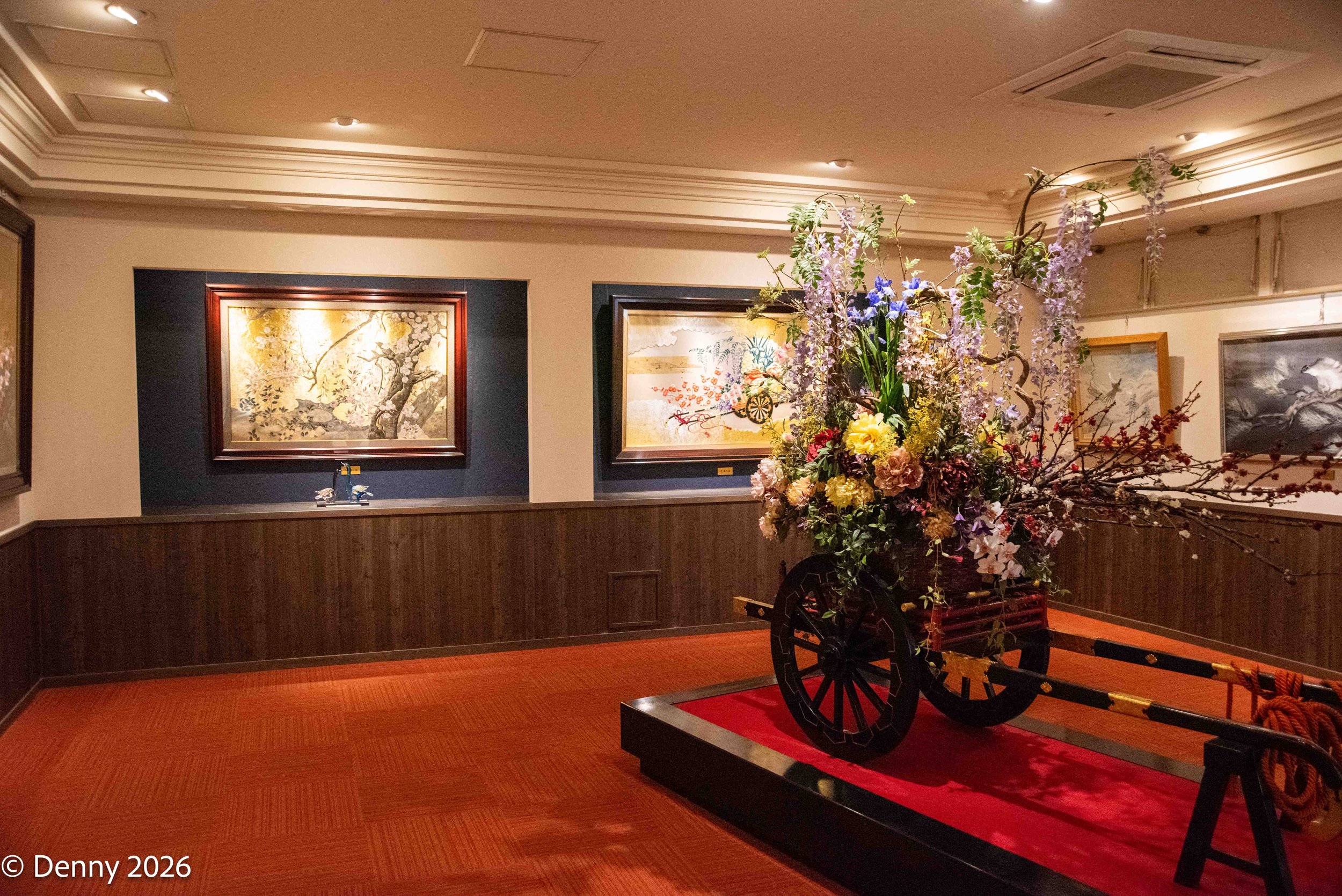
Embroidery display room

Embroidery of wine goblets in a basket

Close up of stitches, embroidery of wine goblets in a basket

We returned to our hotel at 14:00 and rested before crossing to the other side of the Kyoto Station to go to the top of the Kyoto Tower.

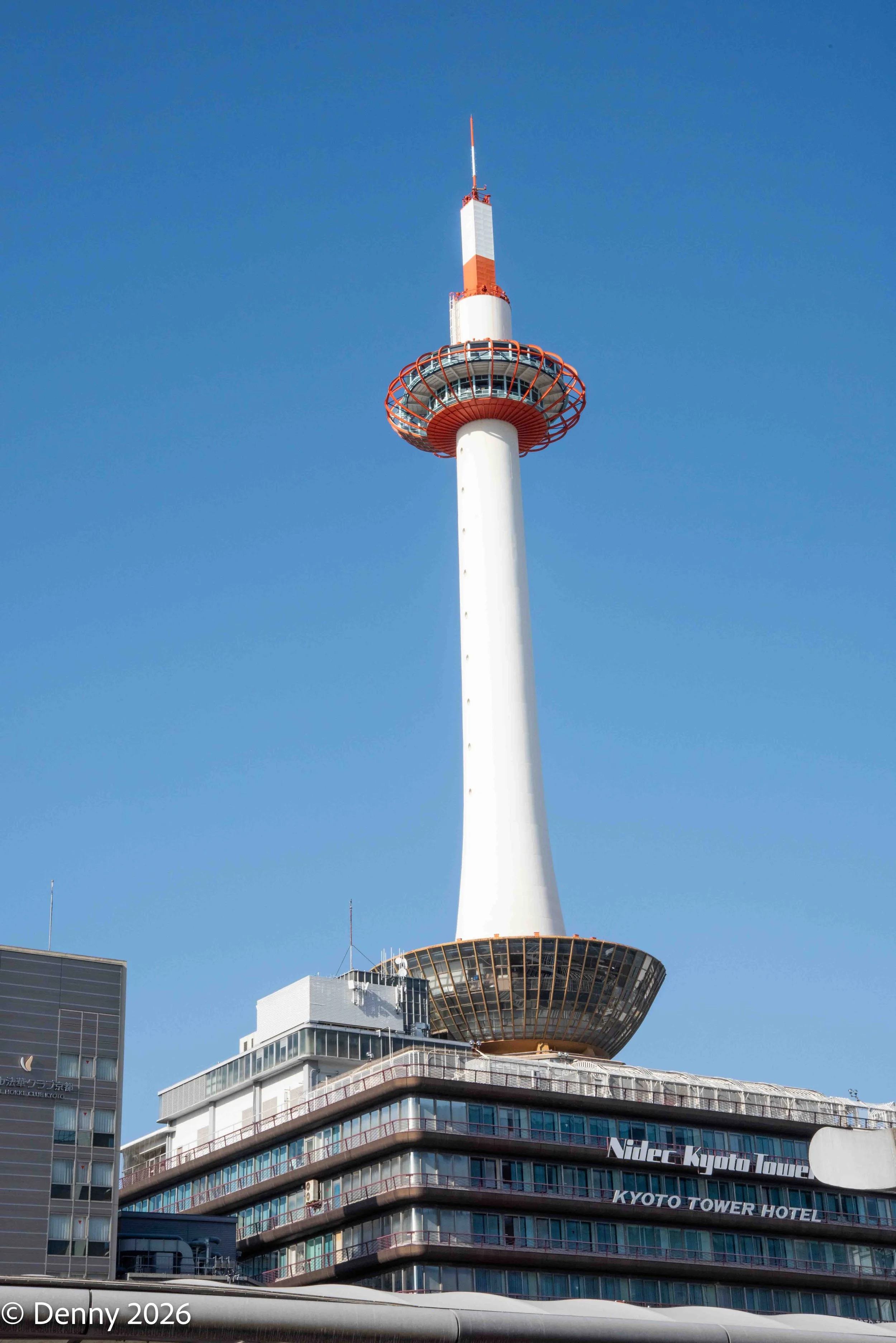
Kyoto Tower

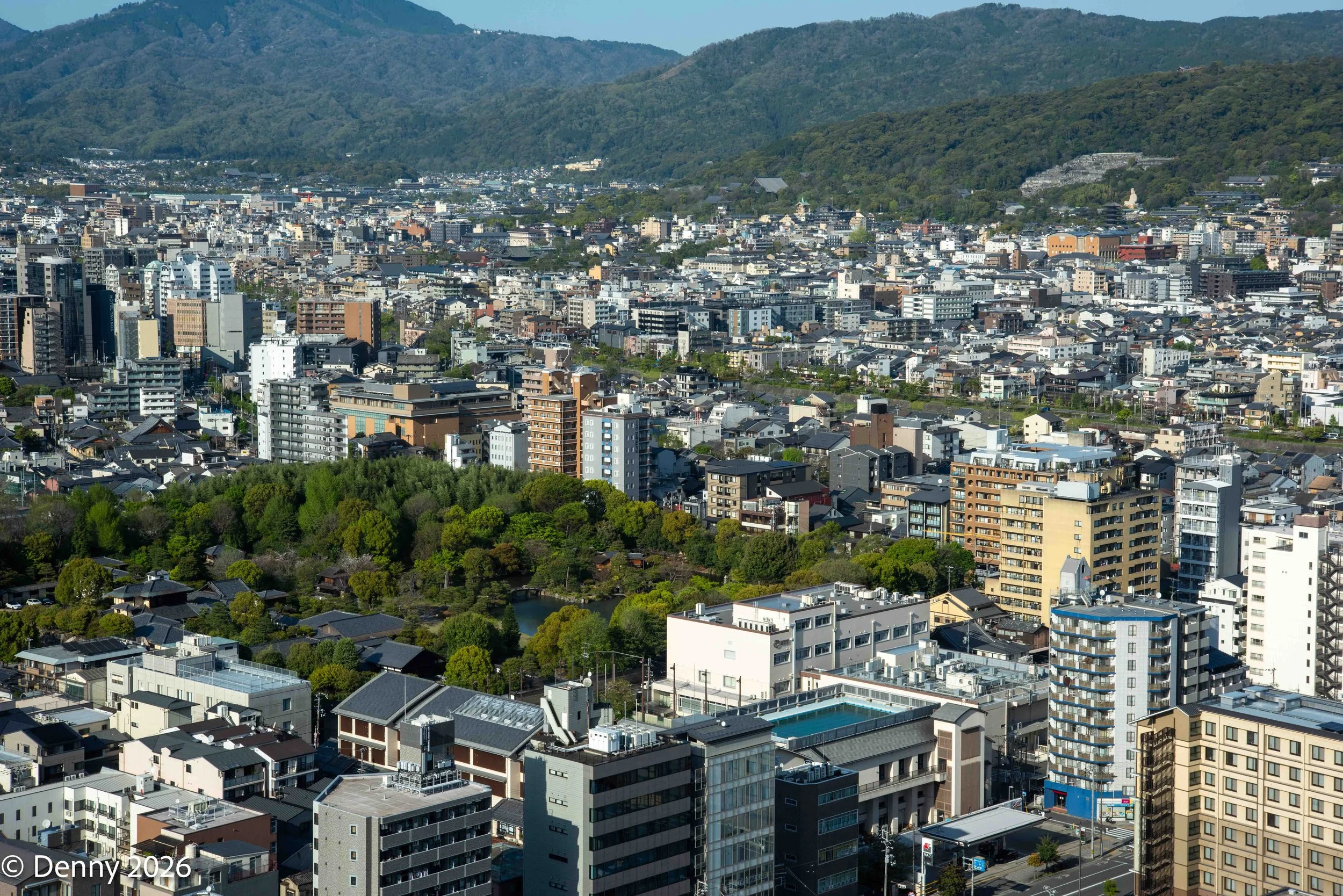
The 360 degree view from 100 m above the streets below was panoramic and looking south-westwards through the haze, we may have been able to just see Osaka. We were a little concerned to notice the amount of corrosion on the steel beams that supported the upper lookout dome of the tower.

View of our hotel, Miyakoo Hotel Kyoto Hachijo (building with green roof - our room is 2nd from the top on right hand end)

View from Kyoto Tower

View towards Osaka from Kyoto Tower,

Top of Kyoto Tower, viewed from the ground

On our way home we had a coffee and then went to the Avanti Shopping Complex and bought a few items including the electrical plug adapter we’ve needed as a spare.

After having such a big meal at our lunchtime tofu session, we decided that we didn’t need much for our evening repast. We had a wine, savoury biscuits and cheese dinner and then set about preparing our luggage issues for the next three days.

Tomorrow we will transfer to Hiroshima but our big bags will be transferred to Osaka and so we need an overnight bag to cover us for the two evenings before we end up in Osaka.

Our Japanese Discovery tour is sadly now approaching the final stages and today like every other day has been a truly memorable experience. We are deeply indebted to Mitzie who has been amazing in her organisational skills, her knowledge of Japanese history and her unbounded enthusiasm for showing us her enthralling country.

DAY 31: Sunday 12th April 2026 KYOTO – HIROSHIMA, JAPAN

Having made arrangements for our large bags to be forwarded to Osaka to be retrieved on Tuesday evening, we were driven westwards for about forty minutes to the suburb of Sagano where we commenced our two hour stroll through gardens, past temples and finally through a bamboo forest.

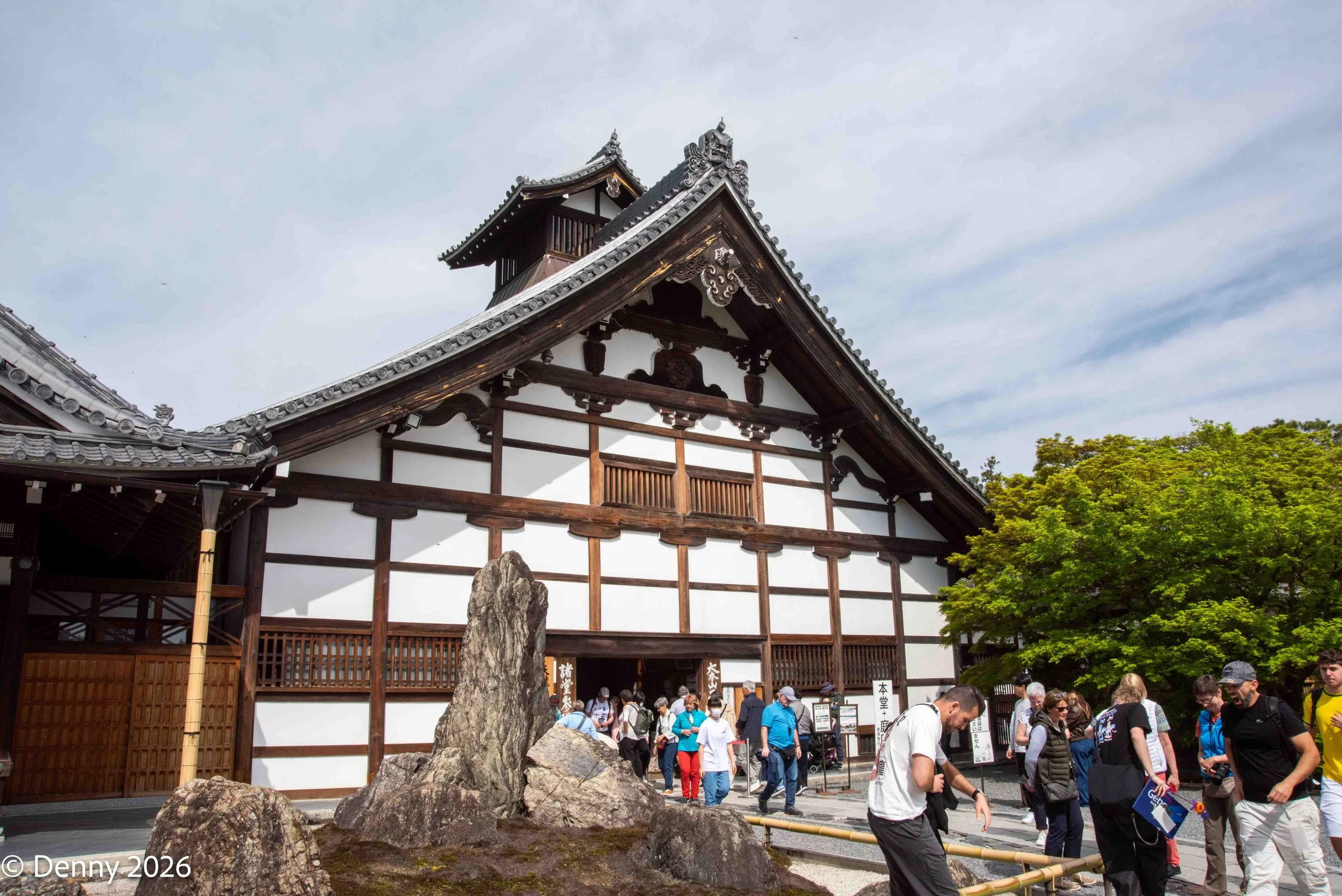
We parked quite close to the Tenryu Temple which is the head temple for the Rinzai sect of Zen Buddhism.

Tenryu Temple

The temple is next to a bamboo forest and it’s not surprising to know that since its origin in 1339 it has been ravaged by fires a total of eight times.

Consequently, most of the temple buildings date only to the Meiji period (1868-1912).

We did not venture into any of the temple buildings at this stage because the principal reason visitors come to the Tenryu Temple is for the extensive landscaped gardens that surround. The gardens themselves, not the temple are UNESCO World Heritage listed.

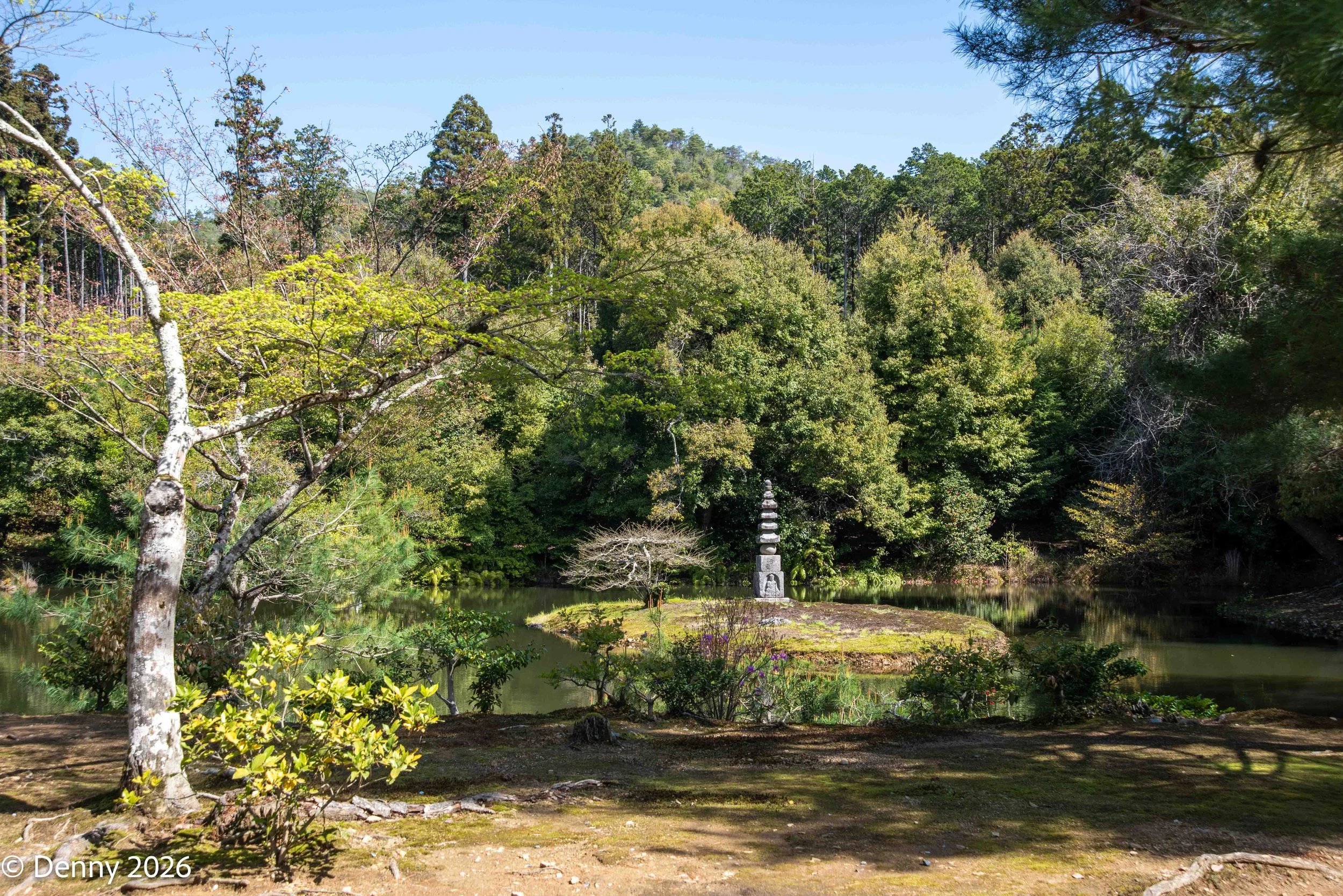
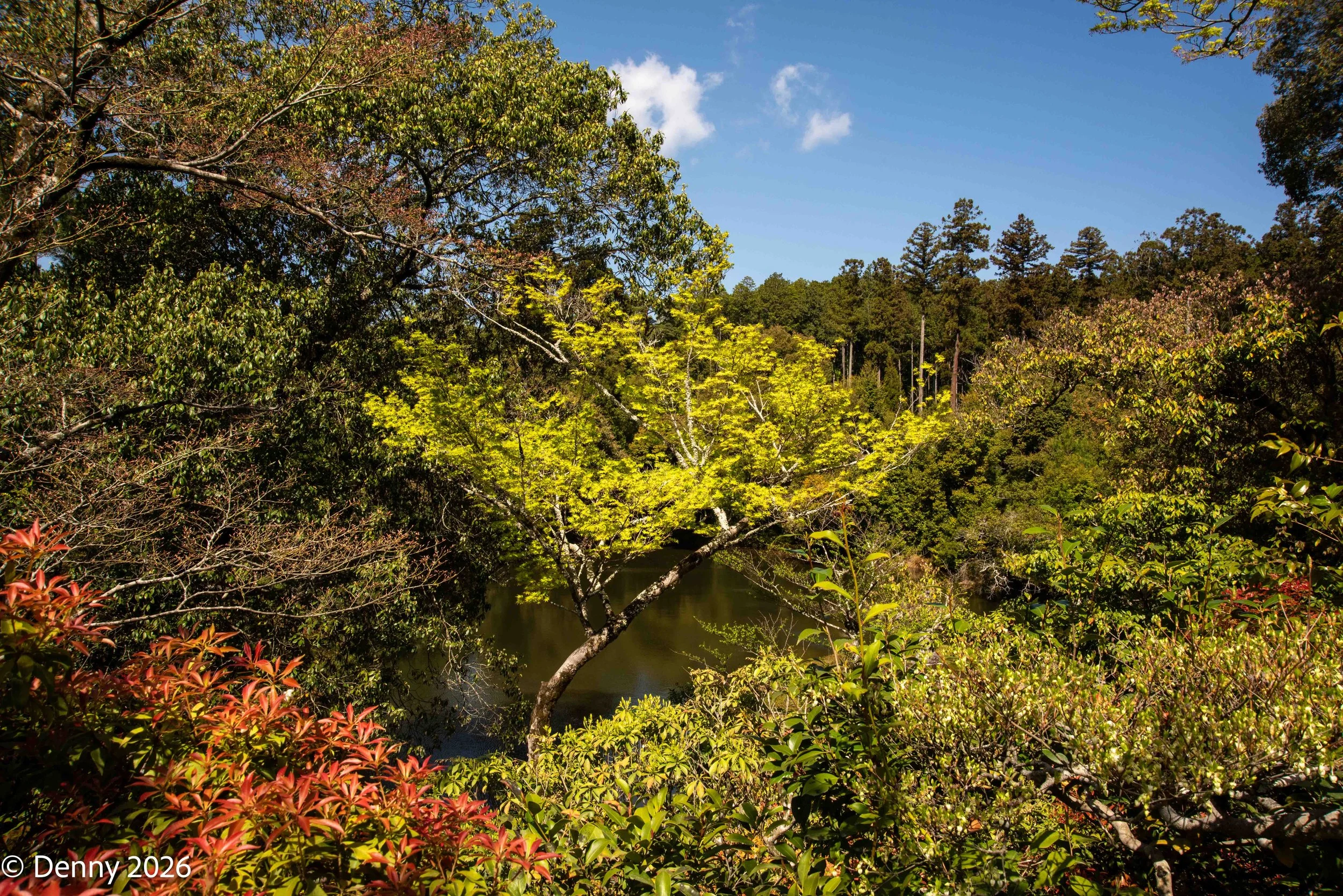
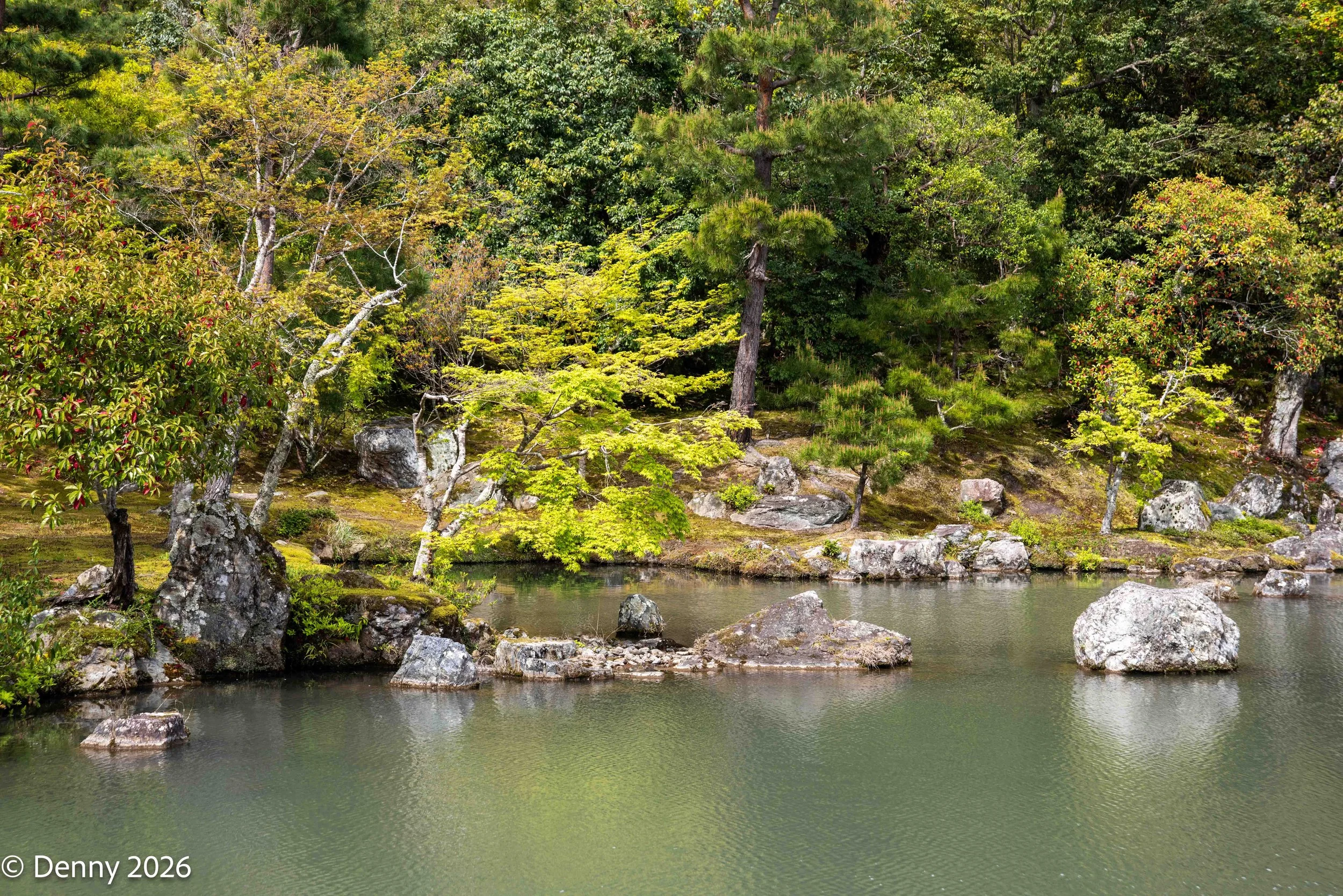
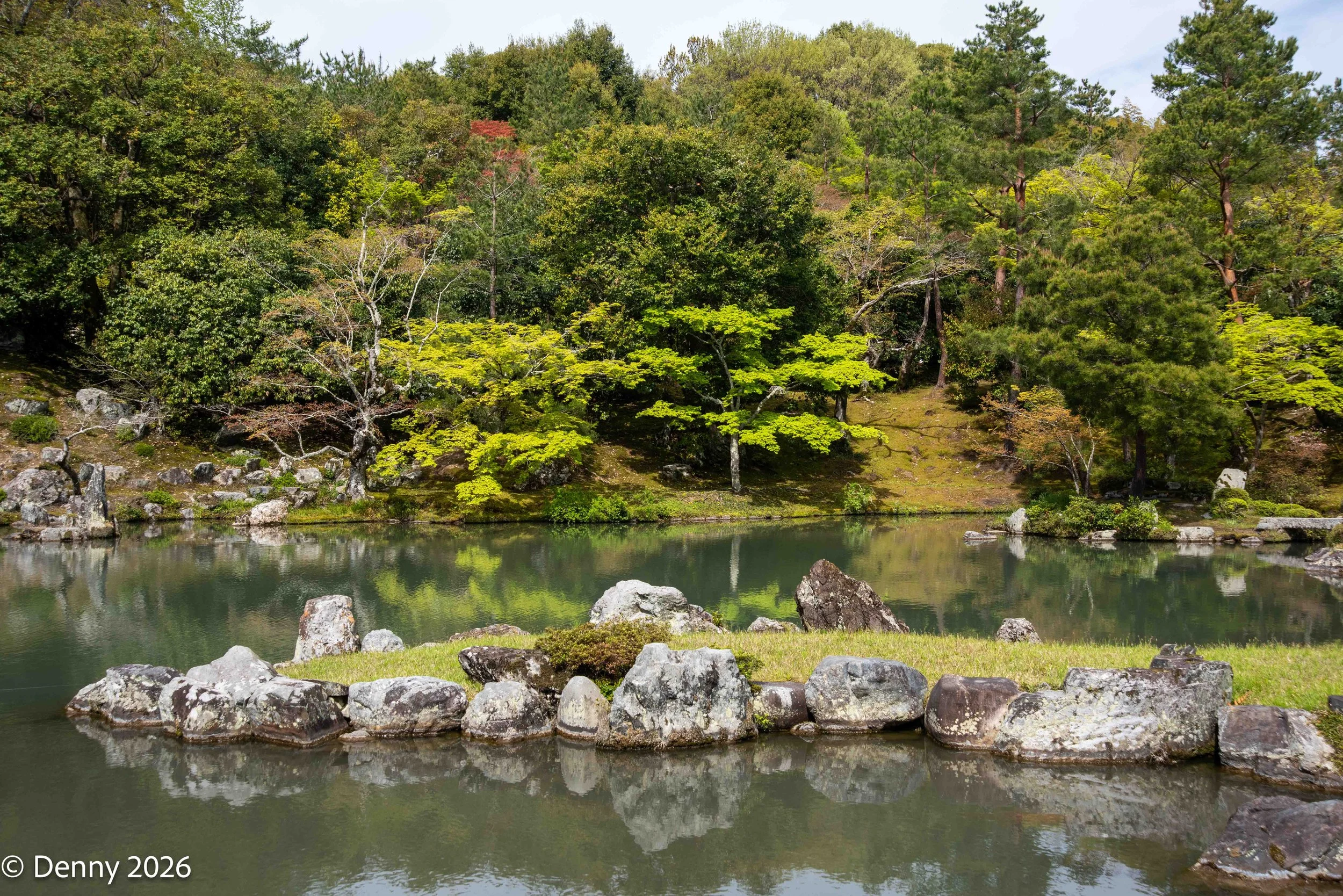
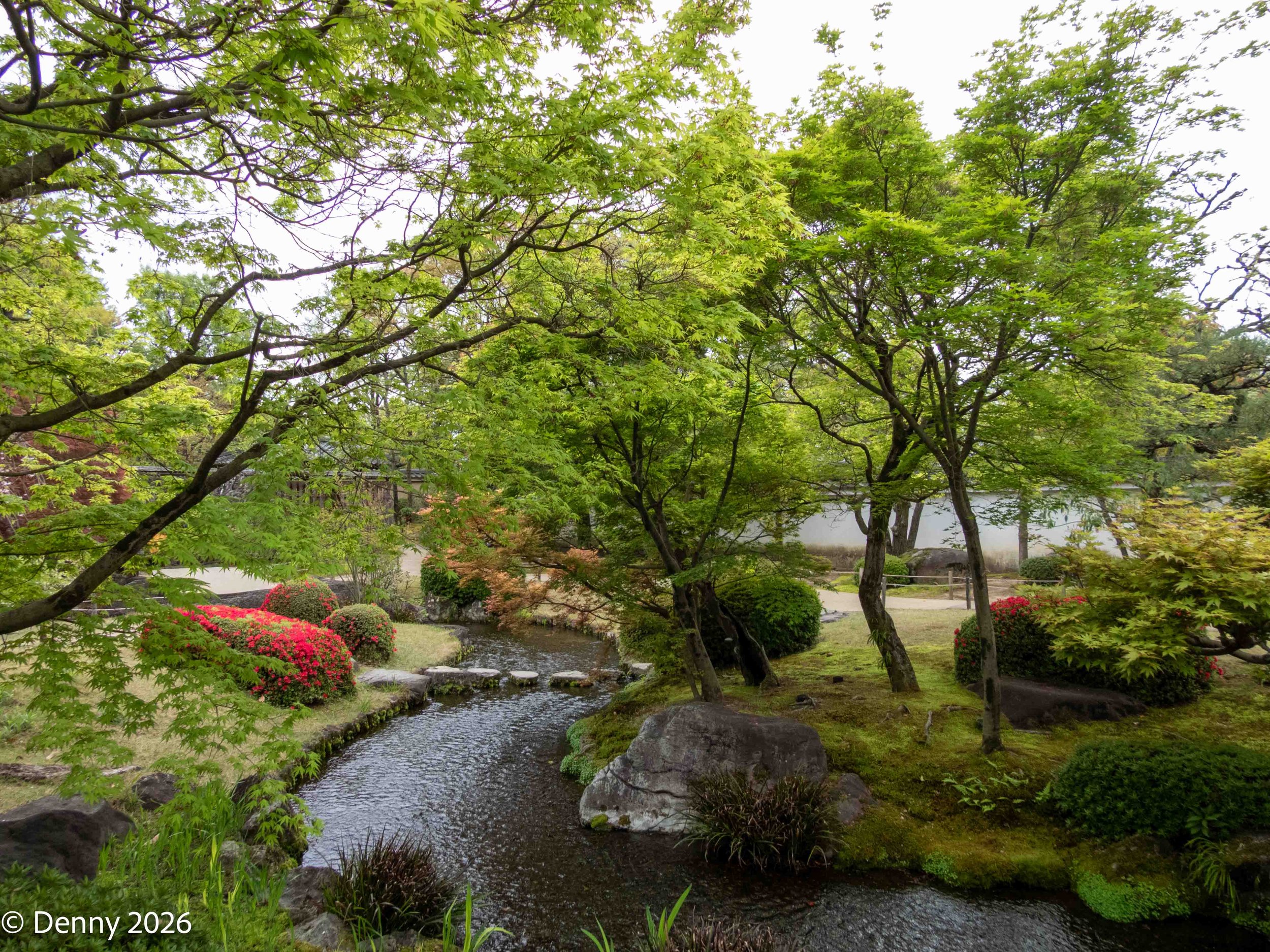
We commenced our garden walk behind the Hojo which is the main abbot’s quarters and right next to the reflection pond with its tiny rock islands, conifers, maples, cherry blossoms and forest backdrop making for an utterly delightful scene.

Reflection pond, Sogenchi Garden

Reflection pond, Sogenchi Garden

The garden is known as the Sogenchi Garden and it was the first special historical scenic area named by the Japanese government. Apparently there are fifteen fulltime gardeners of whom, only five are allowed in sacred areas such as around the waterfall at the back of the reflection pond.

Our walk took as past many interesting plants many of which were labelled in English.

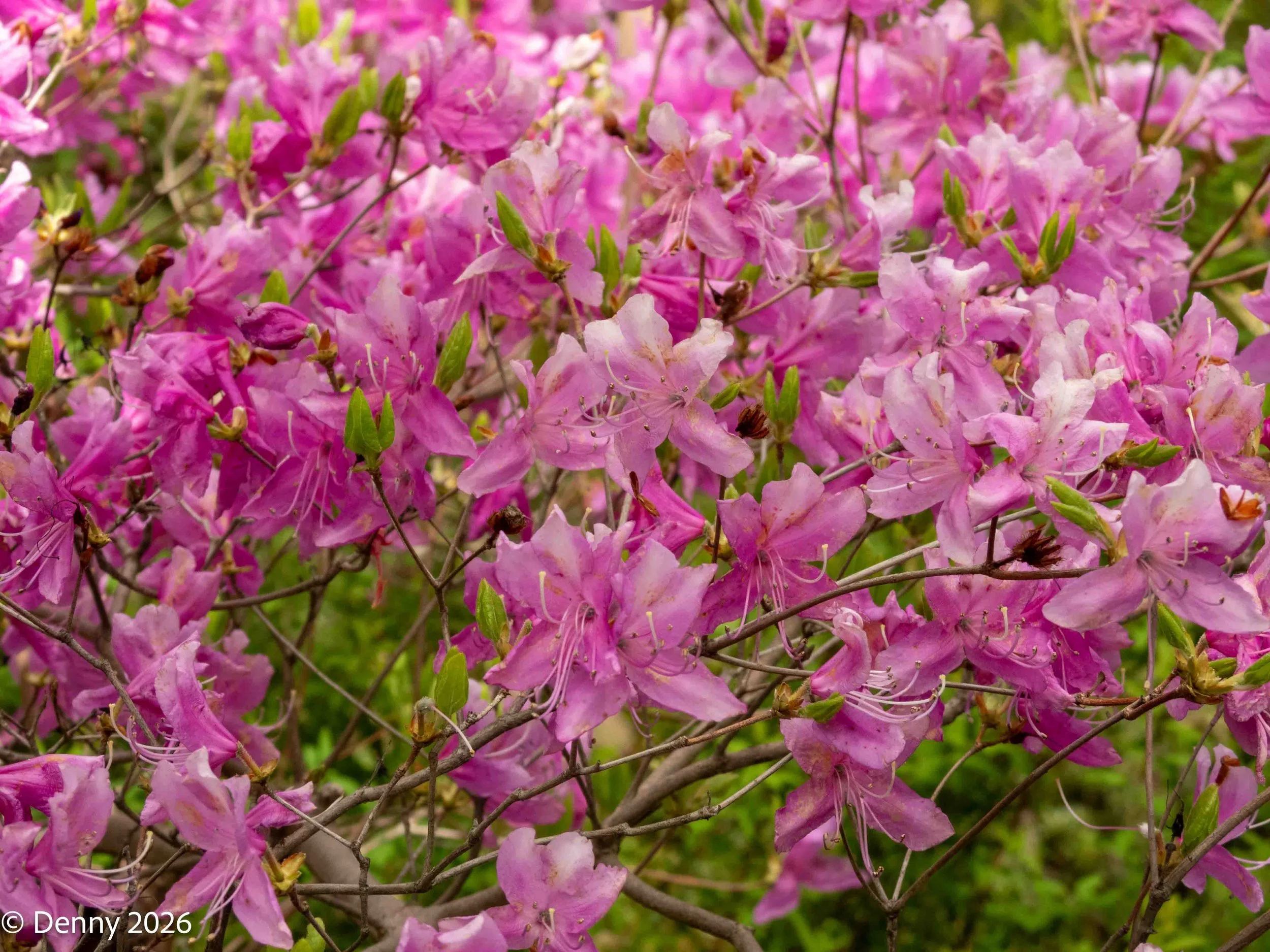
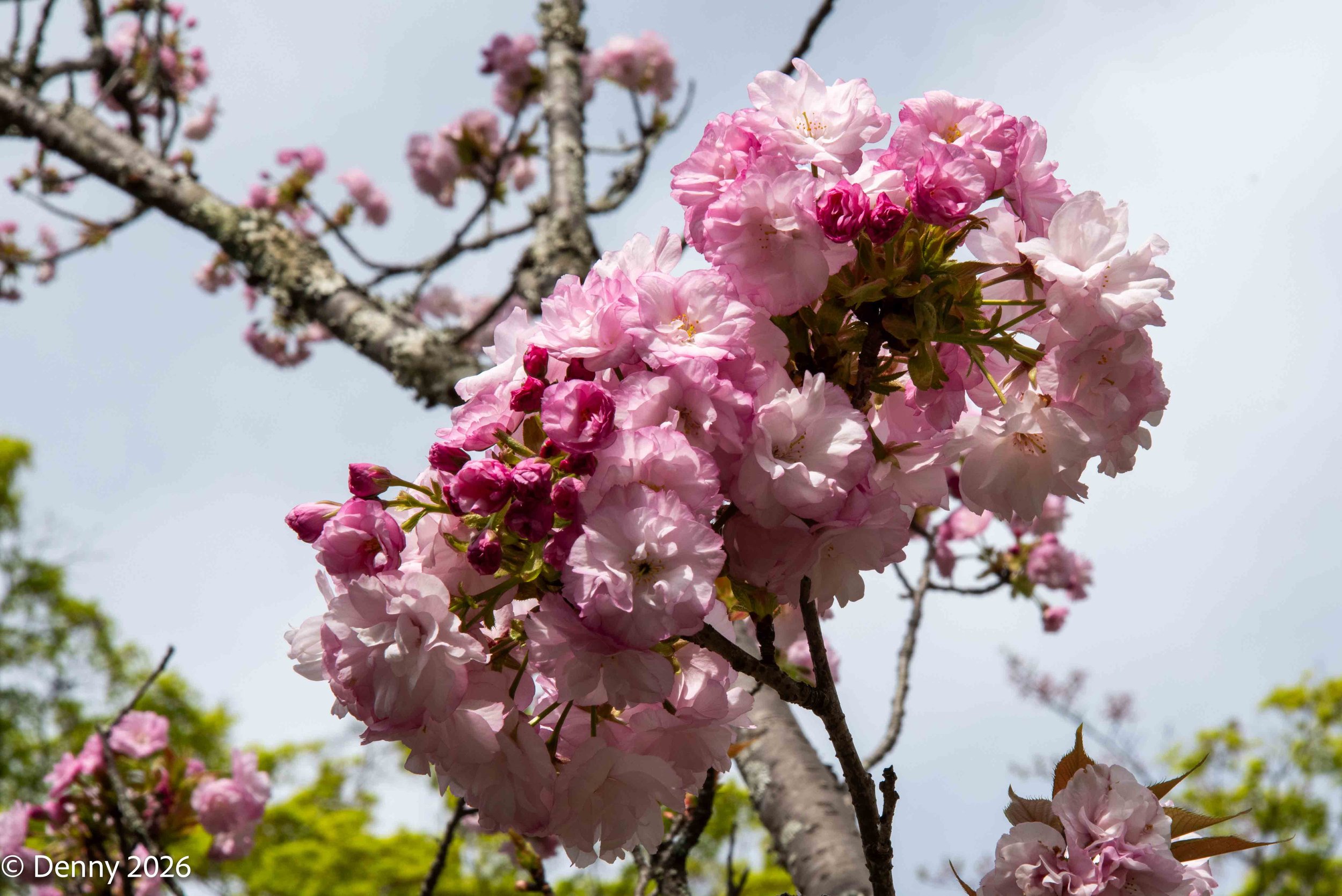
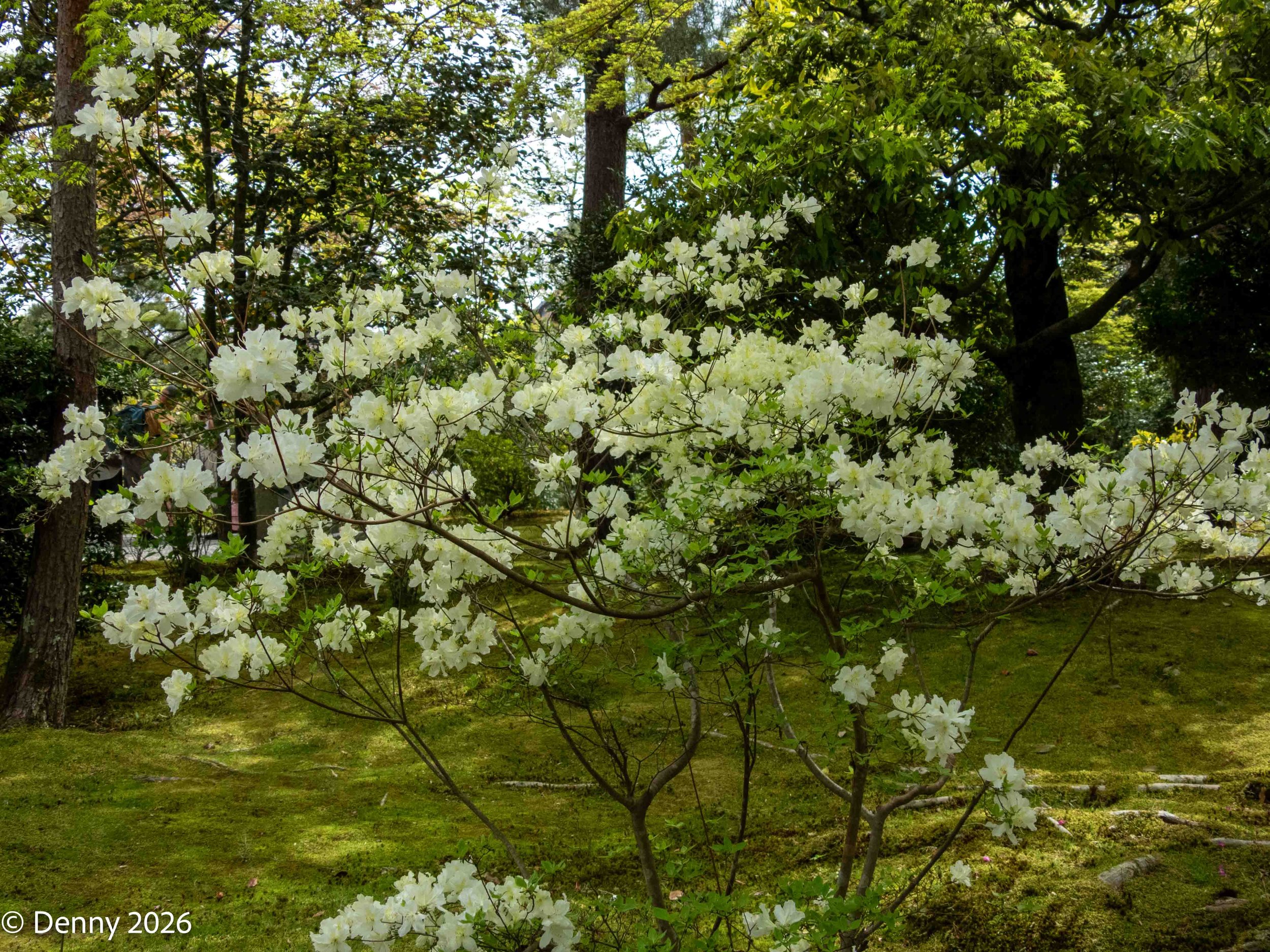
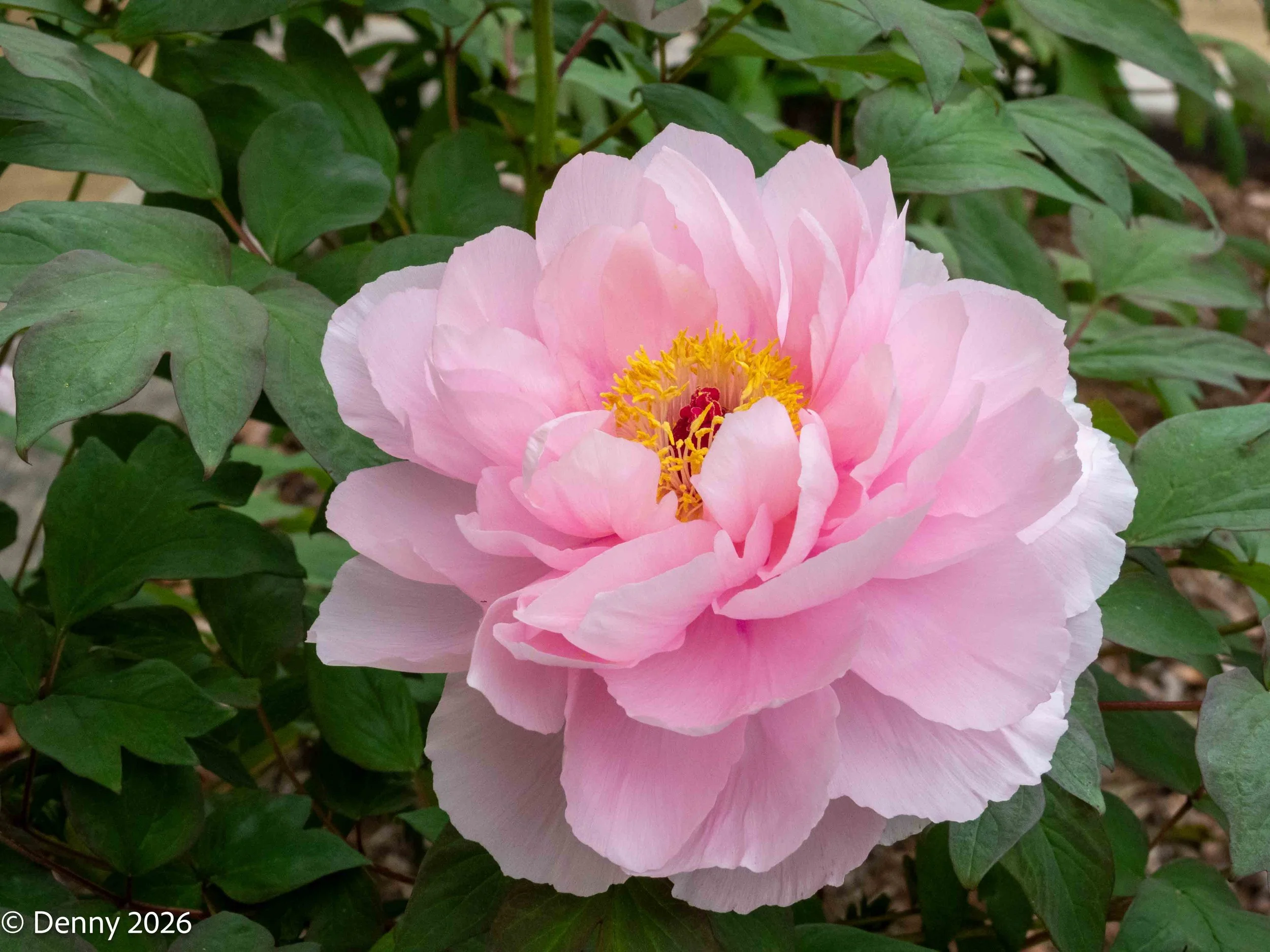
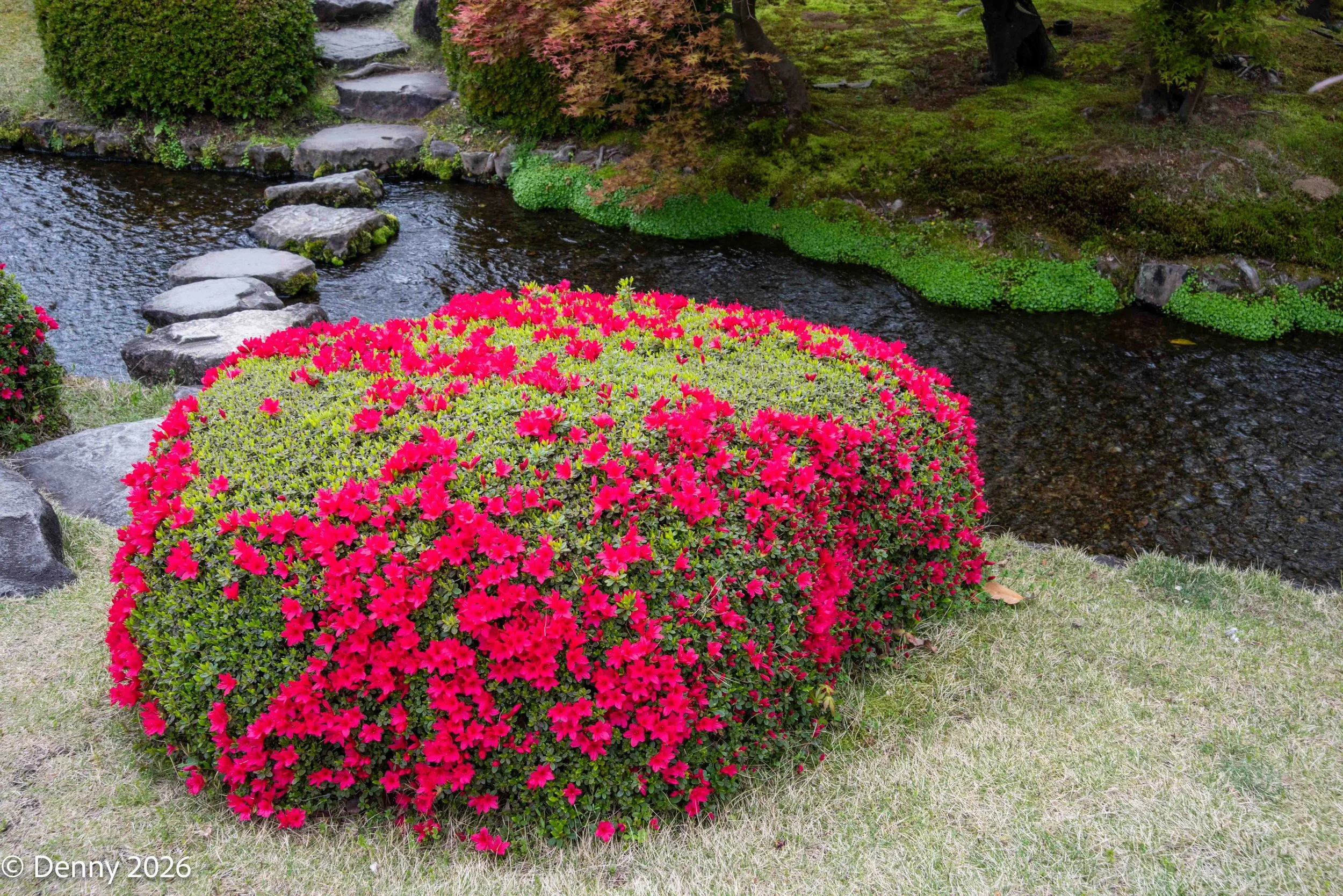
There were numerous azaleas and rhododendrons in flower and some of the less common plants in flower included tree peonies, kerrias and some very dark pink and yellow blossoming cherry trees.

Azalias, Sogenchi Garden

Yökihi Cherry, Sogenchi Garden

Yellow cherry blossom, Sogenchi Garden

Rhododendrons and bamboo, Sogenchi Garden

We then came upon a small shrine with the centrepiece being a frog (kaeru) in a shallow pond. People were tossing coins into the pond in hope of gaining good fortune and longevity as the frog is a powerful Japanese symbol of good health and a long life.   

Shrine with a frog (kaeru) in the pond, Sogenchi Garden

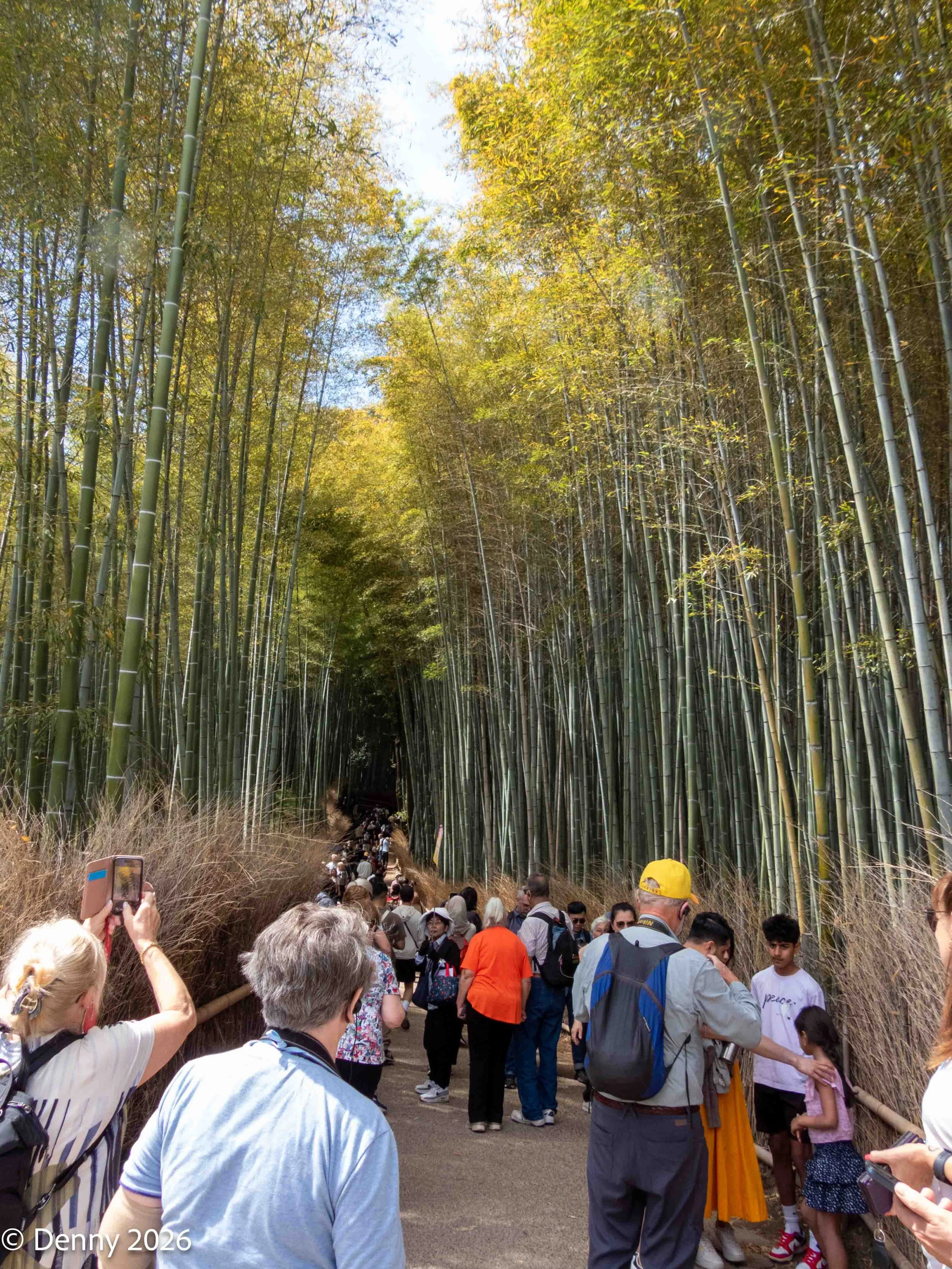
After a most serene and relaxing walk in this stunning garden we emerged into the overly crowded tourist area and commenced the ‘bamboo forest walk’.

The forest was high density bamboo and so was the tourist traffic on the walkway. However, when we reached a steeper section of the track the crowd density duly dropped off and we walked in comparative comfort, no-longer shoulder to shoulder.

Our group walking through bamboo forest

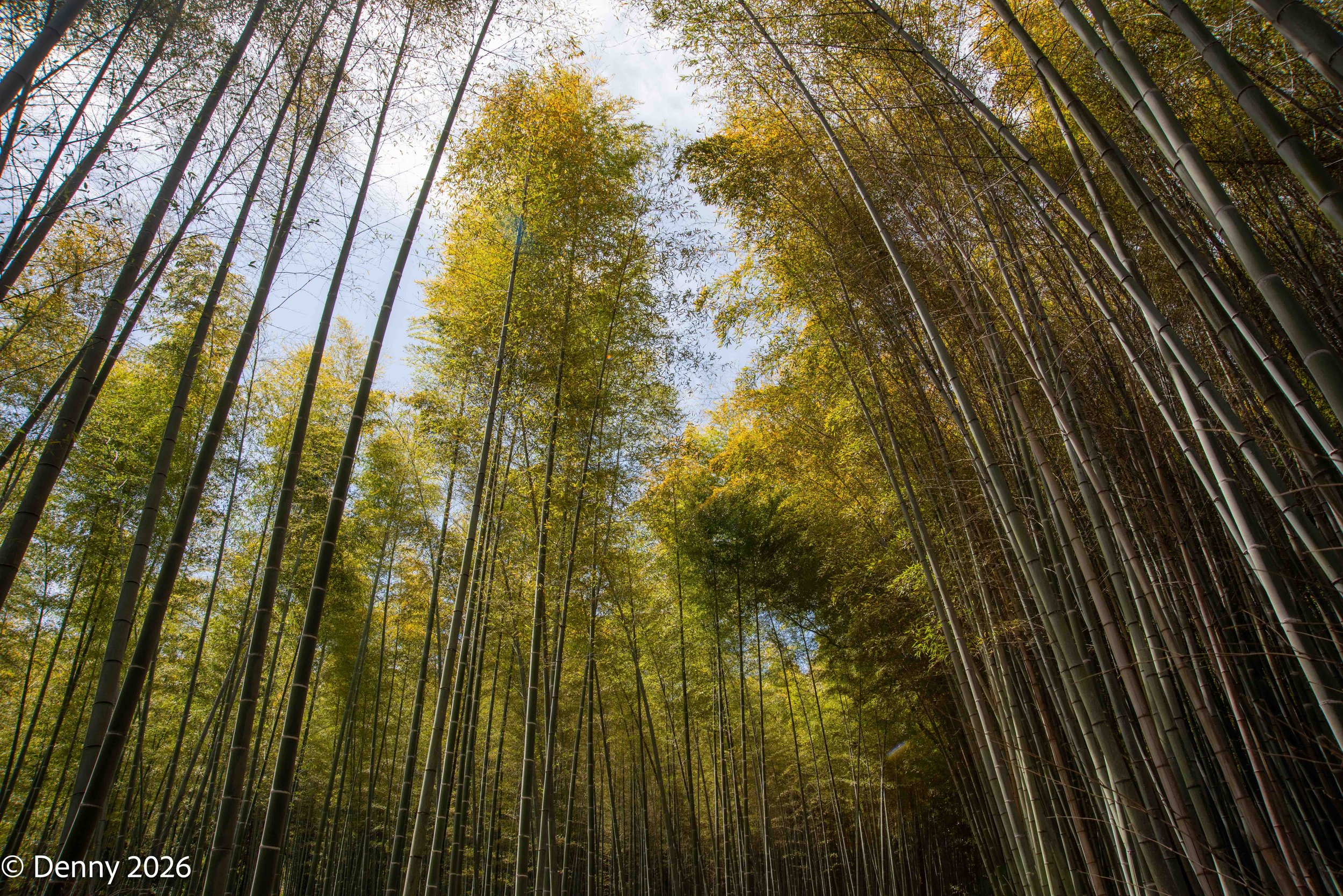
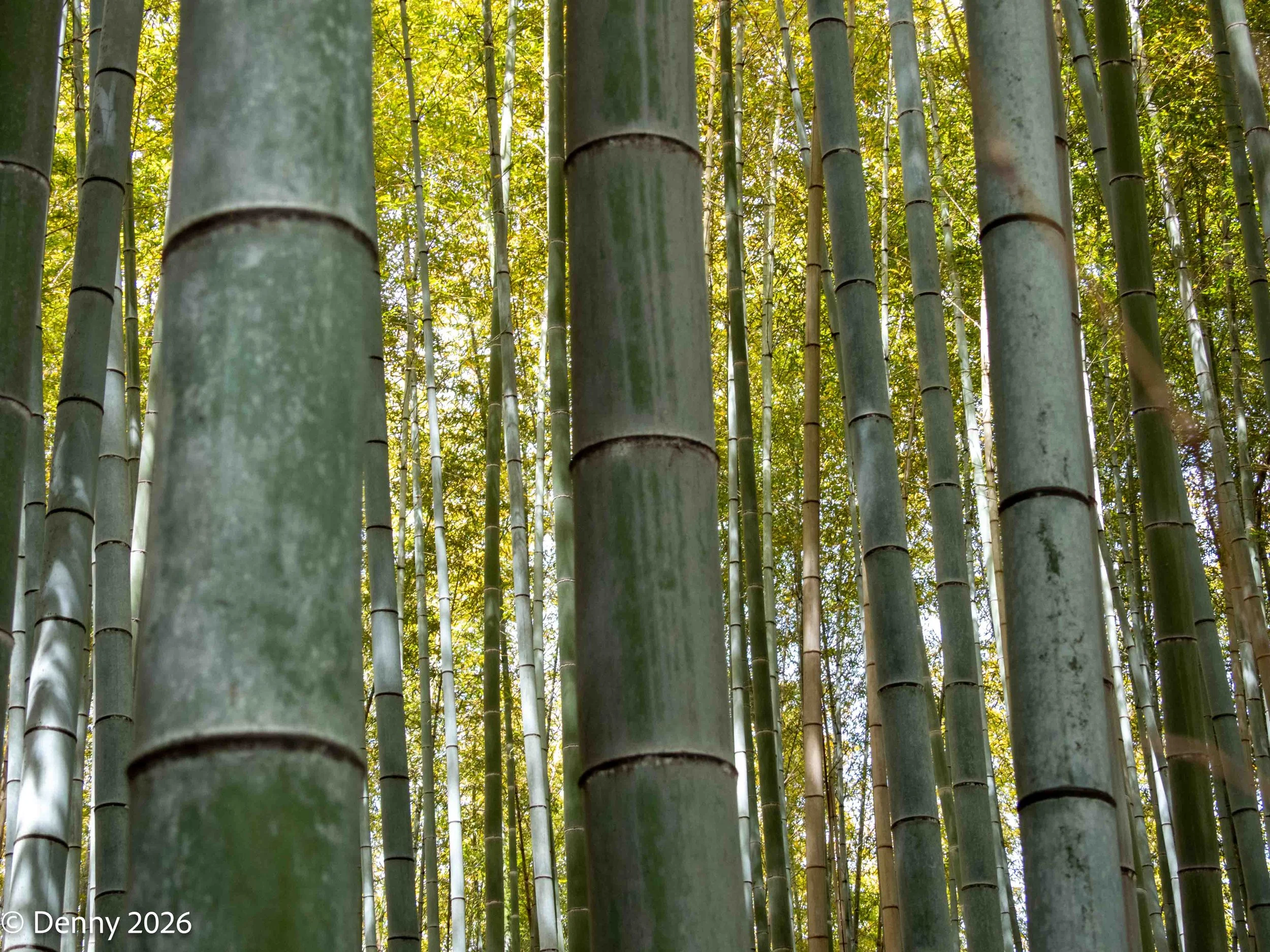
Bamboo forest,

Bamboo forest

On the side of the bamboo forest trail we encountered an artist drawing black ink sketches of the bamboo and its leaves with the drawings having their titles done in calligraphy.

artist drawing black ink sketches of the bamboo and its leaves

Nearby a man was playing his three stringed fretless lute called a shamisen using an unusually large plectrum which is called a bachi. The tone was haunting and had a distinctly humming tone.

Busker playing a shamisen

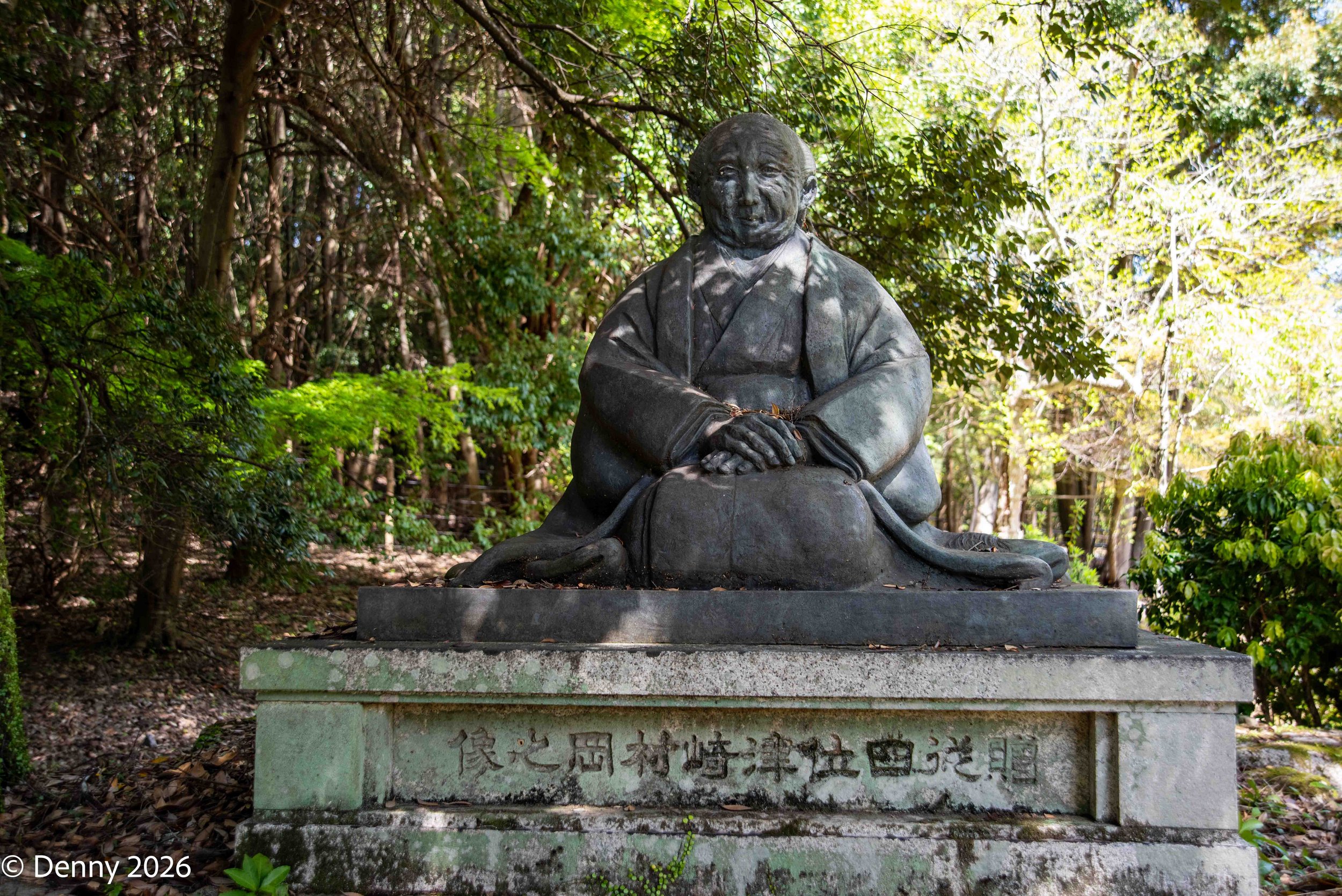
At the end of our bamboo trail we re-entered a garden area where we photographed a bronze statue of Tsuzaki Muraoka-no-Tsubone which must be the first statue of a female we’ve seen. She was a prominent lady-in-waiting in the shogunate era.

Statue of Tsuzaki Muraoka-no-Tsubone

Our path continued down until we reached the Katsura river where there were many row-boats and tourist gondolas relishing the ideal weather conditions.

Path down to Katsura River

Boats on Katsura River

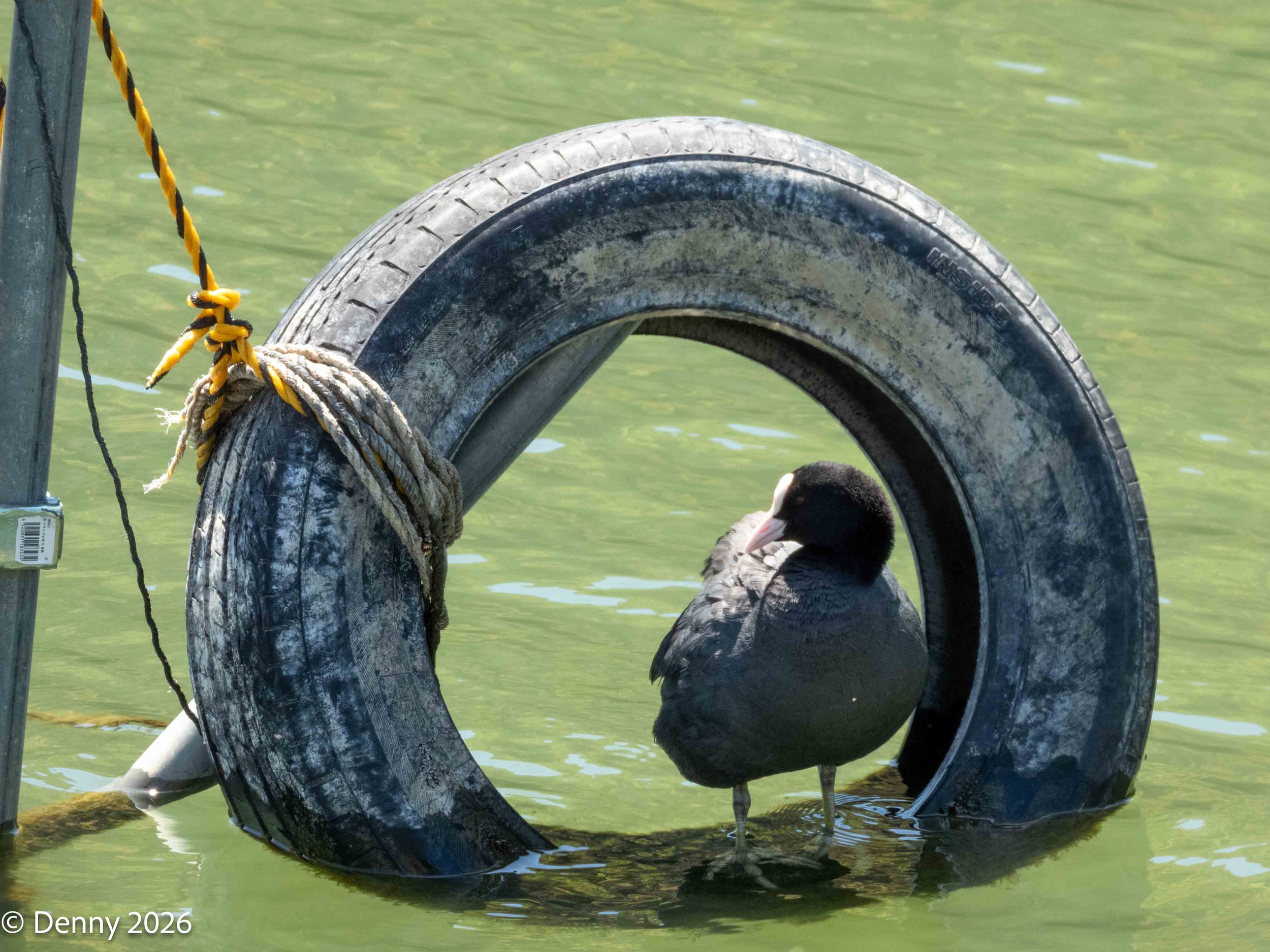
Eurasian Coot (Fulica atra) in tyre on Karsura River

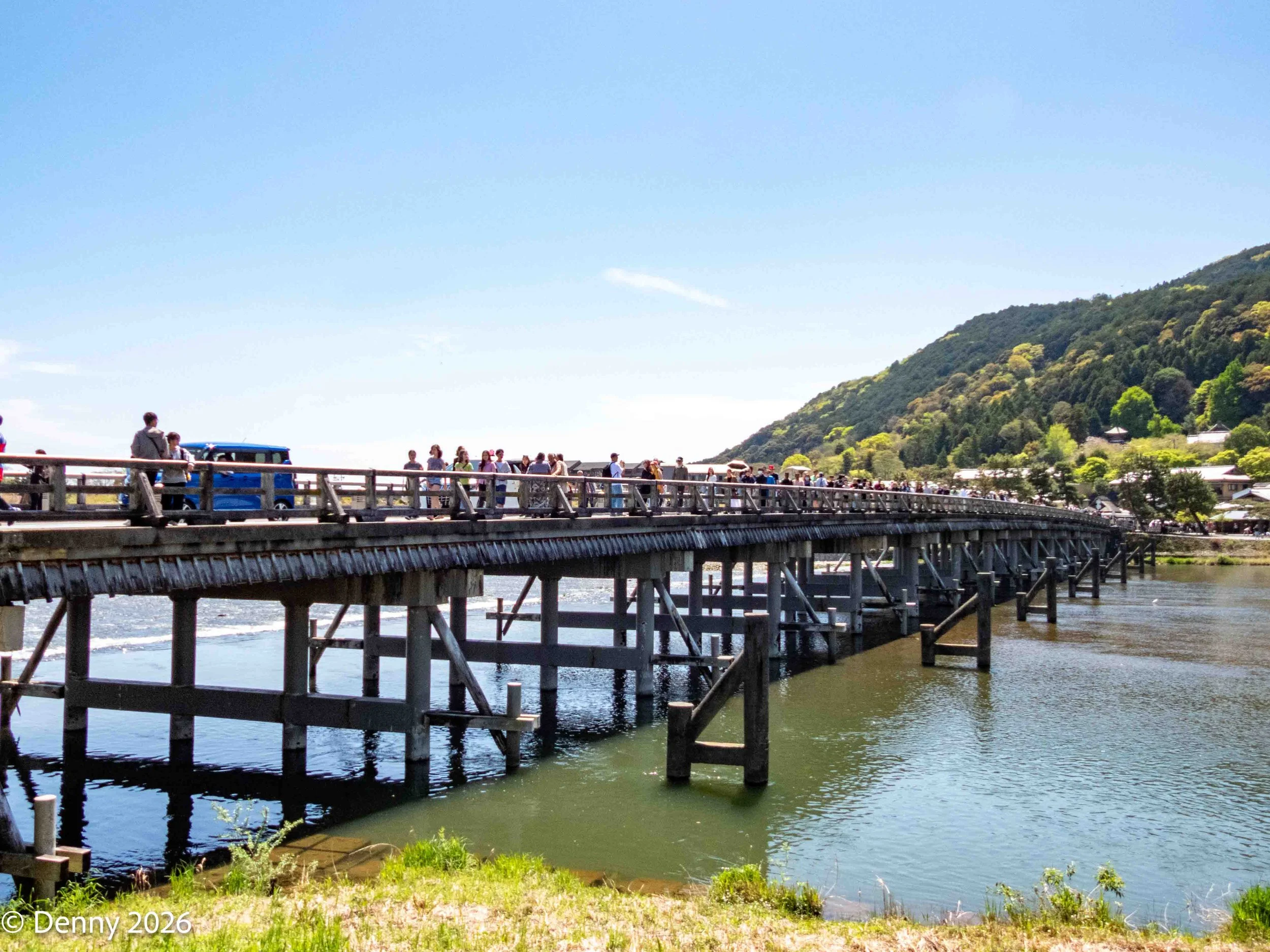
Bridge over Karsura River

Japanese maple (Acer palmatum)

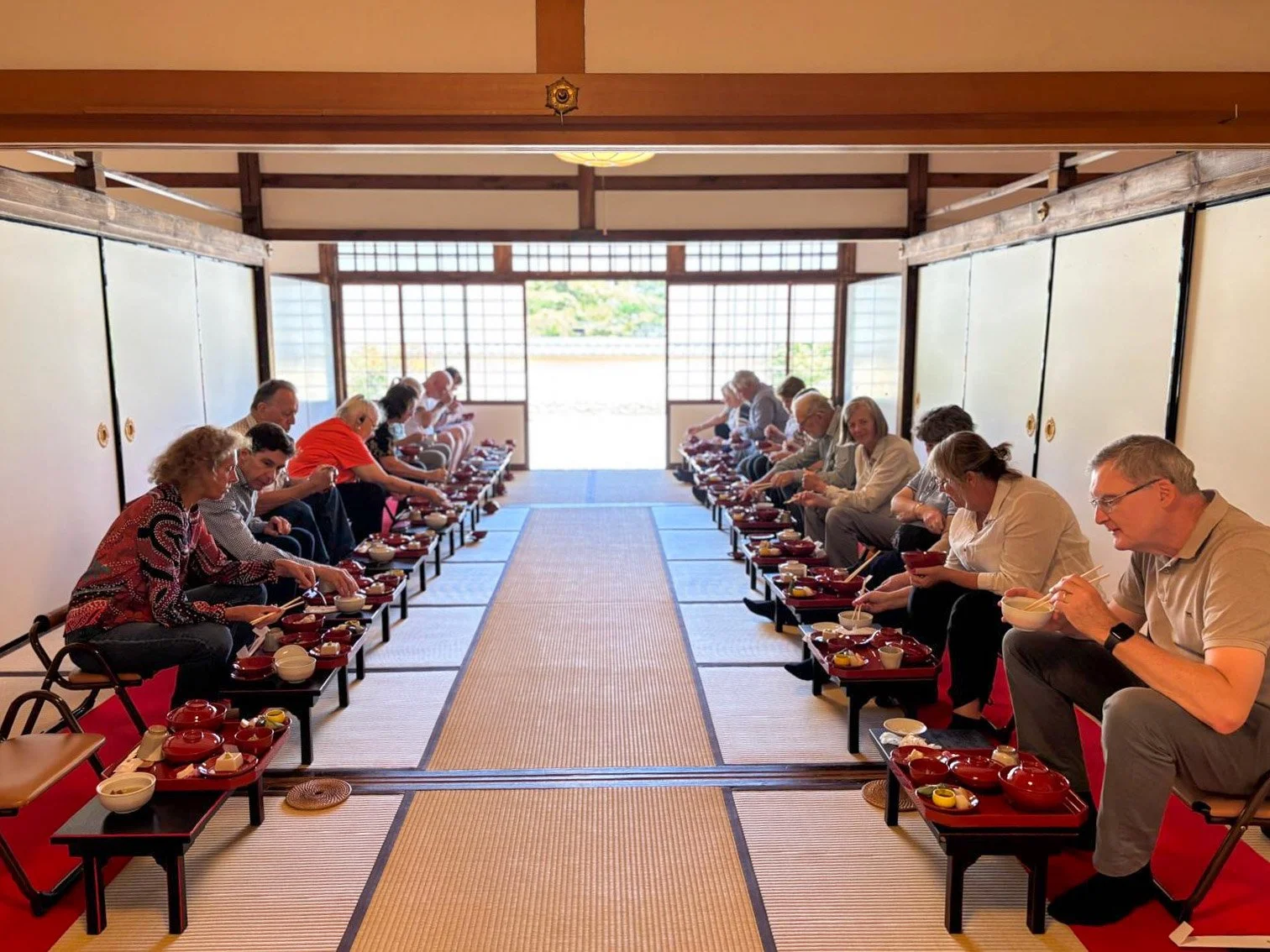
We made our way back to our starting point and then our group enjoyed a traditional Japanese meal in one of the Buddhist temple’s buildings.

Japanese meal in Buddhist temple

The vegan cuisine was immensely varied and it was clear that our hosts had put a huge amount of effort in preparing and presenting the ten or more dishes we tried. Several of the fresh ingredients used were unknown to us but the flavours were delicate and unusual.

In the mid-afternoon we caught the shinkansen to Hiroshima and arrived at 14:26.

Our train arriving at the station, Kyoto

We are staying in the Marriott Hotel which is right next to the station and very convenient as the area in and around the station is filled with restaurants and shops

The hotel’s lobby is on the sixth floor and all our group have rooms on the tenth floor. Eight of our group crowded into one lift and duly pressed the ‘10’ button and up we went, but not to the tenth floor. The lift stopped at the eleventh floor. Unbeknown to us, due to the crowded conditions one of our team had his backpack pressing against the lift’s floor number buttons. This pressure had not just cancelled floor ten but had activated stops at all floors from 11 through to 17. It was quite a while before we eventually went back down to our designated tenth floor.

Lift buttons (2 of the 4 in the lift) at the Marriott Hotel

For our evening meal we went to a bakery and bought some savoury and sweet pastries to consume in our room with some wine and beer.

Tomorrow we will explore this famous city which is now a powerful symbol of peace and hope.

DAY 32: Monday 13th April 2026 HIROSHIMA - MIYAGIMA - HIROSHIMA, JAPAN

After an early breakfast at 06:30 we commenced a very busy day of bus travel, walking and visiting historical sites.

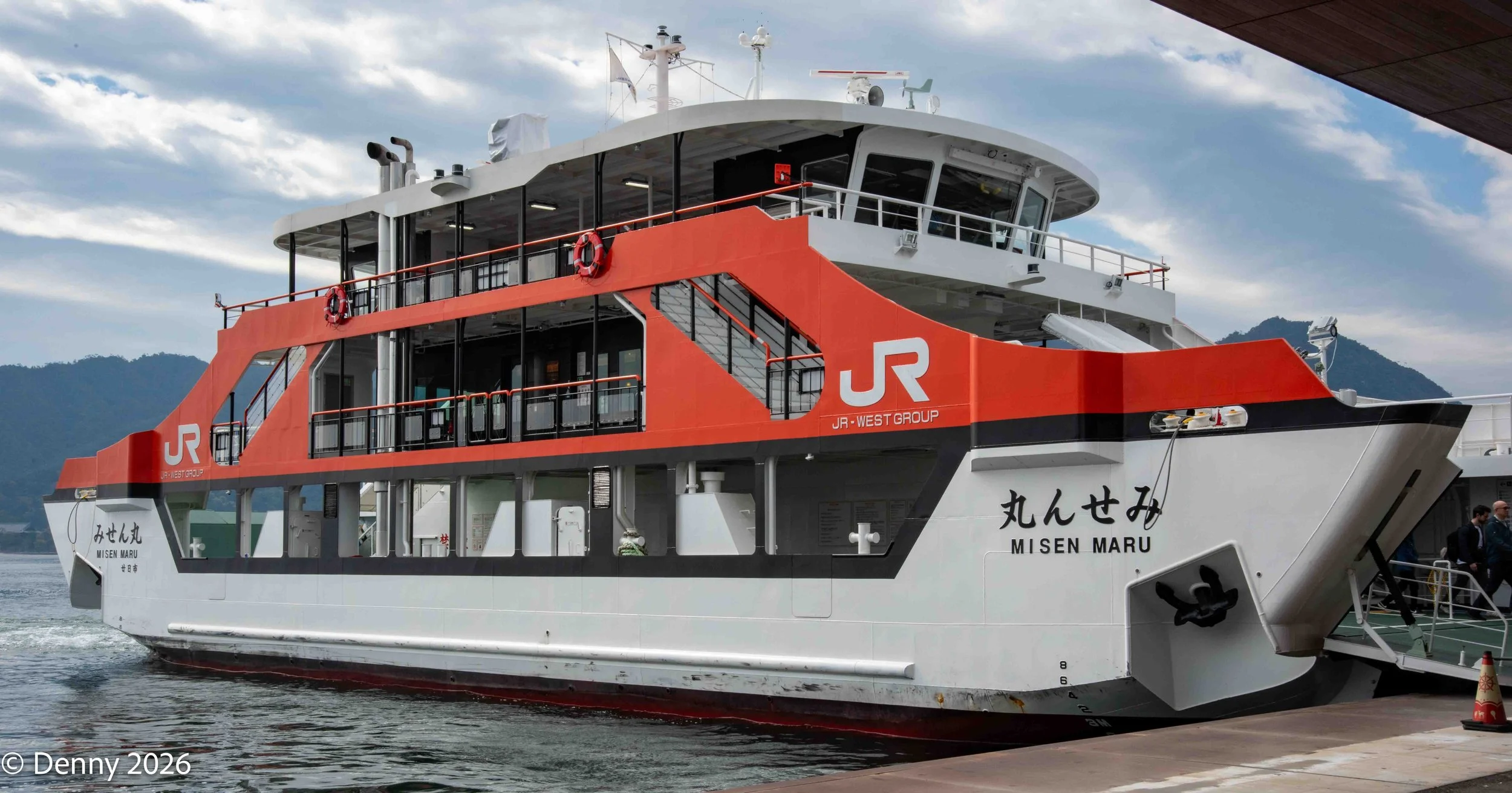
The first part of our day involved a one hour drive south of Hiroshima to the port city of Miyajimaguchi where we boarded the ferry, the ‘Misen Maru’ to Miyajima Island. Mt. Misen is a prominent mountain on the island.

Our ferry ‘Misen Maru’ to Miyajima

The short distance across to the island took about fifteen minutes. We then spent the next three hours exploring the northern section of the island which is regarded as one of Japan’s three most scenic spots.

Our walk followed the coastline passing through a touristy shopping area.

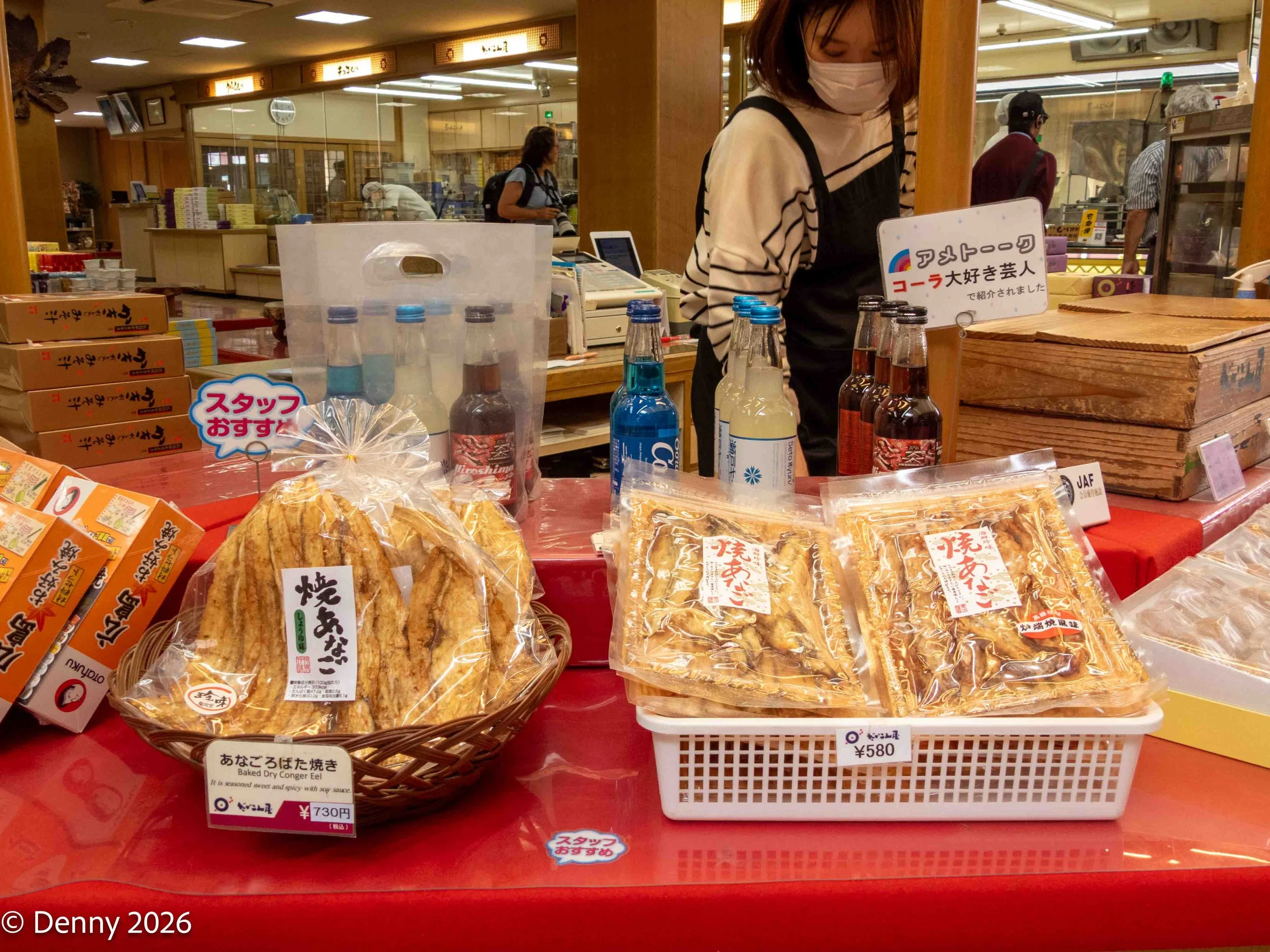
Conger eel produce, Miyajima Island

We then passed under a large Torii Gate with cylindrical granite pillars supporting two massive granite crosspieces. There were two bronze lions at the base of the torii.

Komainu ('lion-dogs) guarding the entrance (honden) to Irsukushima Shrine, Miyajima Island

Komainu ('lion-dog') with open mouth (agyoo), symbolizing the beginning and end of all things, guarding the entrance (honden) to Irsukushima Shrine, Miyajima Island

Komainu ('lion-dog') with closed mouth (ungyoo), symbolizing the end of all things, guarding the entrance (honden) to Irsukushima Shrine, Miyajima Island

Further on we were able to get good photos of the O-torii Gate to the Itsukushima Shrine. The gate, built in 1875 is standing in the water about two hundred metres from the shoreline. The brightly vermilion coloured torii has a height of 16.6 m and weighs about 60 tonnes. The upper cross-member is 24 m in length and is filled with 4 tonnes of stones to give stability. The main vertical supports are made from massive camphor and cedar tree logs.

O-torii Gate, Miyajima

Our group with our amazing guide Mitzie, UNESCO World Heritage-listed Island of Miyajima

Our walk then took us to the nearby Itsukushima Shrine renowned for its architectural beauty and glorious appearance. This Shinto shrine was first built in the 6th century and later remodelled in 1168 by the powerful leader Taira-no-Kiyomori.

Itsukushima Shrine, Miyajima

The shrine consists of the main hall, a stage area, music rooms together with worship and purification halls. All the timber structures are painted vermilion and the roofs are black terracotta tiles.

While we were at the shrine, a wedding ceremony was being held in the main hall area and a large crowd gathered to watch this occurrence.

Wedding, Itsukushima Shrine, Miyajima

We spent the next hour or more slowly wandering and observing the buildings, gardens, wooden bridges, stone monuments and the wild deer that are plentiful and don’t appear to be too wild at all.

Arch Bridge, Miyajima

House, Miyajima

Waterway, Miyajima

Sika deer (Cervus nippon), Miyajima Island (Itsukushima)

Sika deer (Cervus nippon), Miyajima Island (Itsukushima)

Temple complex with main temple being renovated, Miyajima Island (Itsukushima)

Beach, Miyajima

Our return pathway took us back to Machiya Street which offers an abundance of tourist shops within a neat row of centuries old stores and houses.

We found a delightful Japanese mini-garden out the back of a cafe with massive carp in its pool.

Garden behind cafe, Miyajima

We decided against buying roasted chestnuts which we love, because the ones on sale looked too charred. Nearby was a shop producing biscuits with a basic robotics system controlling the production line.  

Machine for producing momiji manju (waffle shaped like a maple leaf), Miyajima Island

Machine producing momiji manju (waffle shaped like a maple leaf), Miyajima Island

Red bean Box of momiji manju (waffle shaped like a maple leaf), Miyajima Island,

Corinne bought an attractive pendant and chain where the blue shinkai stone is attached to and cradled in a silver double helix.

Another souvenir shop had some small colourful bowls that with their blue pattern and nautical motifs we thought would be ideal for the Anson’s Bay shack. These were purchased at a bargain price.

We departed Miyajima Island on the same ferry and then our bus driver drove us to the Hiroshima Peace Memorial Park where we spent the next three hours.

Hiroshima Museum

For the worst of reasons, Hiroshima needs no introduction, but each year millions of visitors are drawn to this city because of one unforgettable cataclysmic event.

At 08:15 on August 6th in 1945 a B-29 bomber ‘Enola Gay’ detonated a nuclear fission bomb called ‘Little Boy’ at an altitude of 580 m above the city centre.

Clock showing the number of hours since the first dropping of the A-bomb & number of days since the latest nuclear test, Hiroshima

Tens of thousands of people were killed instantly by the blast and the toll rose to 300,000 over the following years as the intense gamma radiation effects took hold. The level of destruction caused by this comparatively ‘small’ nuclear bomb could be best described as apocalyptic. A vast proportion of Hiroshima city was utterly destroyed by the bomb’s induced pressure wave and subsequent fires.

Part of mural showing devastation caused by the nuclear fission bomb, Hiroshima

The first hour in the memorial park was spent in the expansive museum where we walked from room to room following a path wearing a headset that provided comprehensive audio details on many of the numbered exhibits.

The photos and many items recovered from that terrible August day were very confronting and the images of burnt adults and children were utterly horrifying.

Wall clock - example of displays, Hiroshima Museum

Wall clock annotation, Hiroshima Museum

Following our museum visit it was a relief to get outside to feel the refreshing air around the memorial fountain and to wander amongst the trees and garden of the Memorial Park.

Azaleas in bloom, Hiroshima Museum gardens

We then came upon a bronze statue of a woman with her child playing a trumpet standing on a golden crescent moon; the title being a ‘Prayer for Peace’.

Statue of a woman with her child playing a trumpet standing on a golden crescent moon, Hiroshima Museum gardens

Next there was the curved Cenotaph and the Flame of Peace which will only be extinguished when nuclear weapons have been eliminated. The Cenotaph designed by Kenzo Tange holds beneath its arch a chest which contains the names of all those who died, together with an inscription that reads ‘Rest in Peace. We will never repeat the error’.

Cenotaph and the Flame of Peace, Hiroshima

The Children’s Peace Monument nearby, depicts a girl with a crane flying above her. Her name is Sasaki Sadako and she was a victim of the bomb. She believed she would survive if she made 1000 origami paper cranes. She did not survive but there are now tens of thousands of paper cranes made by school children that adorn the memorial.

Children’s Peace Monument, depicting a girl with a crane flying above her.

After passing the Peace Bell we now focussed on the iconic relic of Hiroshima, namely the haunting and twisted girders of the ‘A-bomb Dome’.

‘A-bomb Dome’, Hiroshima

‘A-bomb Dome’, Hiroshima

The original 1915 building was the Hiroshima Prefectural Industrial Promotion Hall which was loved by the local people because of its green tarnished copper dome.

This building was only 160 m from the epicentre of the bomb’s detonation and all its occupants died instantly.

In 1996 this building was added to the UNESCO World Heritage List as a reminder of the horrors of the atomic bomb and as a symbol of world peace.

After a distressing afternoon’s exposure to the tragedy of war we returned to our hotel with a fervent and yet unrealistic wish that there could be a total elimination of all nuclear weapons.

Subsequently, we had a most enjoyable evening meal together with travelling companions Chris and Shelley at a nearby okonomiyaki restaurant. Hiroshima is famous for this savoury pancake, cabbage and noodle specialty, cooked on a hotplate in front of you.

Ikonomiyaki Restaurant, Hiroshima

Chefs at Ikonomiyaki Restaurant, Hiroshima

Sheraton Grand Hiroshima Hotel (our room was on 10th floor), Hiroshima

Tomorrow we’ll leave Hiroshima and move on the Himeji and end the day in Osaka.

DAY 33: Tuesday 14th April 2026 HIROSHIMA - HIMEJI - OSAKA, JAPAN

After breakfast sitting in a sunny window corner of the hotel dining room we then departed the Sheraton Grand (aka Marriott Bonvoy) and, for this trip we had our final shinkansen train trip when we boarded the 09:56 train bound for Osaka.

Window seat for breakfast at Sheraton Grand Hiroshima Hotel,

Our Shinkansen bullet train arriving at the station, Hiroshima

We followed an easterly track for an hour at around the 300 km/h mark with only two stops before reaching our midday’s destination of Himeji.

Our new bus and driver were waiting at the station and we then were driven to the parking area adjacent to Himeji-Jo Castle.

This is an incredibly popular tourist site with so called ‘white heron castle’ being an extraordinarily attractive building sitting so prominently on a hilltop and having the appearance of a bird taking flight.

Himeji-Jo Castle

The castle possesses imposing military architecture and its position, perched on this pinnacle accentuates the graceful aesthetic lines with its undulating dormer gables and the visual contrast between the white plastered walls and the black terracotta tile roofs.

Himeji-Jo Castle, Himeji

The castle’s main donjon (fortified inner tower or ‘keep’) was developed by Terumasa Ikeda in 1609 who transformed this military stronghold into the ultimate symbol of the Tokugawa shogunate’s power.

The castle was adapted to make any form of successful raid virtually impossible. By incorporating steep pathways, tight corners, numerous steps and low height doorways it meant that any attacking army certainly on horseback, faced undoubted failure.

Some of our group passing through narrow doorway, Himeji-Jo Castle

To deter attackers, angled chutes (small holes) were set at numerous points on the castle walls so that stones, boiling oil, arrows and musket fire could be used to defend the castle. The use of gunpowder for military purposes was introduced to Japan by the Portuguese in the 16th century.

Chute in the wall, Himeji-Jo Castle

The Himeji Castle is now listed as a UNESCO World Heritage Site.

We decided to do the climb to the highest castle point (main keep) and so did many others. This meant climbing a succession of ten or more narrow and quite steep, pine timber stairways within the buildings interior which was dark and quite stark being devoid of any interior fittings. On about the fifth level we found a tiny Buddhist temple.

Narrow, steep stairway, Himeji-Jo Castle, Himeji

Having reached the top, we were greeted by an official who was delighted to shake our hands and have his photo taken.

Himeji Castle staff member

The view from this high position at the castle top made the effort of the tedious climb certainly worthwhile.

View from the top, Himeji-Jo Castle

Fish-shaped roof ornaments on top of Himeji-jo Castle are Shachihoko (or sachihoko), mythical creatures with a tiger-like head and fish-like body believed to protect against fire

View from the top, Himeji-Jo Castle

The downward journey needed caution as the steep and narrow pine steps were slippery. Some people went down the ‘ladders’ backwards.

Himeji-Jo Castle from the grounds

We met up with the rest of our group and then spent time wandering through the glorious Koko-En garden which is quite close to the castle.

This is a traditional Japanese garden constructed in 1992 on the site of a former feudal lord’s residence.

The garden covers about 3.5 hectares and has a network of gentle streams flowing through rustic styled gardens and ponds home to large and colourful carp.

The garden features many species of maples, cherry, bamboo and conifers all in a beautifully manicured setting.

The peonies, rhododendrons and azaleas were in flower and at their very best. Despite the mid-April date, there were still a number of different cherry blossoming trees displaying their delightful colours.

Waterfall, Japanese garden, Himeji

Japanese maple, Japanese garden, Himeji

Peonie, Japanese garden, Himeji

Japanese garden, Himeji

Azaleas, Japanese garden, Himeji

Walking in this garden was a most pleasant and highly desirable antidote to the hustle and bustle of the crowds in the castle.

We then returned to our bus and commenced a two hour bus trip to Osaka via the large port city of Kobe.

Our accommodation for the next two nights in Osaka is at the Sheraton Miyako Hotel and then on Friday we head back home to Australia.

For our final full day in Japan tomorrow, we will visit the city of Nara and hopefully see some samurai sword experts in action.

DAY 34: Wednesday 15th April 2026 OSAKA - NARA - OSAKA, JAPAN

Much of the morning was to be spent in Nara, a city one hour’s drive east of Osaka.

Founded in 710 Nara developed to become one of Asia’s most admired cities due to its natural beauty, tranquilty and the position of being the grand diocese of Buddhism. Despite being separate from the Chinese mainland Nara was the principal far eastern destination on the Silk Road.

Our trip to Nara was to visit the Todai-Ji Temple which is the headquarters of the Kegon school of Buddhism.

The main entrance gate to the temple is the Nandai-mon (Great South) Gate. This massive wooden structure is 25 m high and a National Treasure having been rebuilt in 1203. It is the largest temple gate in all of Japan.

Nandai-mon (Great South) Gate to Todai-Ji Temple, Nara

Inscription on Nandai-mon (Great South) Gate to Todai-Ji Temple, Nara

Eaves on Nandai-mon (Great South) gate to Todai-Ji Temple, Nara

It features eighteen massive wooden pillars and on either side of the entrance way there are two eight metres tall, 13th century gruesome Nio Guardian Kings, sculptured from wood by Unkei and Kaikei. The gate is so impressive that it alone would make a trip to Nara worthwhile.

Nio Guardian King, Nandai-mon (Great South) gate to Todai-Ji Temple, Nara

Nio Guardian King, Nandai-mon (Great South) gate to Todai-Ji Temple, Nara

We then walked across to the main temple area, avoiding the many deer that pester tourists for food.

Great Buddha Hall, Todai-Ji Temple, Nara

Great Buddha Hall, Todai-Ji Temple, Nara

Just outside the temple’s main entrance is a large octagonal bronze lantern and being cast in around the year 752 AD, it is one of the temple’s oldest treasures.

Octagonal bronze lantern at entrance to Todai-Ji Temple, Nara

The construction of the Todai-Ji Temple was ordered by Emperor Shomu in 743 AD, ostensibly to house the Great Buddha image but also to consolidate the position of the city as the capital and powerful centre of Buddhism.

The temple is a World Heritage Site and comprises the Great Buddha Hall, sub-temples, other halls, pagodas and gates including Nandai-mon.

The most impressive part is undoubtedly the Great Buddha Hall. It has been rebuilt twice since the 8th century and the current structure completed in 1709 after an earthquake is only two-thirds the size of the original hall. Despite this being a smaller structure, it is still reputedly the largest wooden building in the world.

Inside, the focal point is the seated statue of the Great Buddha. At 16 m high it is the world’s largest bronze image of Buddha. The casting of the Great Buddha in 752 AD used hundreds of tonnes of molten bronze, mercury and vegetable wax.

Statue of the Great Buddha, Todai-Ji Temple, Nara

Statue of the Great Buddha, Todai-Ji Temple, Nara

A point of interest is a small hole bored through a large wooden pillar just behind the Buddha. A popular belief holds that if you can squeeze through the hole, you will be protected from bad things happening in the future.

In 1692, after fires and an earthquake, the Buddha image was severely damaged and a new head had to be cast as a replacement. It is the one in place today.

On either side of the Great Buddha are two golden Bosatsu statues representing ‘Enlightened Beings’. These protective servants ensure that the Buddha is not affected by evil issues.

Bosatsu statue, Todai-Ji Temple, Nara

On the morning of August 7th each year, 120 priests in white robes and straw sandals undertake the task of ‘dusting down’ the image which require some to abseil down Buddha’s face.

At the exit point to the temple we noticed several priests writing Buddhist text in very stylish calligraphy. These messages were for both personal enlightenment and to presumably boost the temple’s finances.   

Priest writing buddhist text, Todai-Ji Temple, Nara

Flowers at exit from Todai-Ji Temple

The temple organises a Great Music Experience each May and internationally famous names like Bob Dylan, Jon Bon Jovi, INXS and Joni Mitchell have performed here at the temple for the four night festival.

We departed the Great Buddha Hall and took photos of the golden nine tiered pagoda with its sorin (spire) that sits atop the pagoda.

Golden nine tiered pagoda with its sorin (spire) that sits atop the pagoda, Todai-Ji Temple, Nara

Sorin (spire) that sits atop the pagoda, Todai-Ji Temple, Nara

Gate, Todai-Ji Temple, Nara

After a coffee break we returned to our bus and were driven back to Osaka by which time it was now raining quite heavily.

The next two and a half hours were spent in rainy weather in one of Osaka’s popular shopping precincts. The walkway was overly crowded with most people holding umbrellas. The tricky bit was avoiding being poked in the eye and at the same time side-stepping to bypass puddles.

Our group walking in the rain, Osaka

We did not find this much fun and so we walked along a one kilometre covered arcade and eventually found a coffee shop where we could spend time out of the weather and able to eat lunch we’d bought earlier in the day.

Shoppers in the under cover shopping arcade, Osaka

This fairly miserable shopping spree terminated with us rejoining the bus and being dropped off at a small centre that invites tourists to discover the ‘Way of the Samurai’ at the Japan Tatedo Association.

A group of experts showed us the basics of sword positioning and the various movements together with the loud guttural vocal effects.

Demonstration oif the ‘Way of the Samurai’ at the Japan Tatedo Association, Osaka

Demonstration oif the ‘Way of the Samurai’ at the Japan Tatedo Association, Osaka

Demonstration oif the ‘Way of the Samurai’ at the Japan Tatedo Association, Osaka

The artistry of the samurais was compelling as they performed some exceedingly well choreographed tussles and later acted out several amusing skits with pretend samurai fights between two males and later one where both males were defeated by a very competent female.

Later, members of our group were invited to perform the basic sword actions and then participate in a mock fight. Much merriment prevailed and the samurai acting using wooden and blunt ‘swords’ wasn’t a cause for any bloodshed.

Some of our group learning the ‘Way of the Samurai’ at the Japan Tatedo Association, Osaka

Group photo at Samurai experience, Osaka

This evening our ‘Japan Discovery Tour’ terminated with a nine course dinner comprising a key selection of Japan’s culinary specialties. The food was amazingly varied and beautifully presented with unlimited drinks being an added bonus.

Dinner menu, ‘Japan Discovery Tour’ Group, Sheraton Miyako Hotel, Osaka

Appetiser, ‘Japan Discovery Tour’ group dinner

Fifth course, ‘Japan Discovery Tour’ Group dinner

Dessert, ‘Japan Discovery Tour’ Group dinner

Tomorrow morning, after a very early breakfast, at 07:20 we leave our Sheraton Hotel for Osaka Kansai International airport and the start of our homeward journey.

DAYS 35 - 36: Thursday 16th - Friday 17th April 2026 OSAKA - HOBART

We’d finished breakfast before 07:00 and having checked-out of our hotel we boarded a mini-bus with six other members of our travelling group plus Mitzie and commenced an early morning battle with traffic for our one hour travel to Kansai International Airport with code KIX.

A fair proportion of the trip was close to the waterfront and it was interesting to see the extensive wharf sections assigned to container ships. The level of industrialisation was huge with several large oil refineries and steel works with the landscape being dotted with massive chimneys belching out lots of condensate plus ‘who knows what’?

There were a few minor traffic issues but we arrived at Kansai as expected at 08:30. Osaka’s Kansai airport is where we landed three weeks ago to meet up with Marcus and Bryce prior to the Japanese F1 GP. The airport is built on an artificial island connected to the mainland by the 3.75 km long Sky Gate Bridge. As to whether it’s a claim to fame or otherwise, Kansai has the world’s longest airport terminal being just on 1.7 km.

Sky Gate Bridge R to the Kansai International Airport viewed from the road to the airport, Osaka

Sky Gate Bridge R connecting Kansai Airport to the mainland viewed from the airport, Osaka

We said our farewells to our friends and especially thanked our amazing guide Mitzie who has been like a ‘mother hen’ to us all for these last two weeks.

The flight to Singapore departed at 10:50 and our Boeing 787 had us there in slightly under six hours.

Our plane at Kansai International Airport

We bought an induction power pack for our iphones and then spent two hours in the Singapore Airline’s Lounge.

The overnight Airbus A350-900 flight to Melbourne was another six hour stint but made a little more comfortable by having a spare seat next to us. Short periods of napping were fleeting events and on arrival in Melbourne at 04:05 Friday morning, we were certainly feeling the effects of sleep deprivation.

With four hours to wait in Melbourne before our Hobart flight, it was a godsend to have the Virgin Lounge as a sanctuary for rest and partial recovery.

Needless to say, we were back happily on firm Tasmanian land by Friday mid-morning after a full day of planes and airports.

Our five week holiday adventure in South Korea and Japan has been one of much activity with lots of exciting things to see and do and a whole new part of the world’s history to contemplate and study further.

The delightful scenery in rural areas was a pleasant change from the big cities with their skyscrapers and dense crowds. The trip entailed a fair amount of walking which we really enjoyed. Two key features of our South Korean and Japanese holiday were the warm reception we received throughout and the opportunity to experience two quite different cultures and yet both heavily based upon a special interest in food and its preparation.

Within both countries we were amazed at the extraordinary road and rail infrastructures that existed. Major freeways crisscross the big cities with many sections supported on concrete bridges with numerous overpasses, underpasses and tunnels. The engineering involved in the construction of this network of roads and rail-lines within the cities is mind-blowing.

The complex network of intercity railways and the subways are phenomenally well planned and cater for millions of passengers every day. Train travel plays a critical role for everyday life in both Korea and Japan.  

We found train travel comparatively easy to use and fantastically convenient. Even on some of the really crowded train trips we had, we never felt any unease and it’s pleasing to hear that petty and serious crime in both countries is comparatively uncommon. Corrupt government officials were often mentioned when matters of criminality were raised.

Another interesting observation we made was the role that religion plays in lives. Although South Koreans are predominantly protestant and many Japanese are Buddhist, there doesn’t appear to be a preoccupation with religion as one sees in many south-east Asian countries. The Japanese have a culture that tends to be prone to beliefs that inculcate superstition although this is disappearing amongst the youth who are clearly influenced much more so by a modern pop-culture.    

A special note is, as Mitzie commented at the end of our Japan Discovery trip, we could not have been any luckier than we were in terms of being at the perfect time for the cherry blossom season.

Cherry blossom, Sogenchi Garden, Arashiyama district, Kyoto