
As predicted, today was to be a rainy day across most of Japan and Kyoto was no exception. Fortunately, we were to spend most of the morning indoors.
After breakfast, our group was driven to a local arts centre where we were introduced to the ancient Japanese ritual of the ‘tea ceremony’ which has its origins with 12th century Kyoto’s Zen Buddhists.
The tea ceremony or ‘chado’ is a well orchestrated series of events involving greetings, washings, multi-step preparation of the tea and then tea drinking.

Demonstration of Japanese tea ceremony at local arts centre, Kyoto
The tea is made from powdered matcha which is finely ground green tea shoots.
Because it has an astringent taste the tea is usually served after eating a sweet snack. We had red-bean curd wrapped in sticky rice which was excessively sweet.
The water is heated in a steel kettle or ‘kama’ to boiling and then allowed to cool to 80C. It is then poured on top of the brightly coloured green powdered matcha in an earthenware bowl called a ‘chawan’. The mixture is then stirred vigorously with a small bamboo whisk called a ‘chasen’ until a froth forms on the surface.

Whisk, Japanese tea ceremony at local arts centre, Kyoto

Red-bean curd wrapped in sticky rice (sweet snack eaten prior to drinking tea), Japanese tea ceremony

Matcha tea, Japanese tea ceremony
Even the drinking step involves strict rules. After greeting your guests and bowing, the chawan is held with the right hand and placed in the palm of the left hand before rotating it ninety degrees clockwise.
We each made our own matcha drink by carefully following our tutors’ instructions.
The ritual suggests the tea should be consumed in three gulps but most of us decided that one sip was sufficient to check the taste, but no more.

Our group at Japanese tea ceremony at local arts centre
The women demonstrating this ceremony did a great job explaining the complex etiquette and Zen ideals and Mitzie translated the tutors’ information very well which made the event most interesting. The deep meaning behind the ceremony has been summarised through Buddhist philosophy as “one lifetime, one meeting”.
We stayed in the same art centre building but then moved to the room next door for our brief lesson in calligraphy or shodo.
Shodo involves an ink-dipped brush being used artistically to create Chinese kanji and Japanese kana characters, skills that have their origins as far back as 220 AD in China and 6th century AD in Japan. In those days shodo was an essential part of the education of the elite and ruling class families.
Nowadays, most Japanese use ballpoint pens and pencils but the shodo art is still practised by many and is admired especially when used to write birthday and New Year’s greeting cards.

Mitzie and our instructor at Japanese black ink calligraphy session
We commenced by using tracing paper to write the character ‘ei naga’ or long time. The brush stroke action and brush pressure on the paper are the keys to creating desired characters. Even one’s posture affects the outcome.
We then attempted this again without a template and then had a third try. Some efforts were better than others but we were all given lots of encouragement by our teachers. My second ei naga was described by a very kind and generous lady as ‘very good’ and yet Corinne’s was classified as ‘excellent’.

Jak at Japanese black ink calligraphy class
We also wrote our names in kanji and kana. ‘Jak’ translated to ‘young’ and ‘Corinne’ translated to ‘old forest’.

Our attempts at writing our names below our work at Japanese black ink calligraphy class
The session was enjoyed by all and there was much merriment when we compared our ‘entry level’ calligraphy work.
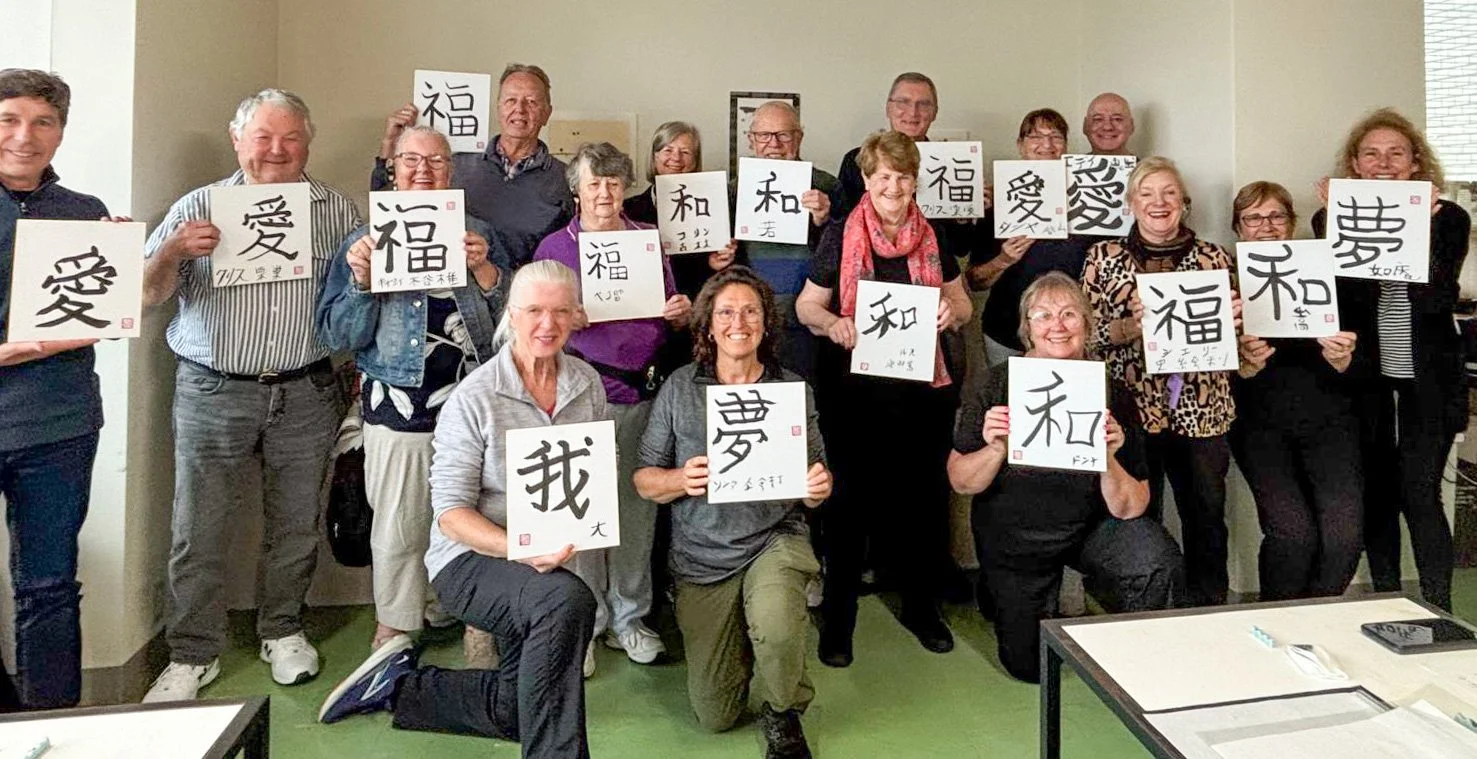
Our group showing our work at Japanese black ink calligraphy class
Before leaving the art centre we spent time in the centre’s souvenir shop where there were many beautiful Japanese paintings of all sizes for sale. In addition, there was a selection of jewellery, especially pearls and hand painted dishes with gold foil. An impressive range of kimonos were on display too as well as a number of beautifully dressed Japanese dolls.

Japanese doll, souvenir shop, local arts centre, Kyoto
It was still raining slightly when we left the art centre and were driven to the ‘Philosopher’s Walk’ in northern Kyoto.
With umbrellas in hand we walked on a stone path along the side of a narrow canal lined with cherry, maple and ginkgo trees. The cherry trees were past their best with the blossoms now being replaced by new leaves that glistened in the drizzly rain.

Our group walking along ‘Philosopher’s Walk’ in the rain
The walk is named after a Kyoto University philosopher who walked it daily deep in thought and these days it has become a place to seek peace and tranquility in amongst the avenue of beautiful trees.

Cherry blossom along ‘Philosopher’s Walk’

Tulips in garden, ‘Philosopher’s Walk’

Lily of the valley bush, commonly known in Japan as Asebi (Pieris japonica), ‘Philosopher’s Walk’
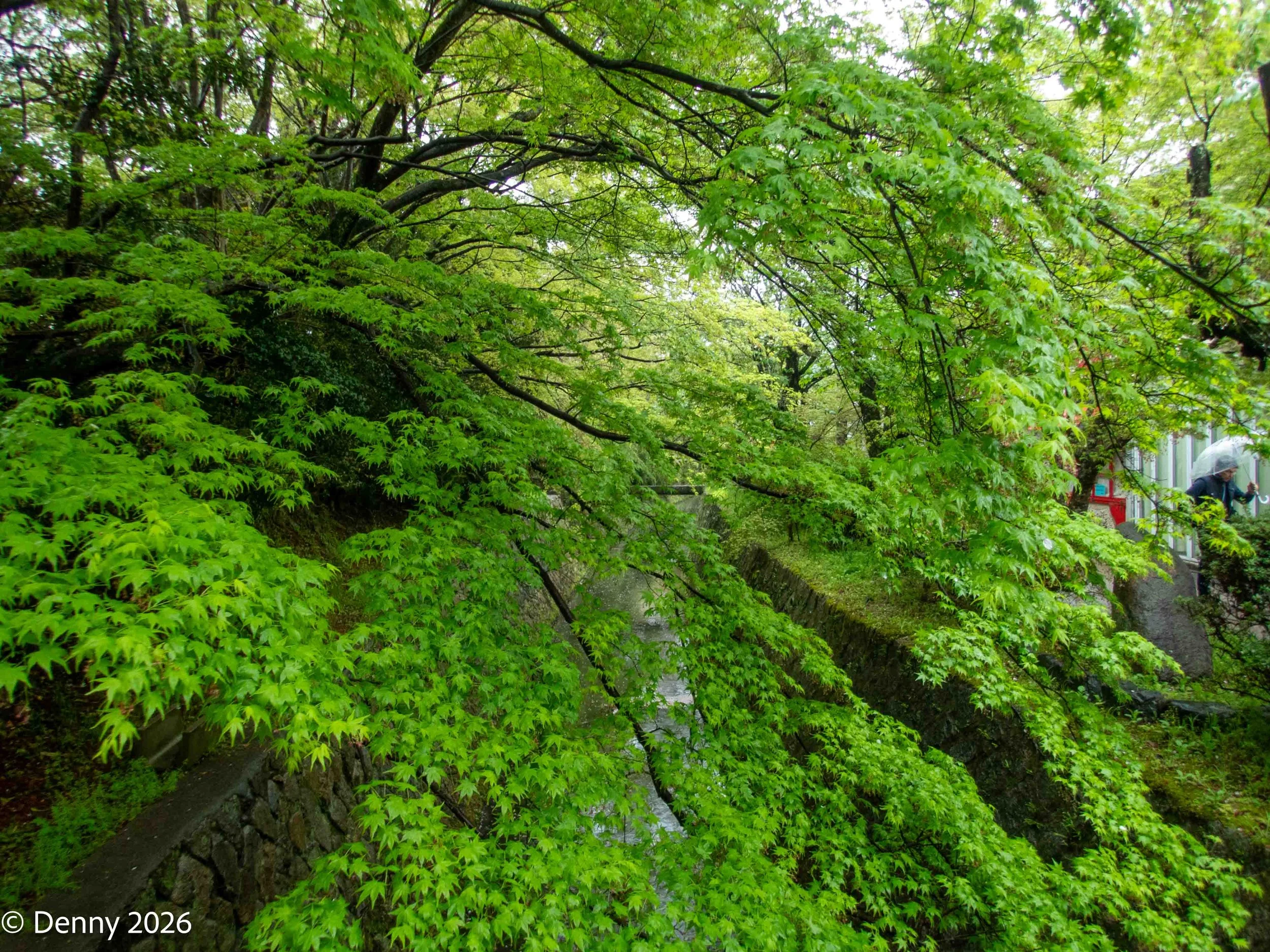
Small-leafed maple trees, often dwarf Acer palmatum cultivars, ‘Philosopher’s Walk’
We ventured into a little coffee shop on the edge of the canal and had a hot drink that was much appreciated, it being great coffee as well as an ideal hand warmer.

Coffee time watching the rain from inside a warm, dry cafe, ‘Philosopher’s Walk’
We returned to our bus and headed back to our Miyako Hotel. It was now approaching 13:00 and we have the afternoon as free time.
We took the opportunity of having no commitments to spend time catching up on our blog and labelling photos. Jacquie phoned and it was lovely to hear news of the Purden family’s recent holiday trip to Brisbane. It sounds as if the Sydney University physiotherapists’ reunion was a rip-roaring success.
We showed our daughter Jacquie the scene from our hotel window and she was interested to see the number of shinkansen trains passing through Kyoto Station which is directly opposite. A ‘bullet’ train is sighted about every four minutes!
After sunset with the rain now gone, we went to the Aeon Mall next door to our hotel. This is a five-storey collection of every imaginable shop apart from one selling the power-point adapter we needed to replace the plug we lost recently. We trapsed around for an hour or more and then crossed the road to look for a restaurant for tonight’s evening meal.
Nothing much appealed at first and then, eventually we found something to our liking. Unfortunately, there was a considerable queue outside waiting for a table so we abandoned the restaurant idea and took take-away meals and a (AU$5.50) bottle of Chilean Quinta Las Cabras chardonnay back to our hotel room. As there is no excise on alcoholic drinks in Japan, beer, wines and spirits are remarkably cheap. Incidentally, Japanese drivers are very upset as there have been recent price rises for fuel. Unleaded petrol is presently selling for about AU$1.55 a litre, up from $1.40.
We had a relaxing evening in preparation for a forecasted sunny day tomorrow when we visit Kyoto’s Golden Pavilion and later see how tofu is prepared.