
In an attempt to avoid yesterday’s problem of having to queue for breakfast, we decided to go quite a deal earlier but even at 07:15 there was a line-up although we didn’t have too long to wait before a breakfast table was available.
Our transport for today was only on trains and our first venture was to board the monorail at the nearby (U7) Daiba Station and head towards (U1) Shimbashi Station. At Shimbashi we transferred to the Ginza Line where our train took us through to Asakusa where we visited the Senso-Ji Temple area in the Shitamachi district often referred to as Tokyo’s ‘old town’.
To get to the temple we entered the Kaminari-mon or ‘Thunder’ Gate and walked along a densely packed tourist avenue called Nakamise-dori. There were souvenir shops on both sides but the crowd density made the thought of stopping to look, totally unrealistic.

Our group, Shitamachi district (Tokyo's 'old town')
The temple is popularly known as the Asakusa Kannon and is Tokyo’s most sacred and spectacular Buddhist Temple as well as its oldest.

Senso-ji Temple (oldest temple in Tokyo), Shitamachi district (Tokyo's 'old town')
According to legend, in 628 AD two fishers pulled up from the Sumida River a small golden statue of Kannon, the Buddhist goddess of mercy and in 645 AD a holy man Shokai had Senso-Ji Temple built to celebrate this remarkable event.
Since those early times more buildings have been added and fortunately the structures all survived the Great Kanto Earthquake of 1923. Some temple buildings were destroyed during the Allied bombings of World War II but have now been resurrected.
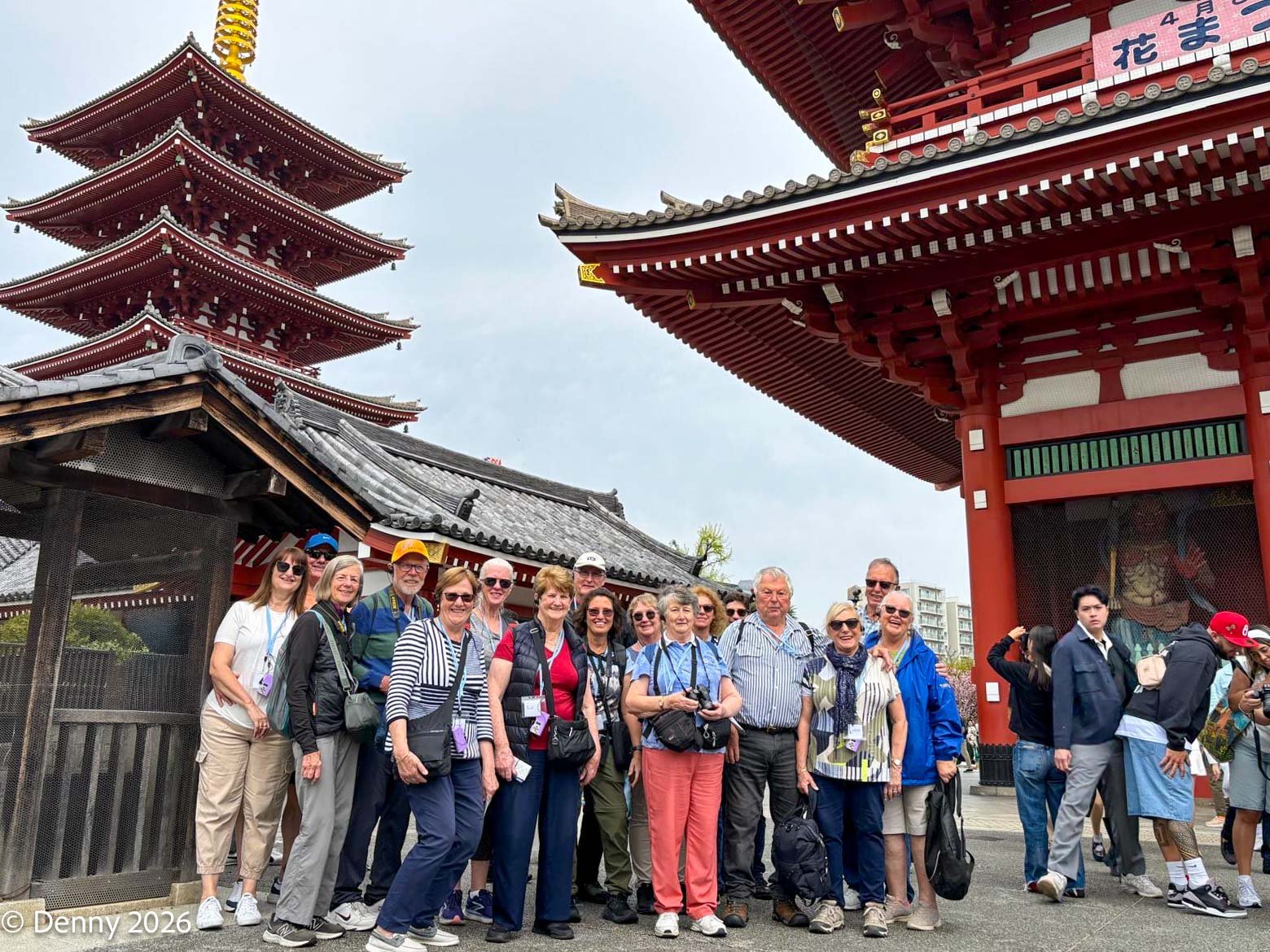
Our Bunnik group at Senso-ji Temple
The main gate is called the Hozo-mon Gate and has three arches each with a suspended, elaborate and massif lantern as a decorative feature.

Hozo-mon Gate, Senso-Ji Temple

Lantern, Hozo-mon Gate, Senso-Ji Temple
To the right of the main walkway is an aesthetically appealing five storey pagoda with a multi-disc golden spire. Despite it being a 1973 replica of the original pagoda, we are assured the pagoda contains the ashes of Buddha.

Five storeyed pagoda with a multi-disced golden spire
With an hour and a half of free time to explore the temple grounds, we wandered slowly through the laneways and gardens that cover a substantial area. Apart from the main Senso-Ji Temple we encountered several other small and beautiful temples including the Awasima-Do Temple and the Hashimoto Yakusi-Do Temple. We passed the Yogo-do Hall which houses eight Buddha Statues but was not open to tourists.

Temple garden
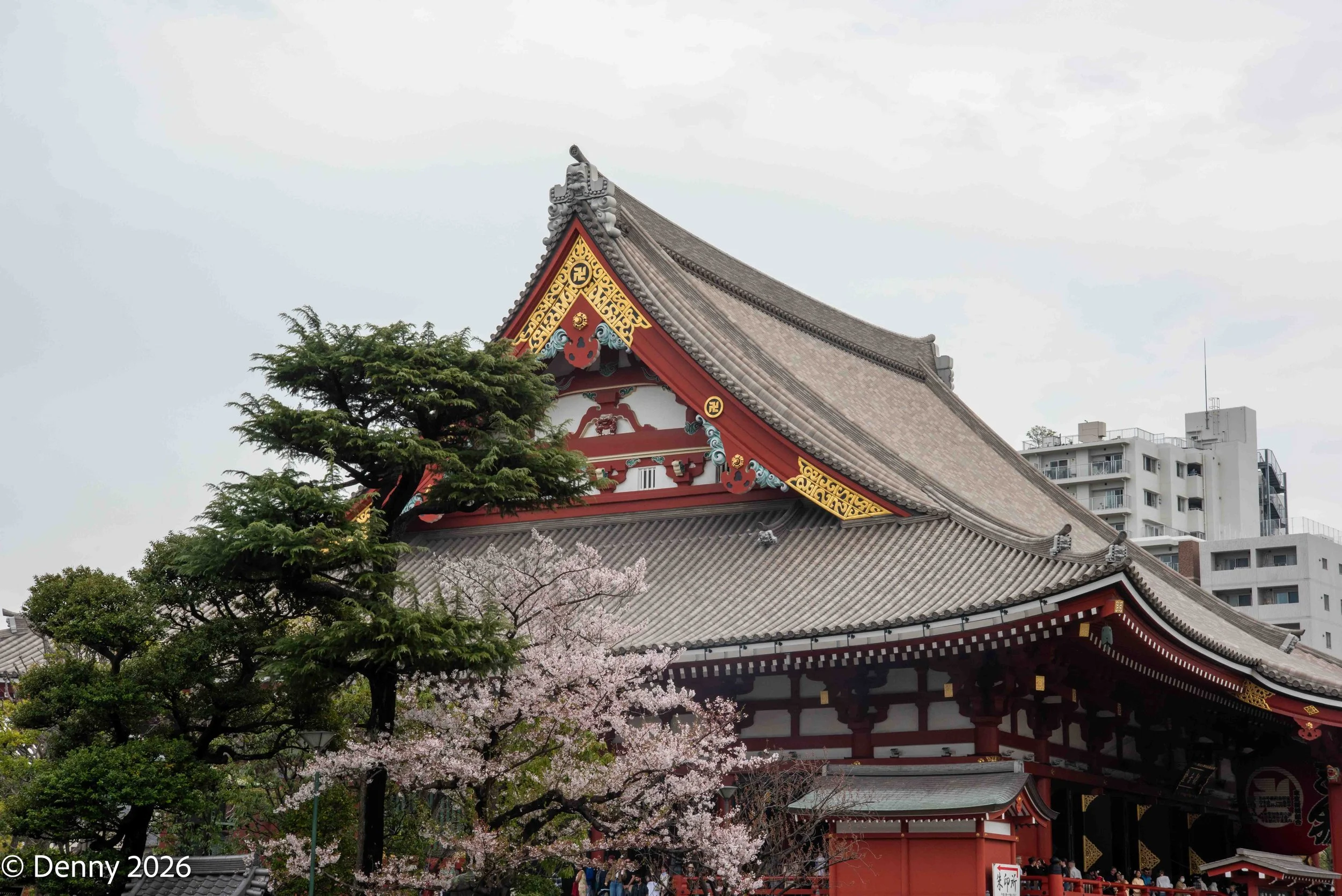
Temple garden

Temple

Wise monkey statue
Near the Yogo-do Hall we met and chatted with a mother and her daughter, Laura from Spain. The mother was originally from Bogata in Colombia and was keen to hear of our travels in South America. They were wearing beautiful kimono style dresses and were only too happy for us to photograph them.

Spanish girl and her mother wearing traditional costume
The main Senso-Ji Temple building was so crowded, it was difficult to take any photos although we managed to photograph part of the temple’s ceiling.

Crowd inside entrance to Senso-ji Temple

Ceiling panel, Senso-ji Temple
Outside the temple was a large incense burner making the atmosphere smoky and non-ideal for photos. Near this burner is one of the oldest remaining temple buildings called the Asakusa-Jinja built in 1649. This temple is dedicated to the two fishers who found the Kannon Statue fourteen hundred years ago.

Crowd and smoke outside Senso-ji Temple
It was time to move on and our group then walked for ten minutes down Nakamise Street to the Asakusa Sumo Club for two hours of pure entertainment.
We were seated in a small, one hundred person theatre with tiered seats either side of a central circular wrestling ring.
Before any activity started, we were provided with a prepared meal where the food, including fungi had to be cooked for several minutes in a broth heated in a hot-pot with our own individual fuel burner. This is a traditional Chanco-Nabe sumo lunch.
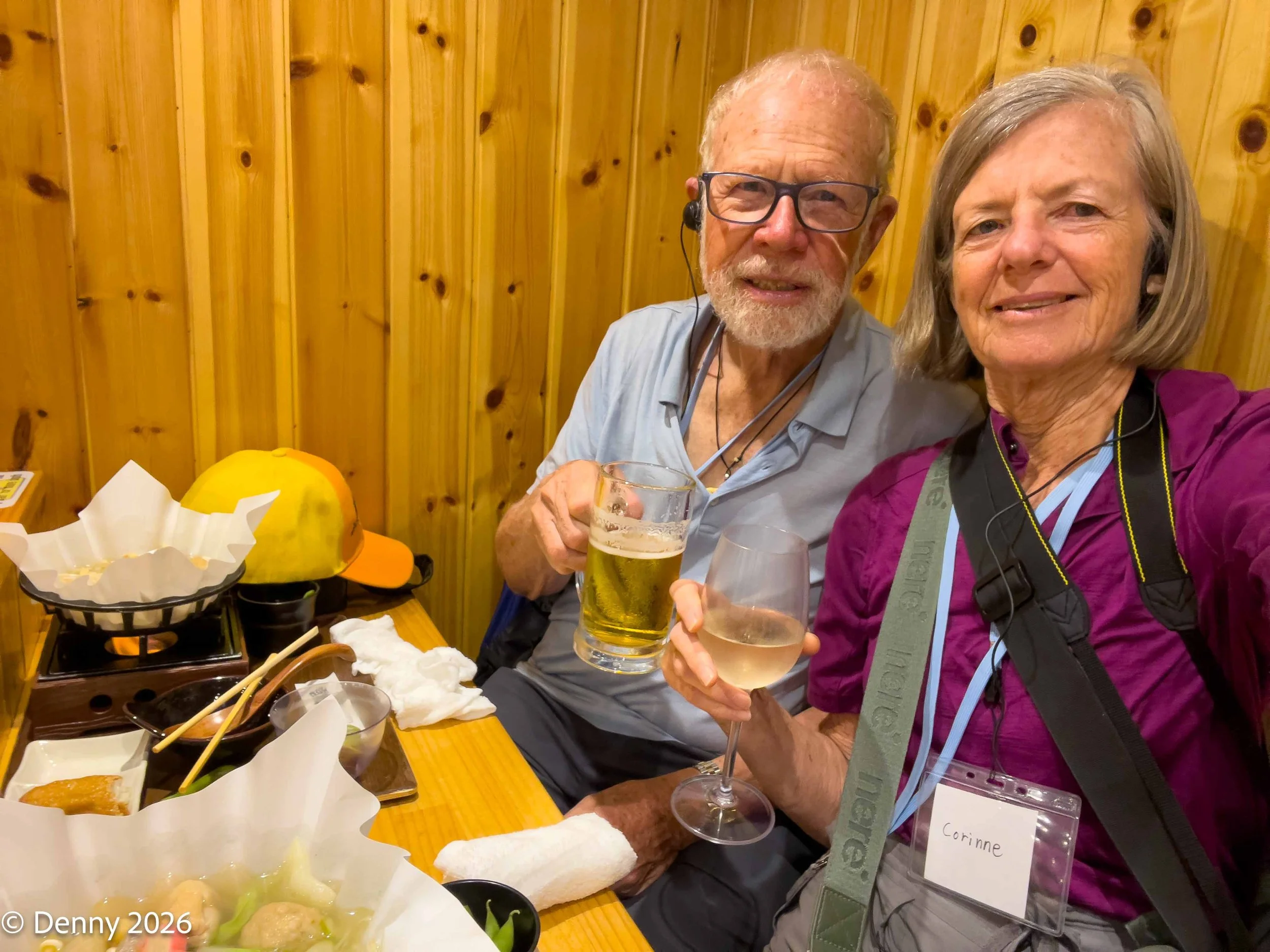
Jak and Corinne, lunch at Asakusa Sumo Club
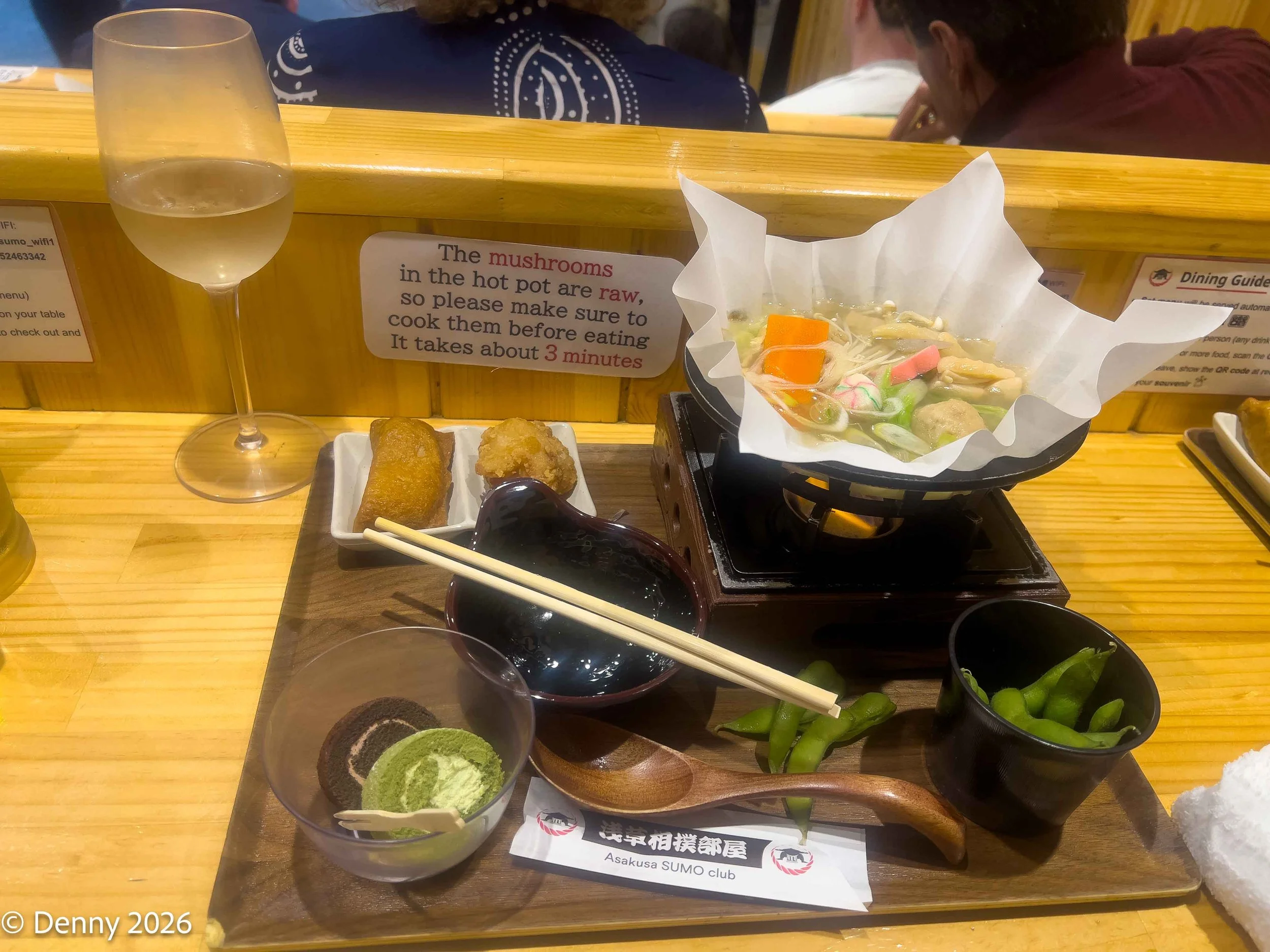
Our meal, Asakusa Sumo Club
The master of ceremonies introduced the first act which was a Geiko girl who performed a very elaborate dance in her traditional kimono costume. We were informed that the term ‘Geisha’ is definitely inappropriate these days as it infers prostitution whereas Geiko translates to a ‘woman of art’.
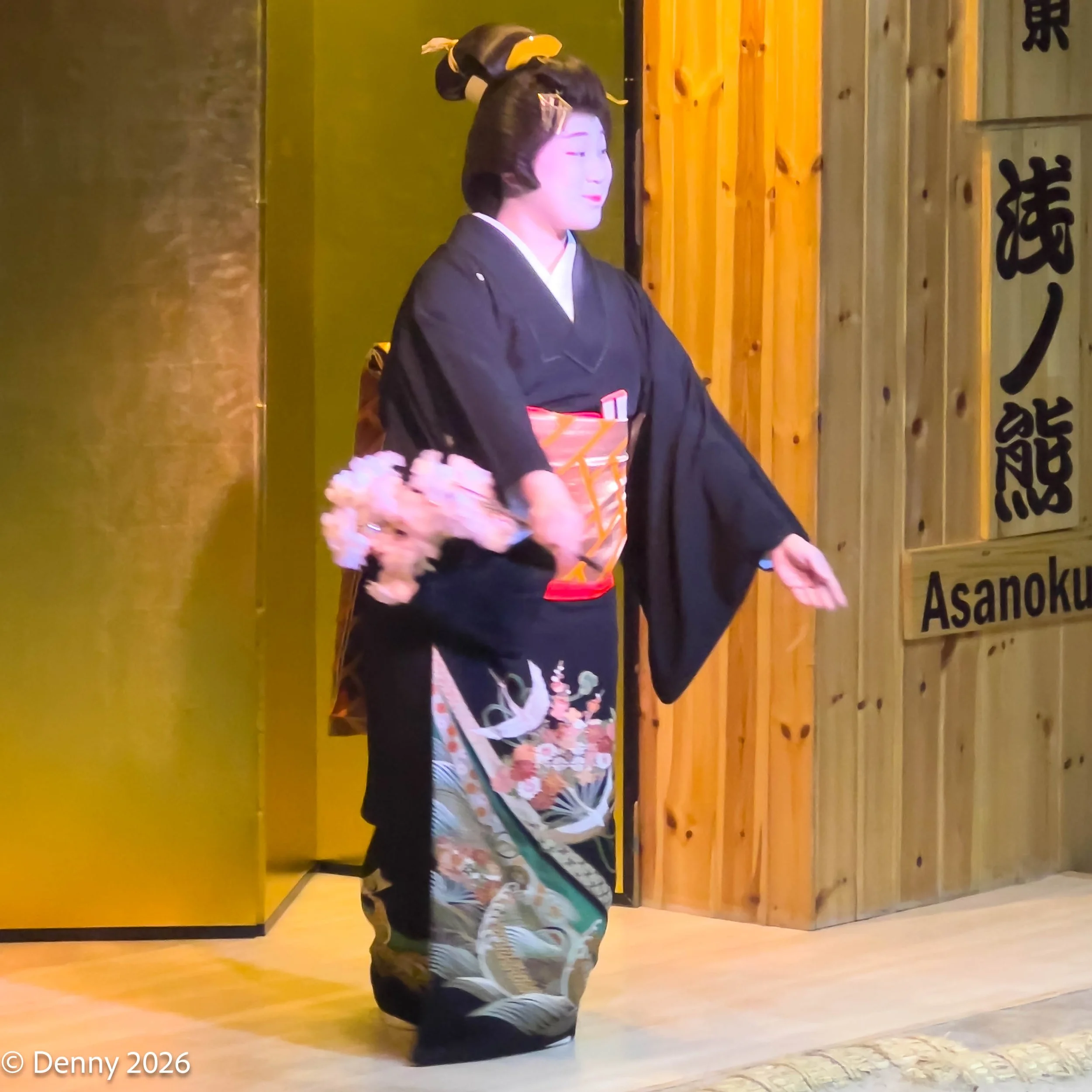
Geiko girl, Asakusa Sumo Club
The two sumo wrestlers were introduced with much cheering and table banging and the MC directed them to demonstrate a series of moves involving rules and rituals of this 1500 year old national sport.
It was not to be just a serious wrestling competition but more of a theatrical performance with comedy and audience participation high on the agenda. The two wrestlers were consummate performers and had the crowd enraptured with their strength and agility.
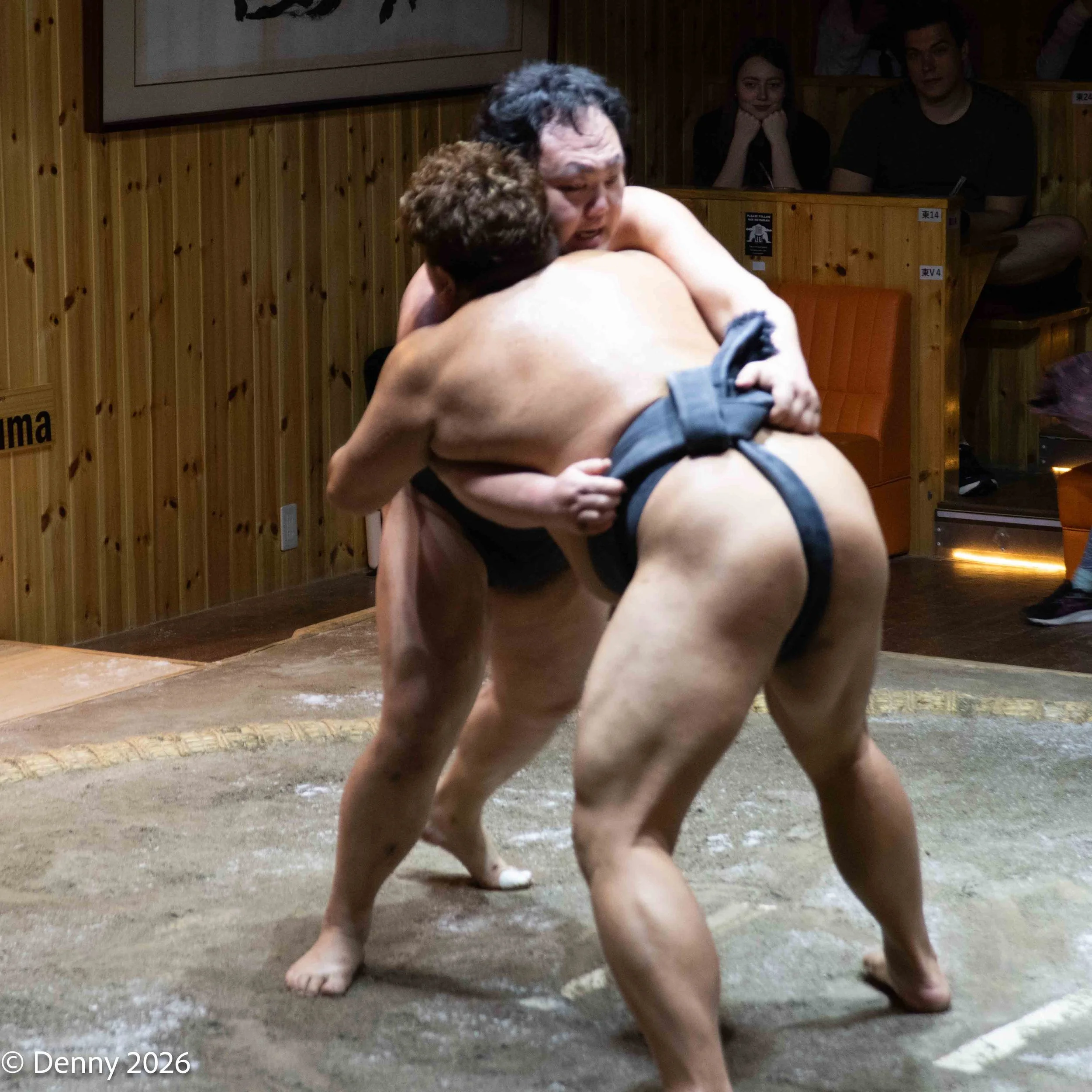
Sumo wrestlers, Asakusa Sumo Club
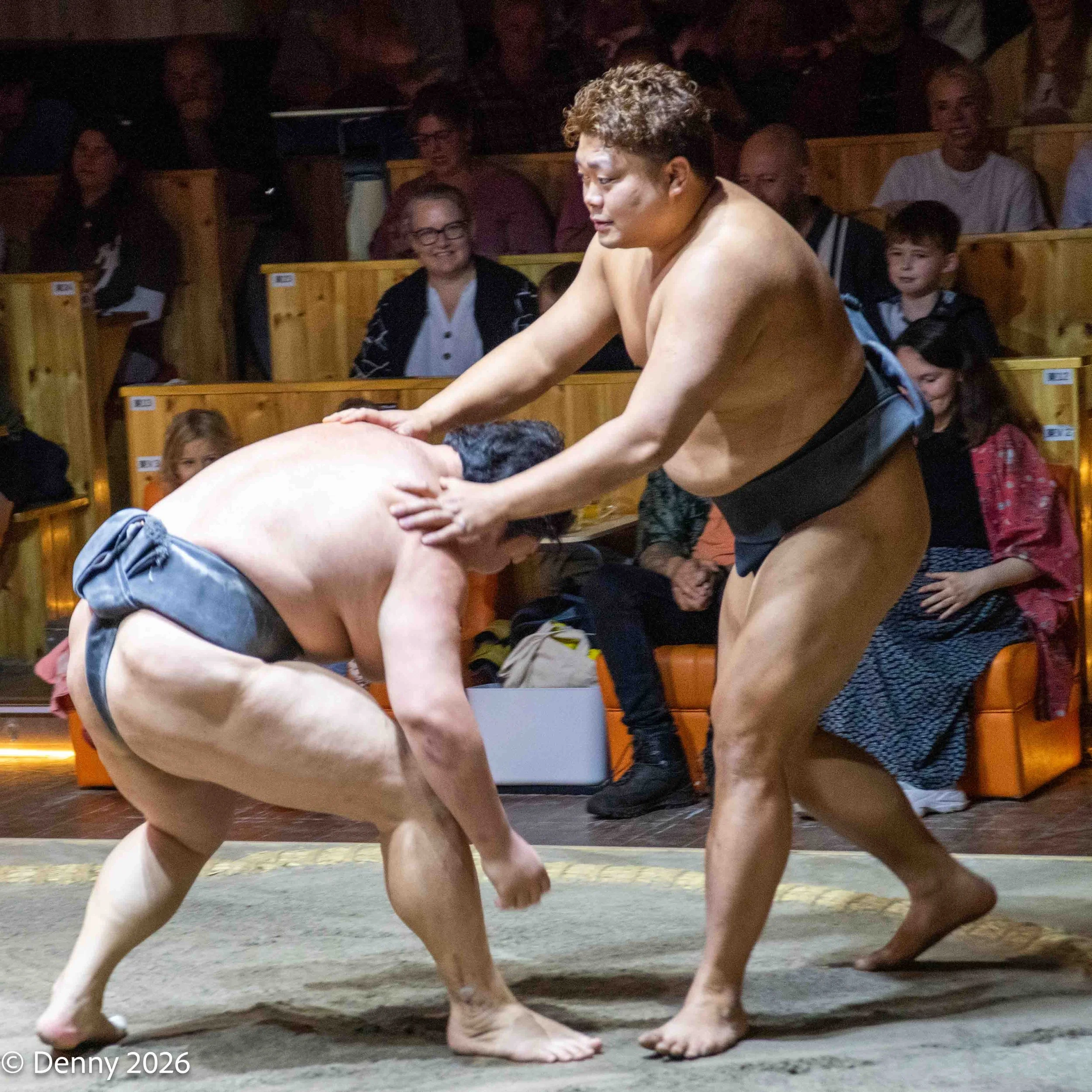
Sumo wrestlers, Asakusa Sumo Club
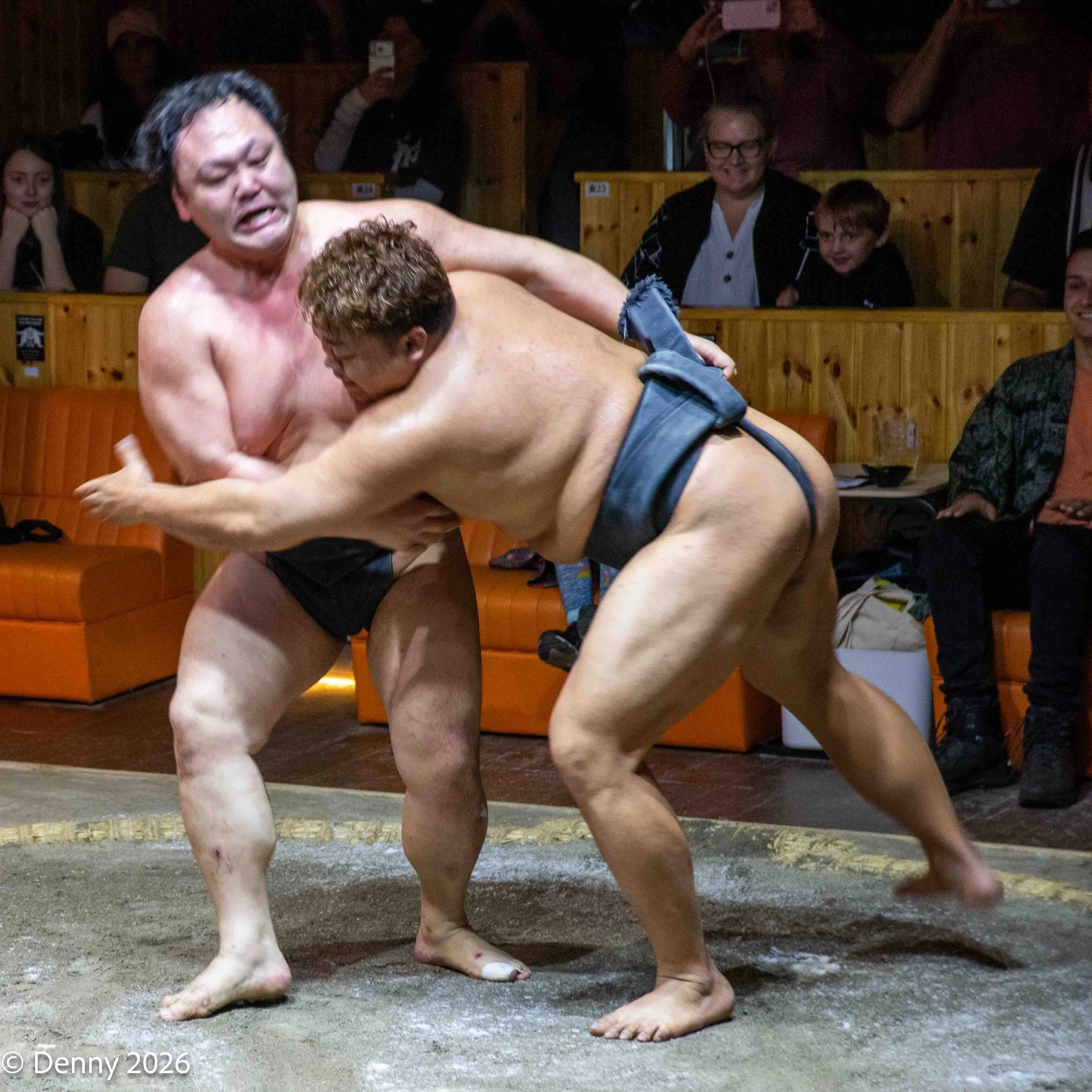
Sumo wrestlers, Asakusa Sumo Club
To end the most enjoyable session, nine people from the audience were invited to compete against the sumos. The totally dominant Japanese wrestlers were never going to be beaten but in some instances they feigned a defeat much to the amusement of the audience.
Linda, from our Bunnik group was the only female participant in the competition against the sumo wrestlers. Linda wore an air inflated costume that made her appear to be 200 kg and she defeated the sumo!

Linda from our group with Sumo wrestlers, Asakusa Sumo Club
It was now mid-afternoon so we then returned to our hotel to experience some relaxing time away from the frenetic activity and noise of the morning’s visit.

Sunset from our room, Grand Nikko Tokyo Daiba, Tokyo
Tomorrow we leave Tokyo and our destination is the scenic mountain town of Hakone.