
Much of the morning was to be spent in Nara, a city one hour’s drive east of Osaka.
Founded in 710 Nara developed to become one of Asia’s most admired cities due to its natural beauty, tranquilty and the position of being the grand diocese of Buddhism. Despite being separate from the Chinese mainland Nara was the principal far eastern destination on the Silk Road.
Our trip to Nara was to visit the Todai-Ji Temple which is the headquarters of the Kegon school of Buddhism.
The main entrance gate to the temple is the Nandai-mon (Great South) Gate. This massive wooden structure is 25 m high and a National Treasure having been rebuilt in 1203. It is the largest temple gate in all of Japan.

Nandai-mon (Great South) Gate to Todai-Ji Temple, Nara

Inscription on Nandai-mon (Great South) Gate to Todai-Ji Temple, Nara

Eaves on Nandai-mon (Great South) gate to Todai-Ji Temple, Nara
It features eighteen massive wooden pillars and on either side of the entrance way there are two eight metres tall, 13th century gruesome Nio Guardian Kings, sculptured from wood by Unkei and Kaikei. The gate is so impressive that it alone would make a trip to Nara worthwhile.

Nio Guardian King, Nandai-mon (Great South) gate to Todai-Ji Temple, Nara
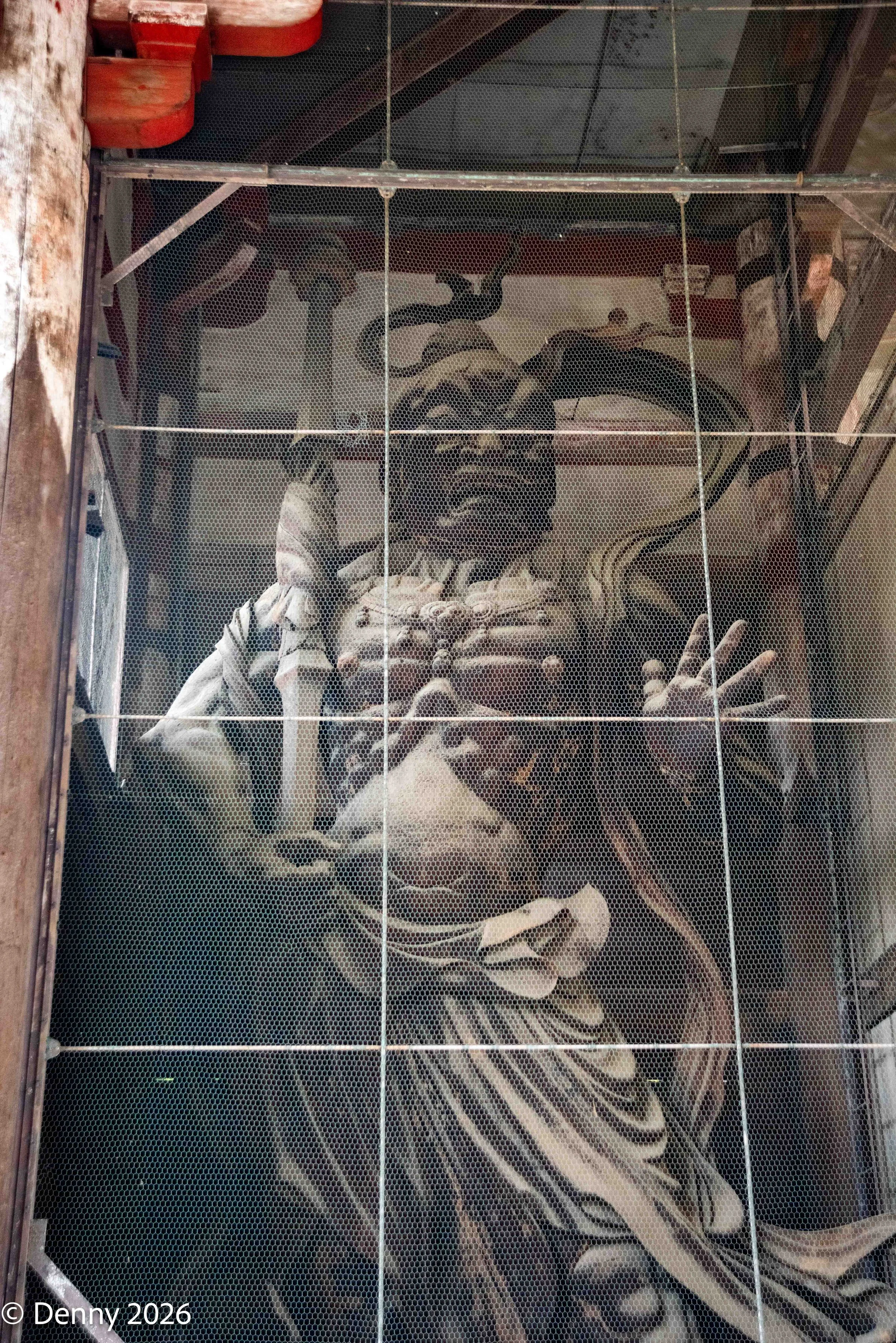
Nio Guardian King, Nandai-mon (Great South) gate to Todai-Ji Temple, Nara
We then walked across to the main temple area, avoiding the many deer that pester tourists for food.
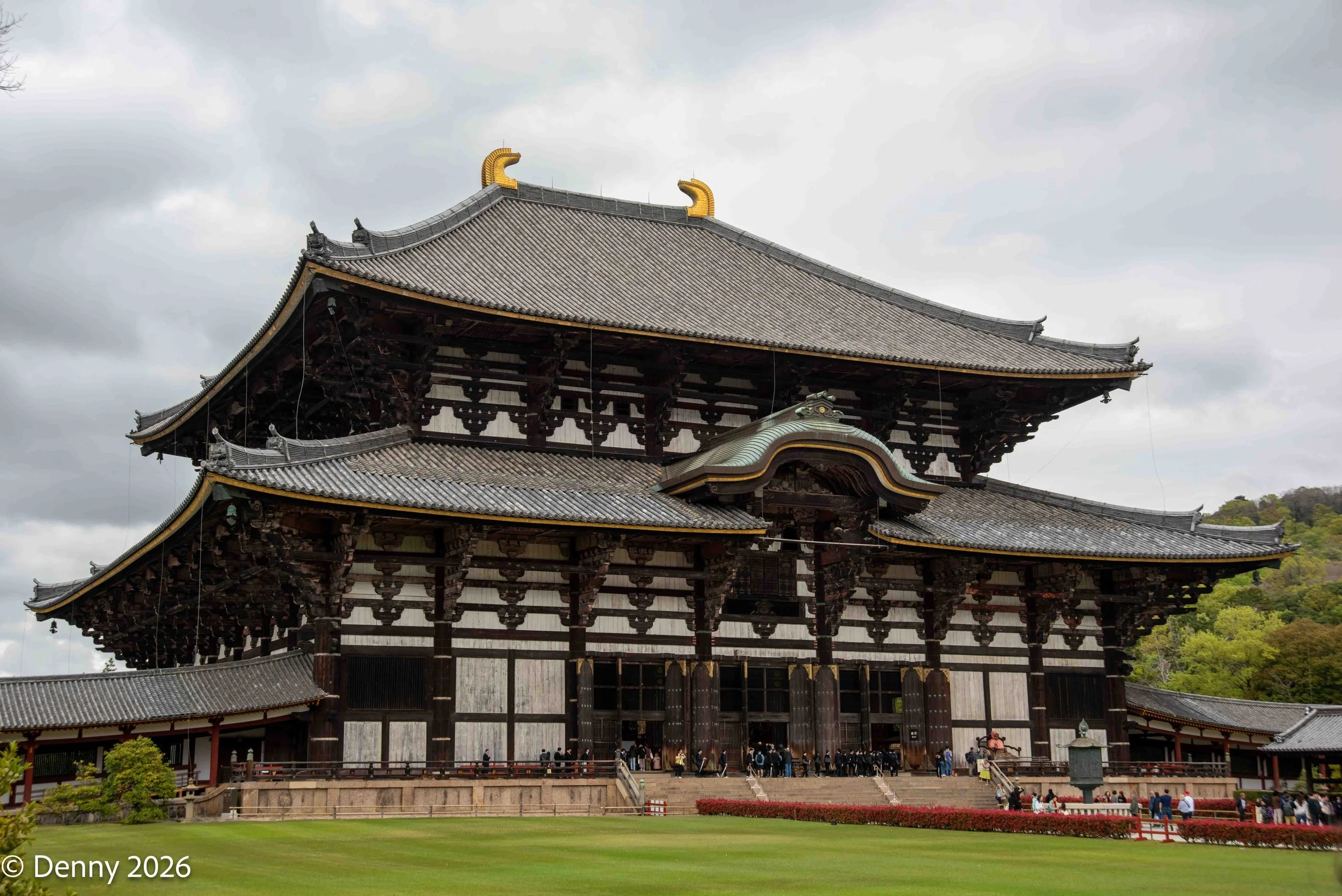
Great Buddha Hall, Todai-Ji Temple, Nara
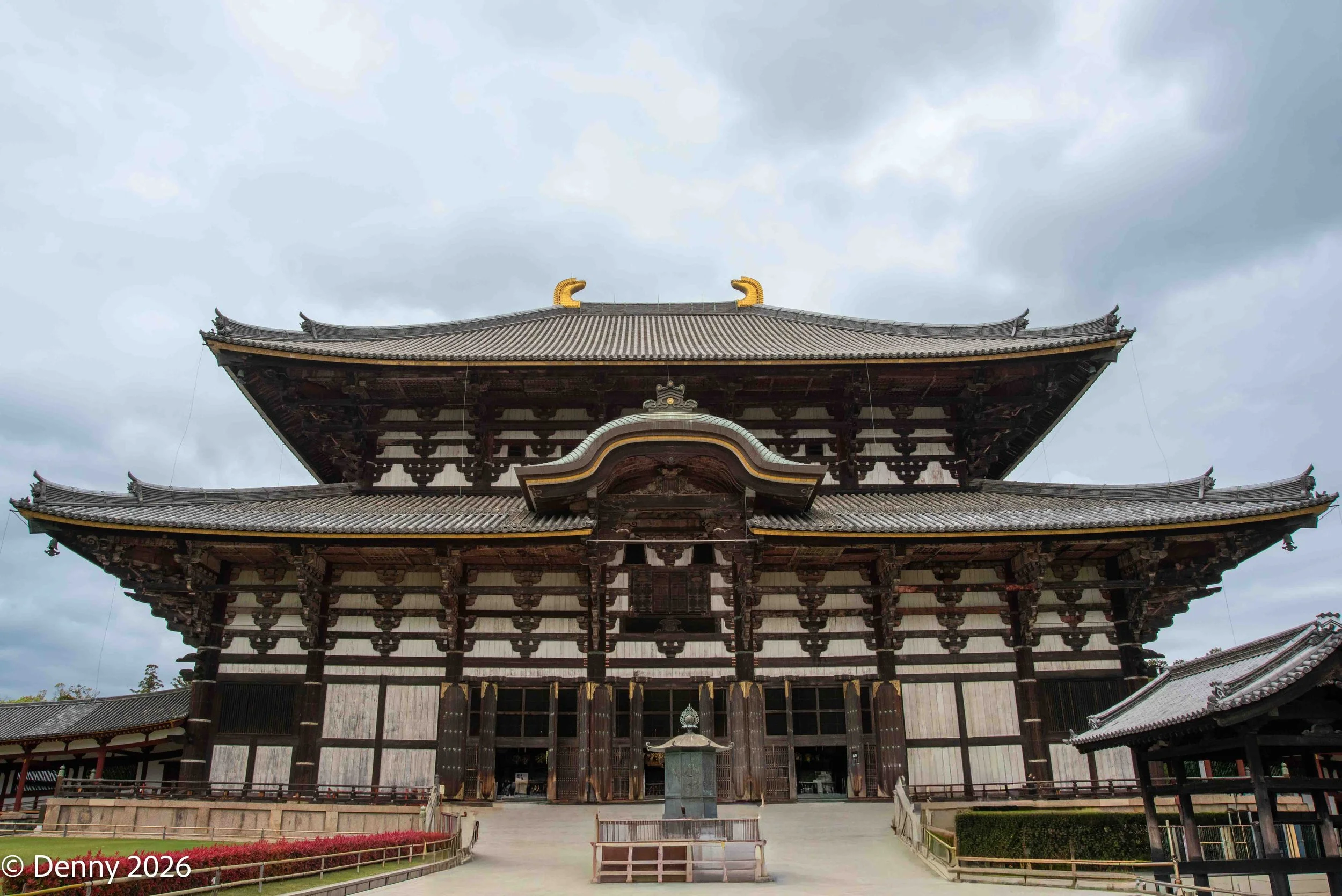
Great Buddha Hall, Todai-Ji Temple, Nara
Just outside the temple’s main entrance is a large octagonal bronze lantern and being cast in around the year 752 AD, it is one of the temple’s oldest treasures.

Octagonal bronze lantern at entrance to Todai-Ji Temple, Nara
The construction of the Todai-Ji Temple was ordered by Emperor Shomu in 743 AD, ostensibly to house the Great Buddha image but also to consolidate the position of the city as the capital and powerful centre of Buddhism.
The temple is a World Heritage Site and comprises the Great Buddha Hall, sub-temples, other halls, pagodas and gates including Nandai-mon.
The most impressive part is undoubtedly the Great Buddha Hall. It has been rebuilt twice since the 8th century and the current structure completed in 1709 after an earthquake is only two-thirds the size of the original hall. Despite this being a smaller structure, it is still reputedly the largest wooden building in the world.
Inside, the focal point is the seated statue of the Great Buddha. At 16 m high it is the world’s largest bronze image of Buddha. The casting of the Great Buddha in 752 AD used hundreds of tonnes of molten bronze, mercury and vegetable wax.

Statue of the Great Buddha, Todai-Ji Temple, Nara
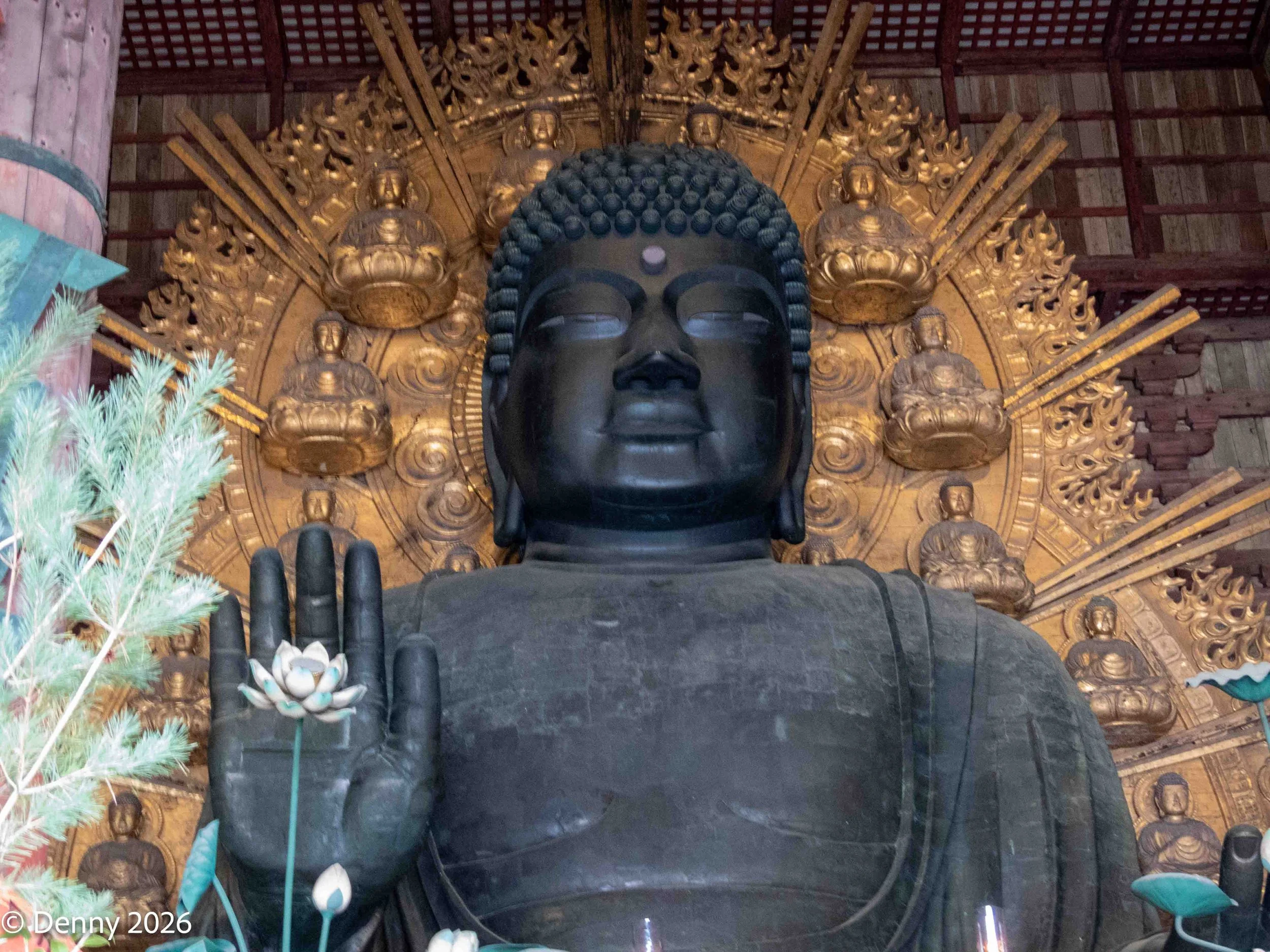
Statue of the Great Buddha, Todai-Ji Temple, Nara
A point of interest is a small hole bored through a large wooden pillar just behind the Buddha. A popular belief holds that if you can squeeze through the hole, you will be protected from bad things happening in the future.
In 1692, after fires and an earthquake, the Buddha image was severely damaged and a new head had to be cast as a replacement. It is the one in place today.
On either side of the Great Buddha are two golden Bosatsu statues representing ‘Enlightened Beings’. These protective servants ensure that the Buddha is not affected by evil issues.
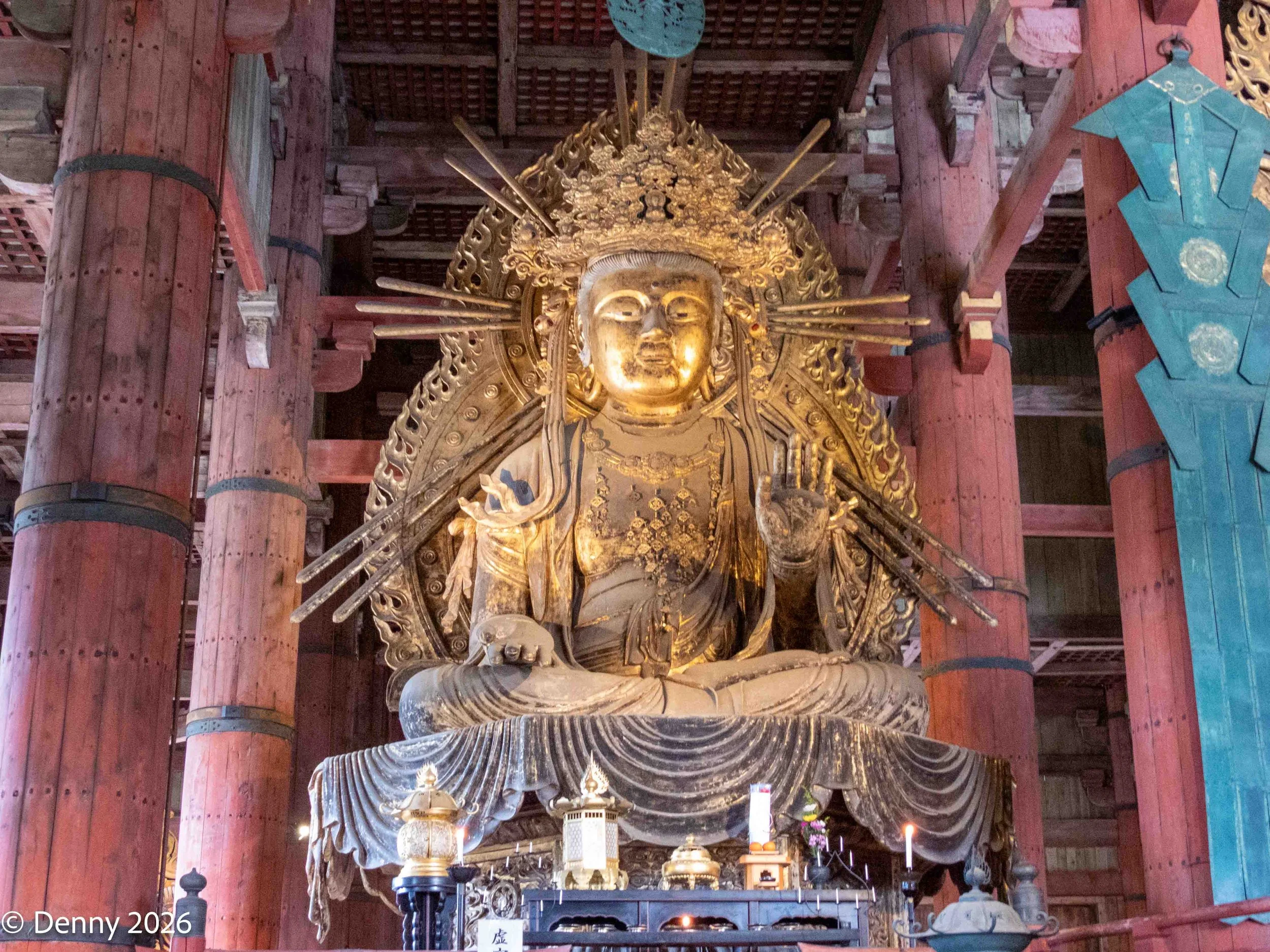
Bosatsu statue, Todai-Ji Temple, Nara
On the morning of August 7th each year, 120 priests in white robes and straw sandals undertake the task of ‘dusting down’ the image which require some to abseil down Buddha’s face.
At the exit point to the temple we noticed several priests writing Buddhist text in very stylish calligraphy. These messages were for both personal enlightenment and to presumably boost the temple’s finances.
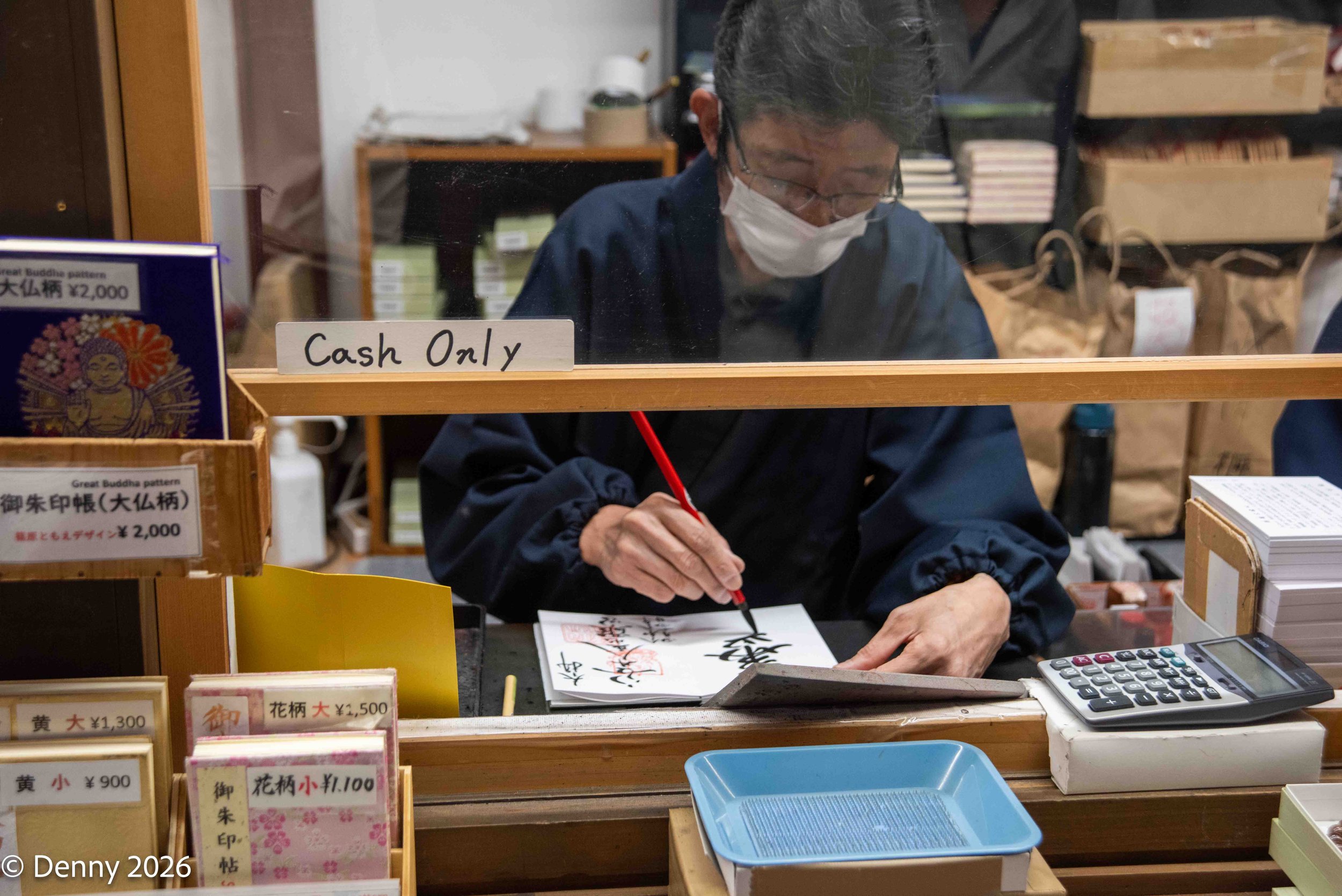
Priest writing buddhist text, Todai-Ji Temple, Nara

Flowers at exit from Todai-Ji Temple
The temple organises a Great Music Experience each May and internationally famous names like Bob Dylan, Jon Bon Jovi, INXS and Joni Mitchell have performed here at the temple for the four night festival.
We departed the Great Buddha Hall and took photos of the golden nine tiered pagoda with its sorin (spire) that sits atop the pagoda.

Golden nine tiered pagoda with its sorin (spire) that sits atop the pagoda, Todai-Ji Temple, Nara

Sorin (spire) that sits atop the pagoda, Todai-Ji Temple, Nara
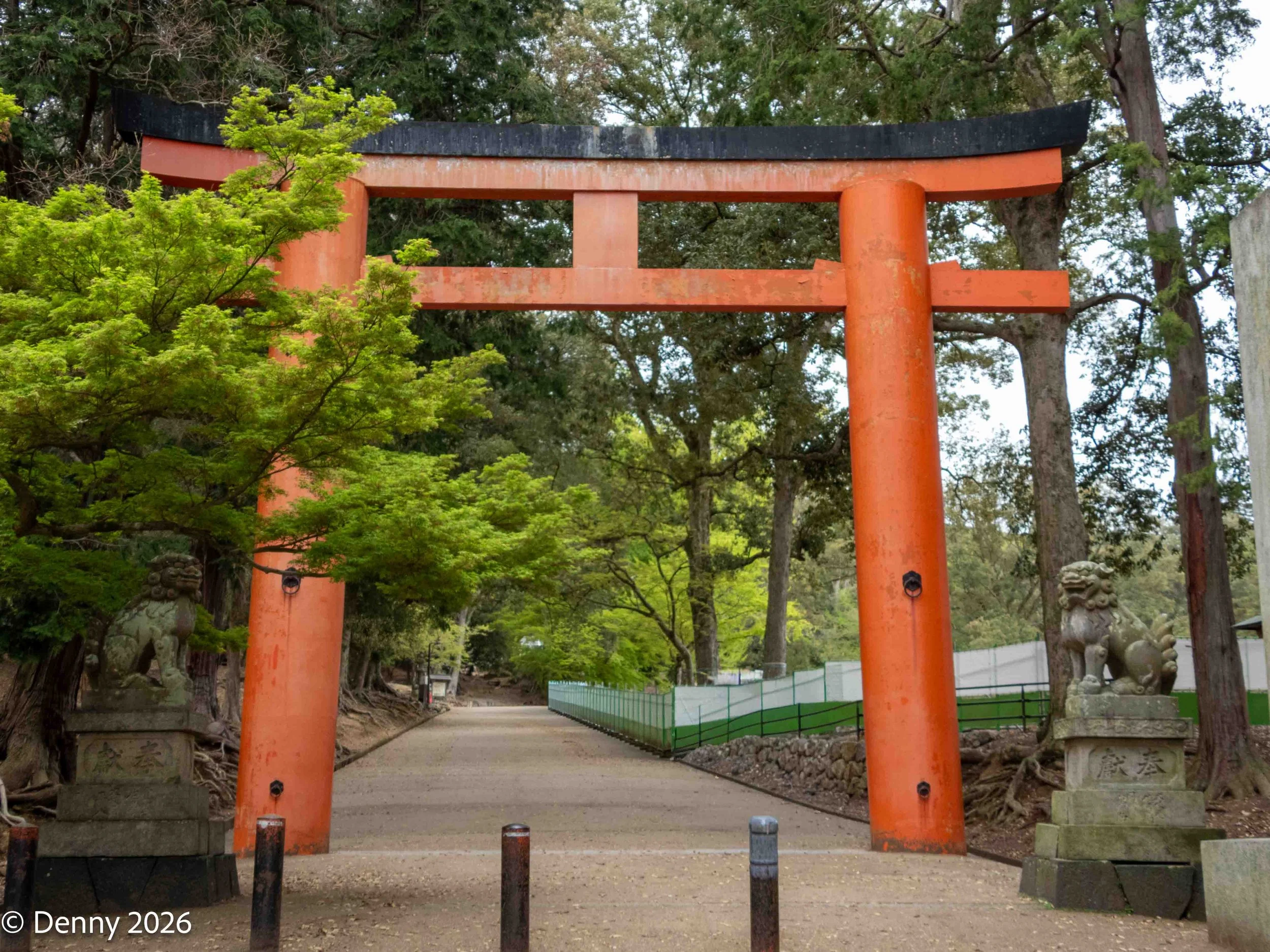
Gate, Todai-Ji Temple, Nara
After a coffee break we returned to our bus and were driven back to Osaka by which time it was now raining quite heavily.
The next two and a half hours were spent in rainy weather in one of Osaka’s popular shopping precincts. The walkway was overly crowded with most people holding umbrellas. The tricky bit was avoiding being poked in the eye and at the same time side-stepping to bypass puddles.

Our group walking in the rain, Osaka
We did not find this much fun and so we walked along a one kilometre covered arcade and eventually found a coffee shop where we could spend time out of the weather and able to eat lunch we’d bought earlier in the day.

Shoppers in the under cover shopping arcade, Osaka
This fairly miserable shopping spree terminated with us rejoining the bus and being dropped off at a small centre that invites tourists to discover the ‘Way of the Samurai’ at the Japan Tatedo Association.
A group of experts showed us the basics of sword positioning and the various movements together with the loud guttural vocal effects.

Demonstration oif the ‘Way of the Samurai’ at the Japan Tatedo Association, Osaka

Demonstration oif the ‘Way of the Samurai’ at the Japan Tatedo Association, Osaka

Demonstration oif the ‘Way of the Samurai’ at the Japan Tatedo Association, Osaka
The artistry of the samurais was compelling as they performed some exceedingly well choreographed tussles and later acted out several amusing skits with pretend samurai fights between two males and later one where both males were defeated by a very competent female.
Later, members of our group were invited to perform the basic sword actions and then participate in a mock fight. Much merriment prevailed and the samurai acting using wooden and blunt ‘swords’ wasn’t a cause for any bloodshed.
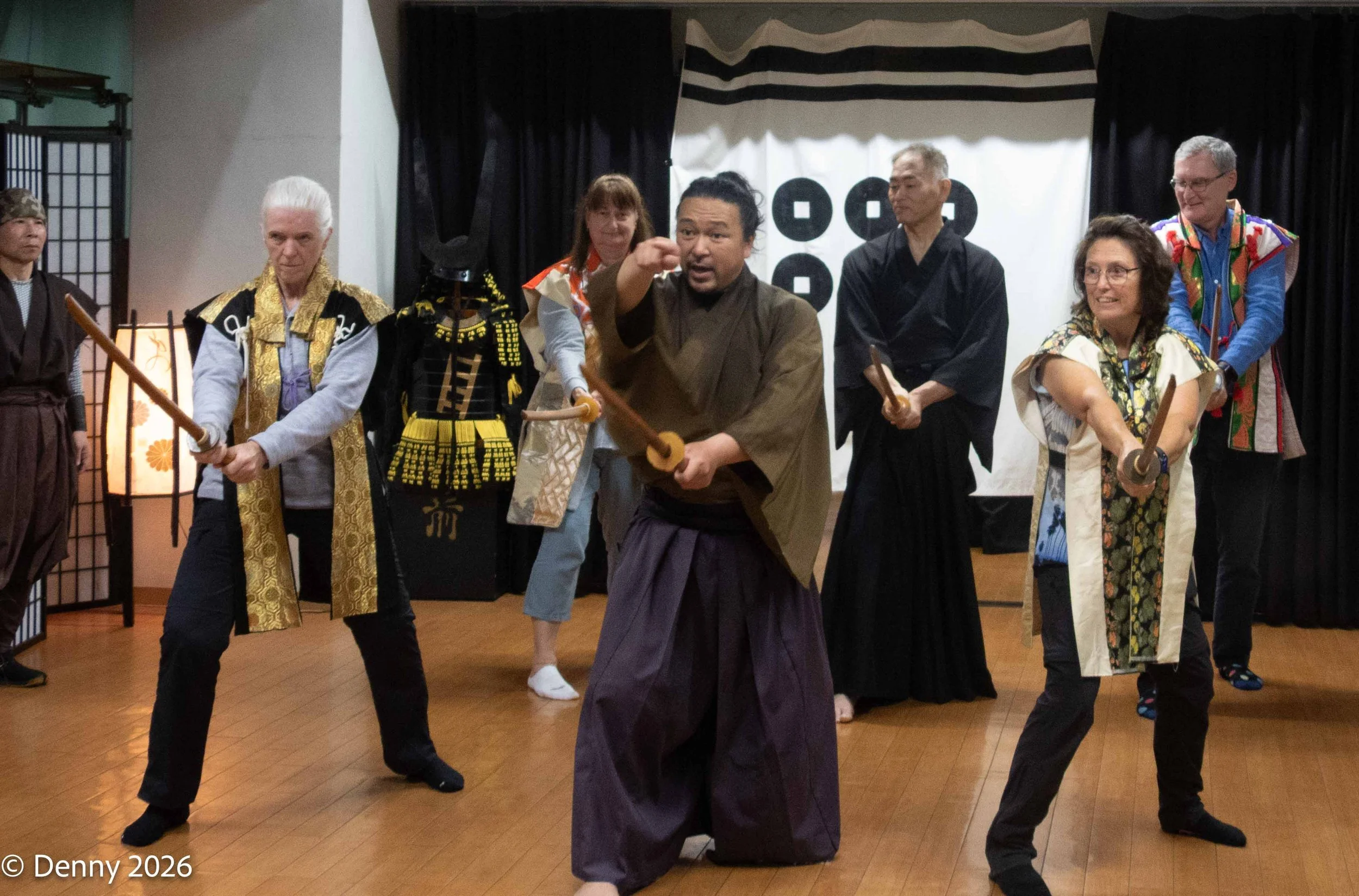
Some of our group learning the ‘Way of the Samurai’ at the Japan Tatedo Association, Osaka
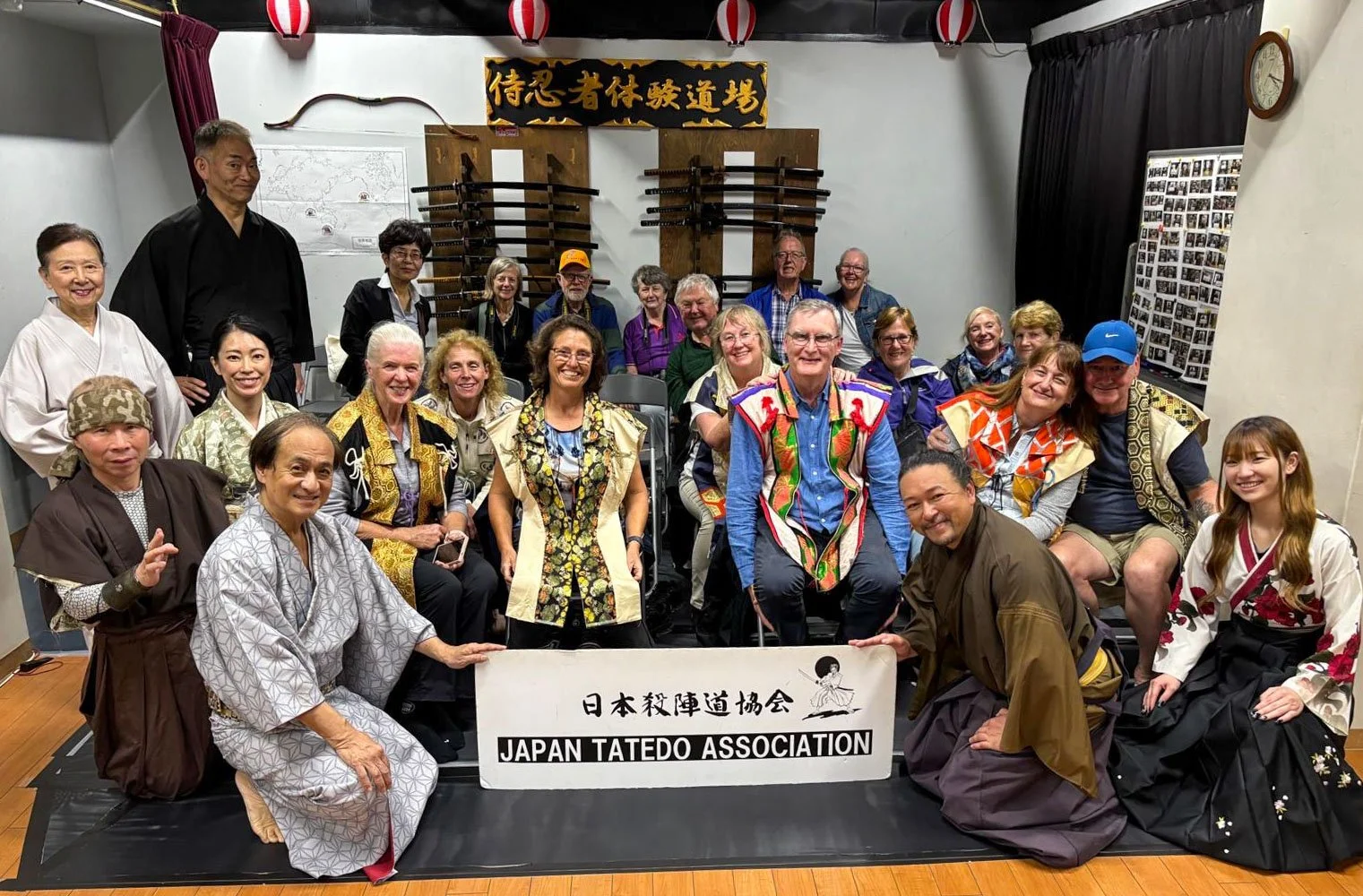
Group photo at Samurai experience, Osaka
This evening our ‘Japan Discovery Tour’ terminated with a nine course dinner comprising a key selection of Japan’s culinary specialties. The food was amazingly varied and beautifully presented with unlimited drinks being an added bonus.

Dinner menu, ‘Japan Discovery Tour’ Group, Sheraton Miyako Hotel, Osaka

Appetiser, ‘Japan Discovery Tour’ group dinner

Fifth course, ‘Japan Discovery Tour’ Group dinner

Dessert, ‘Japan Discovery Tour’ Group dinner
Tomorrow morning, after a very early breakfast, at 07:20 we leave our Sheraton Hotel for Osaka Kansai International airport and the start of our homeward journey.