
A glorious morning greeted us as we prepared for a lengthy train trip to Kyoto, the former capital of Japan.
The first leg of our journey involved the Limited Express Hida #6 that departed Takayama precisely at 09:36 bound for Nagoya. This was to be a two and a half hour trip in the opposite direction to our train trip on Tuesday, but whereas Tuesday’s trip was in rainy conditions, todays was in sunshine.

Staff wishing us a great journey from the plaform at Takayama
The pink and white cherry blossoms adjacent to the railway line as well as high on the gorge hillsides were resplendent and very obvious, contrasting against the deep green of the cypress and cedar (sugi) conifers. Although we were too slow to get a photo, we passed one famous cherry tree quite close to the railway line that is purported to be over a thousand years old.
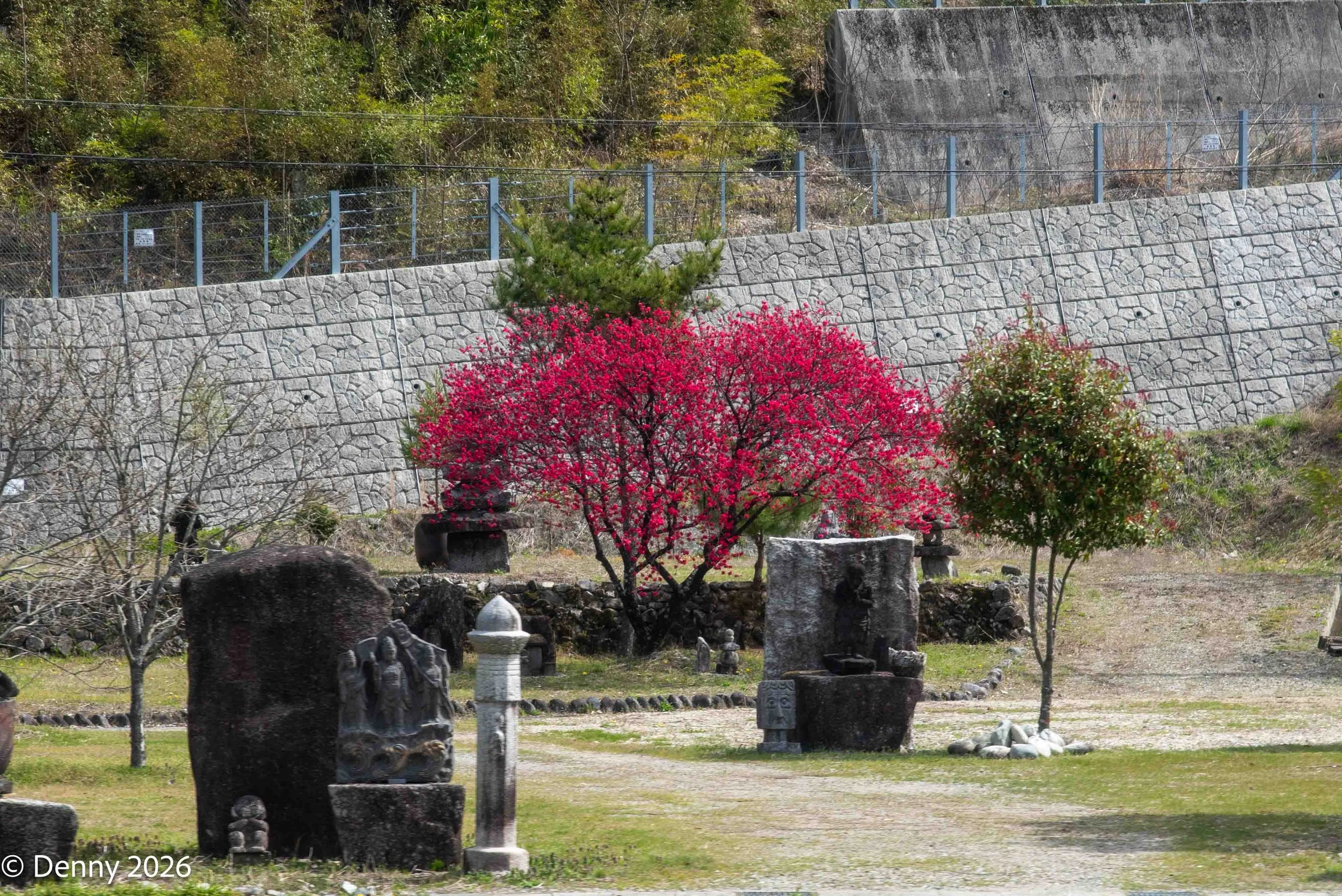
Cherry blossom in village beside railway from Takayoma to Nagoya

Cherry blossom on hillside from fast express train, from Takayama to Nagoya

Farmland viewed from fast express train, from Takayama to Nagoya

Cherry blossom on hillside from fast express train, from Takayama to Nagoya

Cherry blossom on hillside from fast express train, from Takayama to Nagoya
On arrival at Nagoya, we made a quick dash to the shinkansen line for our bullet train trip to Kyoto.
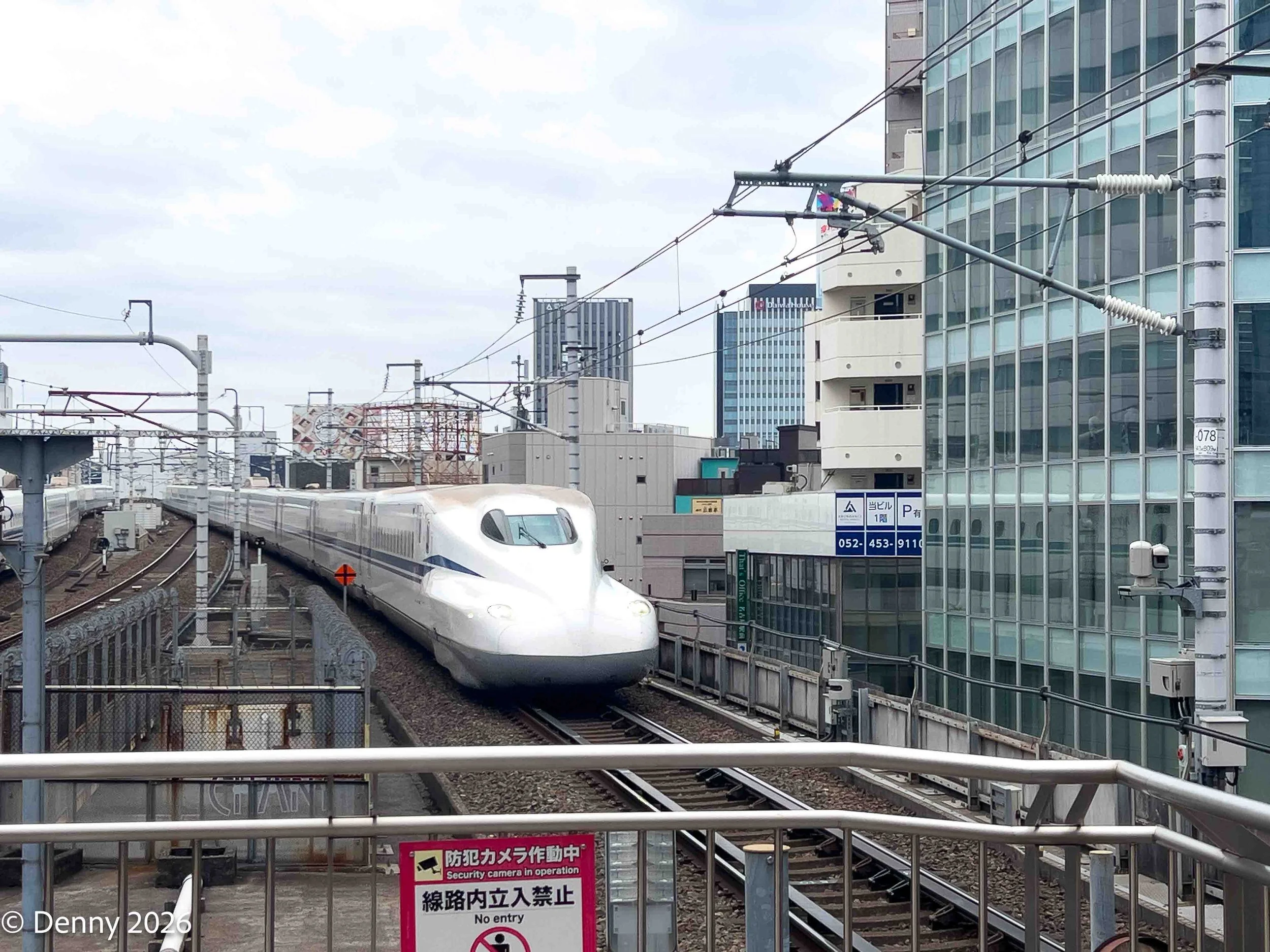
Our bullet train to Kyoto arriving at Nagoya

Station attendant for our bullet train tfrom Nagoya to Kyoto
This high speed train had us arriving at Kyoto just thirty five minutes later. Mitzie did a fantastic job getting all our group together and through the station crowds to our waiting bus which was parked quite close to the Kyoto Railway Station.
Our afternoon’s activities commenced with a visit to the Kizakura Sake Brewery where just outside the brewery entrance was the first yellow cherry blossom tree we’d seen.

Yellow cherry blossom outside Kizakura Sake Brewery, Kyoto
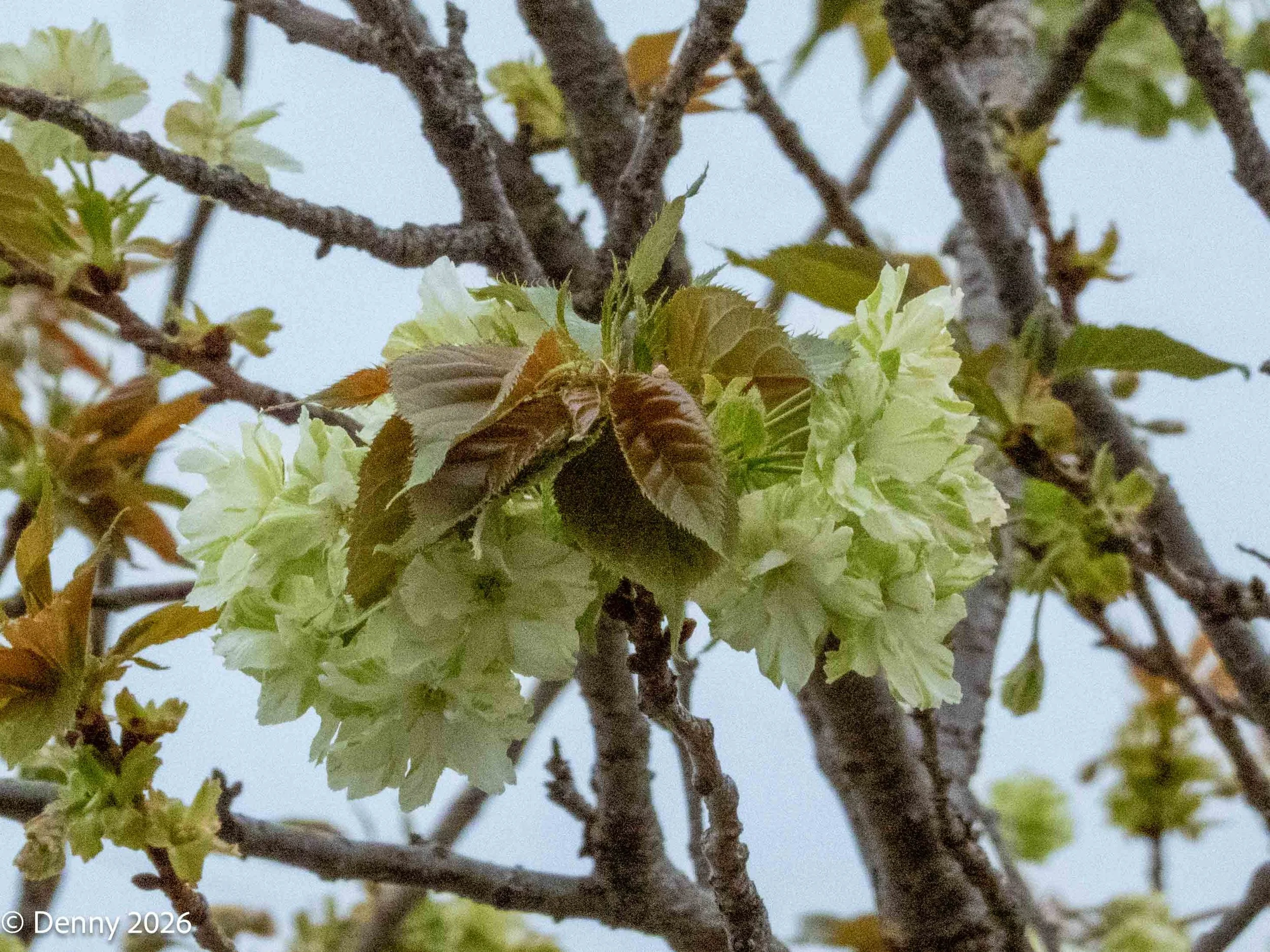
Yellow cherry blossom outside Kizakura Sake Brewery, Kyoto
The tour started with a brief video summarising the brewing of sake.
Apparently, the quality of sake is principally determined by the type of rice grain used and the characteristics of the water. The rice that’s regarded as the best for sake production is Yamada Nishiki rice. The brewery uses only the famous Fushimi (‘hidden’) spring water drawn from underground wells in southern Kyoto as it has the right balance of minerals and allows the fermentation process to occur at low temperatures.
Produce at Kizakura Sake Brewery
We sampled two different types of Kizakura sake. One was called Perle that was a bit nondescript and the second was called S Junmai Daiginjo and it had a much more interesting taste which may have been partly due to it having a 15% alcohol content versus Perle’s 8%.
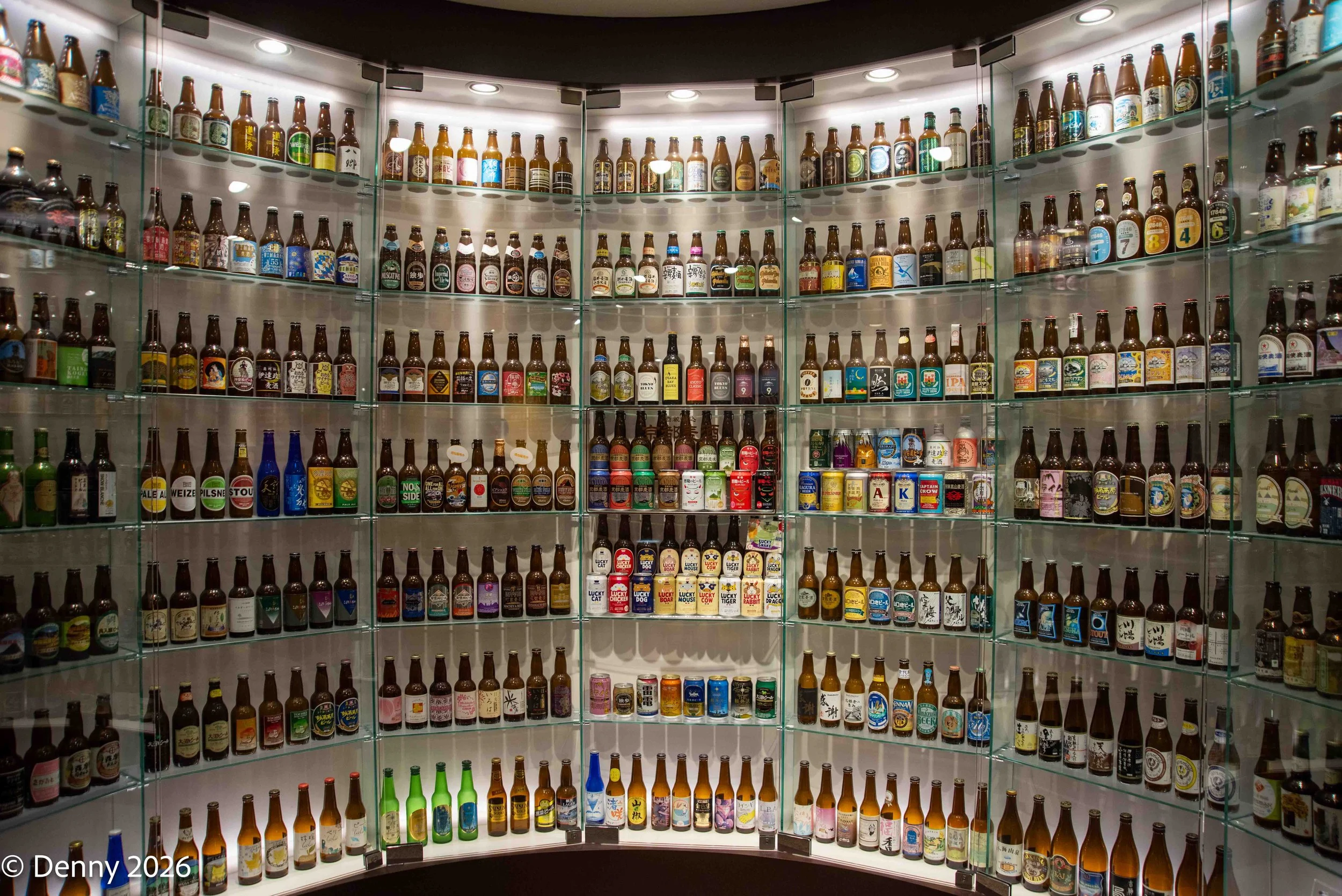
The Kizakura Brewery produces other beverages based on its expertise in processes involving fermentation. There were a number of craft beers on sale and most appeared to be prepared from rice or even non-grain bases such as fruits and vegetables. Some types of gin were on sale too.
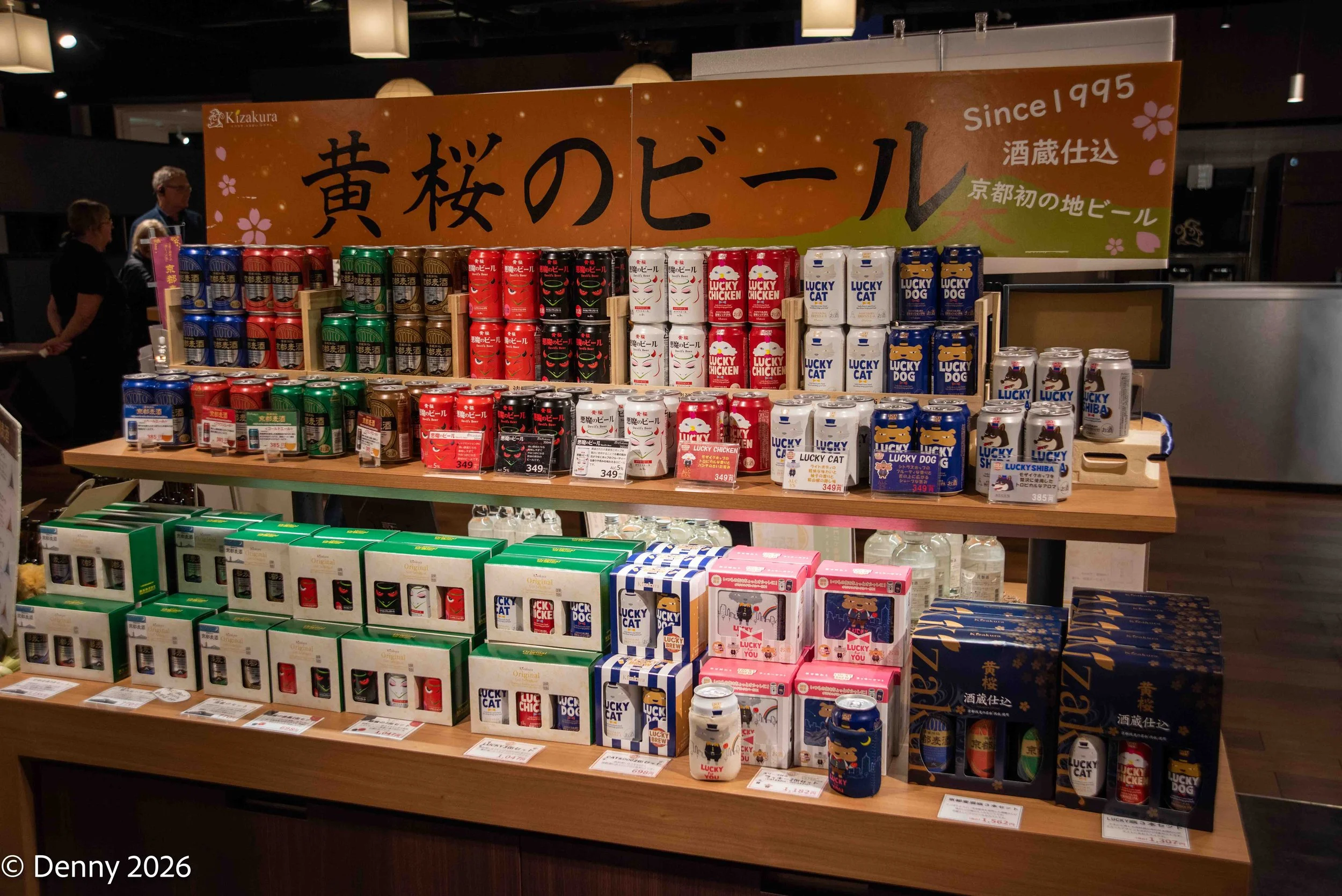
Selection of beers for sale in the shop, Kizakura Sake Brewery
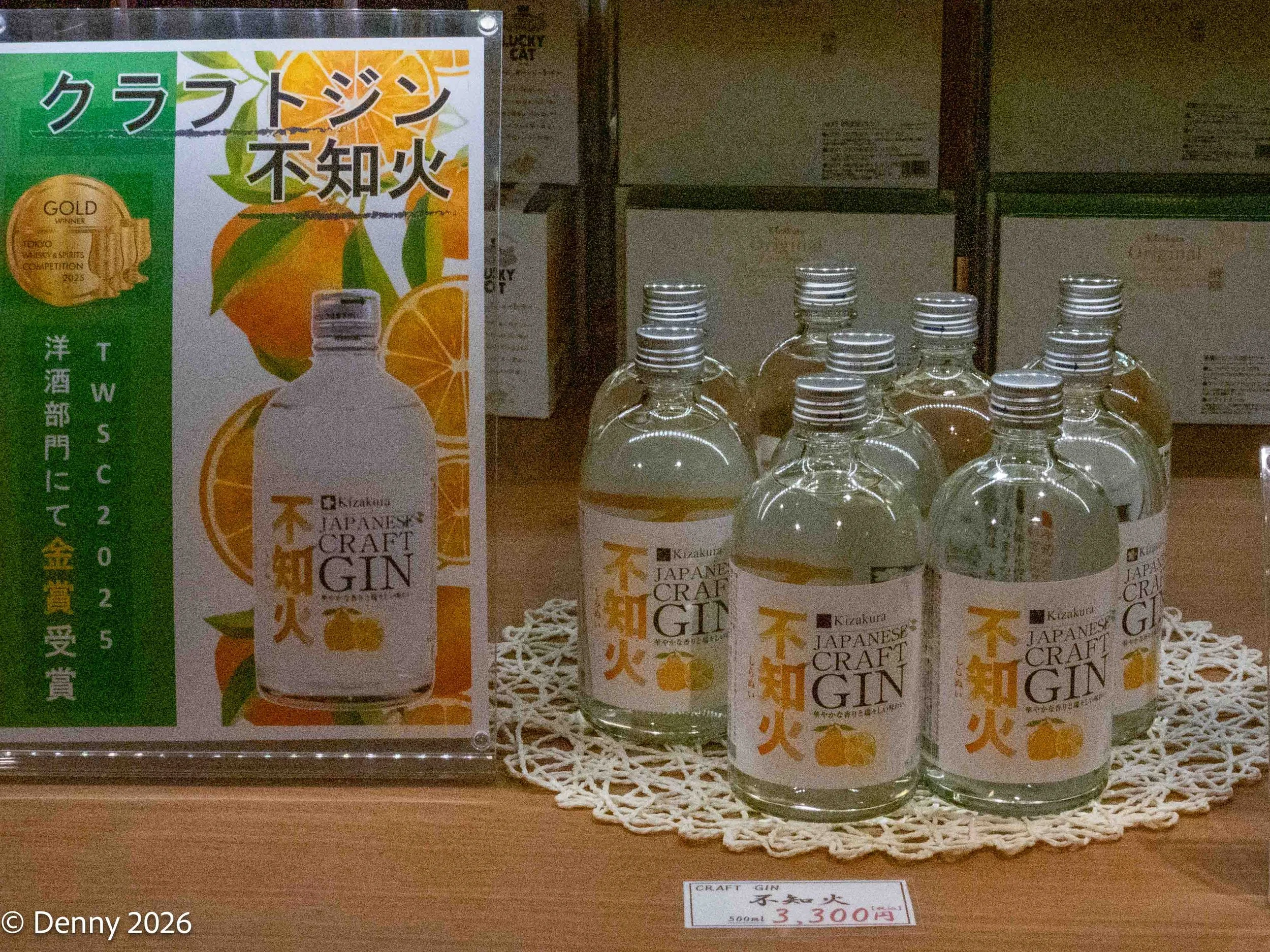
Japanese Craft Gin for sale in the shop, Kizakura Sake Brewery
From the visitors’ observation area we could look down and see bottling and canning operations occurring on two highly efficient production lines.

Sake production from the visitors' obsevation area, Kizakura Sake Brewery
The brewery had a wide range of products on sale in its shop but we were not tempted to make any purchases.

Premium grade sake, Kizakura Sake Brewery
Our final activity for the day was to visit the hillside Fushimi Inari Shinto Shrine which is a major tourist attraction in Kyoto gauging from the number of buses and hordes of people in the parking area.
This ancient Shrine is said to predate the founding of Kyoto and is dedicated to Inari, the Shinto god of rice and sake.
The shrine is sometimes referred to as the ‘thousand torii’ shrine. A torii is an entranceway or gate with two high pillars with ornamental crosspieces. The function of a torii is to mark the boundary between the everyday and the sacred.
We first arrived at the main shrine where the Shinto monks were identifiable as they wear white robes. There is also an impressive pavilion covering a stage used for dance performances during yearly rituals.
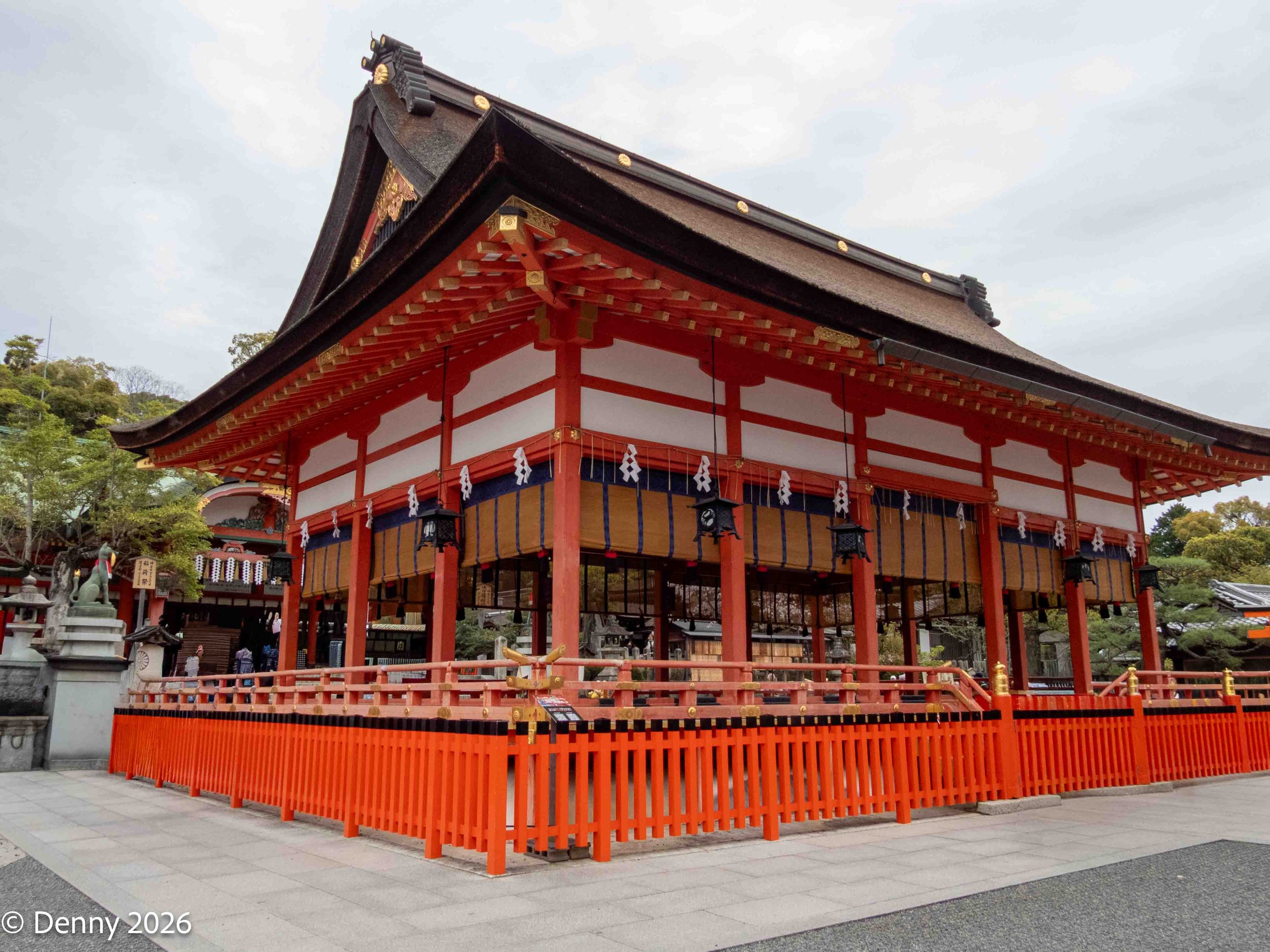
Pavilion, Fushimi Inari Shinto Shrine

Shinto monks in white robes, Fushimi Inari Shinto Shrine
The interesting feature that immediately caught our attention was the number of large statues of foxes around the shrine area.
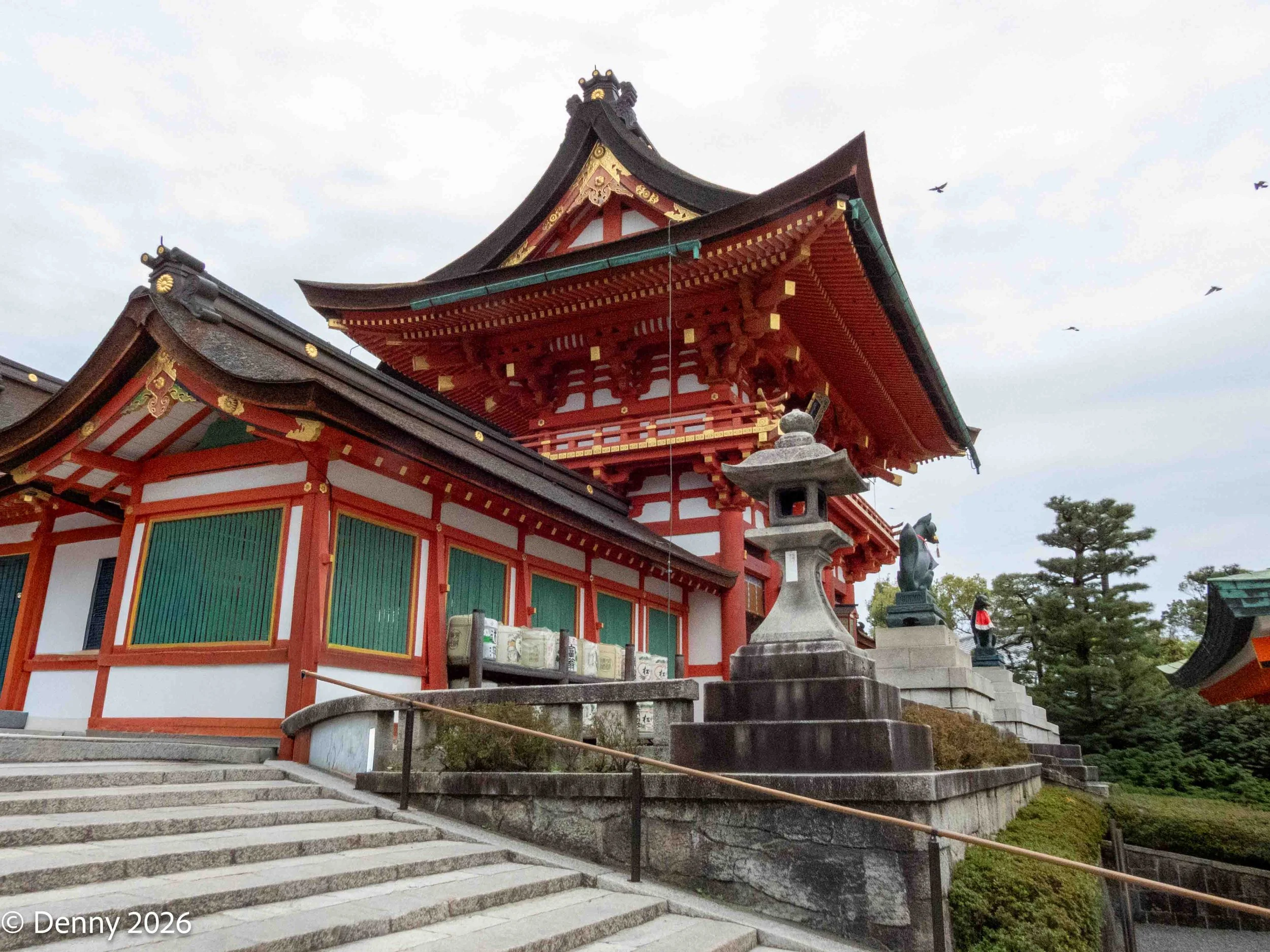
Main shrine, Fushimi Inari Shinto Shrine
Foxes were believed to be one of Inari’s messengers and were revered because it was thought that foxes ate sparrows and sparrows were the primary thieving menaces when it came to rice production. In relation to this bird problem and yet to our amazement, we noticed one of the food stall vendors in the main tourist street was selling barbecued sparrows!
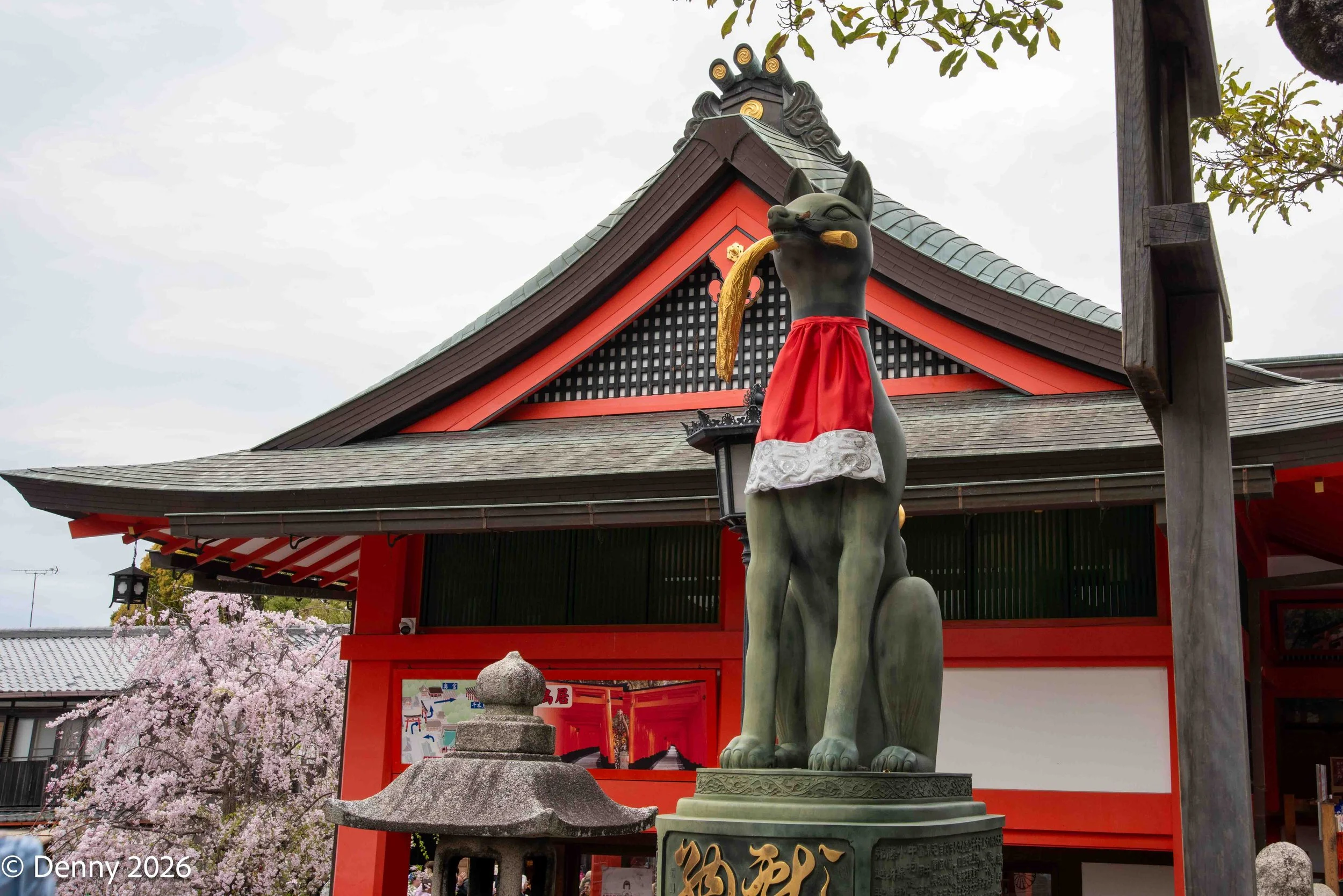
Fox, Fushimi Inari Shinto Shrine

Barbecued sparrows on path to Fushimi Inari Shinto Shrine
Along with hundreds of others, we then took a walk along the pathway formed by the thousands of vermilion painted torii. We didn’t do the full four kilometre walk due to time limitations and the crowd density.

Some of our group amongst the crowds approaching the torii, Fushimi Inari Shinto Shrine

Some of our group amongst the crowds within the torii walkway, Fushimi Inari Shinto Shrine
The torii are donated by individuals or companies as it’s thought that this will lead to desired outcomes and success in business pursuits. The names of donors and the dates of donation are shown on the back of each individual gate.
Larger torii can cost as much as a million yen to dedicate and the most impressive one is the giant Romon Gate near the main shrine, donated in 1589 by Toyotomi Hideyoshi a feudal warlord responsible for the unification of the country.

Descending through the torii walkway, Fushimi Inari Shinto Shrine

Kyoto Tower viewed from parkland, Fushimi Inari Shinto Shrine
On our return walk to the bus we stopped at a shop that specialised in Japanese knives most designed for use as kitchen chopping, slicing and filleting utensils.

Kitchen knife shop on path to Fushimi Inari Shinto Shrine
Top quality Japanese knives are internationally renowned for their long term sharpness as well as their elegance. In this same shop were a number of samurai swords for sale. With their artistic engraving on the blades, these too were works of art and the prices were correspondingly impressive.

Samurai swords on path to Fushimi Inari Shinto Shrine
The crowd density made it hard for buses to move in the parking bay but eventually our bus collected us and then dropped us off at our Miyako Hotel where we’ll stay for the next three nights.
Our luggage from three days ago had arrived and we then made arrangements for our evening meal.

View from our room at Miyakohotel-Hachijo, Kyoto
Tomorrow we will participate in some calligraphy lessons and later partake in a traditional Japanese tea ceremony. We’ll also do a tree lined canal walk which has the intriguing name of the ‘philosophers’ walk’.