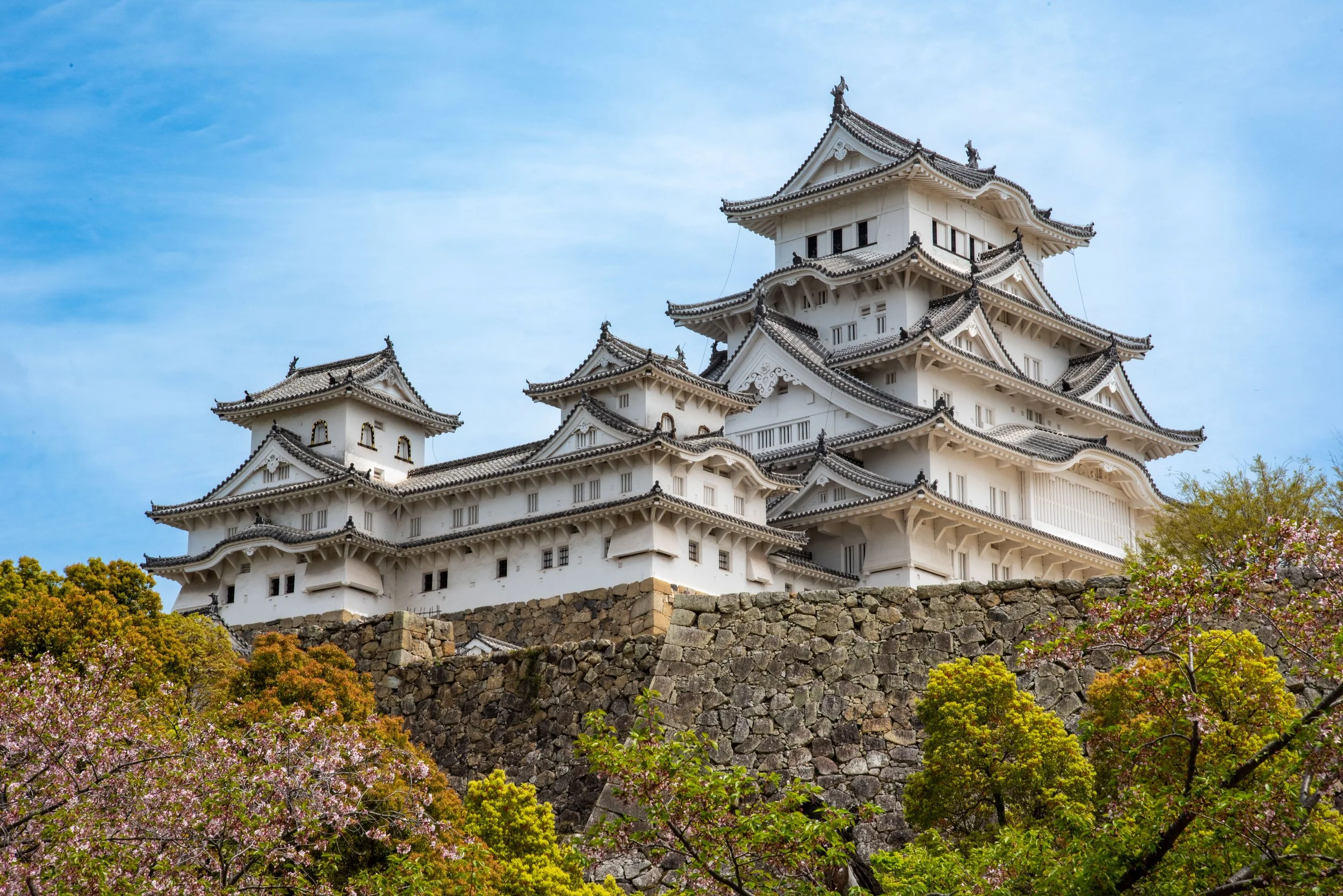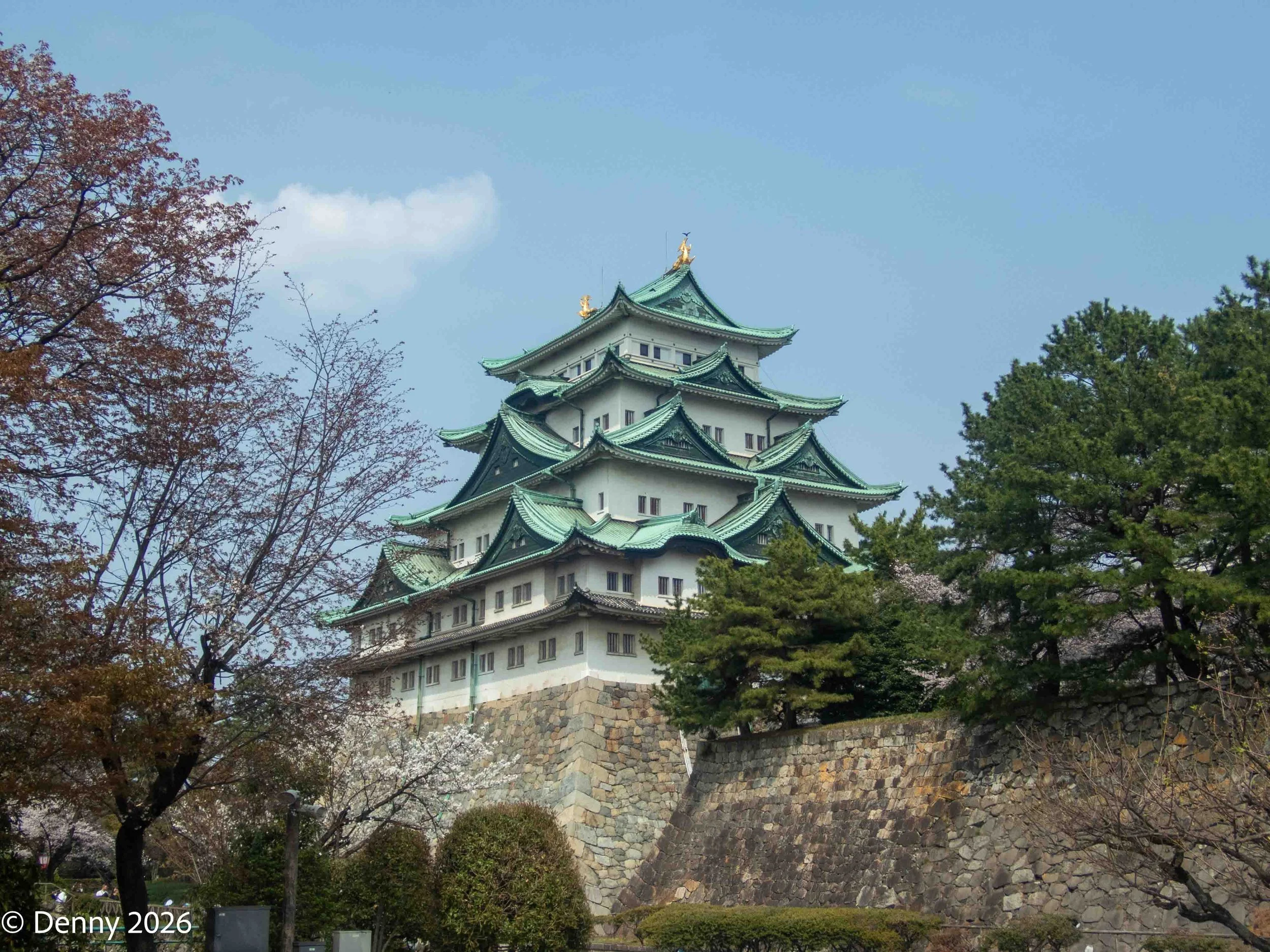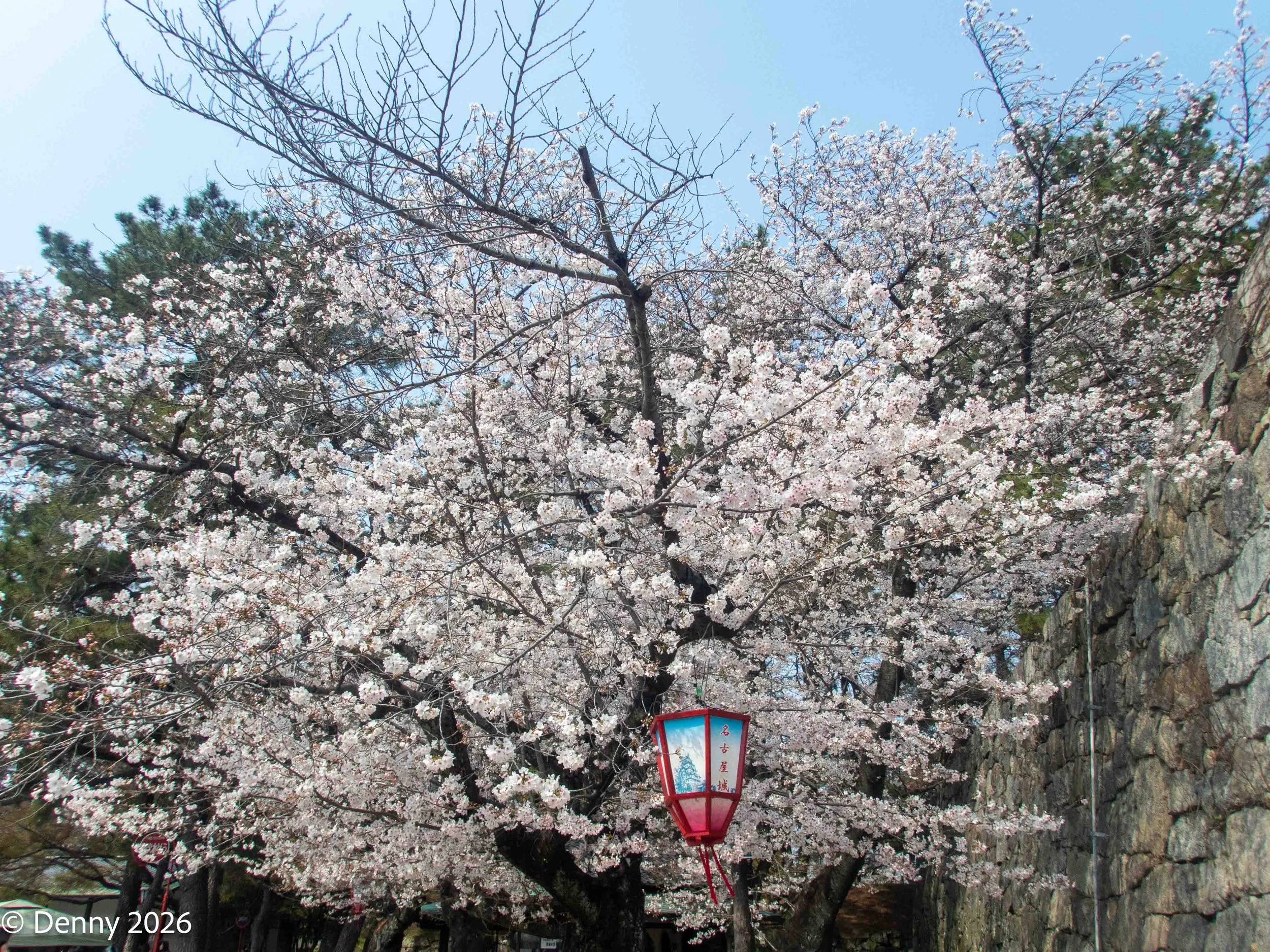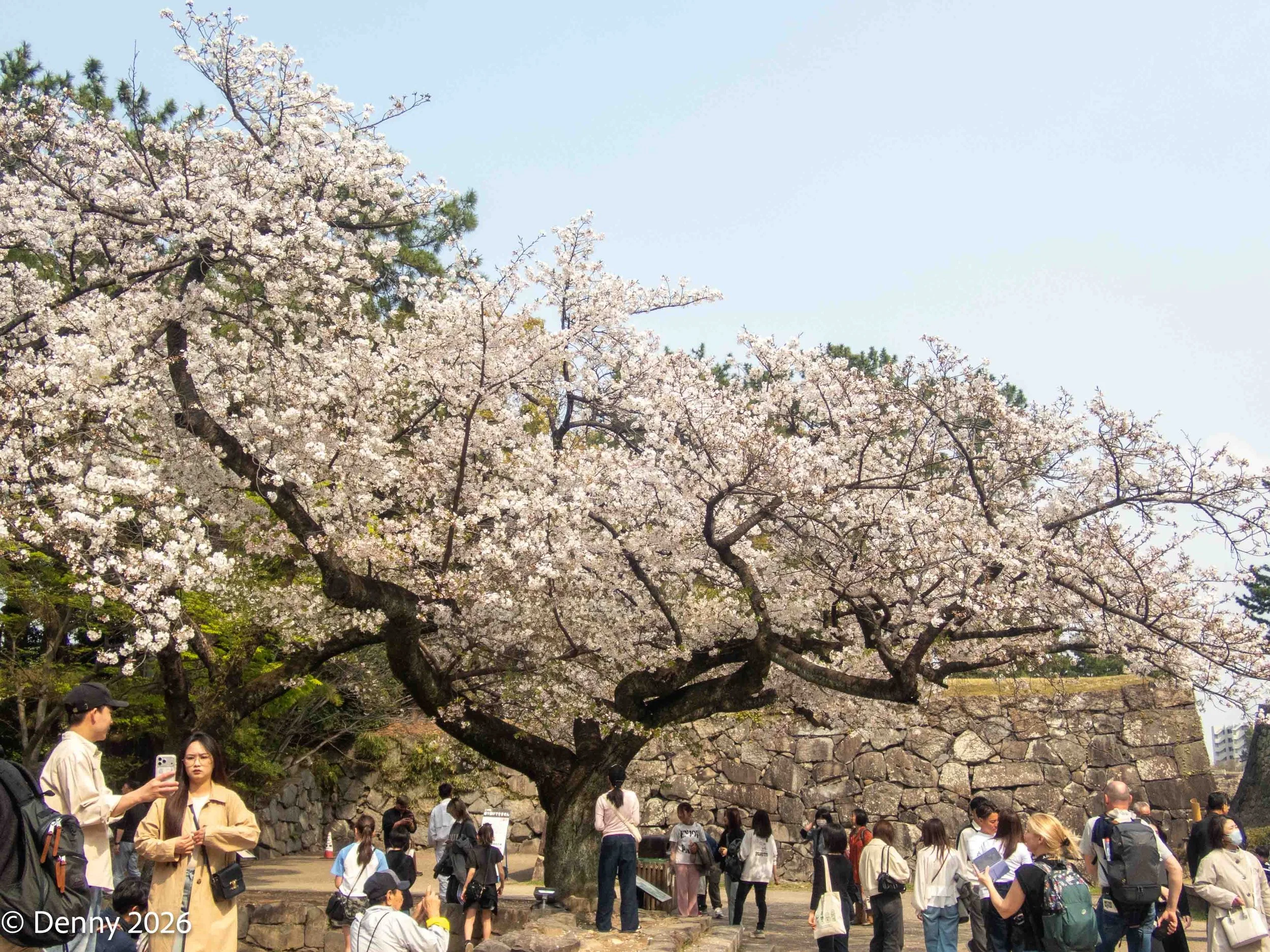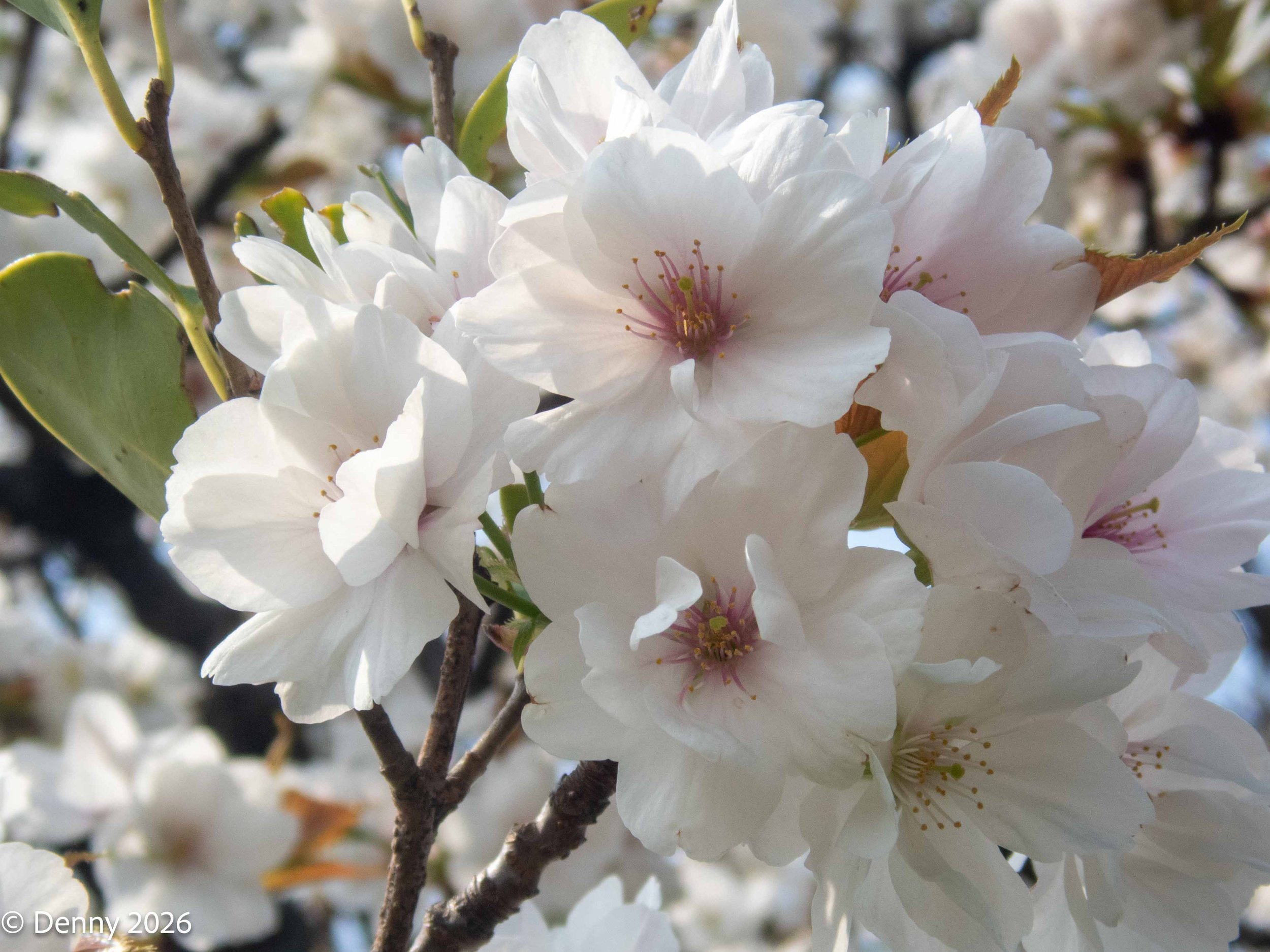
DAY 10: Sunday 22nd March 2026 BUSAN – GYEONGJU

Our early departure and it being Sunday morning, meant that we made good progress heading northwards out of Busan. The northern suburbs were typically jammed with multi-storey apartment blocks with seldom more than 20 m between each high-rise building.

We were informed that many of the locals are employed by major construction companies especially Hyundai which not only produces millions of cars but also builds skyscrapers and is very heavily involved in ship building. South Korea and China are the two biggest ship builders in the world today.

Our destination for today is Gyeongju, often referred to as the ‘museum town without walls’. The city is famous for its Buddhist tombs, temples, pagodas and other historic bits and pieces. 

After an hour and a half’s driving, we stopped at a small museum and spent some time seeing an exhibit of models and learning something of the construction of the Seokguram Temple which we are due to visit later this morning.

Our wonderful driver Mr. Kim did a fabulous job in driving our bus up the ten kilometres of winding road to the major pilgrimage site of Seokguram, the ‘Buddhist Temple in a Grotto’.

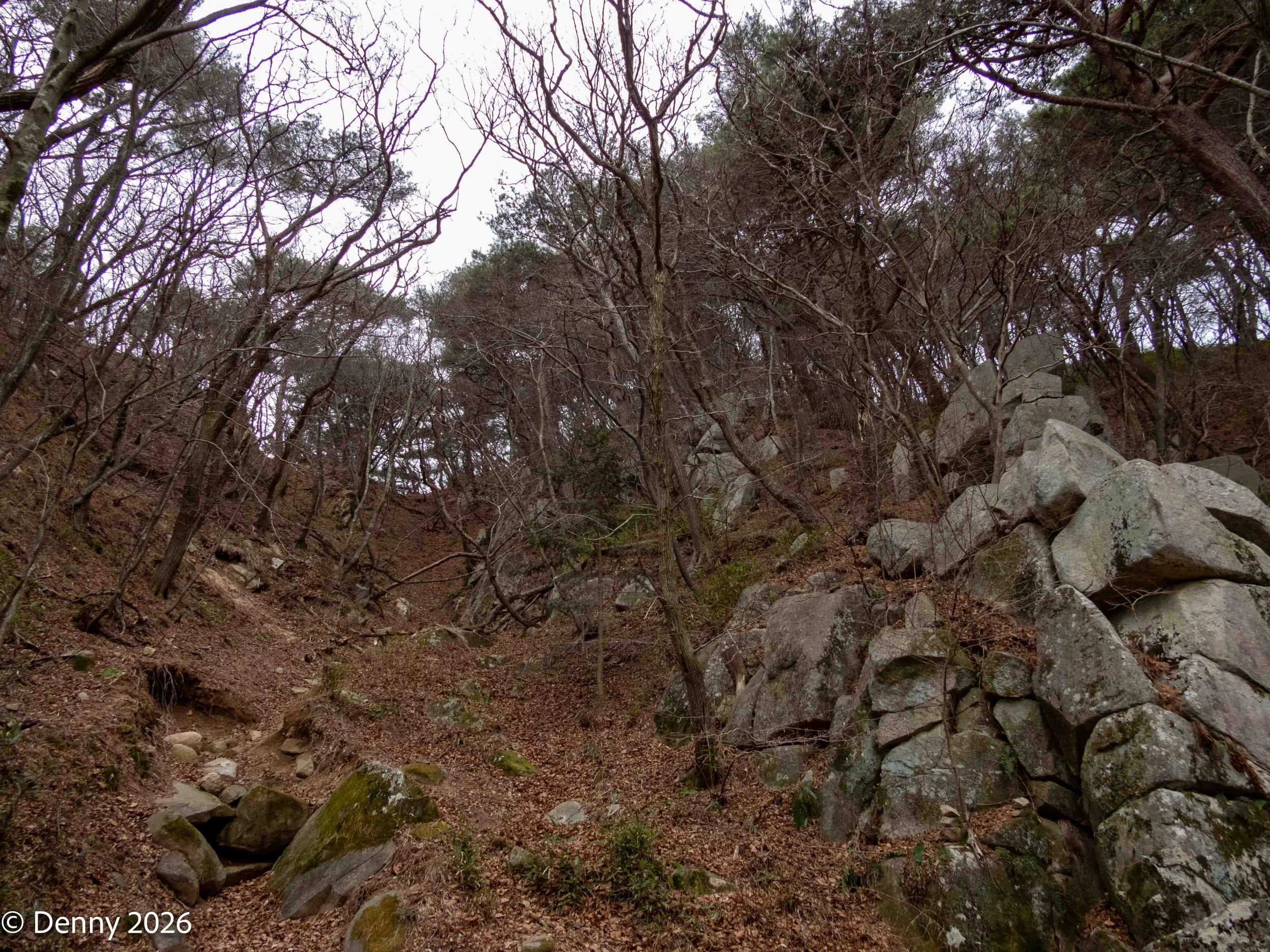
Alighting from the bus we then had a one kilometre walk along a pathway in amongst pines and maples to reach the grotto.

Pathway to grotto, Seokguram

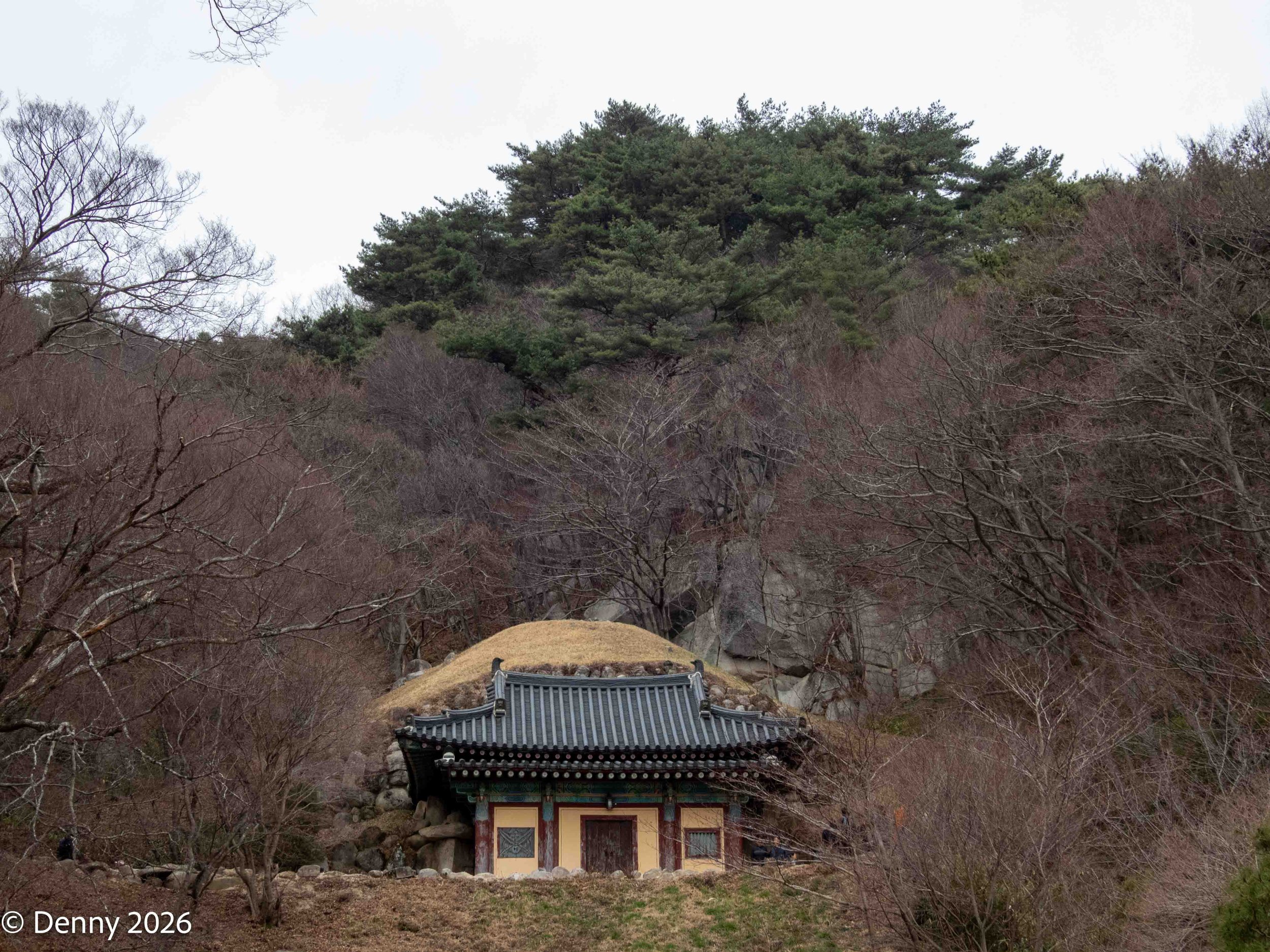
Grotto, Seokguram

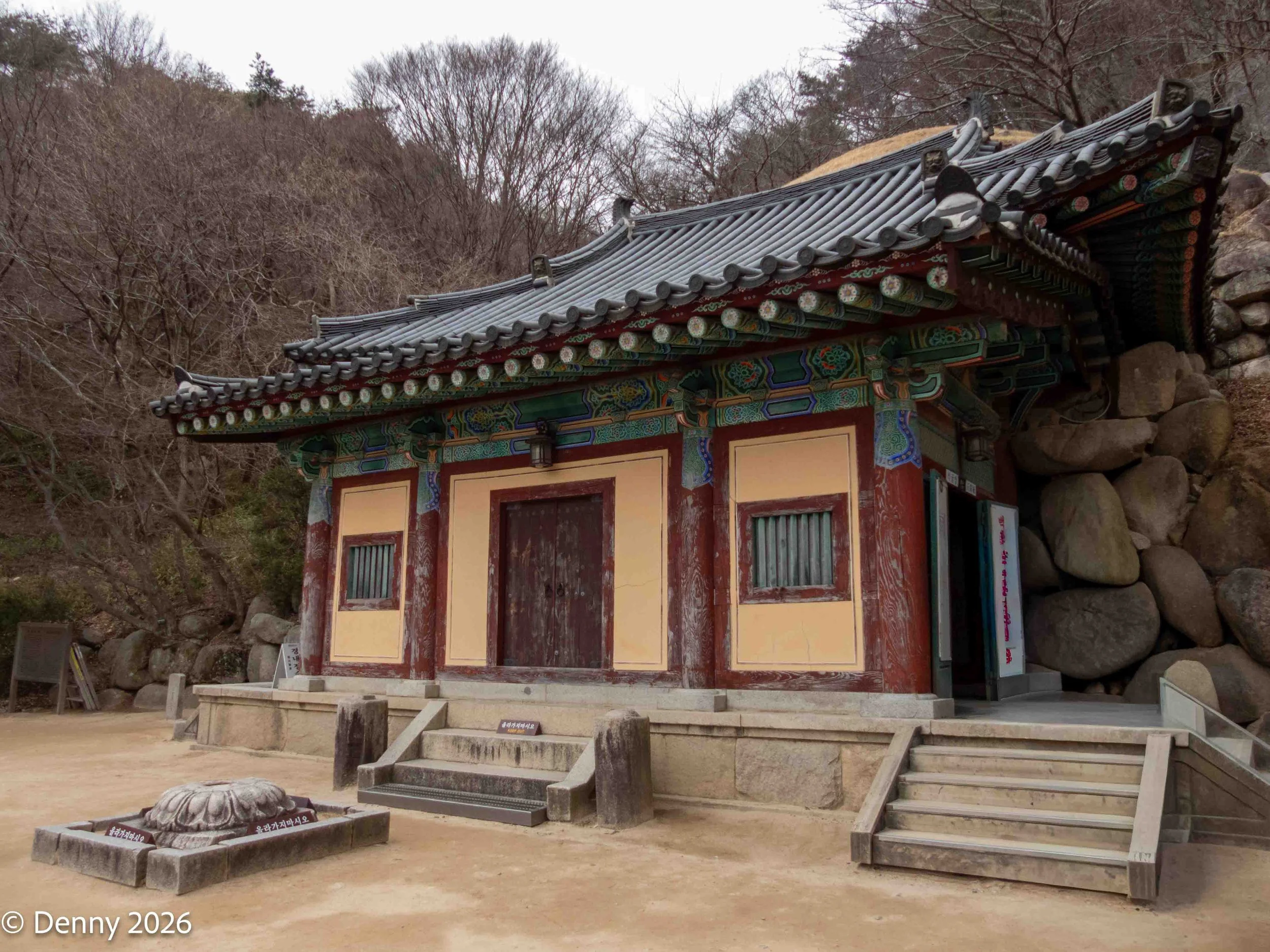
The Sakyamuni Buddha image is enshrined within a granite hillside perched at the top of steep steps leading to the temple.

Grotto temple, Seokguram

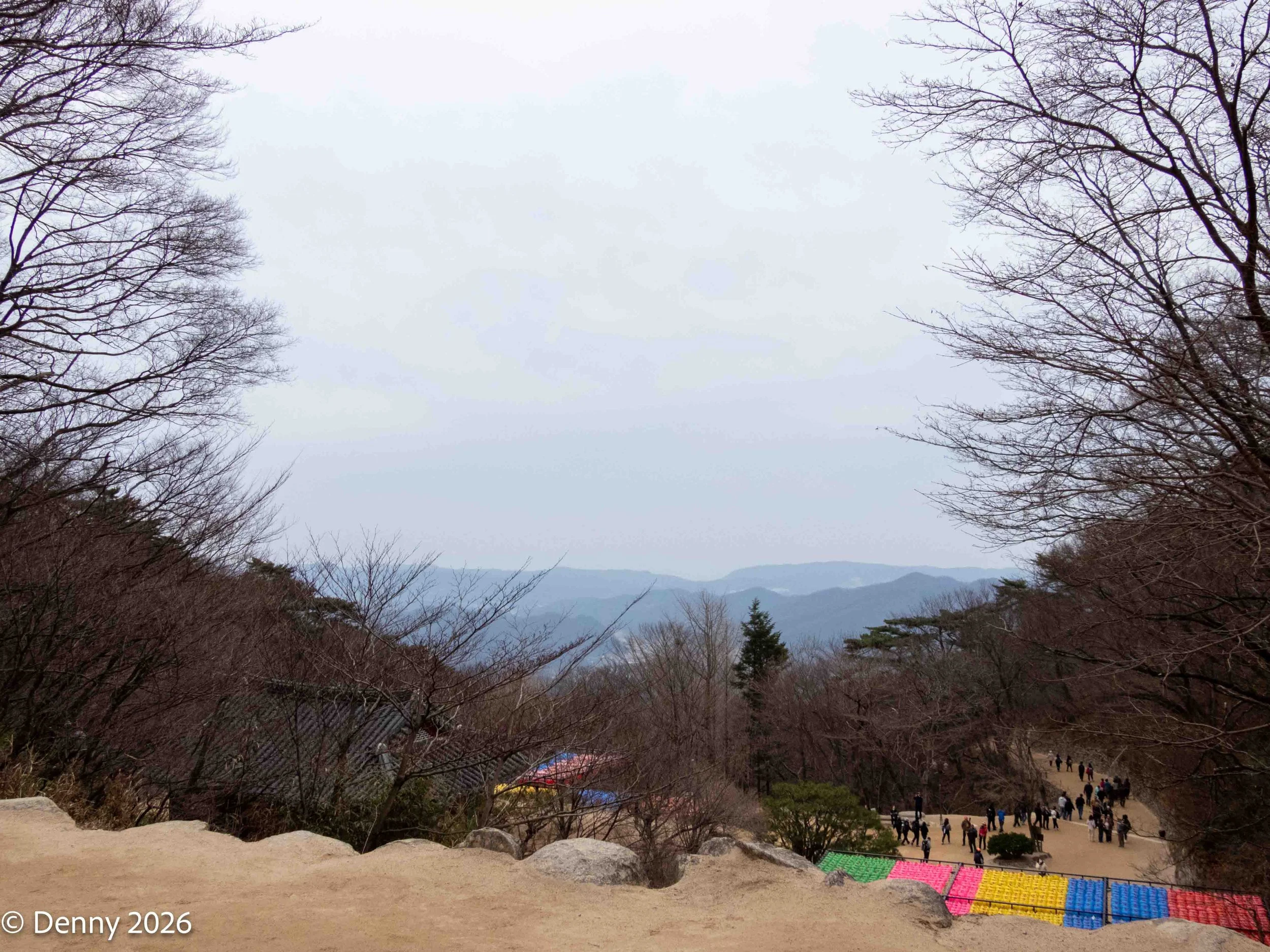
View from Grotto, Seokguram

The image of Buddha was carved from a single block of white granite three metres high. The image is positioned inside an artificial grotto built from large granite blocks with a round interior chamber and a graceful dome shaped ceiling. Unfortunately we were not permitted to take any photos of the image.

The Buddha is accompanied by stone images of eight Generals and four Deva Kings all acting as his guardians. The temple was built during the reign of the Silla King Beopheung around the year 540 AD and is now listed as a UNESCO World Heritage site.

This Sakyamuni Buddha image is generally considered by practitioners and students of Buddhism to be the most perfect of its kind anywhere in Asia and is unequalled in the Buddhist art of the Far East!

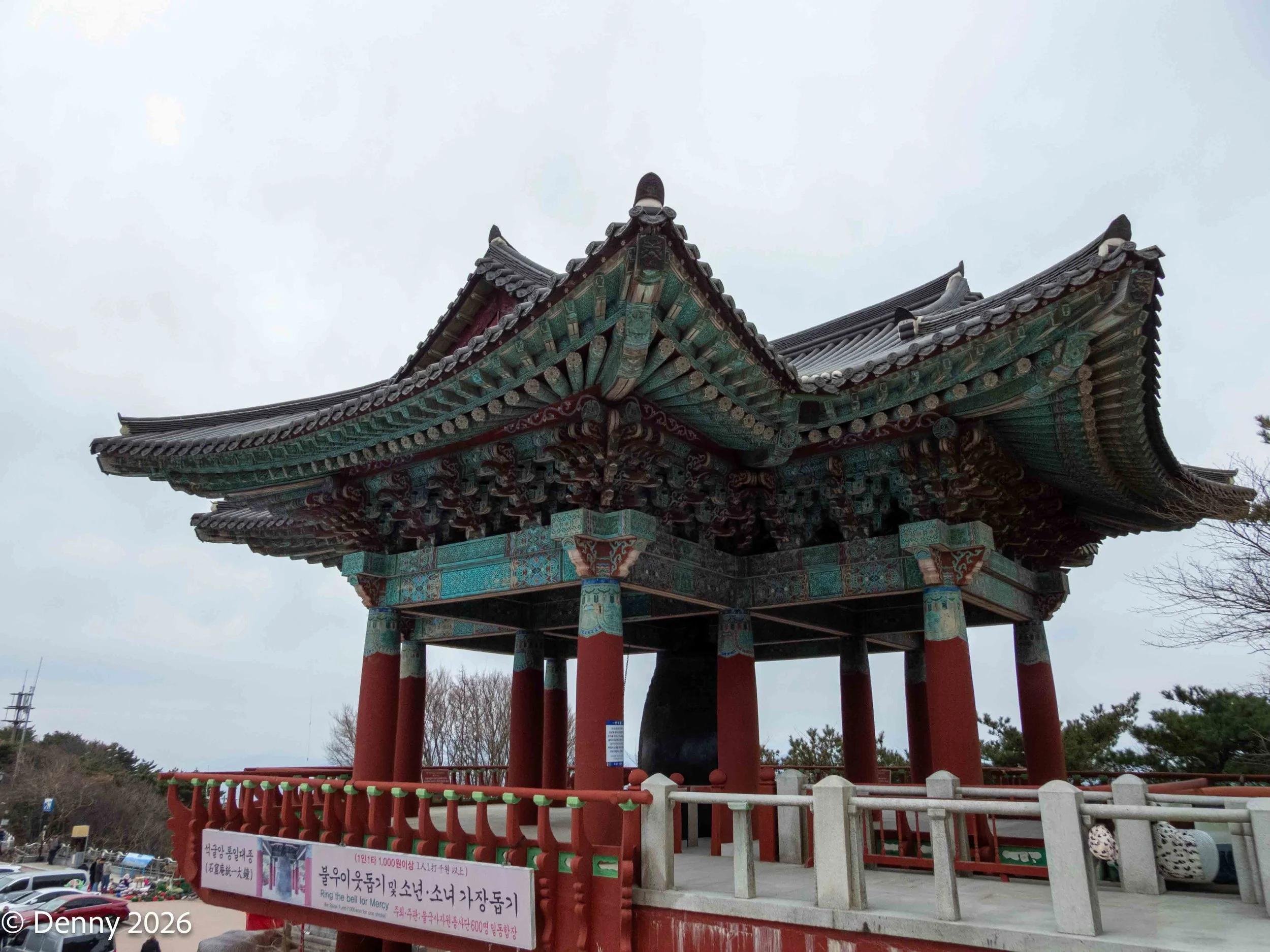
Drum pagoda, Seokguram

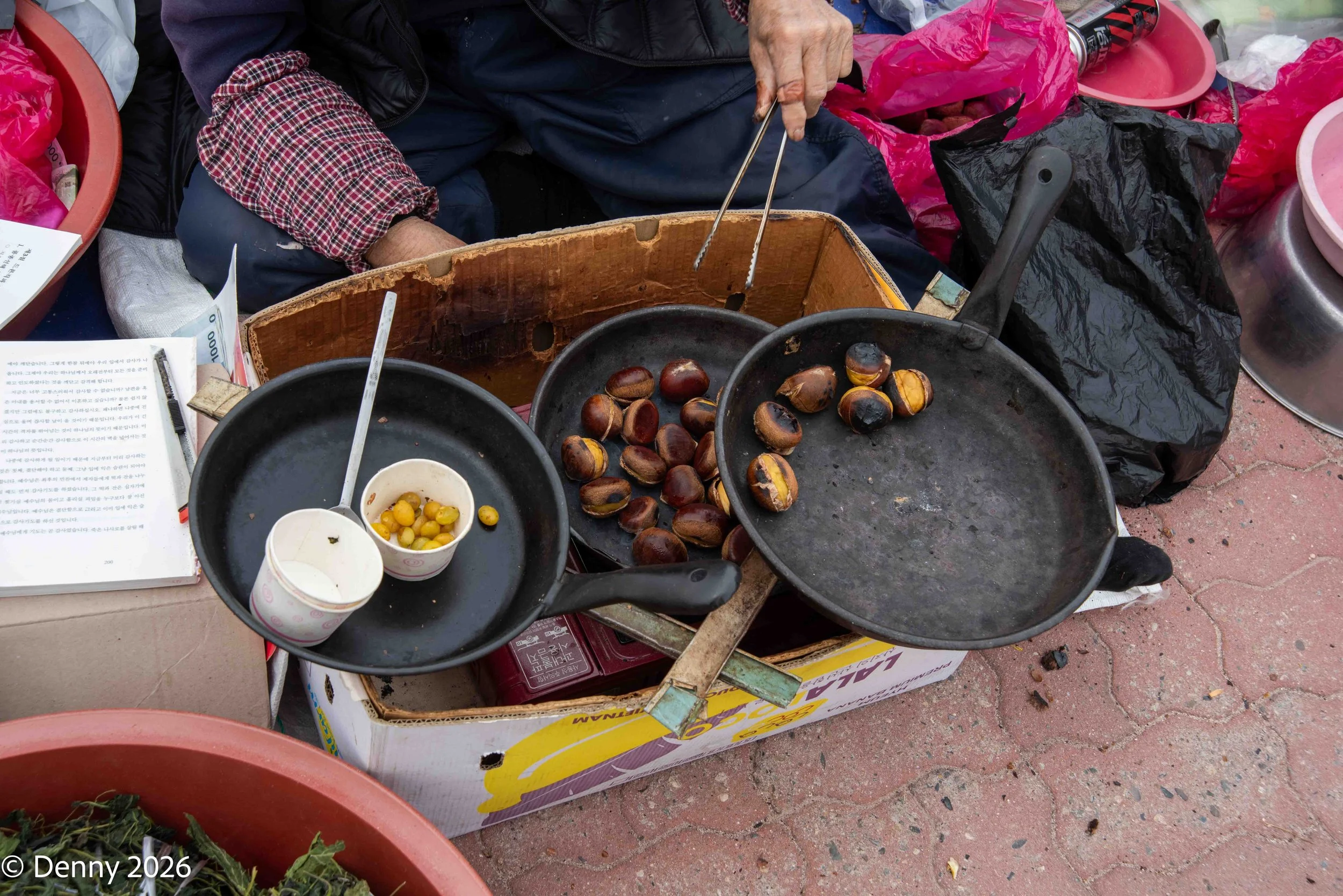
We ventured back down the mountain zig-zag roadway and bought some roasted chestnuts from a roadside stall.

Roasted chestnuts, Seokguram

We then had lunch prior to visiting the second Buddhist temple of the day, that being the Bulguksa Temple.

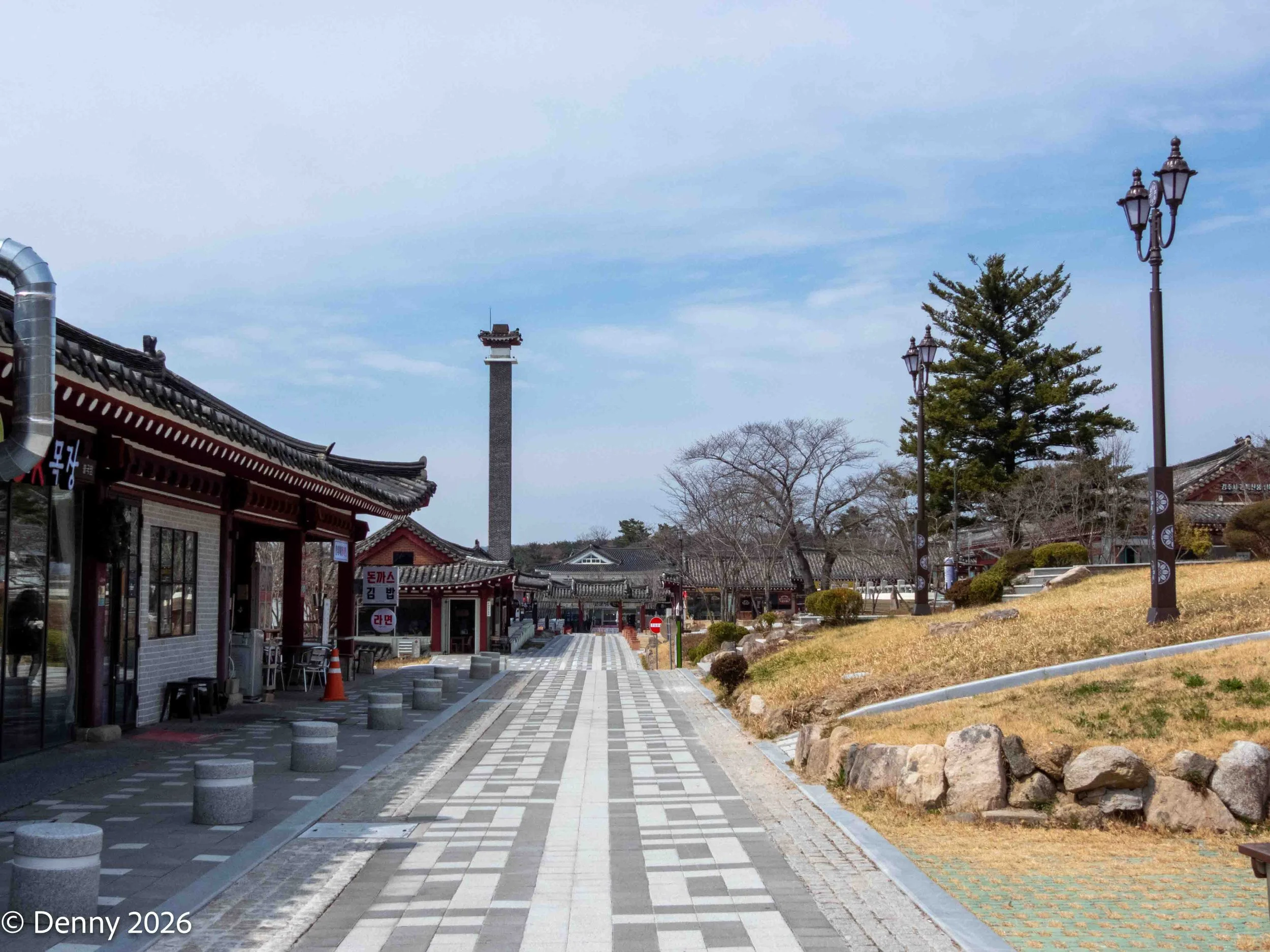
Seokguram where we had lunch

The construction of the Bulguksa Temple began in 528 AD during the Silla Dynasty and served as the centre of Silla Buddhism for the protection of the country from foreign invasion.

The protection worked well for just over a thousand years and then the entire temple was burnt down by Japanese invaders in 1593.

Following extensive research, excavations and investigation, the temple was completely restored in the period 1969-1973.

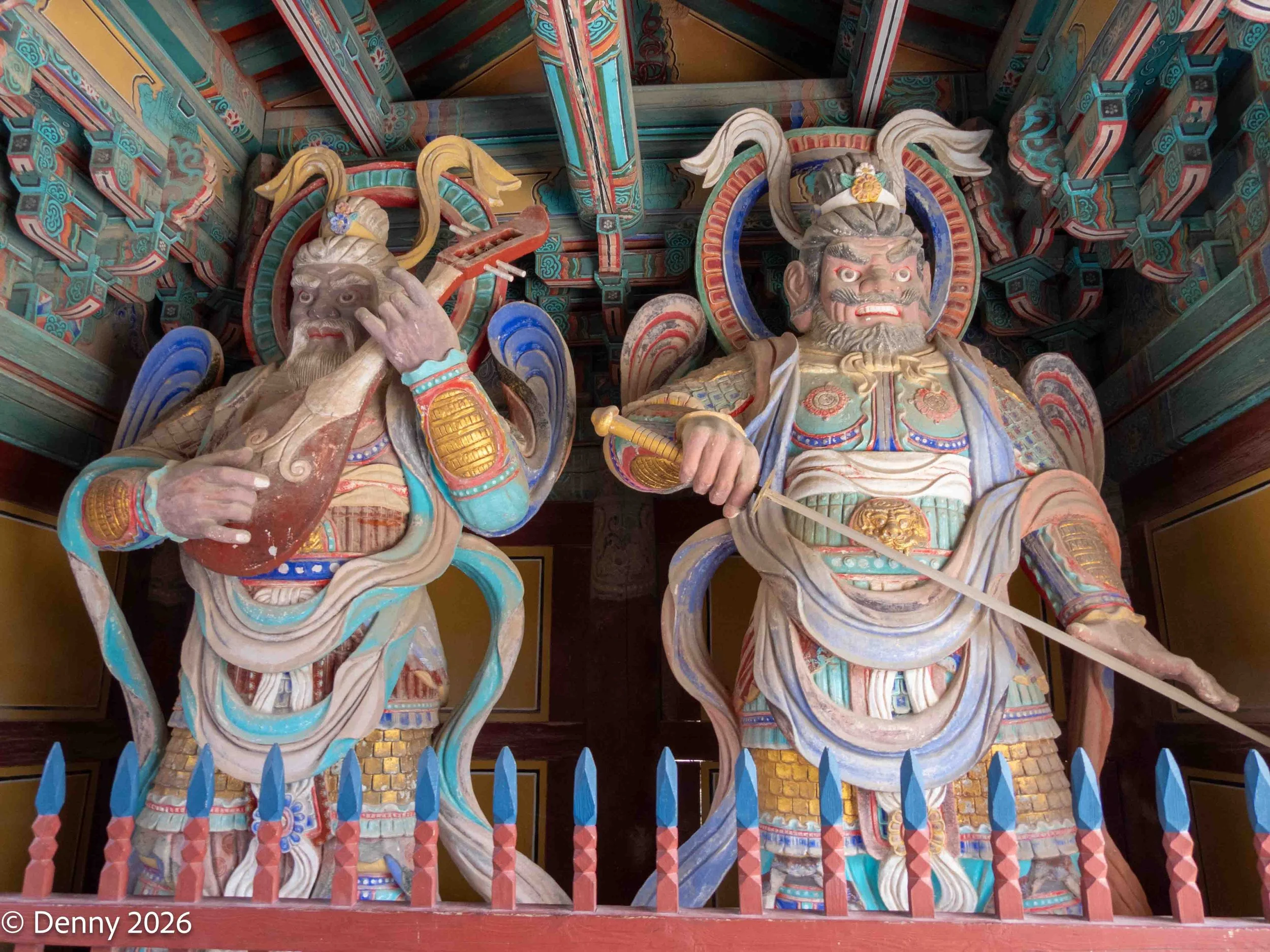
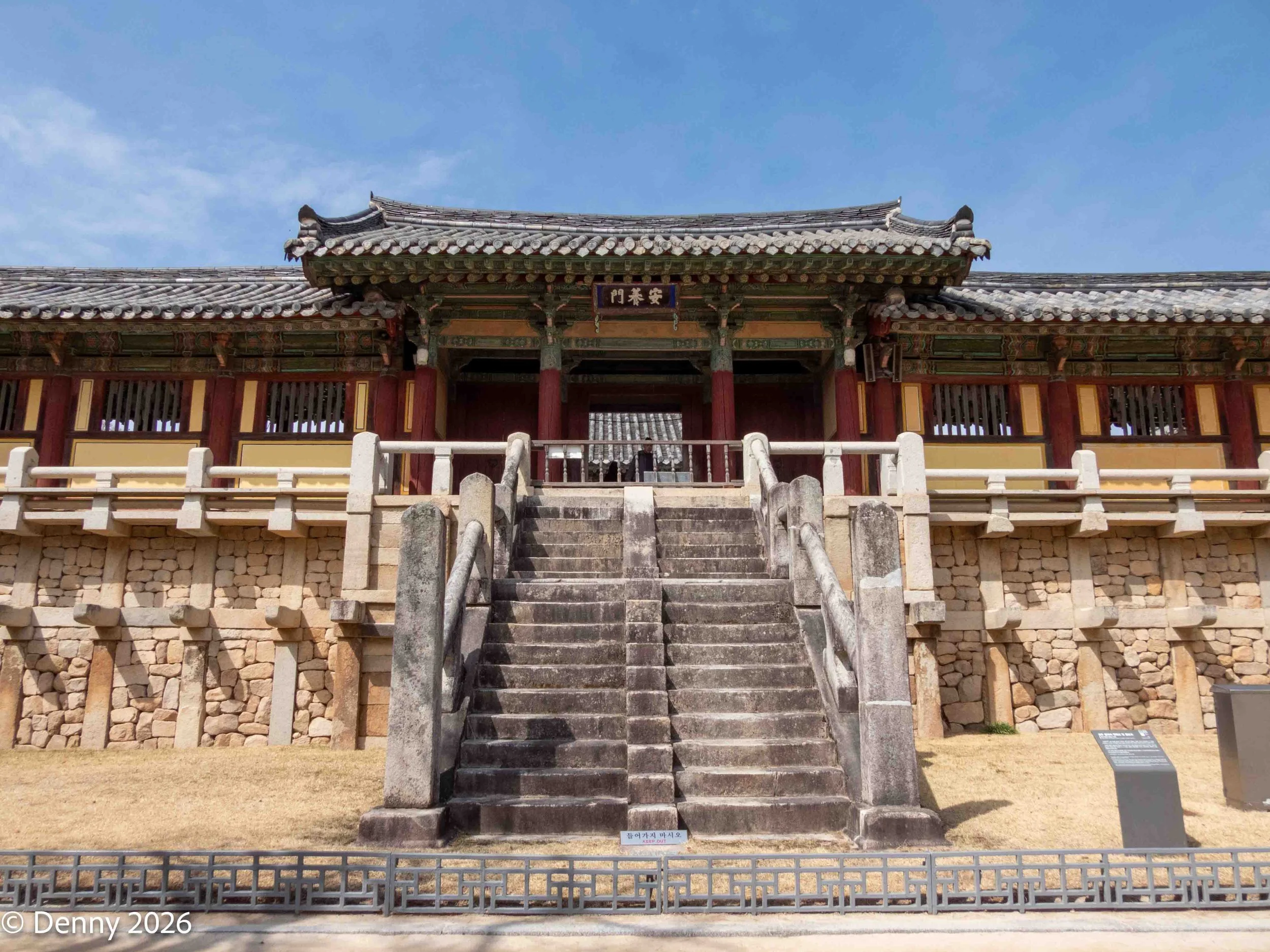
We entered through the small Jongnu pavilion and arrived at the temple’s main worship hall.

Gate keeper statues, Bulguksa Temple

Bulguksa Temple

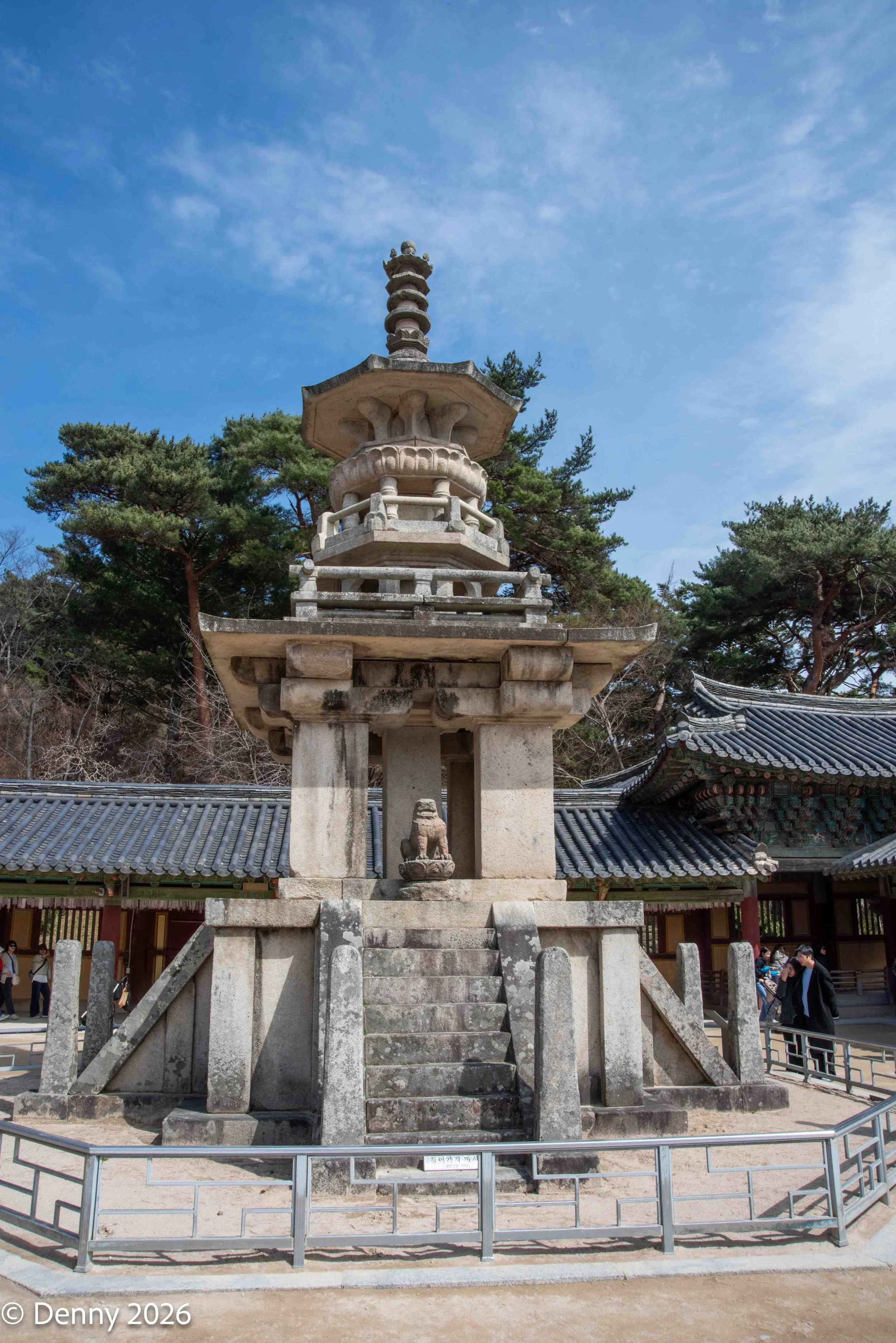
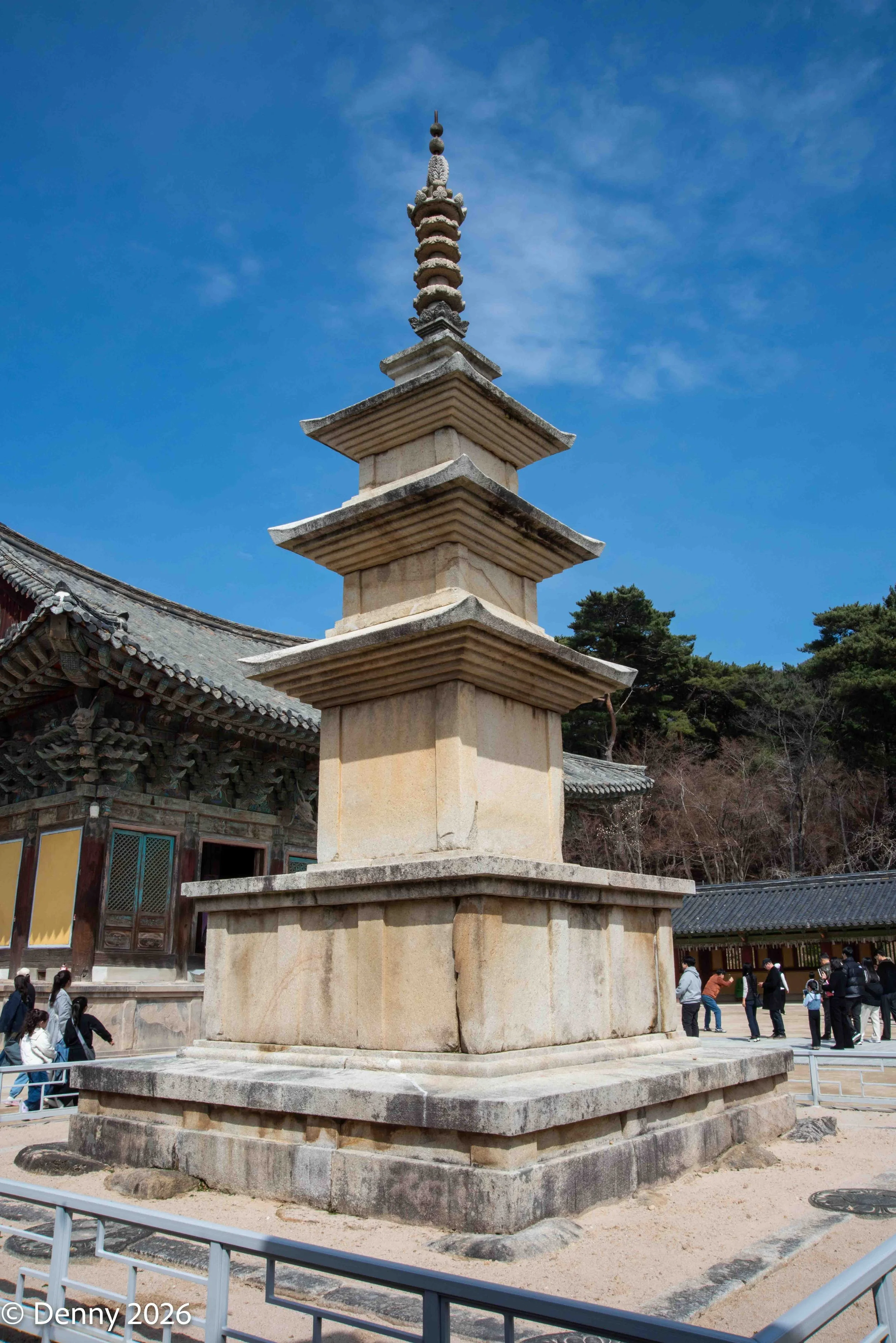
Here there was an expansive courtyard dominated by two unusual and impressive pagodas that still exist from the original sixth century temple.

The smaller pagoda called Seokgatap is 8.2 m high and the larger one Dabotap is 10.4 m high. Both pagodas which have been restored in recent times are regarded as premier examples of Silla architecture.

Seokgatap pagoda, Bulguksa Temple

Dabotap pagoda, Bulguksa Temple

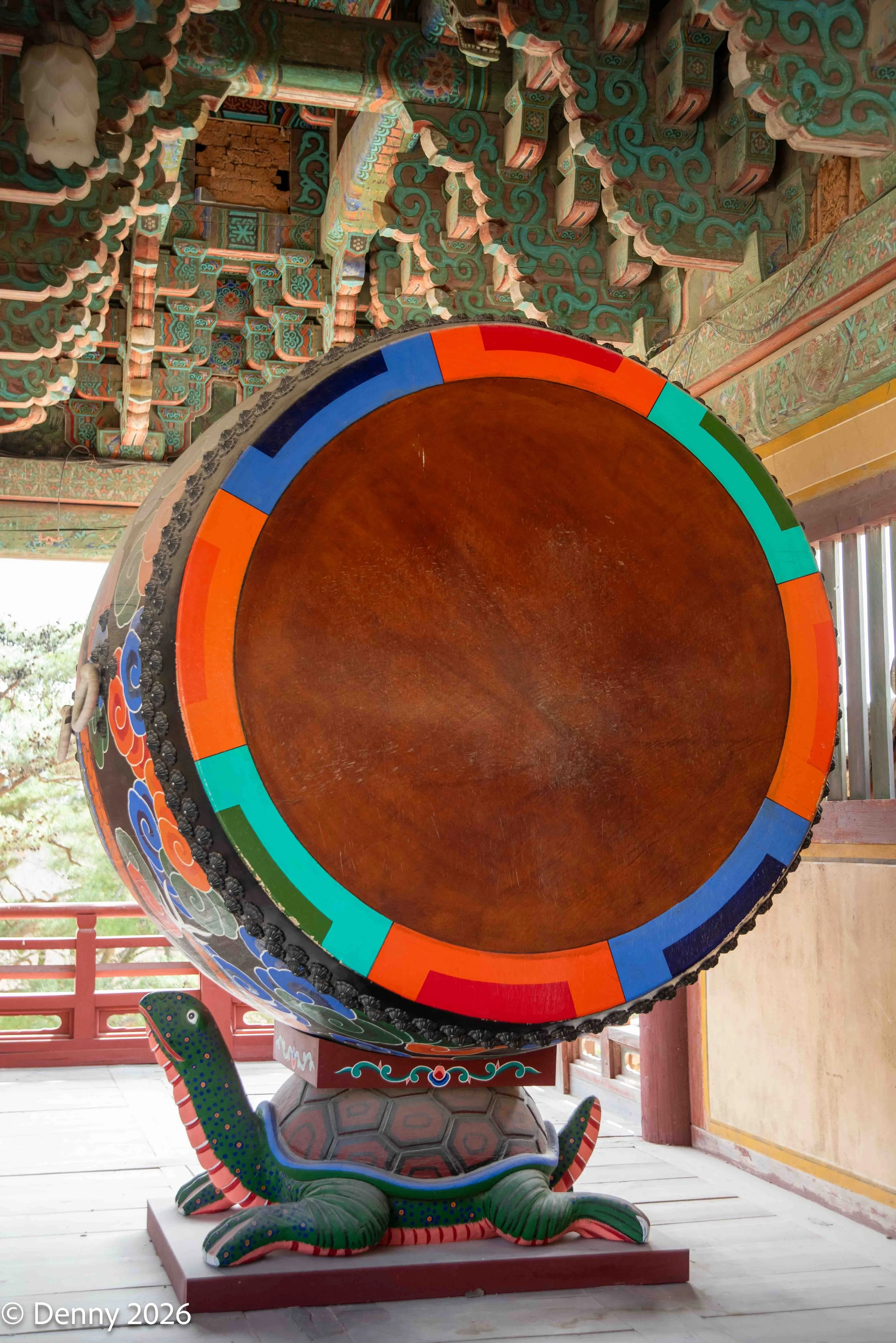
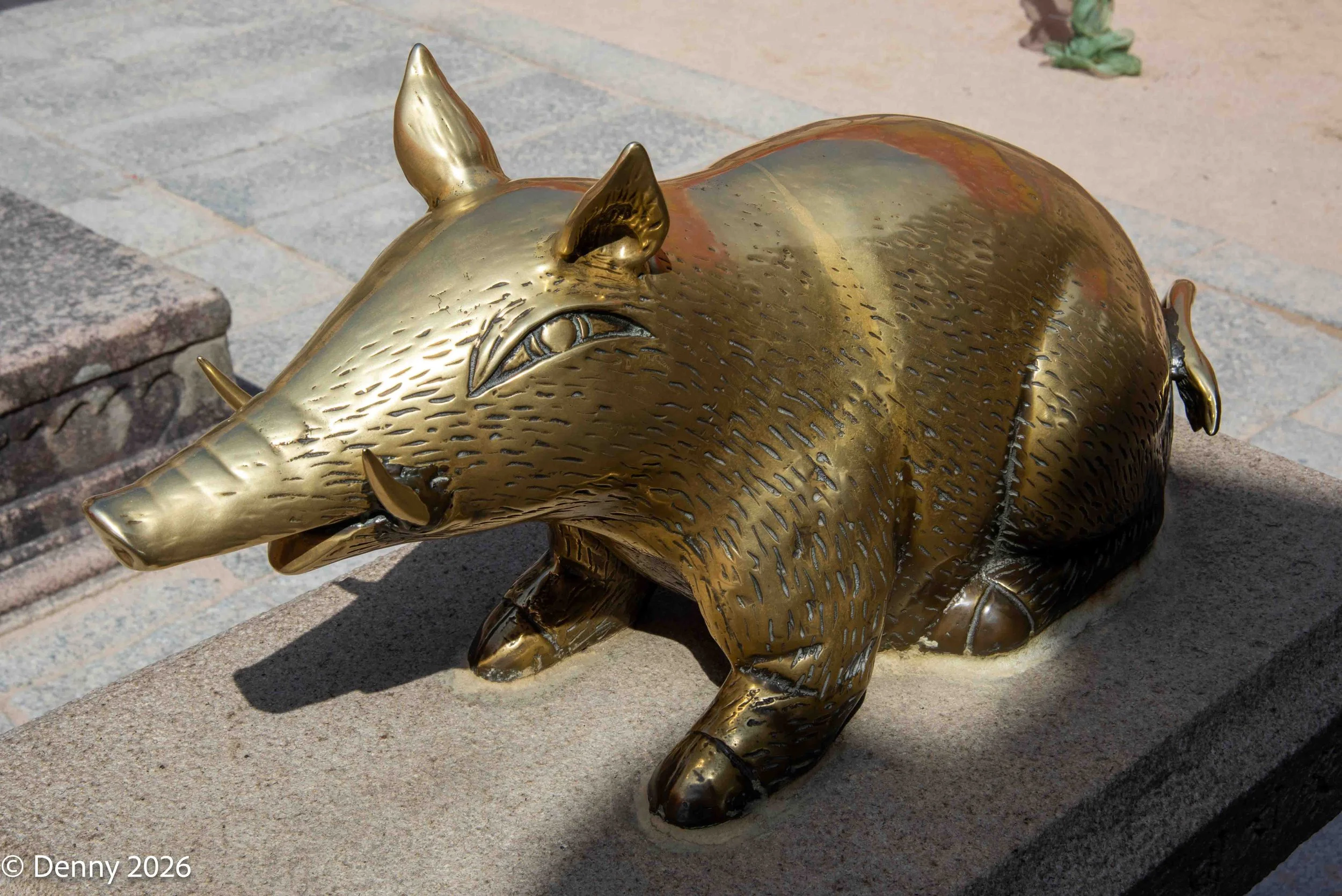
Other ‘treasures’ we encountered were a large highly decorated drum, a small growling lion on a lotus pedestal and a bronze boar which when rubbed is sure to bring you untold wealth!

Drum, Bulguksa Temple

Good luck bronze boar, Bulguksa Temple

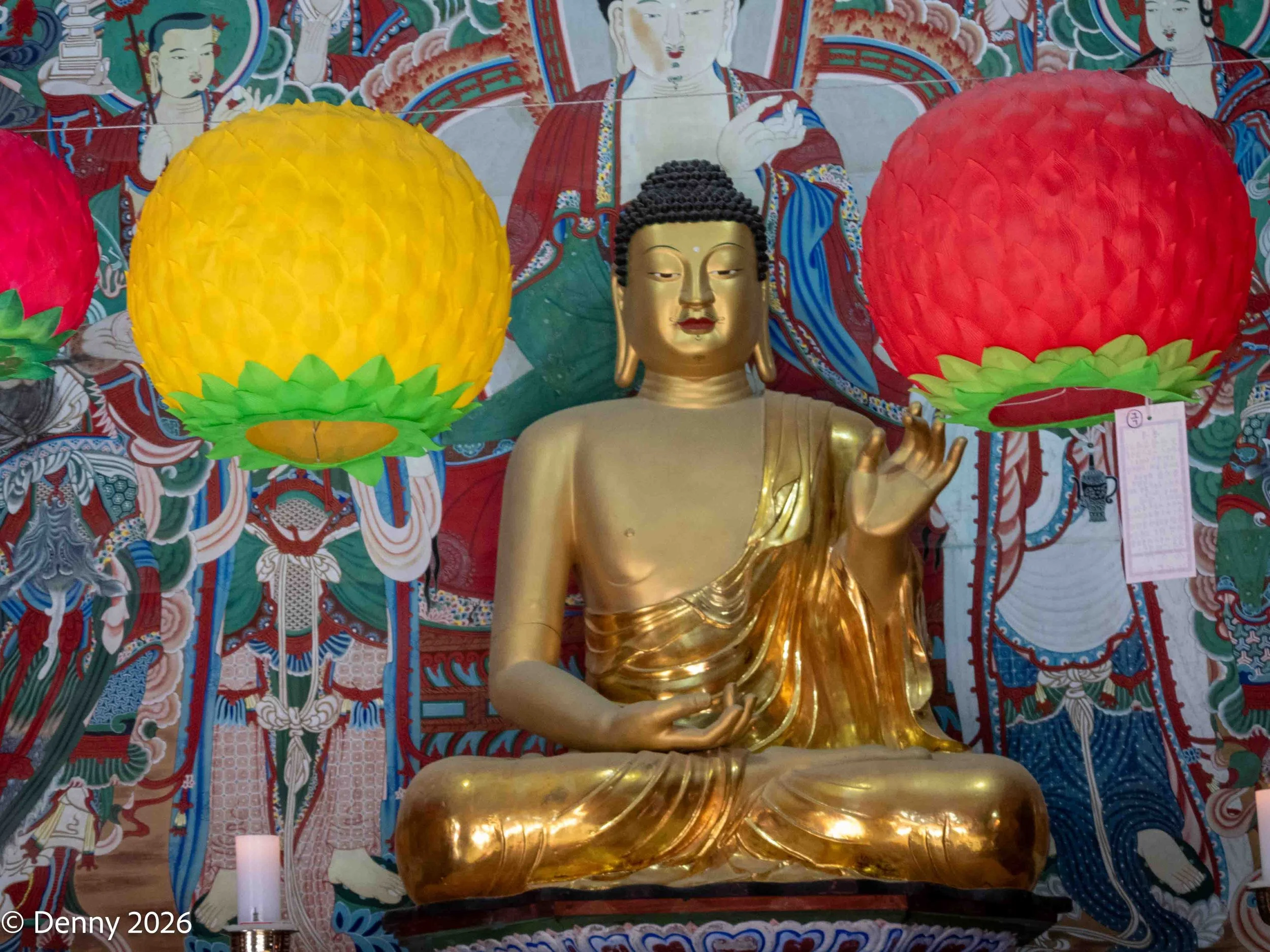
Buddah, Bulguksa Temple

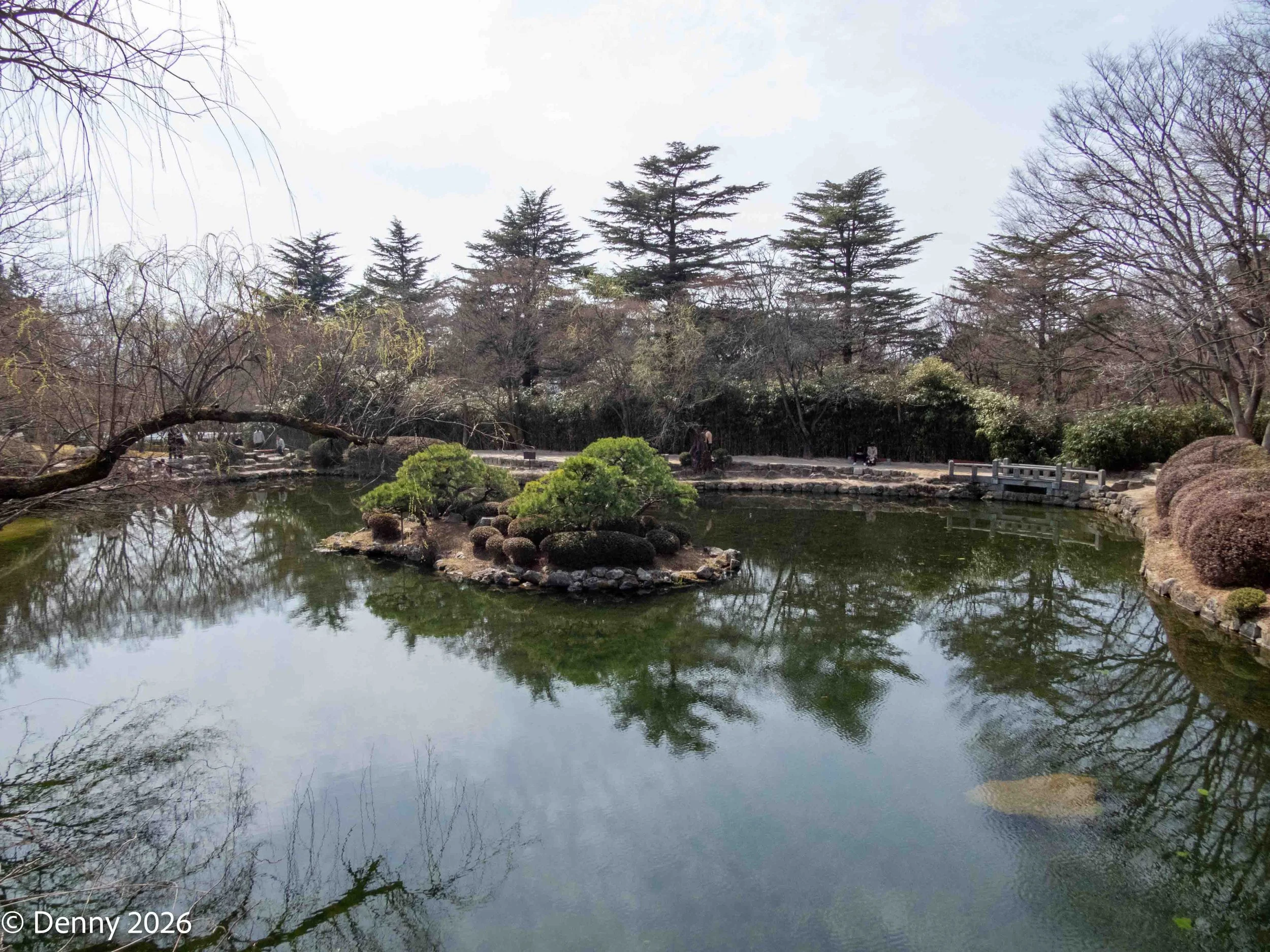
The stone work in the gardens with meandering pathways, cherry blossomed trees and arched bridges made this a particular appealing location.

Pond on pathway to Bulguksa Temple

Pagoda and cherry blossom on path up to Bulguksa Temple

At this stage we all felt we’d been adequately exposed to Buddhist temples and it was time to head to our accommodation in Gyeongju for some free time before we have a sunset tour of the city and a Korean barbecue.

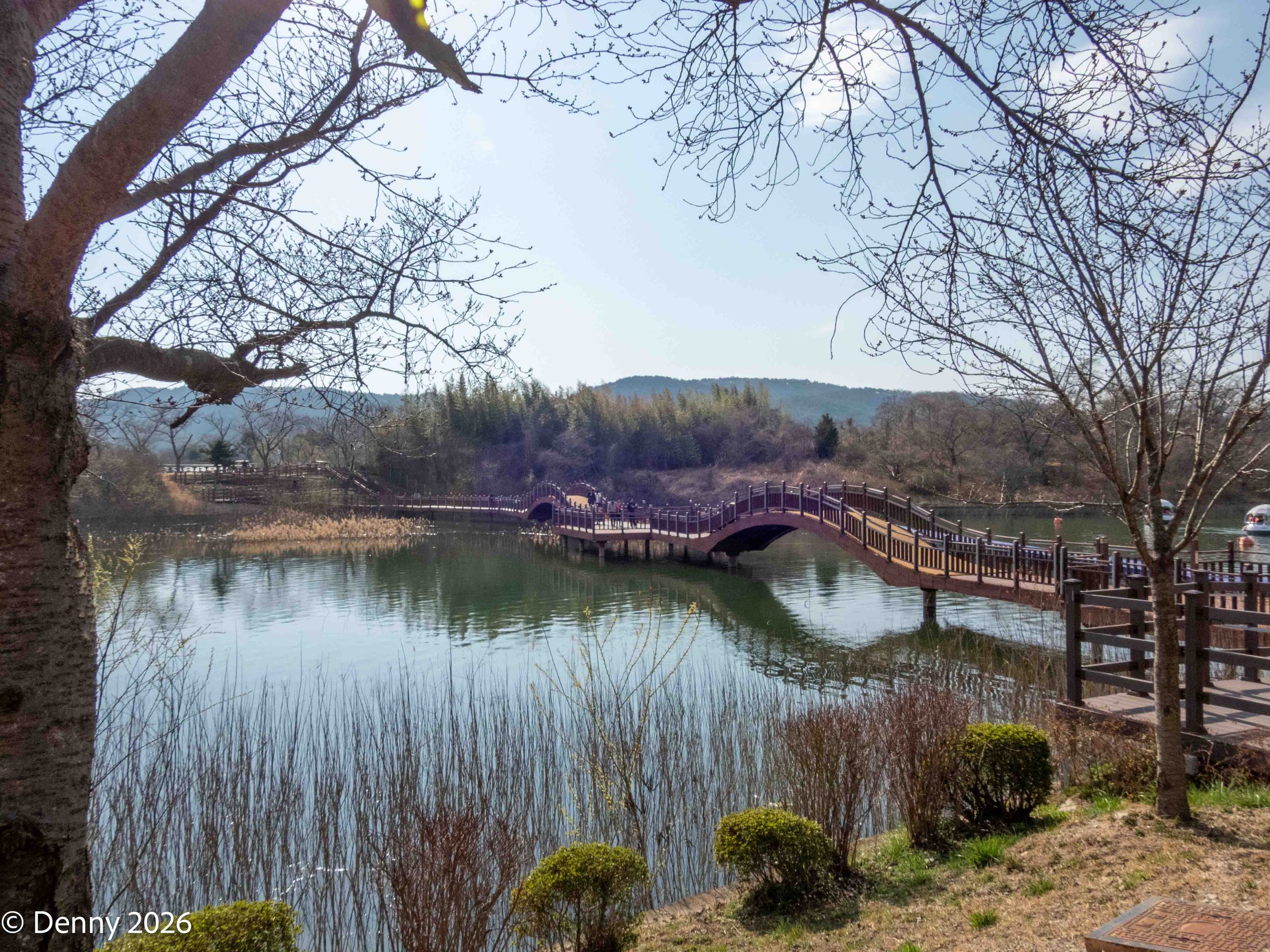
Lake behind Hilton Hotel, Gyeongju

Lake behind Hilton Hotel, Gyeongju

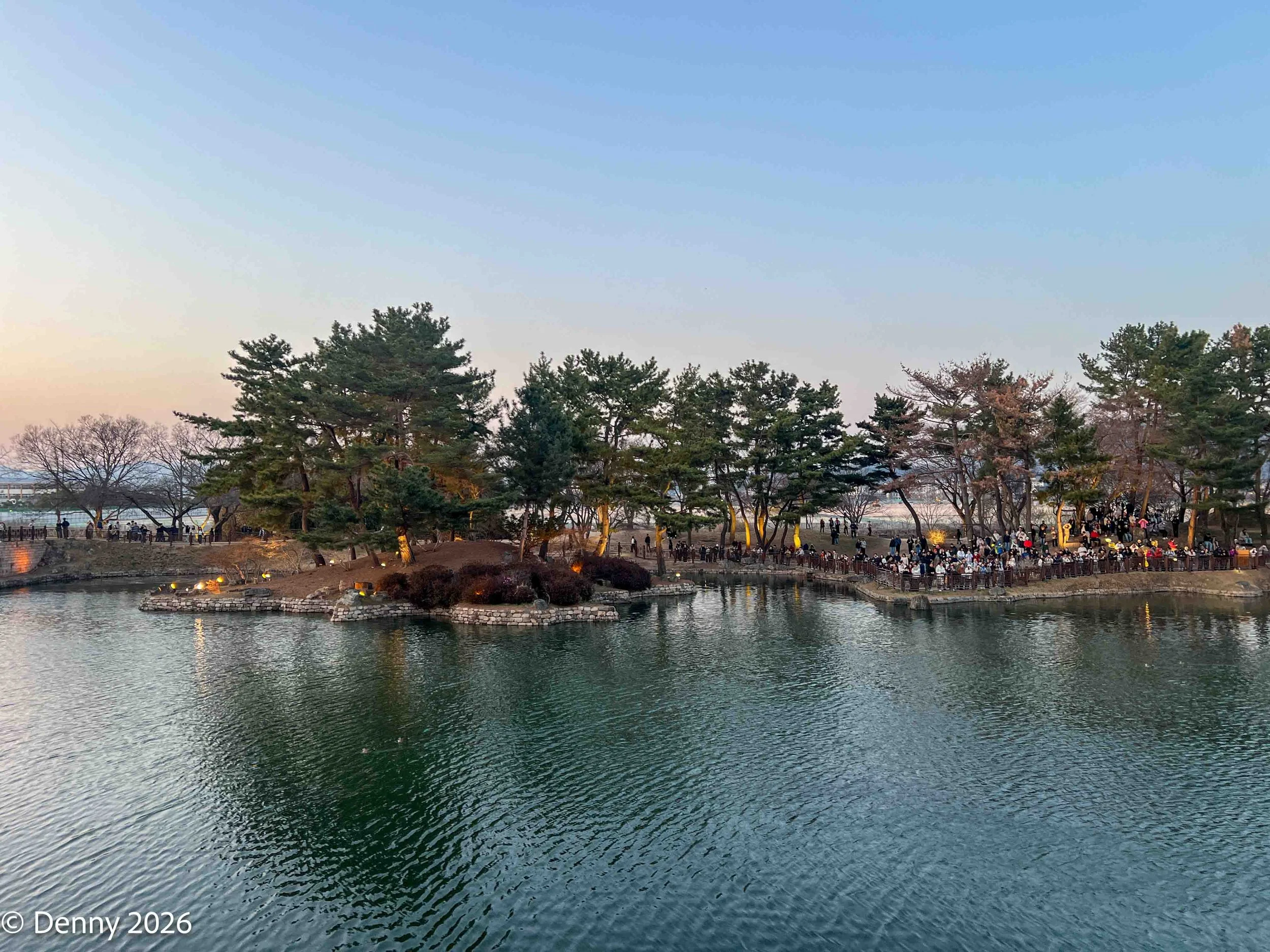
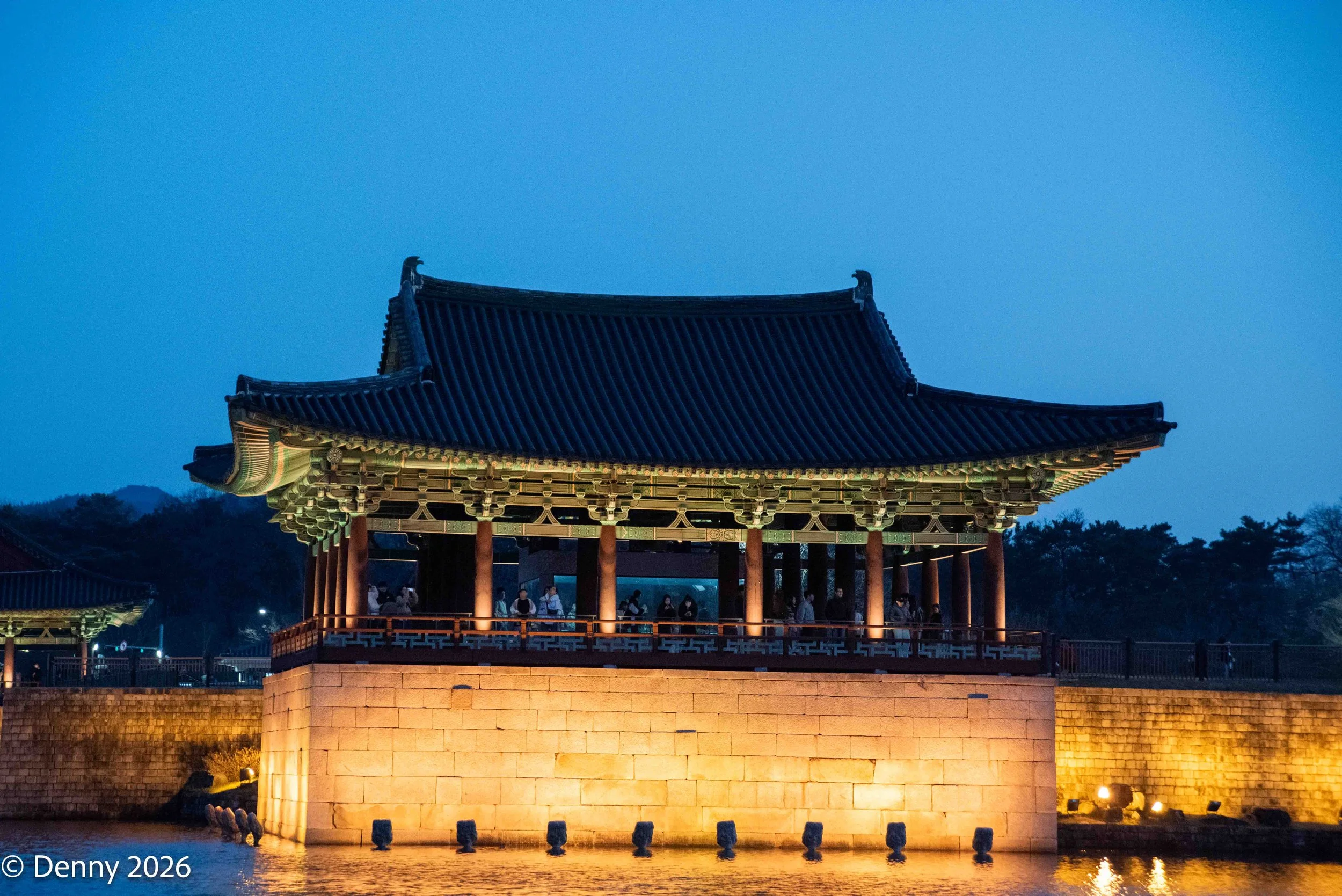
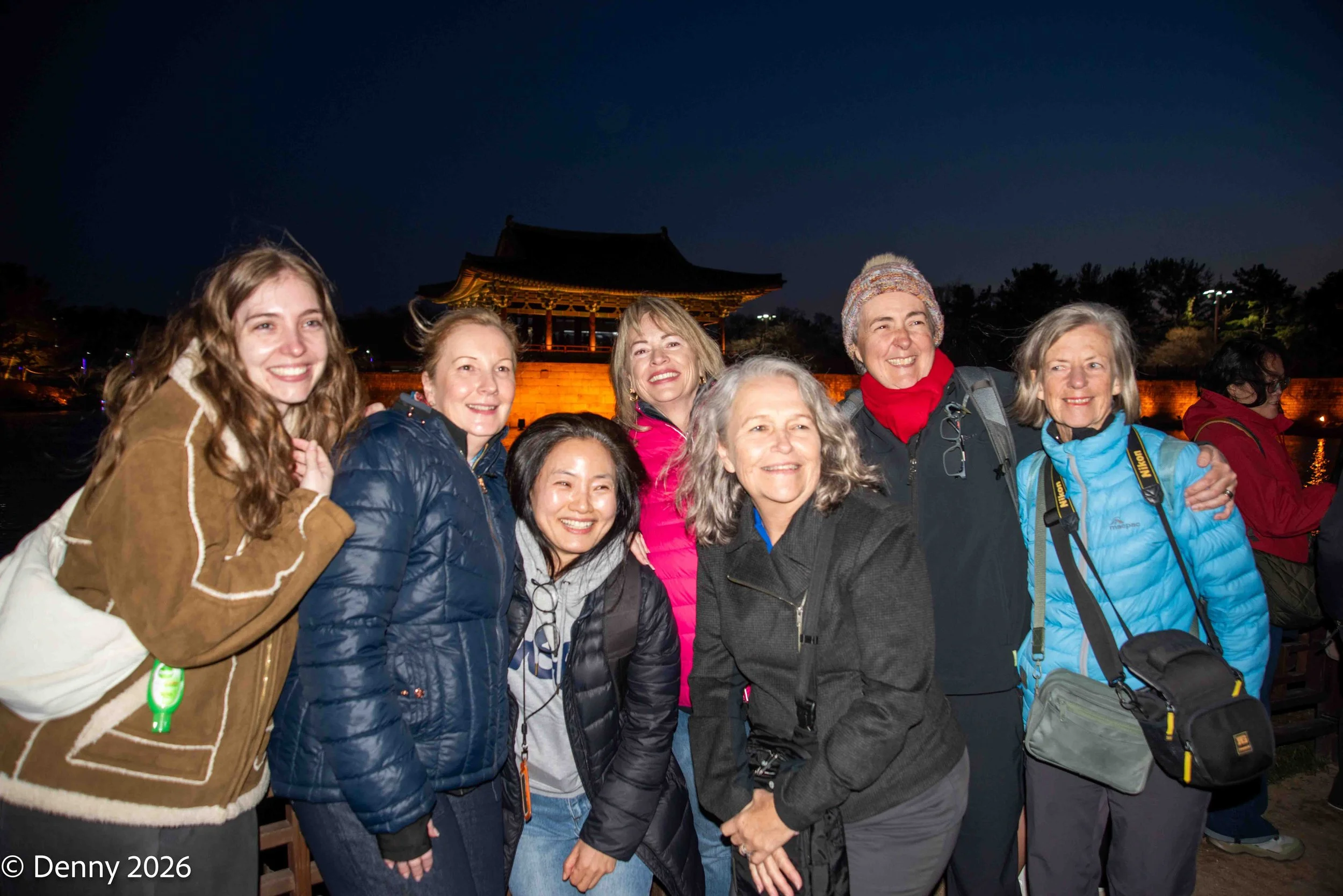
At 18:00 we reassembled and were driven to the Gyeongju Dongjung Palace and Wolji Pond in the local National Park.  The artificial pond, formerly known as Anapji is part of the site of the original 1500 year’s old palace of King Munmu.

Isand on Wolji Pond, Donggung Palace (Palace of the Crown Prince), Gyeongju

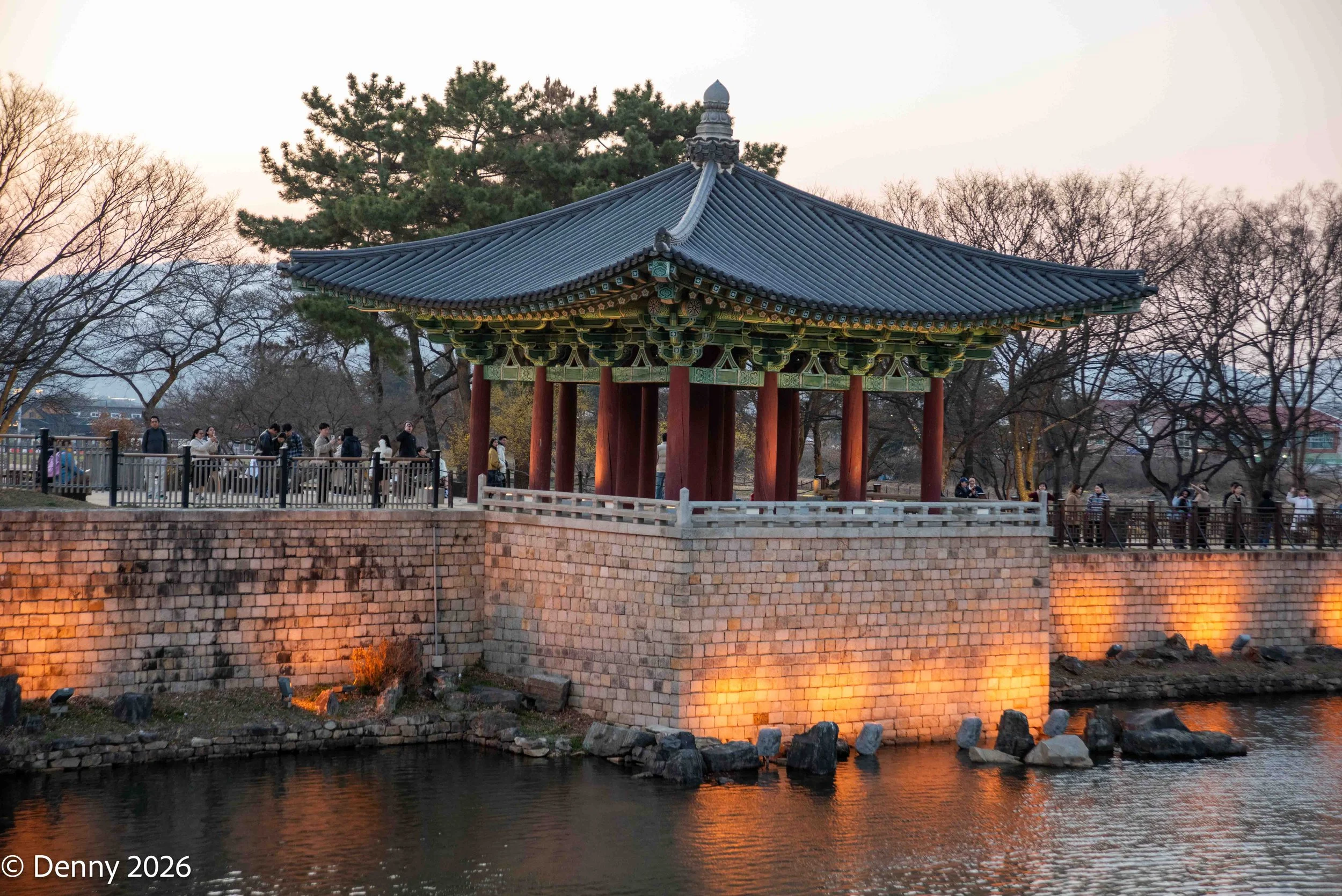
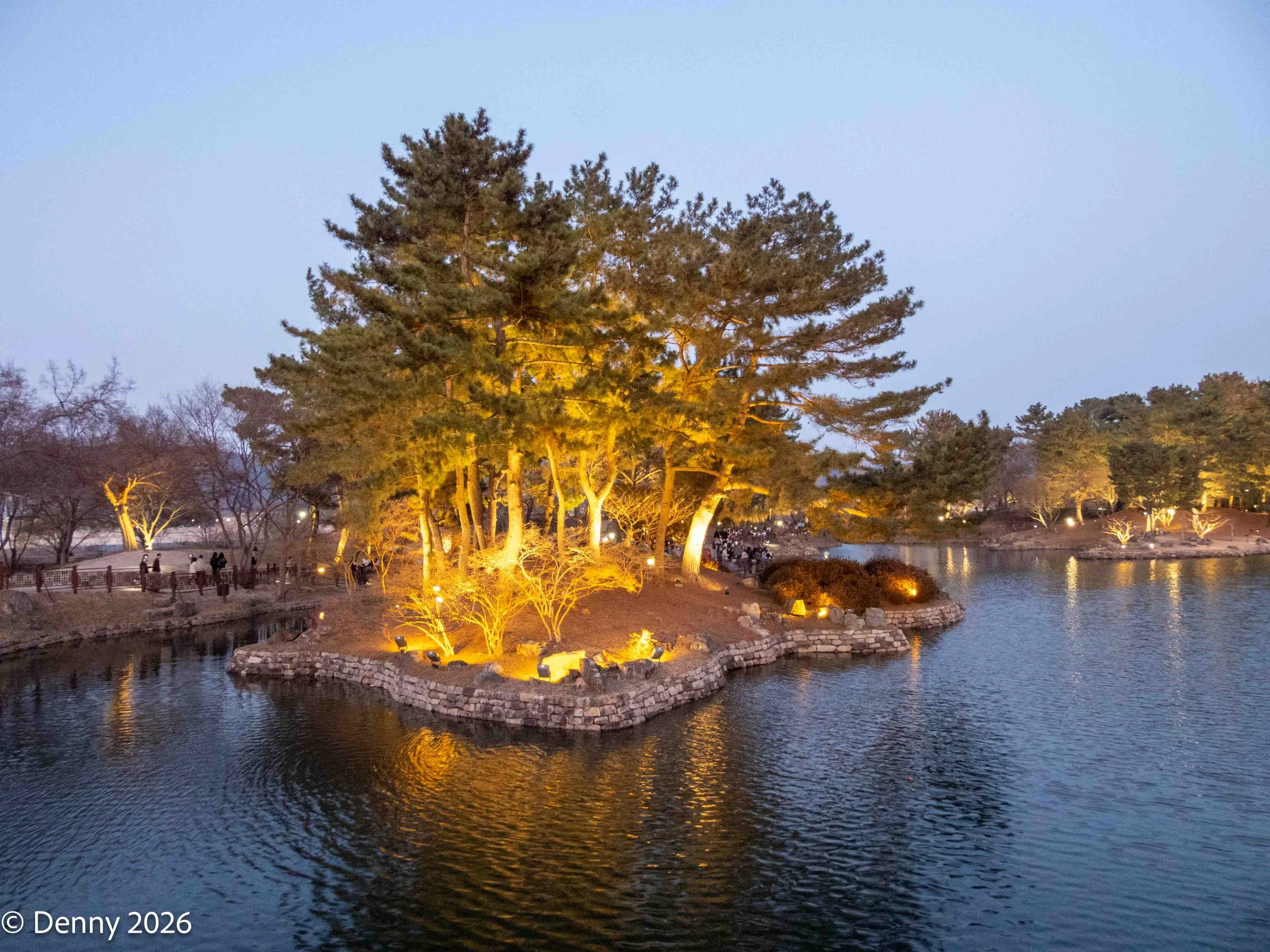
We spent an hour or more wandering around the pond perimeter taking photos of the comparatively new buildings that are attempts to replicate the original palace structures. The buildings were lit up with floodlights and this effect together with the reflections in the pond was very impressive. 

Lake, Donggung Palace (Palace of the Crown Prince), Gyeongju

Donggung Palace (Palace of the Crown Prince), Gyeongj

Island on Wolji Pond, Donggung Palace (Palace of the Crown Prince), Gyeongju

Temple, Donggung Palace (Palace of the Crown Prince), Gyeongju

Girls, Donggung Palace (Palace of the Crown Prince), Gyeongju

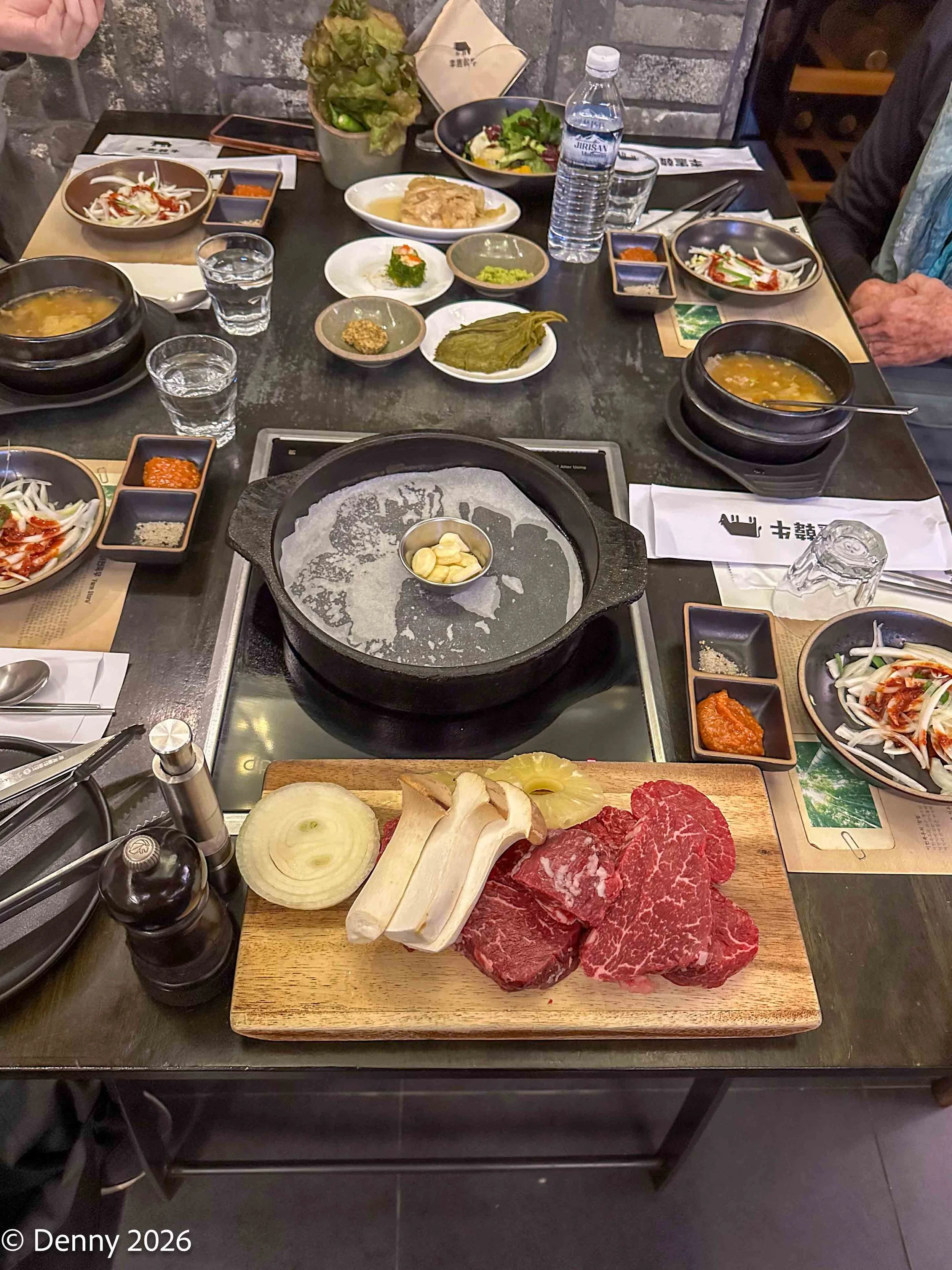
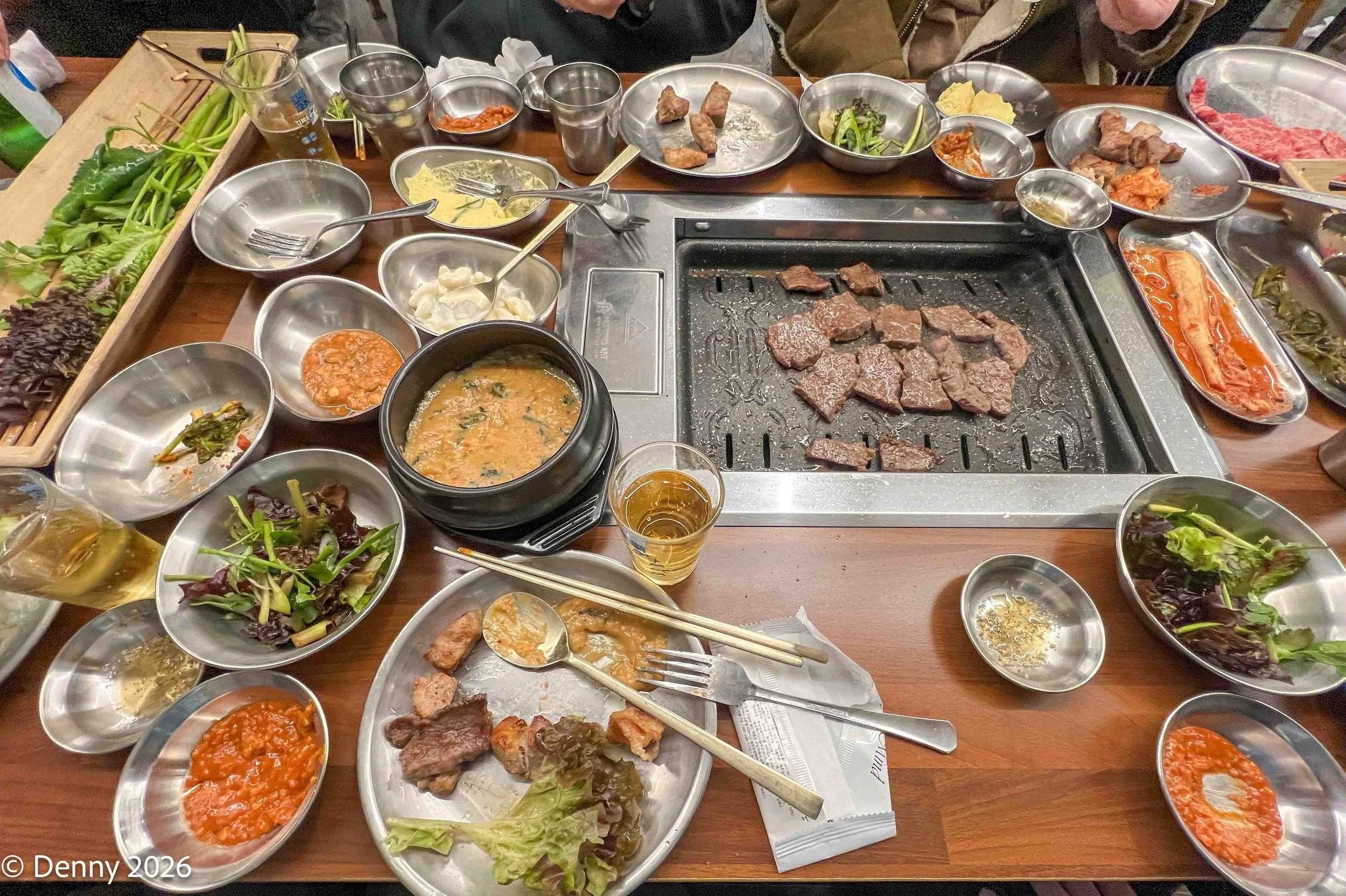
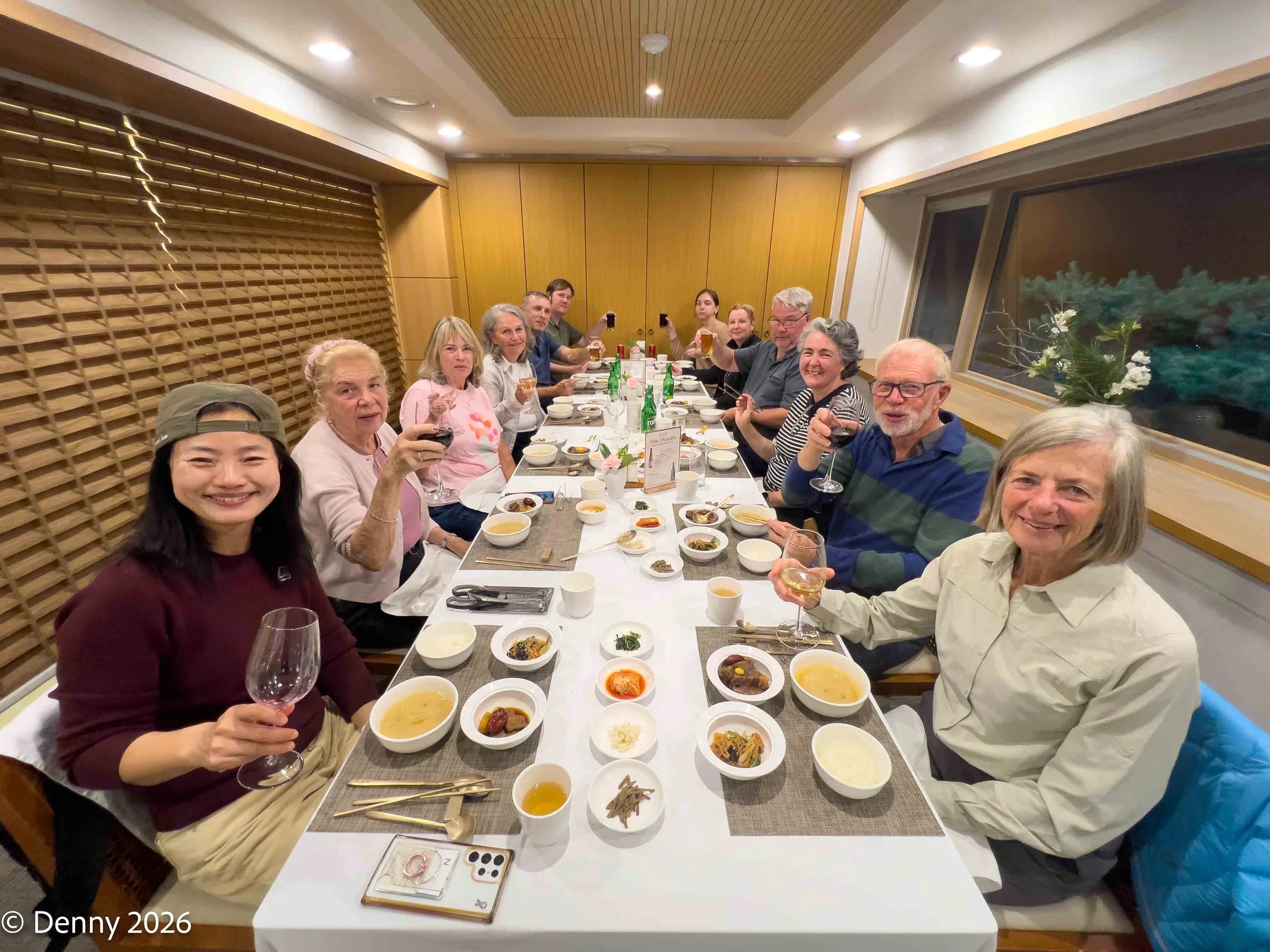
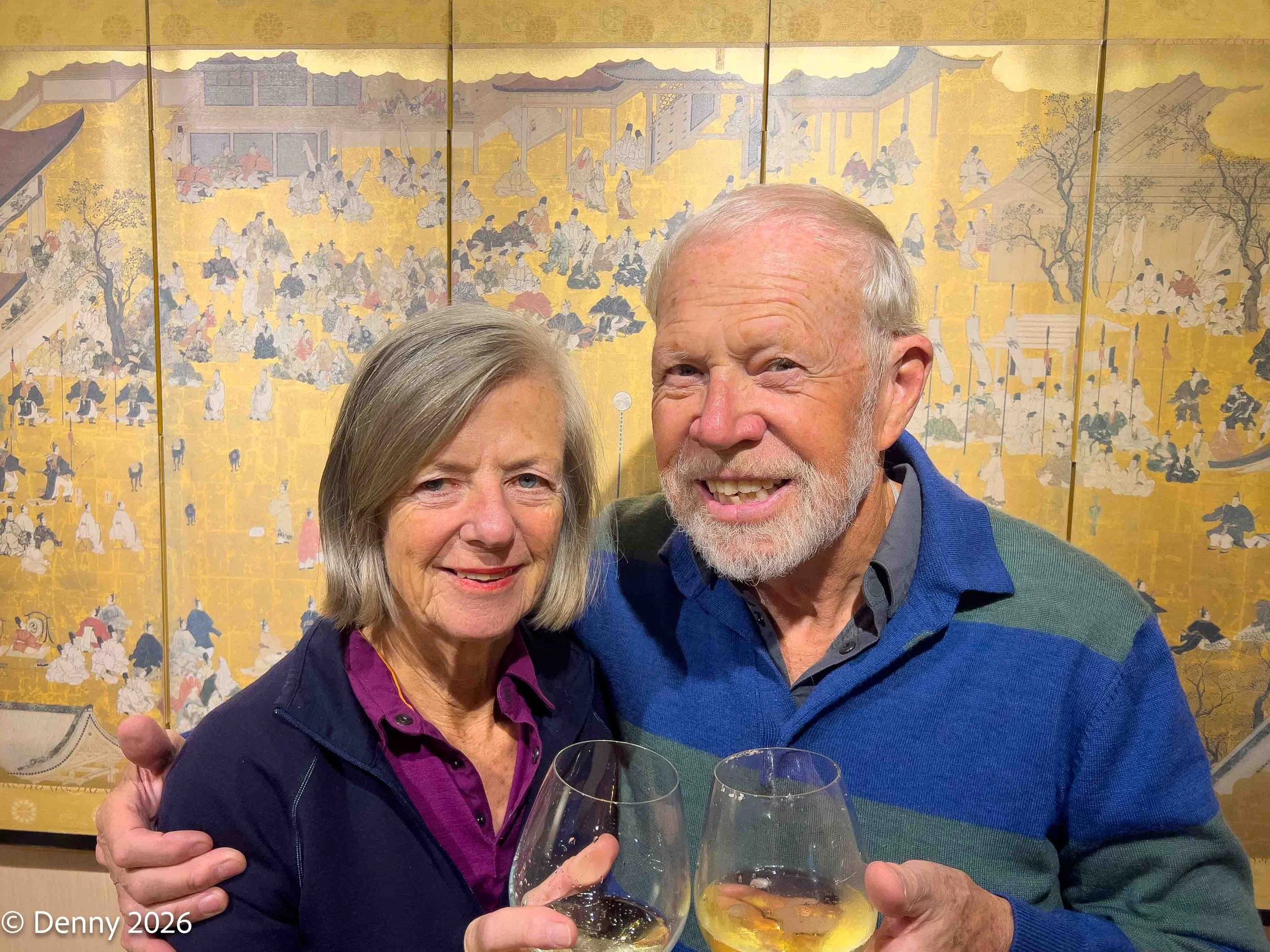
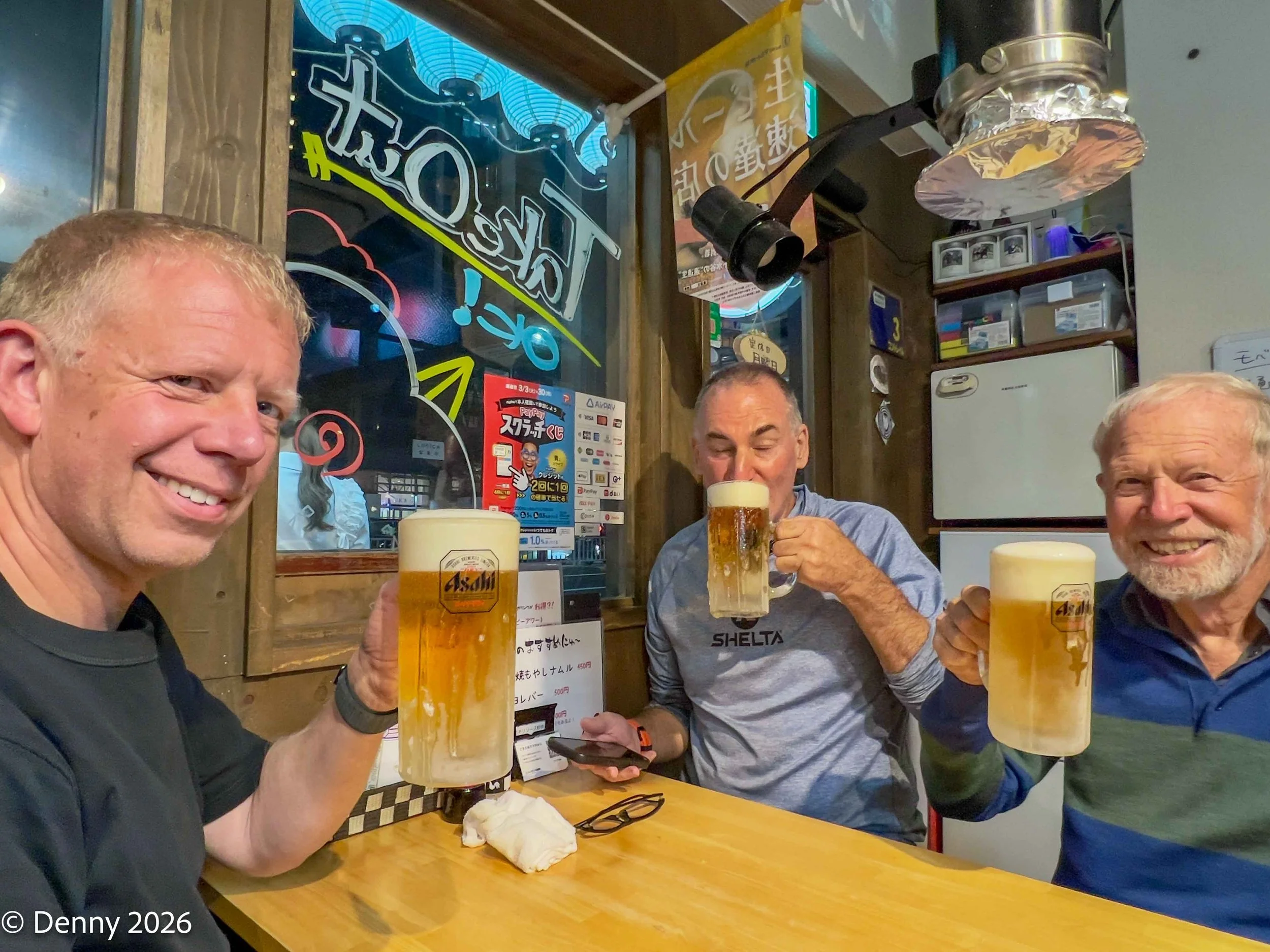
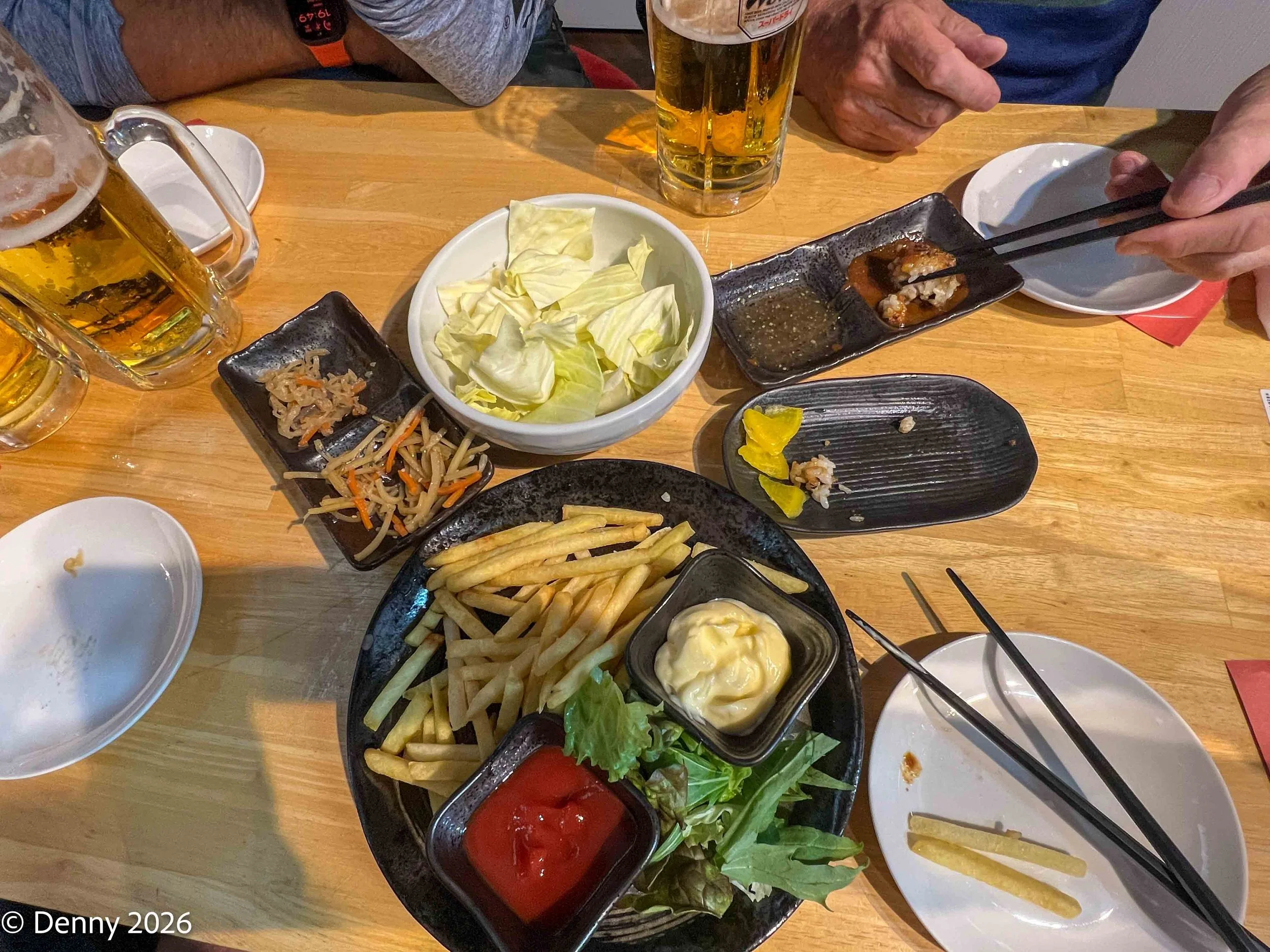
We then had a most enjoyable Korean barbecue with many Korean dishes and local specialties to supplement the beef and pork barbecued at our tables. There was much merriment with the enjoyment of local beers doctored with a significant dash of a Korean equivalent of vodka.  

Korean barbecue, Gyeongju

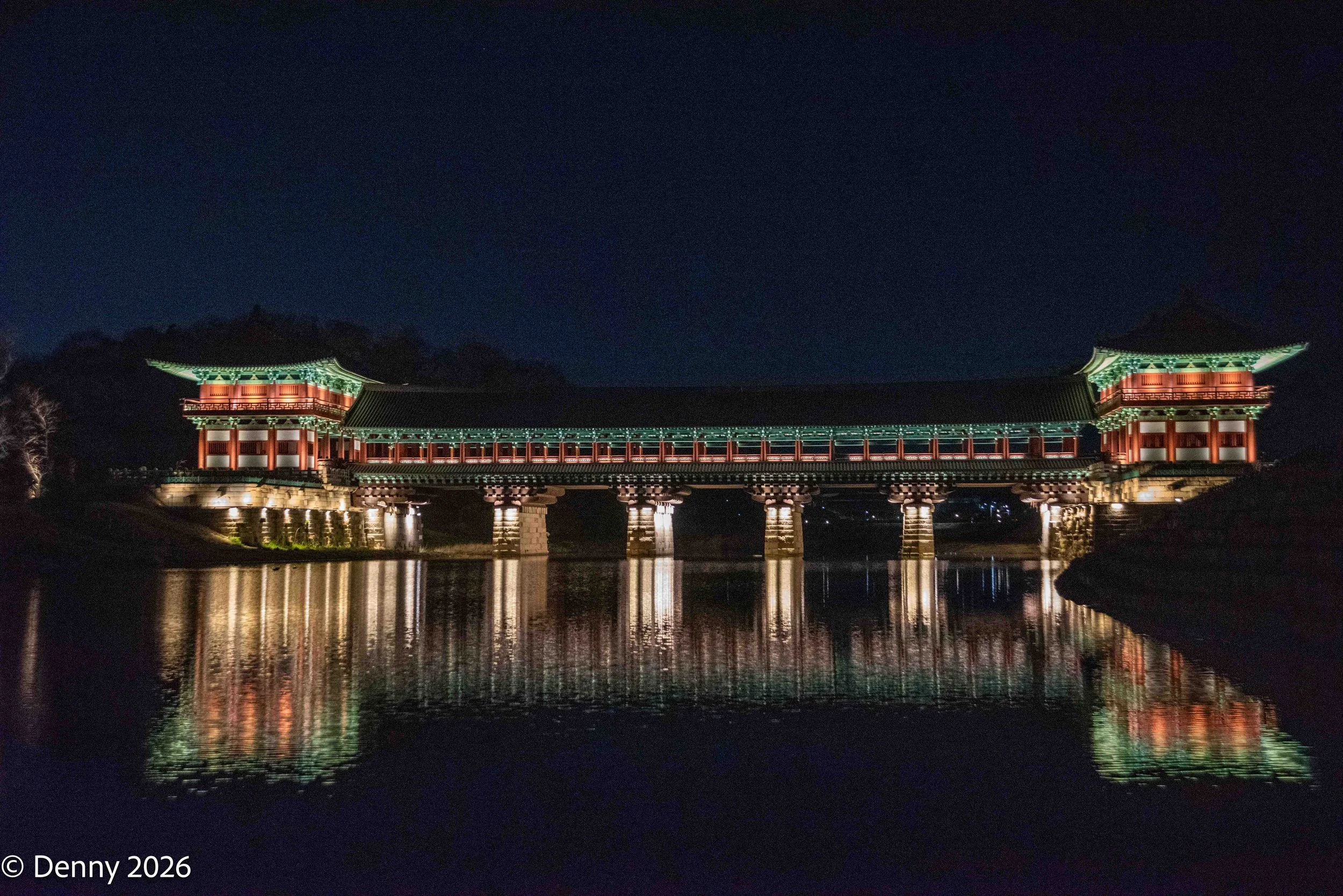
At 21:00, before returning to our hotel we did a short walk along the river bank to enjoy and photograph the stunning night views of the Wolijeonggyo Bridge.

Wolijeonggyo Bridge, Gyeongju

At 22:00 we adjourned for the night after another blue sky day gaining an insight to some of the ancient history of Buddhism in this part of South Korea.

Tomorrow, we explore more of Gyeongju before, in mid-afternoon we catch the bullet train back to Seoul.

DAY 9: Saturday 21st March 2026 BUSAN

Busan is wedged between a mountain range and the sea and is undoubtedly Korea’s most important port city. It has a population of around 3.5 million and is conveniently divided into two main sections, the old city and the new city.

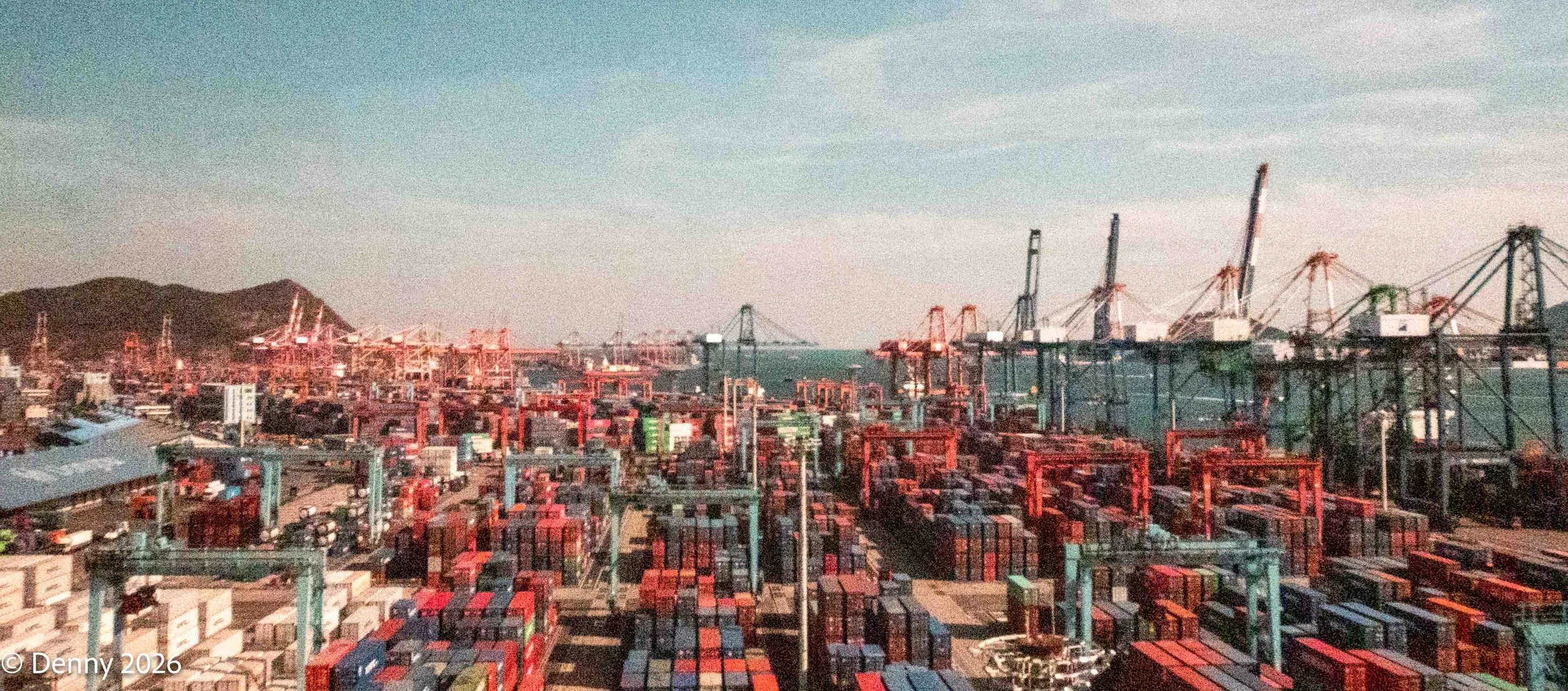
The old city is where the major port area occurs with a vast area of stacked containers, several kilometres of wharf zone and a multitude of associated container loading cranes. Industrialisation in Busan is extensive with the big companies such as LG, Hyundai, Samsung and SK having major operations in this city region. The world’s production of computer chips is centred here in South Korea.

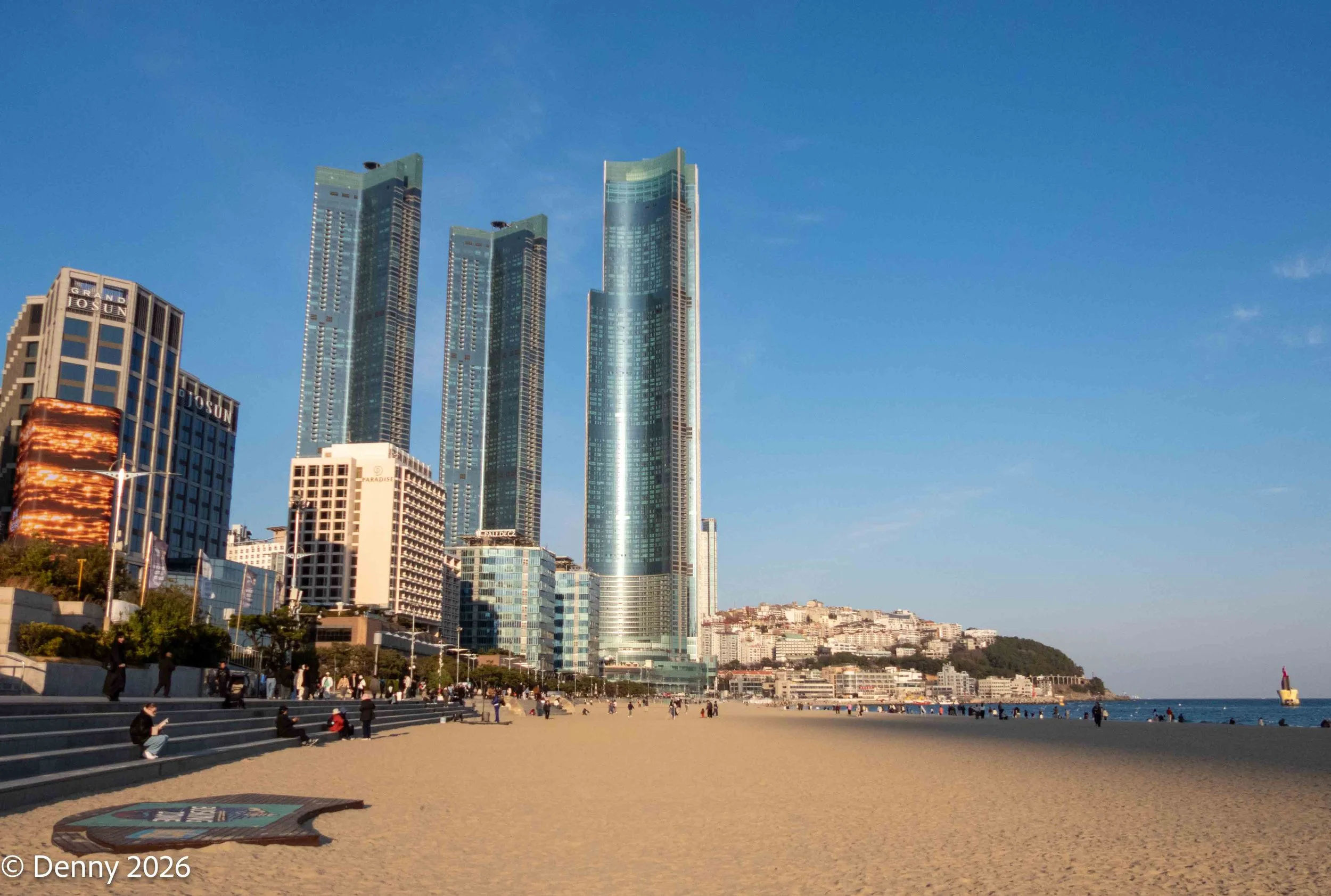
The new city has a substantial beach frontage and is packed with multi-storied buildings some as high as 400 m. The density of human life in the hundreds of sky-scrapers within a comparatively small area begs the question as to the provision of power, water, sewerage treatment, food, health services etc to all these people. We were informed that South Korea has most of its electricity provided by twenty two nuclear power stations.

Our morning in Busan commenced with a visit to the United Nations Memorial Cemetery which is the only UN Memorial Cemetery in the world.

This cemetery is located at Tanggok in the Nam district of Busan and is the sacred, final resting place of 2,300 UN forces who served and died during the 1950 – 1953 Korean War. However, the total number of those who died in the Korean War was over forty thousand.

The cemetery occupies an area of around 10 hectares and is meticulously maintained with manicured gardens and lawns throughout.

We commenced our visit by viewing a short documentary video giving details of the Korean War plus information on the layout of the Memorial Cemetery.

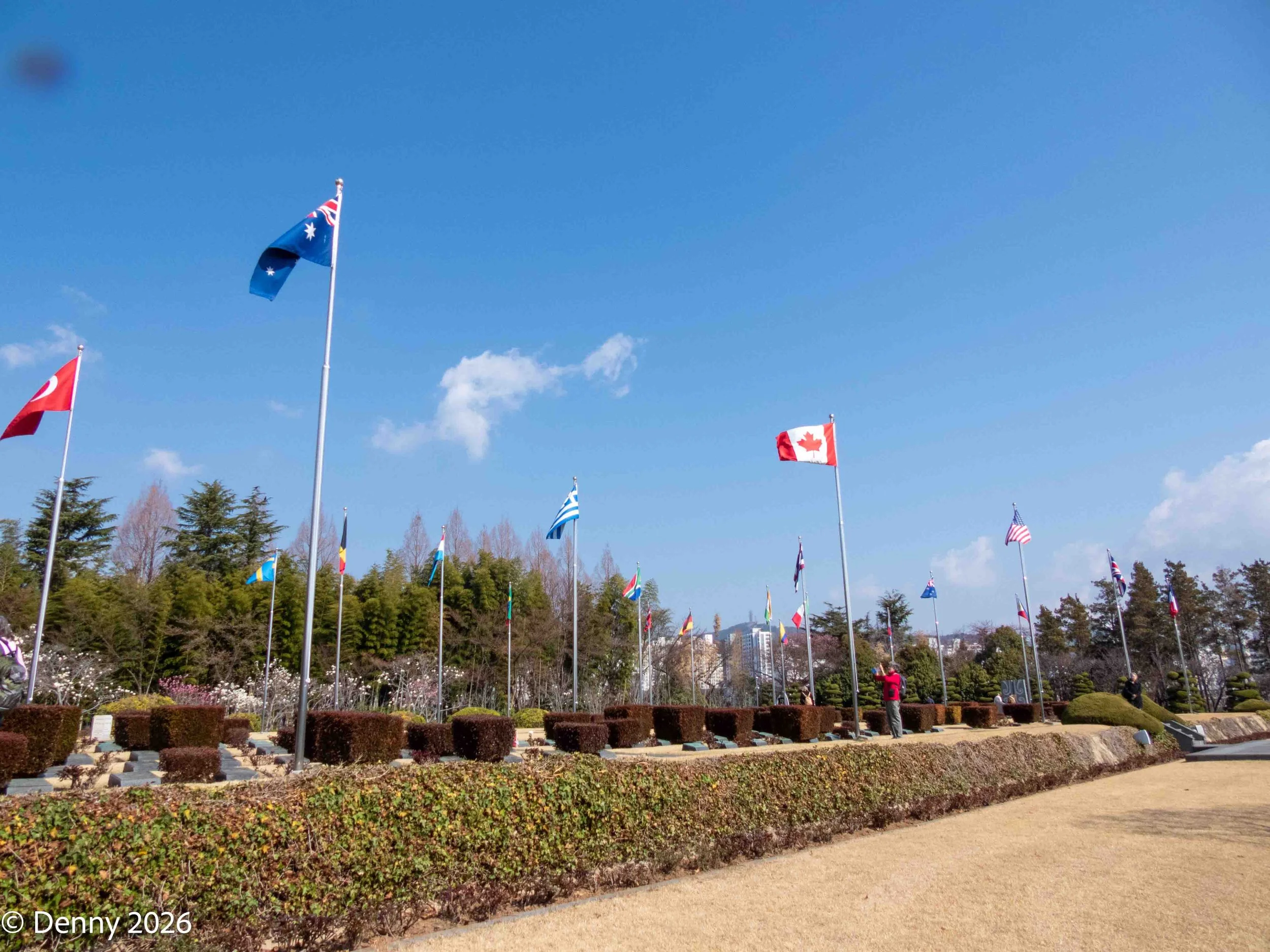
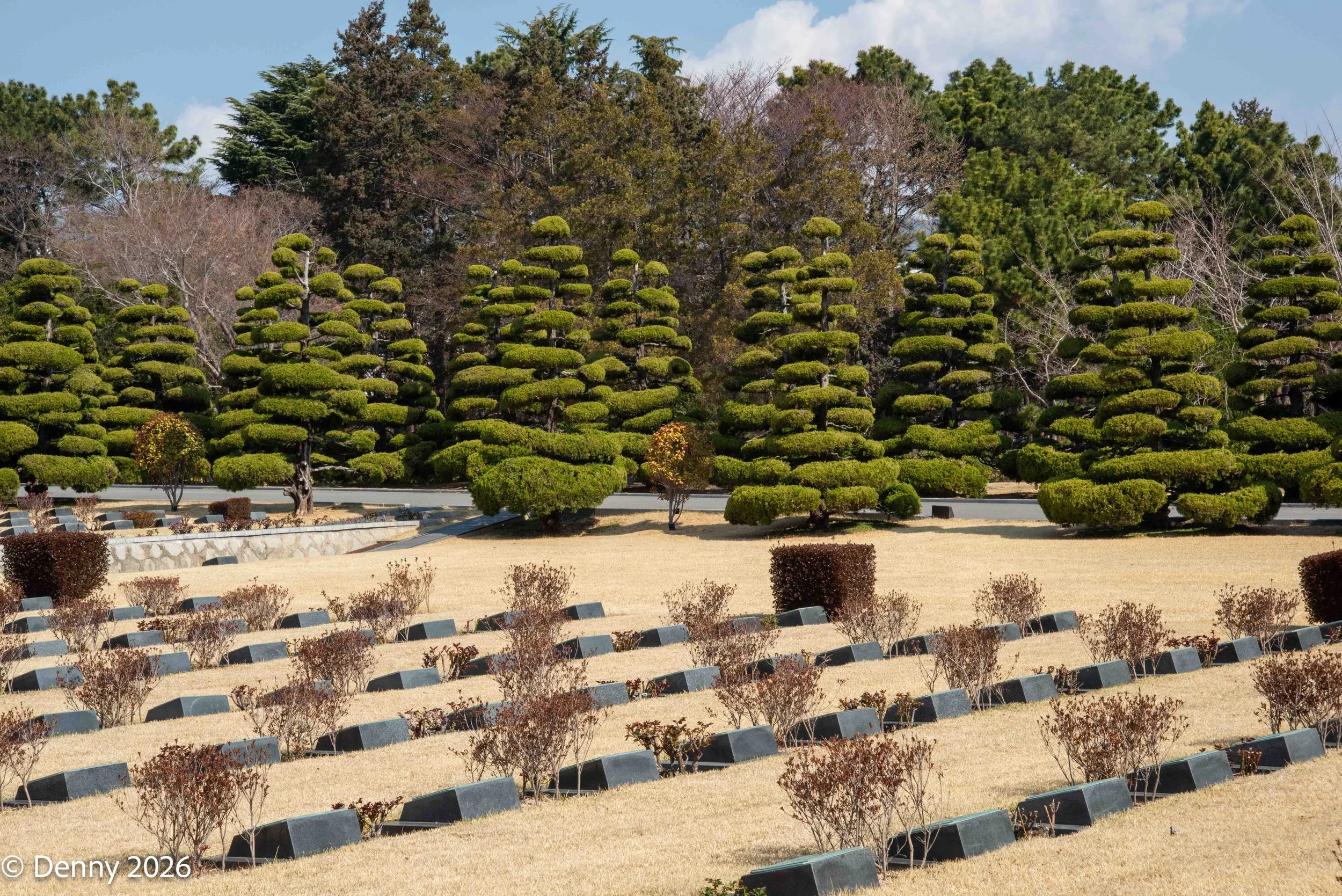
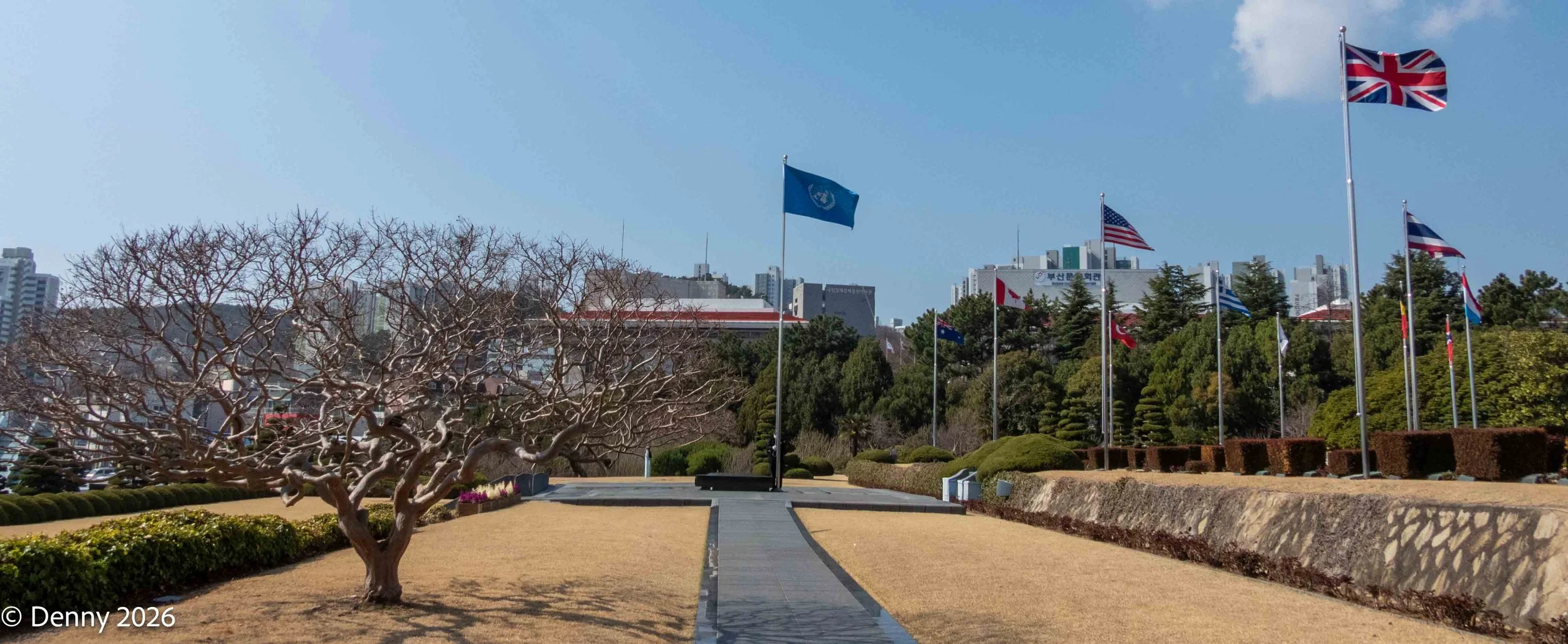
Each of the twenty-two countries that had soldiers involved in the war has its own section of graves with that country’s flag flying high. The Australian section has 281 graves with each headstone giving name, rank, age and date of death. Sadly, many of the soldiers died in their early twenties with the youngest Australian being J.P. Daunt who died at age 17. There is waterway around the lower garden area named in his memory.

UN Memorial cemetery

UN Memorial cemetery

UN Memorial cemetery

At right on 10:00 the UN flag was raised together with a bugle call.

Raising of the flag, UN Memorial cemetery

Gardens, UN Memorial cemetery

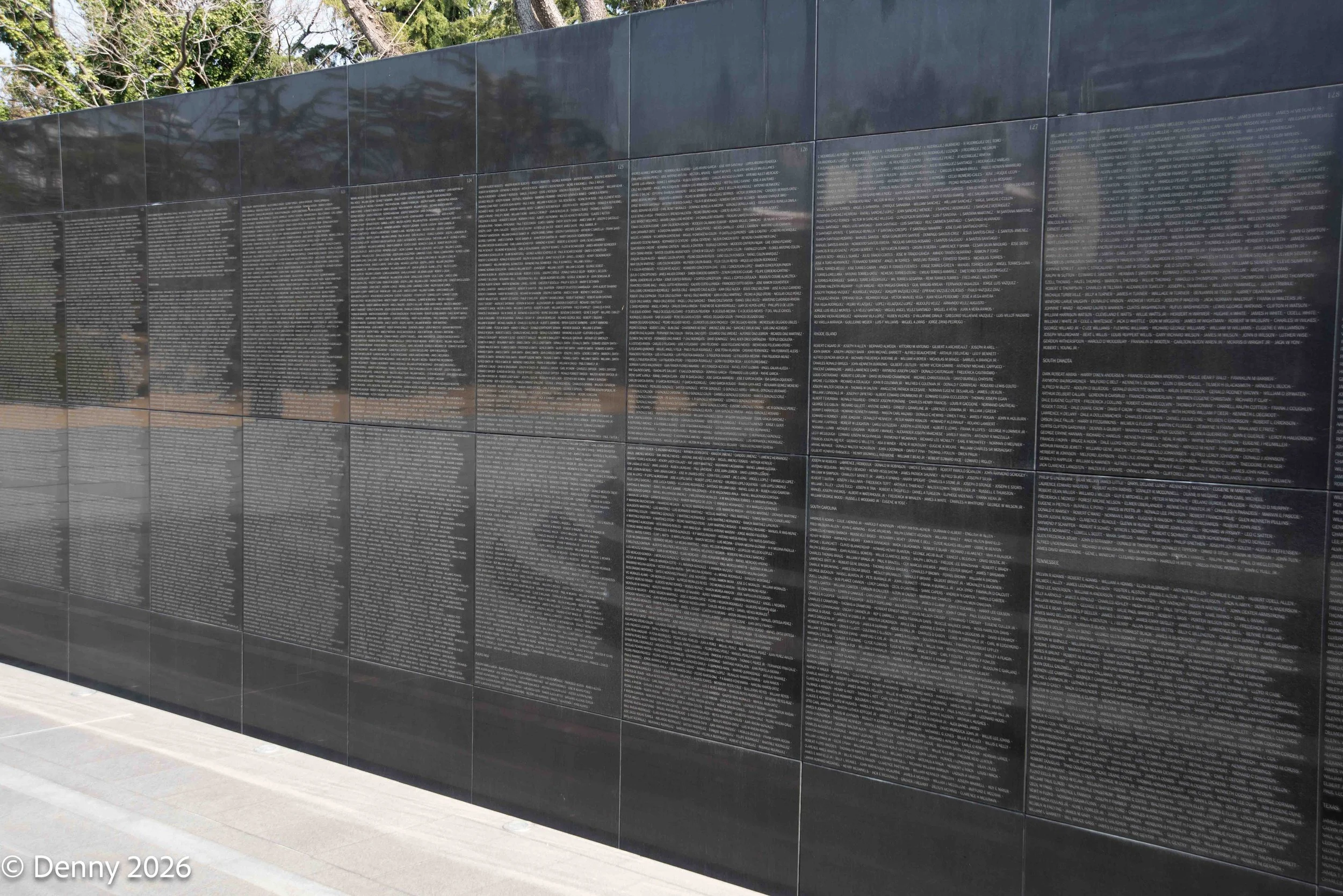
We wandered around the grave “Symbolic Area” and then went down to the Wall of Remembrance where the names of the 40,896 who died in the Korean War are listed in alphabetical country order. Each individual name is engraved into black granite and the forty one thousand names provides a stark reminder of the tragedy of war for not only those who lost their lives but those who survived but suffered terrible physical and mental injuries as a consequence of the conflict.

Wall of Remembrance, UN Memorial cemetery

Wall of Remembrance, UN Memorial cemetery

Wall of Remembrance, UN Memorial cemetery

To complete this visit we spent some time in the Memorabilia Hall where there were many old photos of war-time activities and military personnel.

We then drove to the southern part of down-town Busan across a suspension bridge to the island of Yeong-do and stopped just north of the Taejongdae Park.

The views from the lookout point were impressive with a cliff-top panorama over the ocean. From this high point the Japanese island of Tsushima is usually visible although it was a bit too misty today for a clear sight.

We ventured out onto the Oryukdo Skywalk which is a ‘U’ shaped, seven metre long platform made from steel and with a glass floor that protrudes out over the edge of the cliff and ocean below. This is not an ideal pursuit for those who suffer from acrophobia as one looks down through the floor to see the waves crashing into rocky shore eighty metres below.

Oryukdo Islets viewed from Oryukdo Skywalk

Oryukdo Islets viewed from Oryukdo Skywalk

Oryukdo Skwalk viewed from Igidae Park

With time to spare, we climbed the 250 steps to the high lookout point and took more photos of the steep cliffed coastline with the expanse of Busan city and its many beaches as the background.

Oryukdo Skwalk viewed from Igidae Park

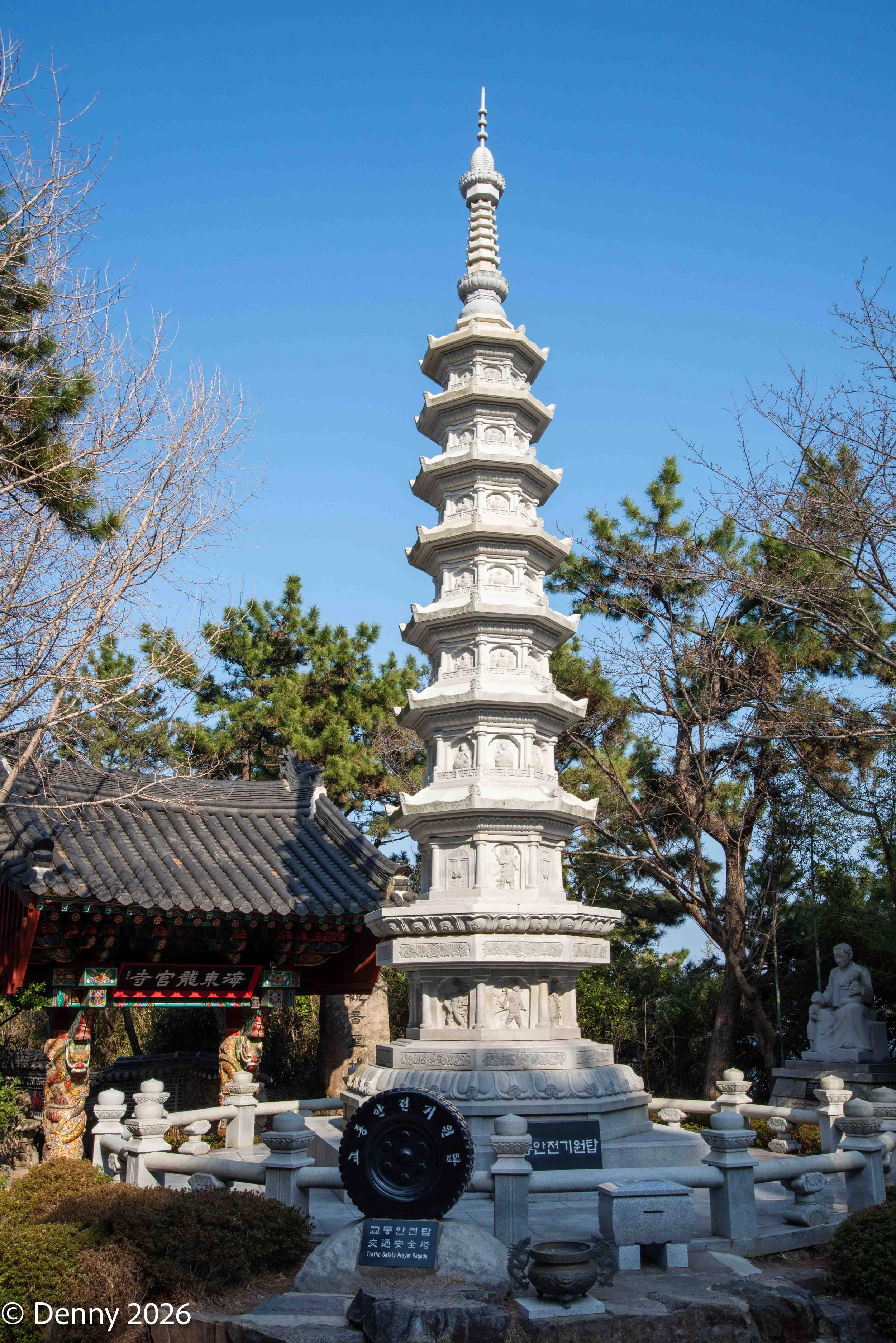
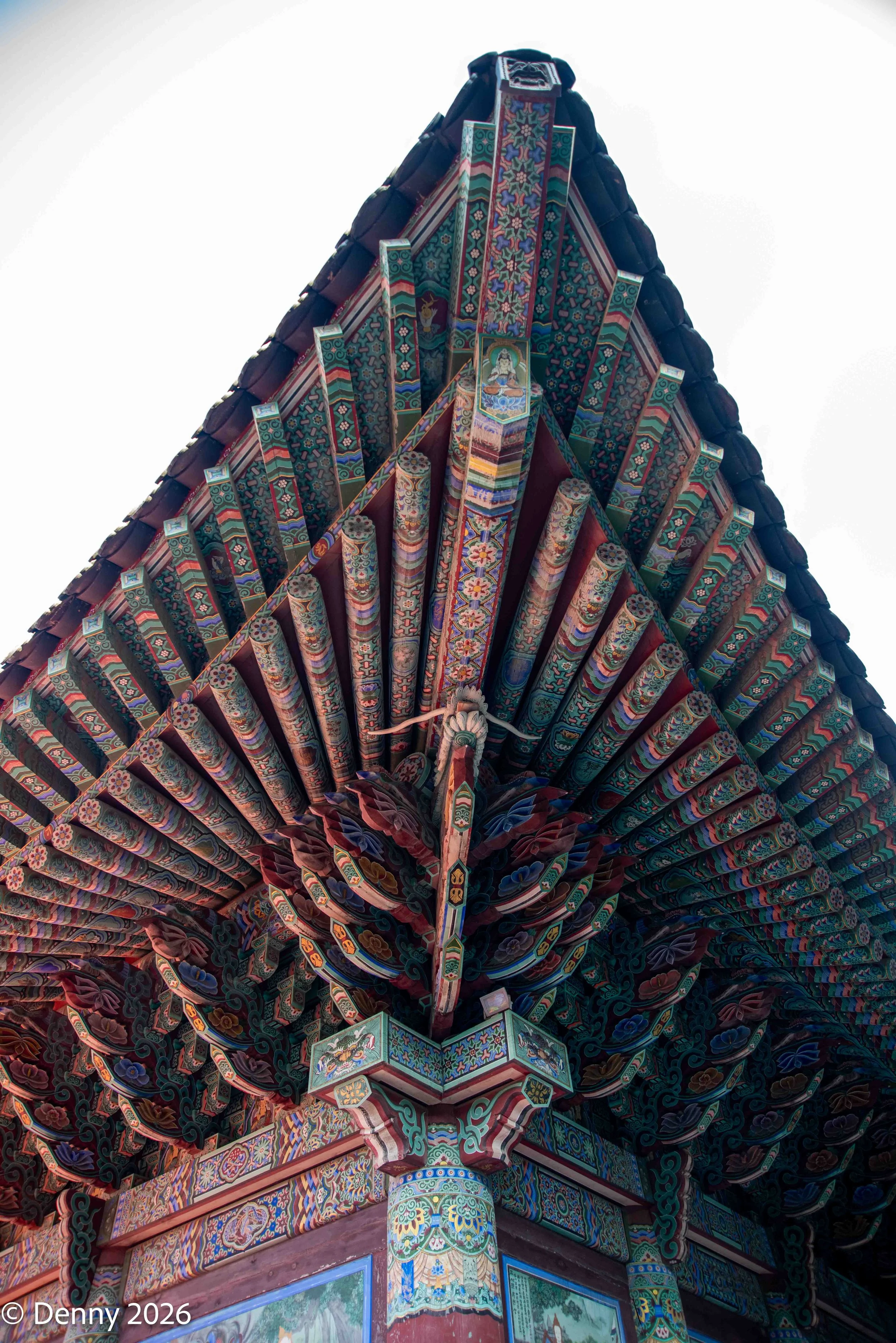
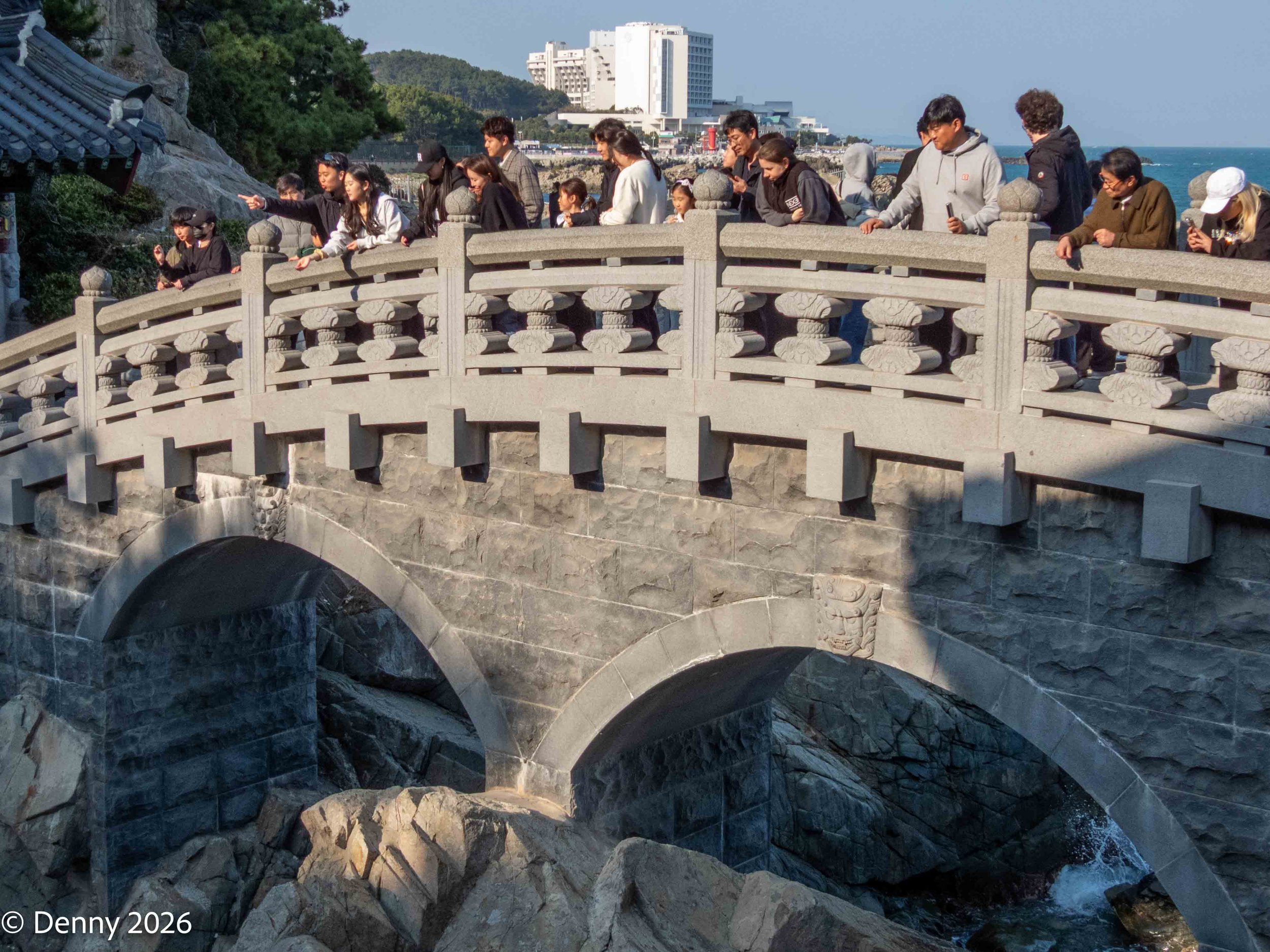
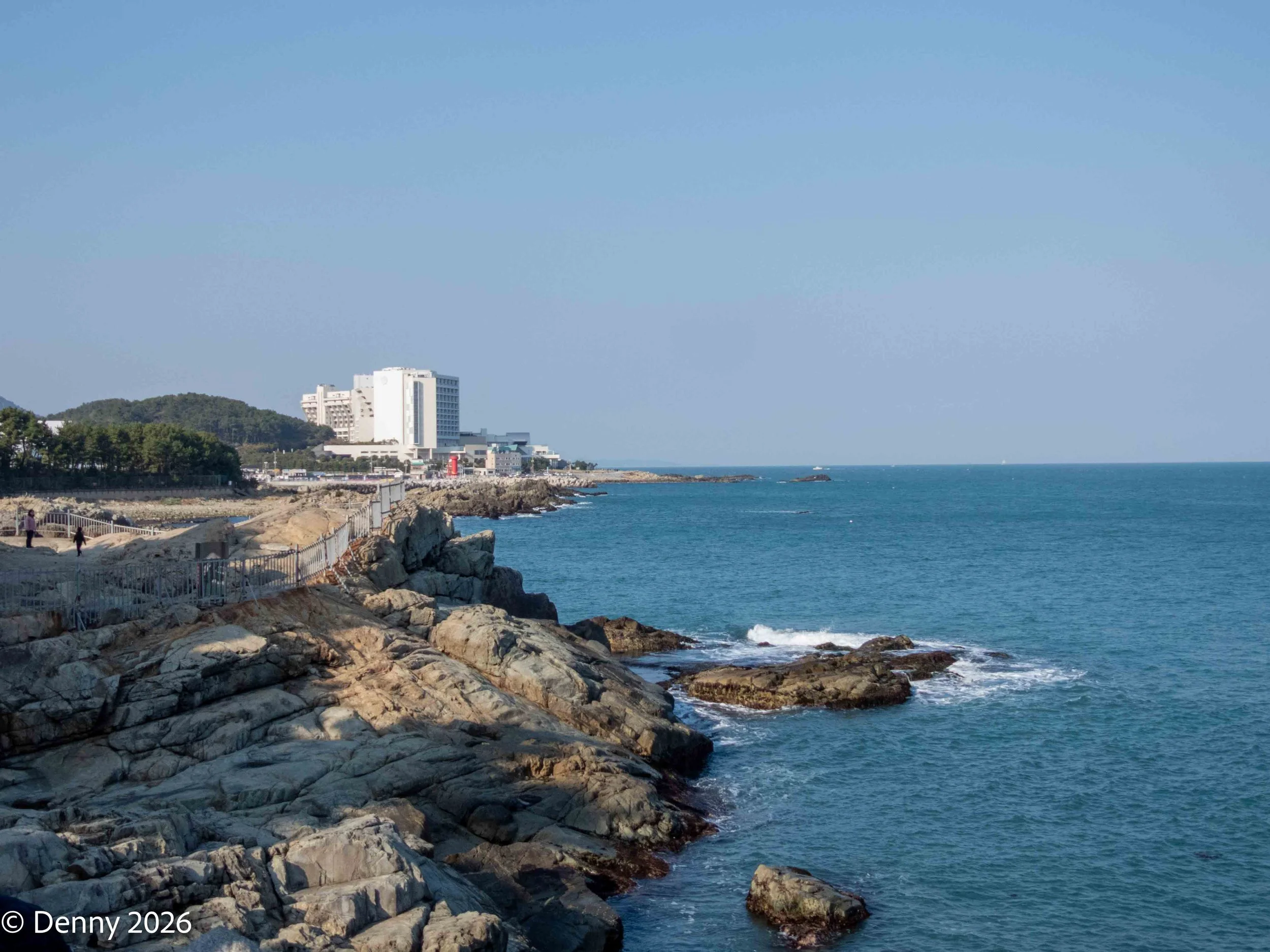
In the later afternoon we visited the Haedong Yanggungsa Buddhist Temple. Gauging by the traffic jam we experienced and the number of people visiting, this is a major tourist attraction. The site incorporates not just the temple and the various buildings but its location on the northeastern coastline results in a blend of Buddhist history, architectural splendour and the ocean vista.

Pagoda at Haedong Yonggungsa Temple

Temple eaves, Pagoda at Haedong Yonggungsa

Buddha, Haedong Yonggungsa Temple

Inside Haedong Yonggungsa Temple

Bridge, Haedong Yonggungsa Temple

View from Haedong Yonggungsa Temple

The crowd density was too great to make for a totally pleasant visit and by the end of the two hour’s visit we were ready to move even if the traffic situation meant moving on slowly!

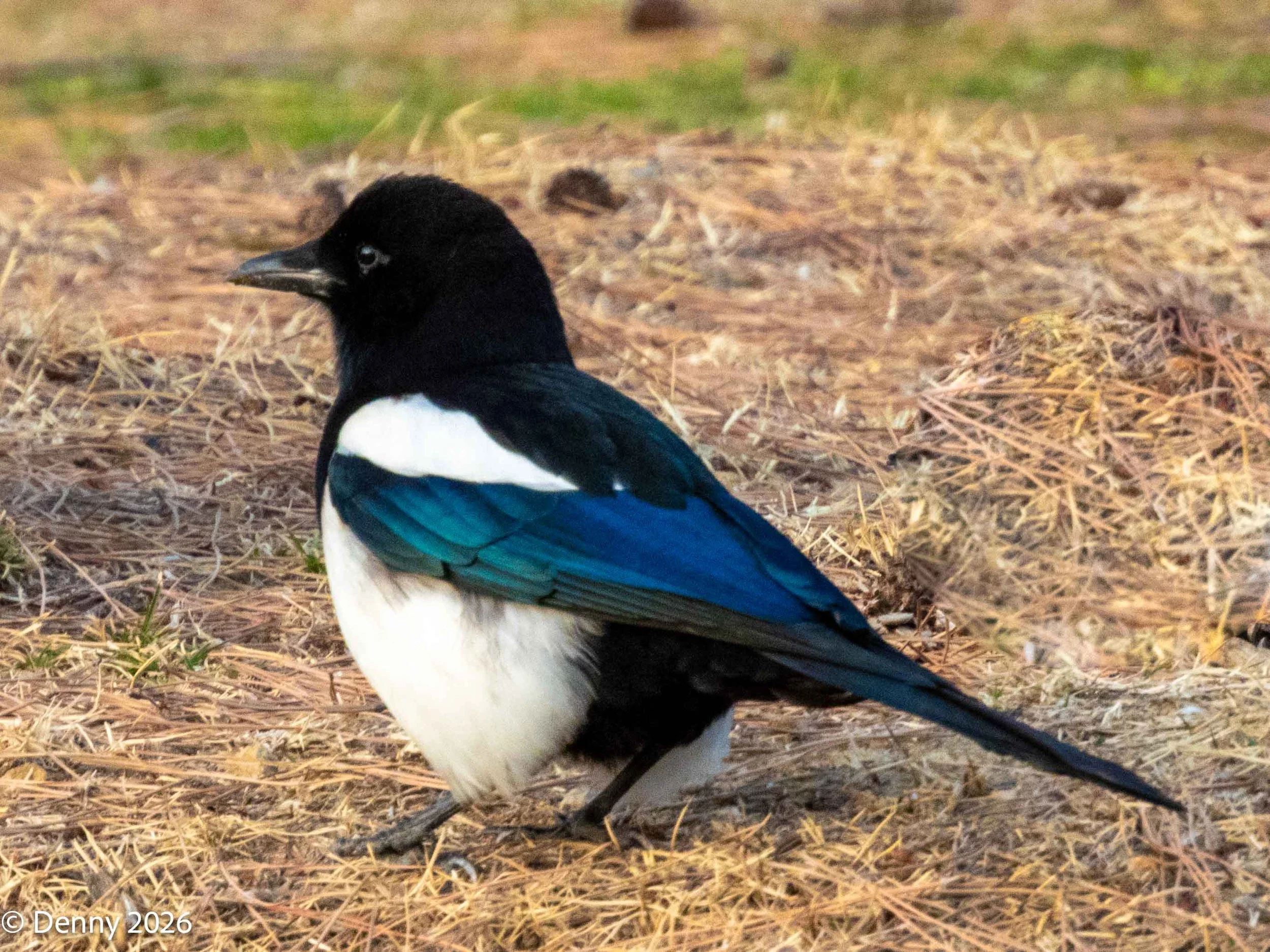
Oriental Magpie (Pica serica) - national bird of South Korea in park near ferry terminal

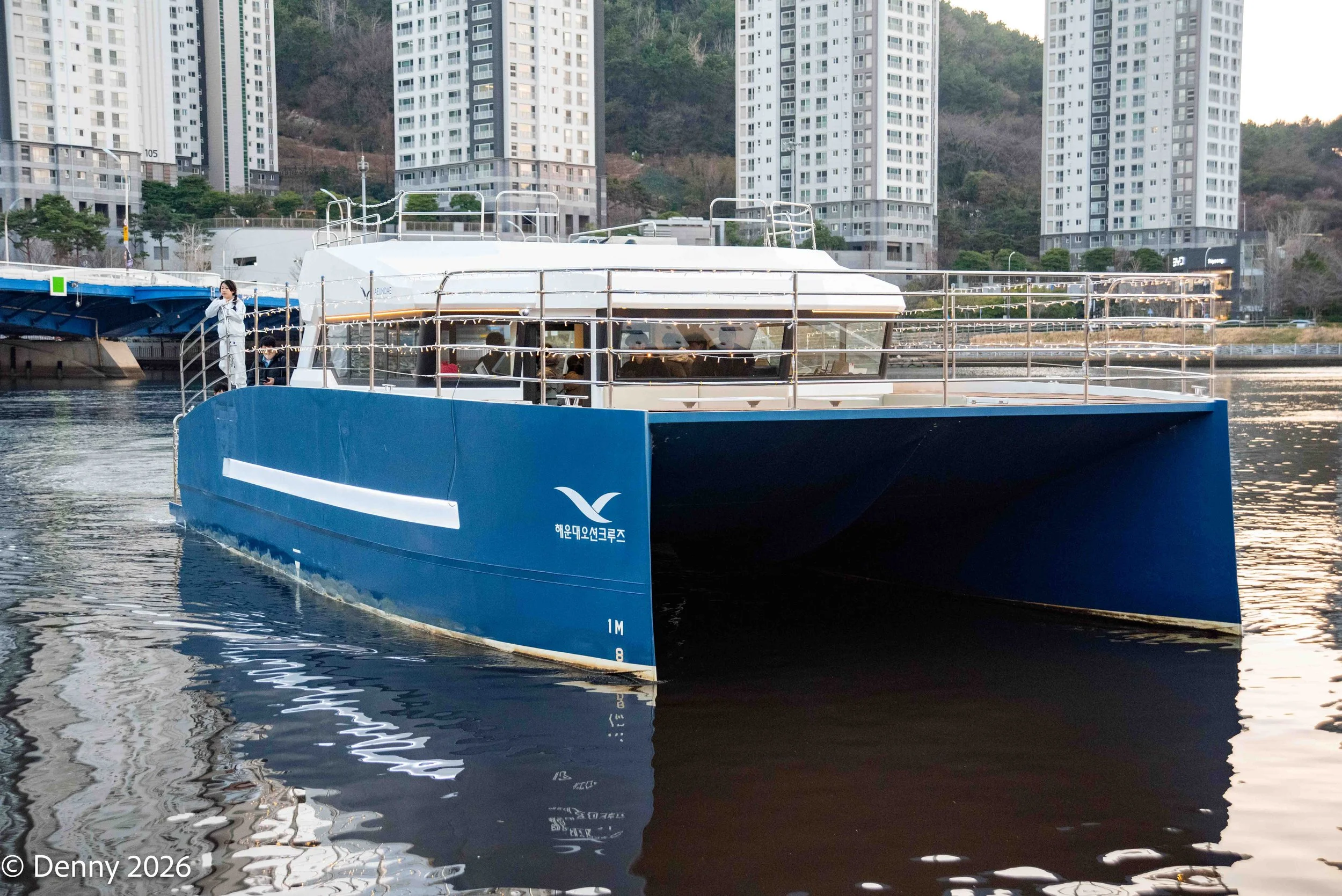
At 18:30 we boarded a catamaran and spent the next hour on a cruise along the Haeundae River.

Our ferry

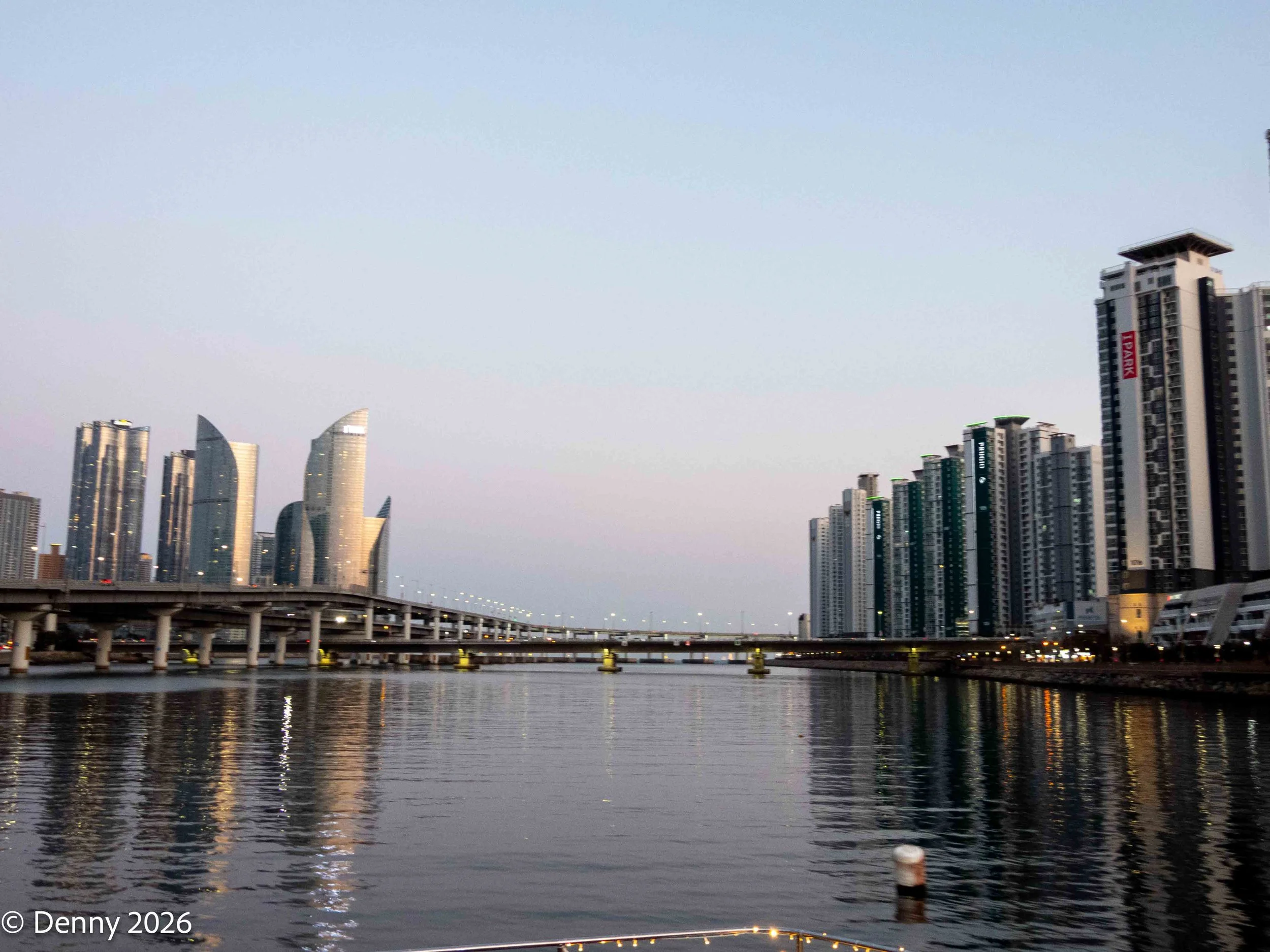
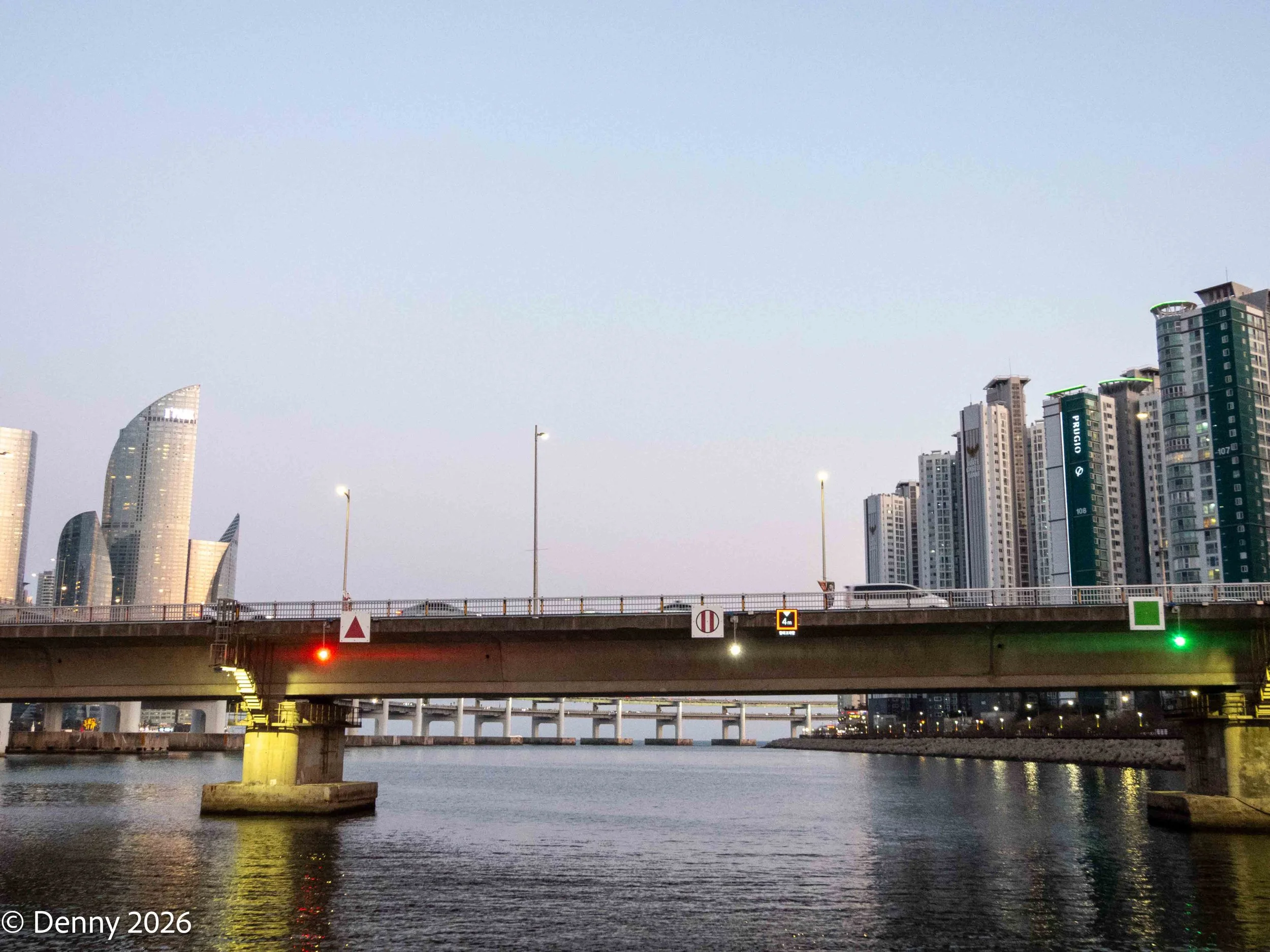
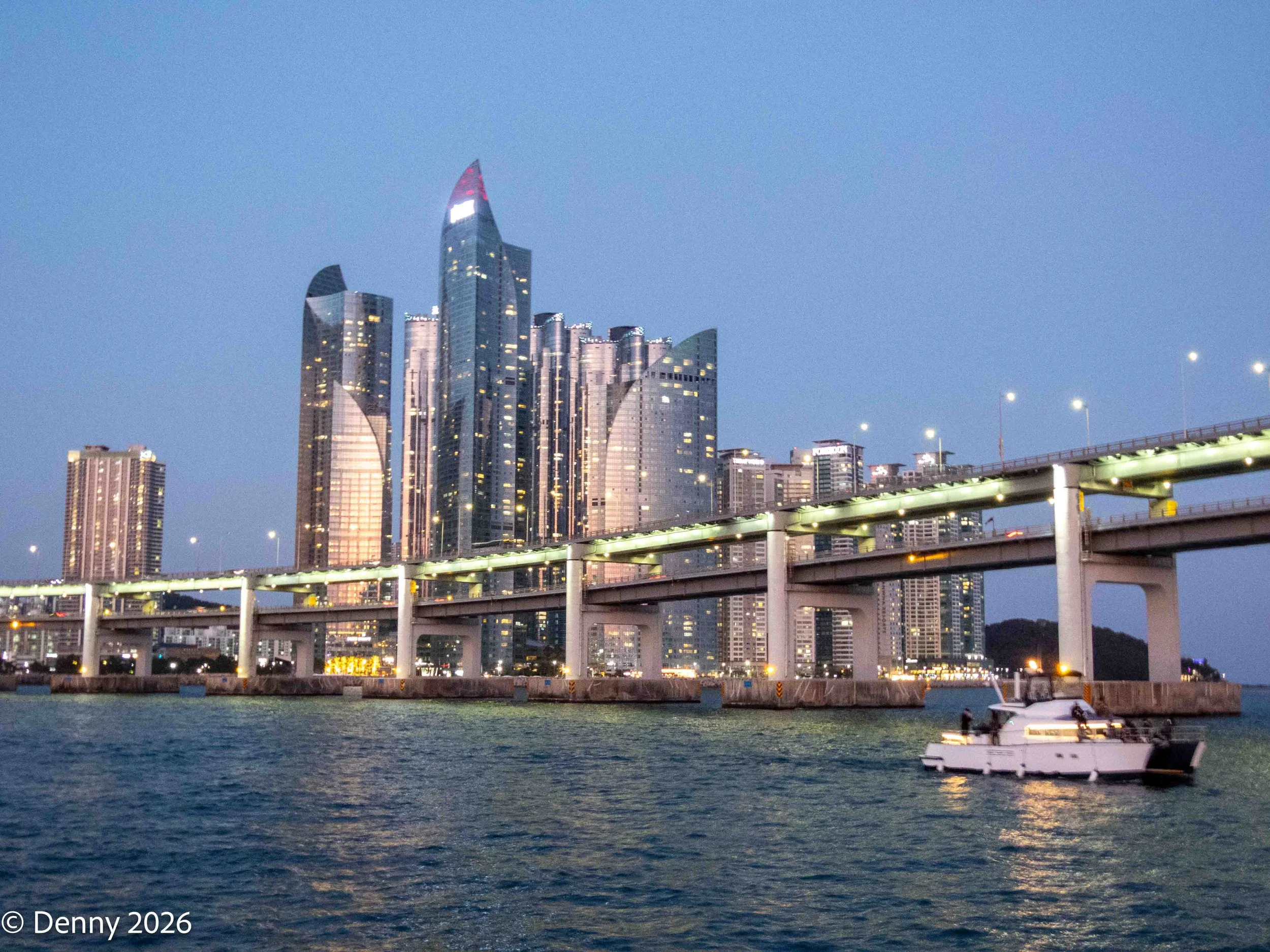
The boat with its thirty or so passengers moved quite slowly, initially up the river and then southwards towards the open ocean but no further than the Gwangan Bridge. When we reached the suspension bridge we sat for a significant period to observe the dazzling array of city lights mostly coming from the surrounding sky-scrapers. The lighting on the Gwangan Bridge was particularly colourful with a large wall section illuminated with a “Busan is Best” message. At this point one of the crew came up onto the foredeck and let off fireworks which for a minute filled the night sky with sparkles and noise.

Sunset cruise on Haeundae River

Sunset cruise on Haeundae River

Sunset cruise on Haeundae River

Sunset cruise on Haeundae River

Sunset cruise on Haeundae River

Sunset cruise on Haeundae River

Fireworks during our sunset river cruise on Haeundae River

Although it was not very windy, the cool evening air meant that warm jackets, gloves and head-ware were desirable if not essential.

We returned to our hotel just before 20:00 for a late evening meal and to prepare for our travels tomorrow when we move on to Gyeongju.

Today marks the equinox and it has been once again, a most enjoyable day with lovely blue skies and lots of interesting pursuits.

DAY 8: Friday 20th March 2026 YEOSU – BUSAN

Having departed Yeosu we headed northwards away from the sea until after an hour we approached the Jurisan National Park. There are a number of small Buddhist temples within the valleys of Mt. Jurisan of height 1915m. We had two hours to visit one of the more famous Zen Buddhist temples, that being Ssanggye-sa Temple.

Leaving Yeosu

Red bridge en route from Yeosu to SSanggyesa temple

According to legend the temple was founded by Priest Sambeop in 732 AD during the Silla Dynasty. Sambeop dreamed of becoming a disciple of the great Buddhist master Hyeneung but Hyeneung died before Sambeop realised this dream.

However, Sambeop gained some compensation by bribing a priest at the master’s Gaiyum Temple in China and stealing Hyeneung’s skull. Sambeop then made his way to Jurisan where he built a shrine for his pilfered relic. This shrine progressively developed over the next thousand years to become the Ssanggye-sa Temple we visited today.

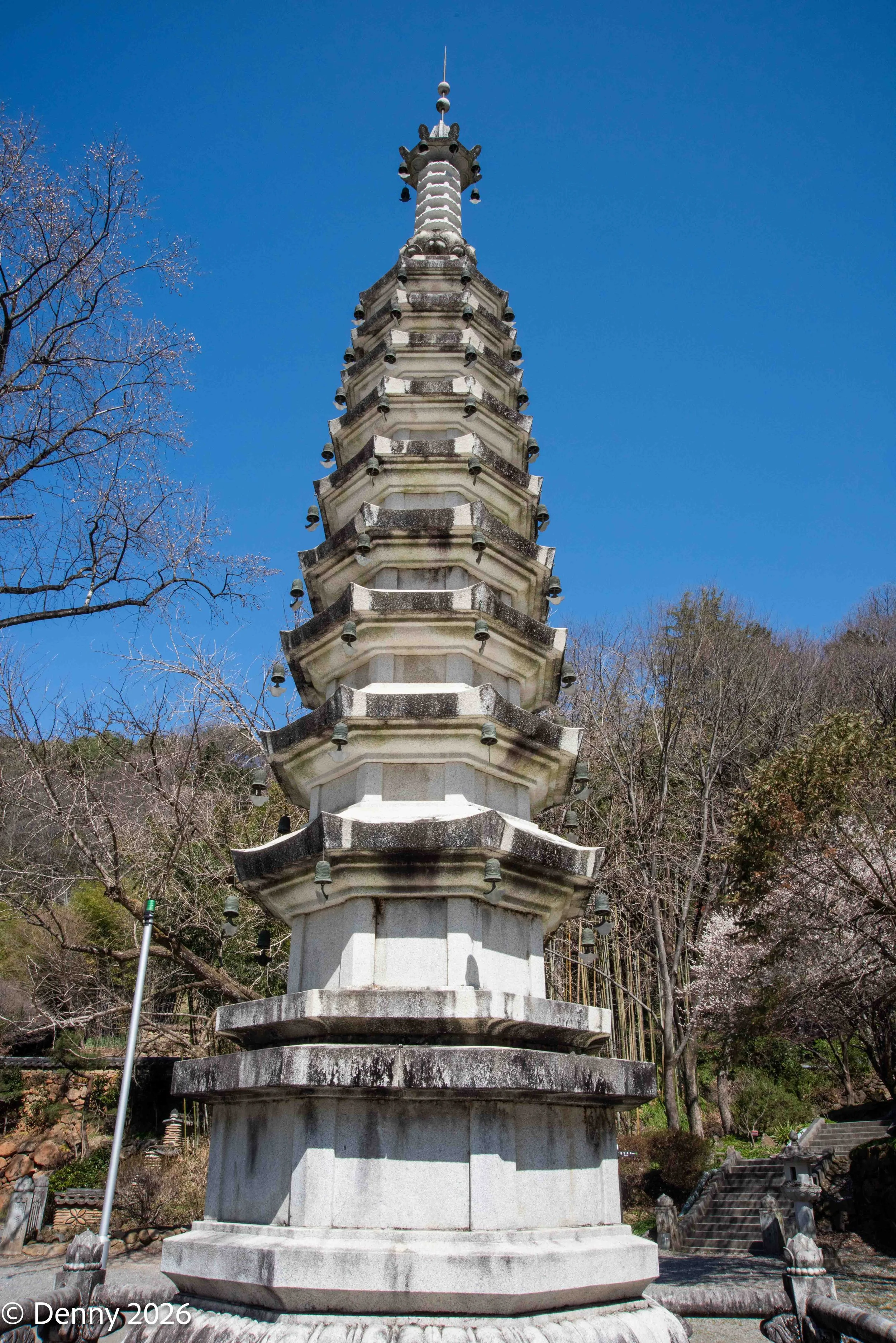
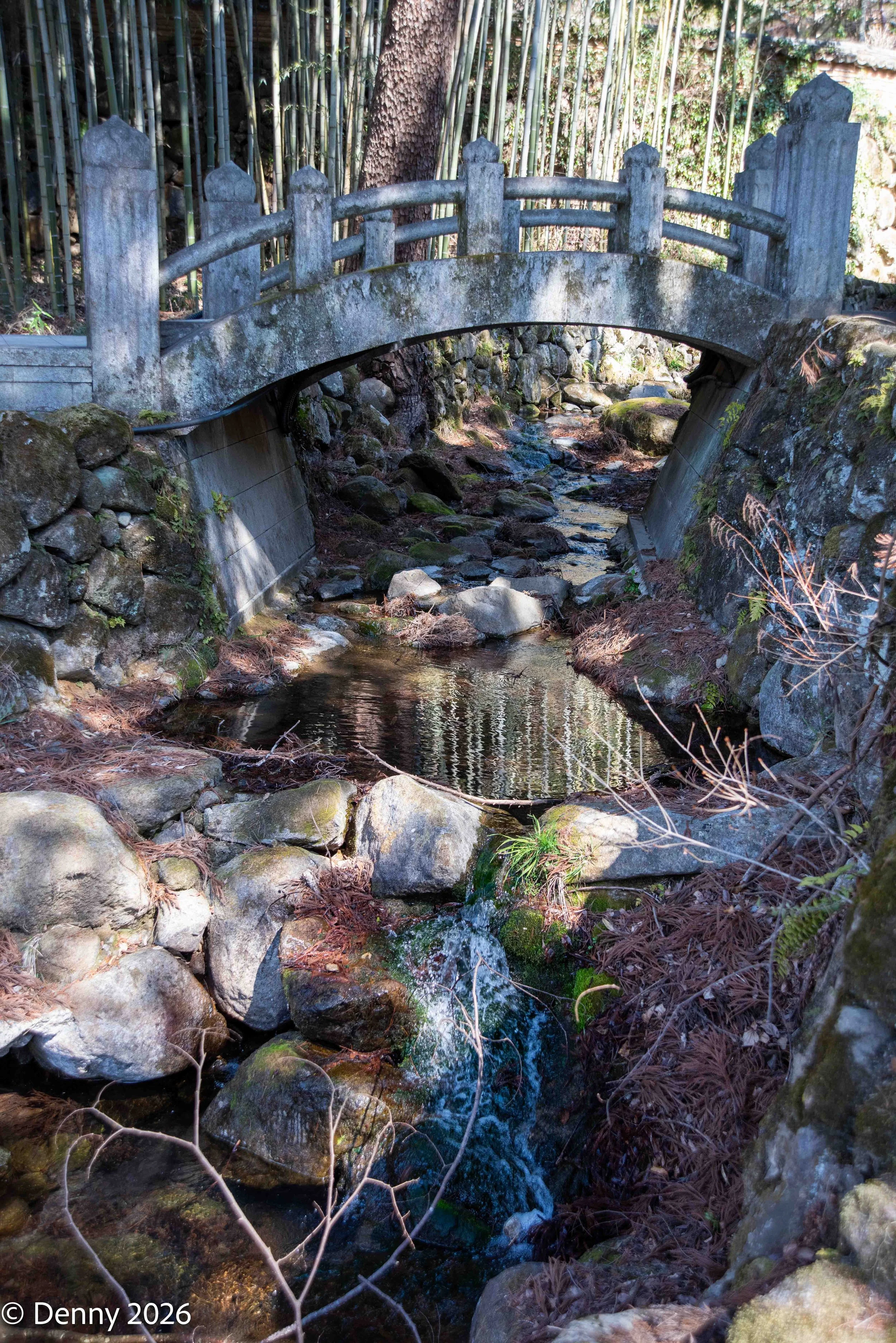
The temple is located in a peaceful valley with a steam flowing through the grounds which have attractive trees and an avenue of cherry trees that were just starting to blossom. There is tall pagoda at the top of the main walkway.

Pagoda

Stone bridge over stream

We spent an hour having a tea ceremony with a Zen Buddhist monk from the monastery who kindly answered our questions via our guide Monica who did a great job as interpreter. The monk then led us on a brief but relaxing moment of meditation with the theme being one of self-reflection.

Tea ceremony with the monk

After the tea ceremony we took photos of the monk and his lovely assistant and then spent time enjoying the gardens and bird life. It was a most enjoyable two hours in this sacred location.

Our host

Our host’s assistant

Our group with monk, SSanggyesa temple

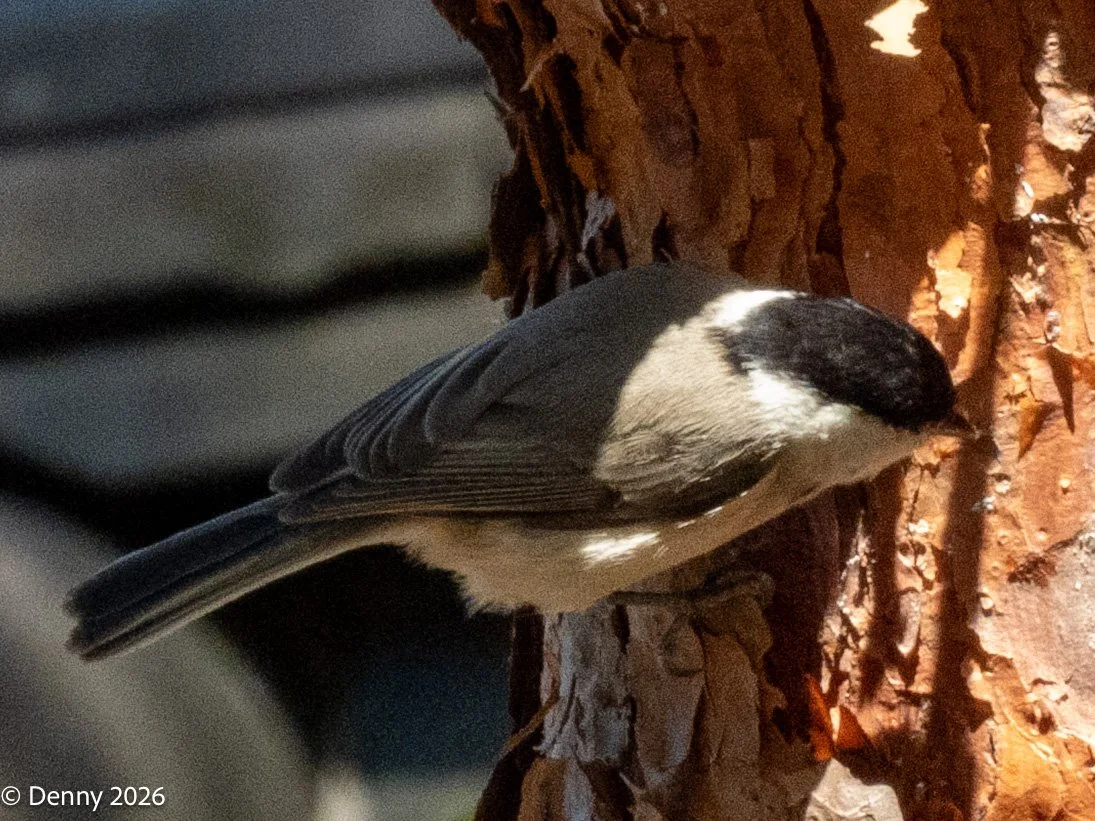
Marsh Tit (Poecile palustris hellmayri)

The lower river valley beyond the temple and the surrounding hillside terraces are well known as major green tea growing areas for South Korea.

Green tea plantation and granite boulders in stream, near SSanggyesa temple

Our long drive to Busan was then continued and apart from an hour’s lunch stop mid-afternoon we ventured on further to the east to arrive at our destination at 16:00.

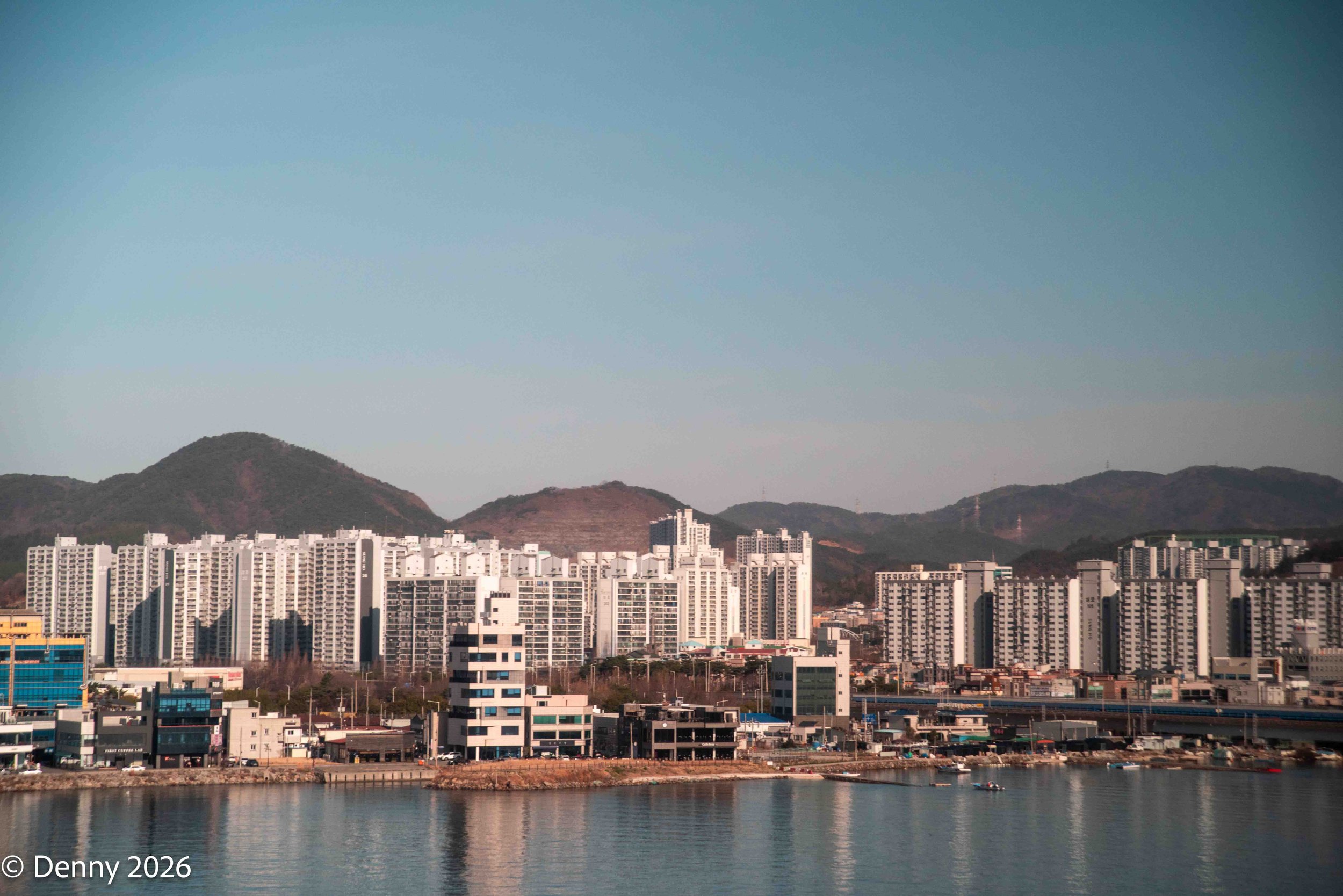
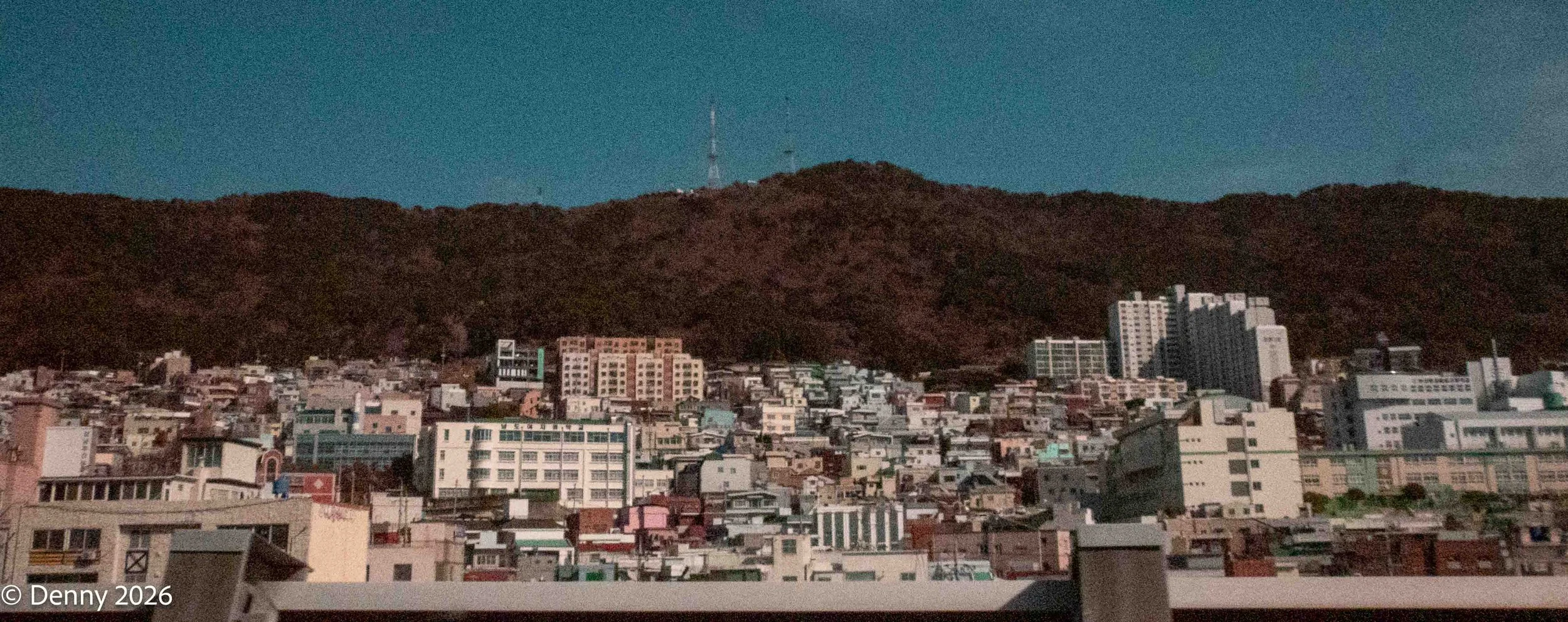
Old Busan (photo taken from bus)

Old Busan (photo taken from bus)

Port, Busan

After settling in to our L7 Hotel, our group spent time wandering through the nearby ‘old’ market area.

Busan old market

The main alleyway was quite crowded and the produce for sale was extensive but the dominant foods were seafood and vegetables. The seafood was in most cases alive in aerated tanks on the footpath’s edge. Amongst the broad range of marine life for sale were eels of various sizes, gastropods, scallops, octopus, squid, abalone, ascidians, prawns, crabs large and small and numerous species of fish including flounder and banded morwong.

Vegetables, Busan old market

Crabs & lobsters, Busan old market

Shellfish and ascidians, Busan old market

Cuttlefish, Busan old market

Fsh, Busan old market

Scallops, Busan old market

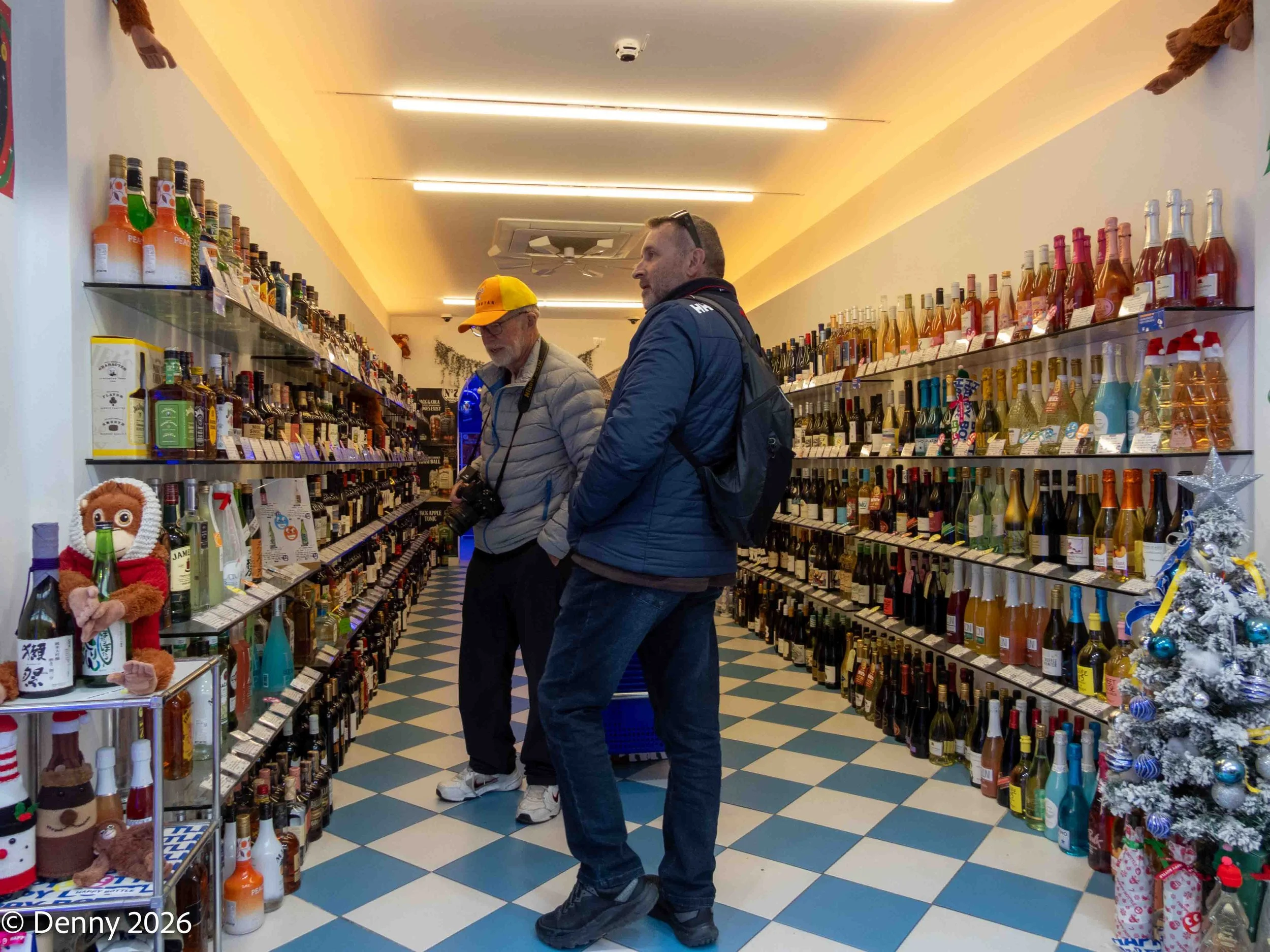
Boys in the bottle shop, Busan old market

There were other shops selling trinkets and tourist souvenirs where we bought hats and some small blue glass tumblers.

We returned to our hotel via the nearby beach which was crowded with Friday evening revellers although there was not a single swimmer to be seen.

The end of this beach is dominated by three sky-scrapers one of which has over 100 storeys and is about 400 m high.

Beach area and skyscrapers, Busan

For our evening repast we wandered back to the main street area and found a small restaurant that had a good but reasonably priced offering of seafood meals.

This has been a long but most enjoyable day of blue skies and interesting sites giving us further insight to this intriguing country. 

DAY 7: Thursday 19th March 2026 GWANGJU – YEOSU

We had a comparatively relaxed start to the day and after breakfast we departed Gwangju at 09:20 and headed south-eastwards for about an hour towards Suncheon. The landscape along our route comprised many small mountain ranges with lush, fertile valleys between where rice and cotton are the main agricultural products. The number of tunnels we passed through on our travels this morning would have been in the order of dozens!

Residential area viewed from or hotel room at Gwangju

We arrive at Suncheon at 11:00 and parked adjacent to the Naganeupseong Folk Village where we have several hours to explore and have lunch.

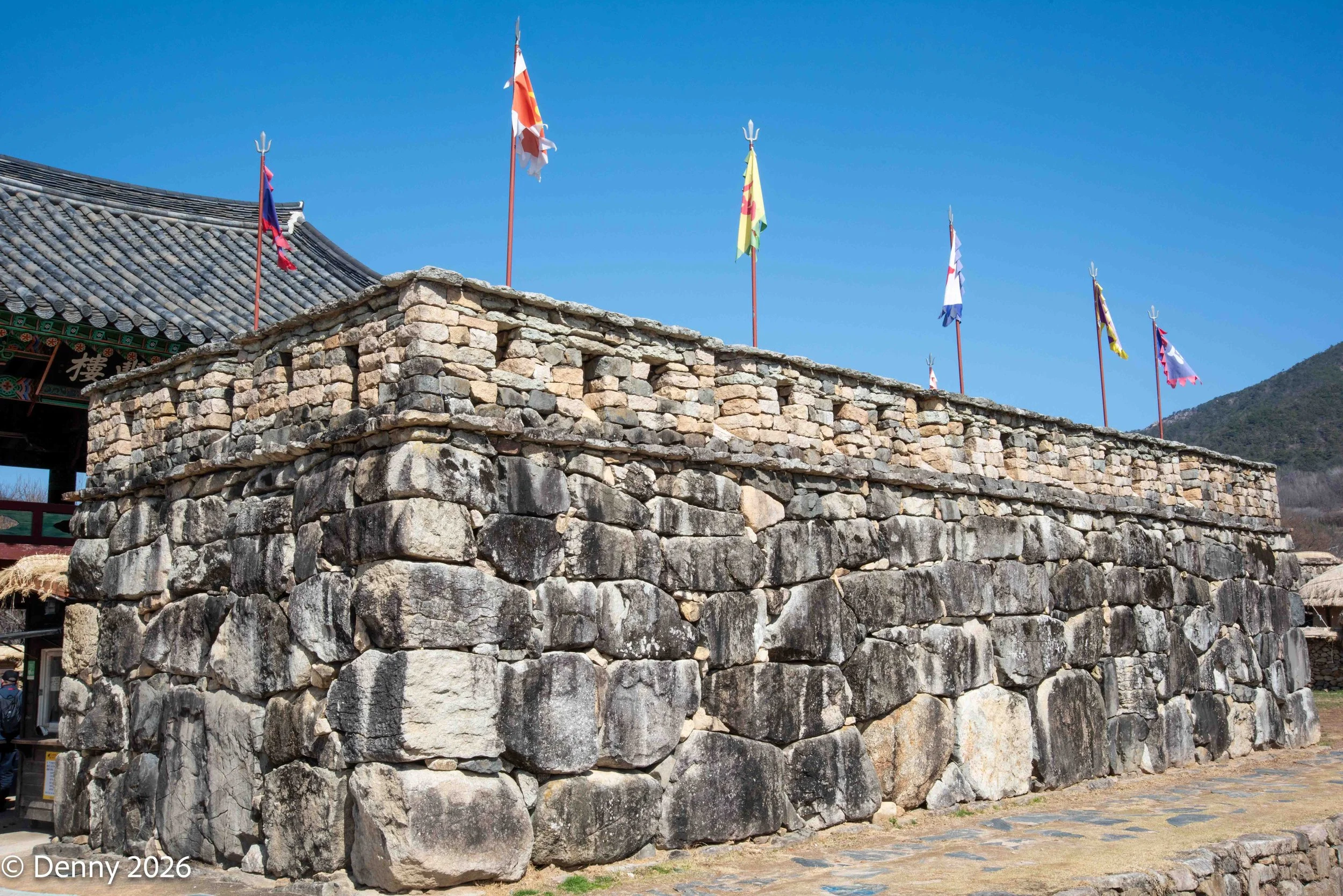
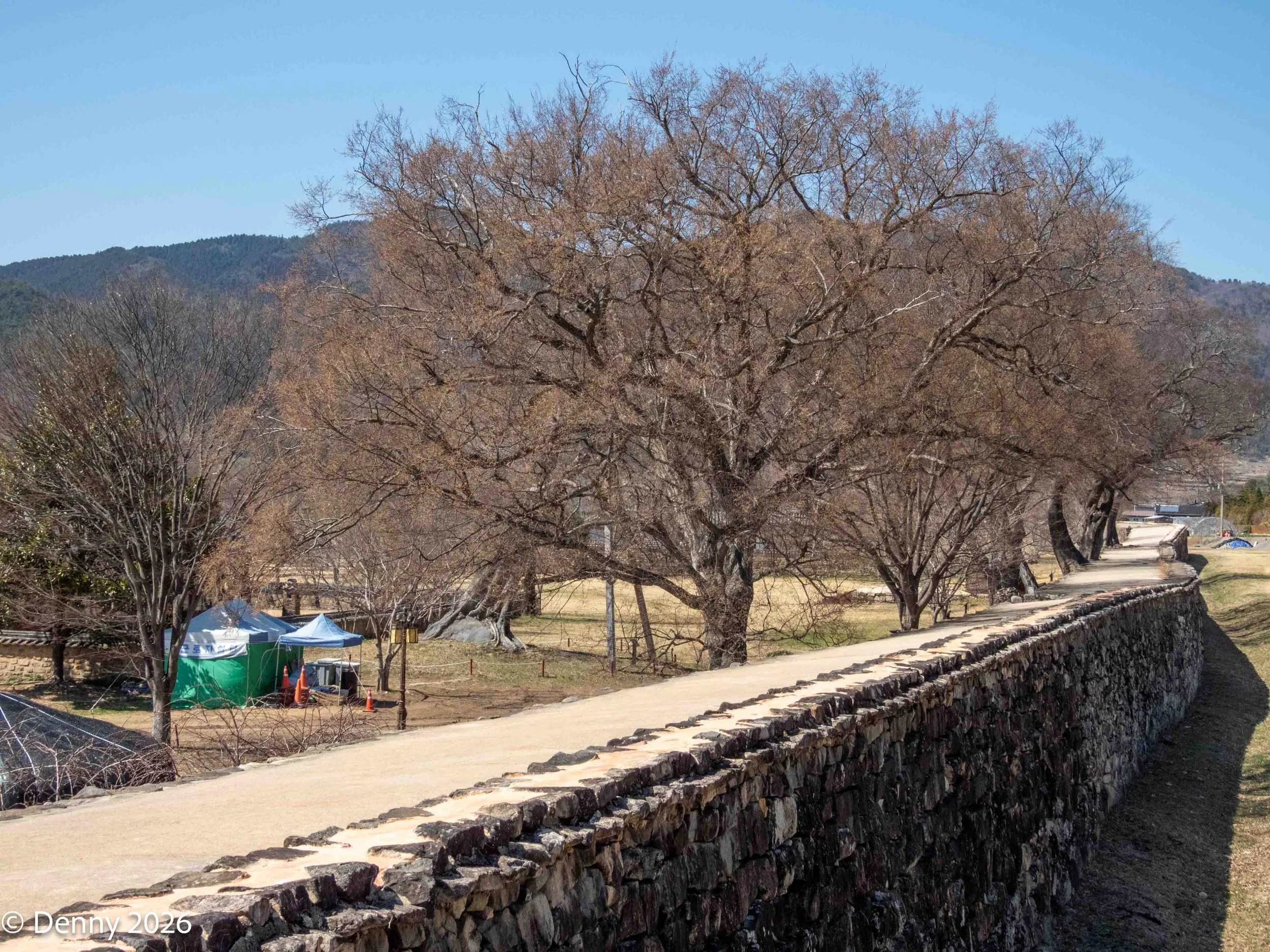
This historic village is enclosed by a rectangular fortress wall of length 1.41 km and around 4 m average height. The wall was originally built under the order of Naval Commander General Kim Bin-gil as an earthen fortification against Japanese pirates. This occurred during the reign of King Taejo of Joseon in 1397. The wall’s construction in stone then commenced in the mid-1400s and was completed in 1626.

Stone wall, at entrance to Naganeupseong Folk Village

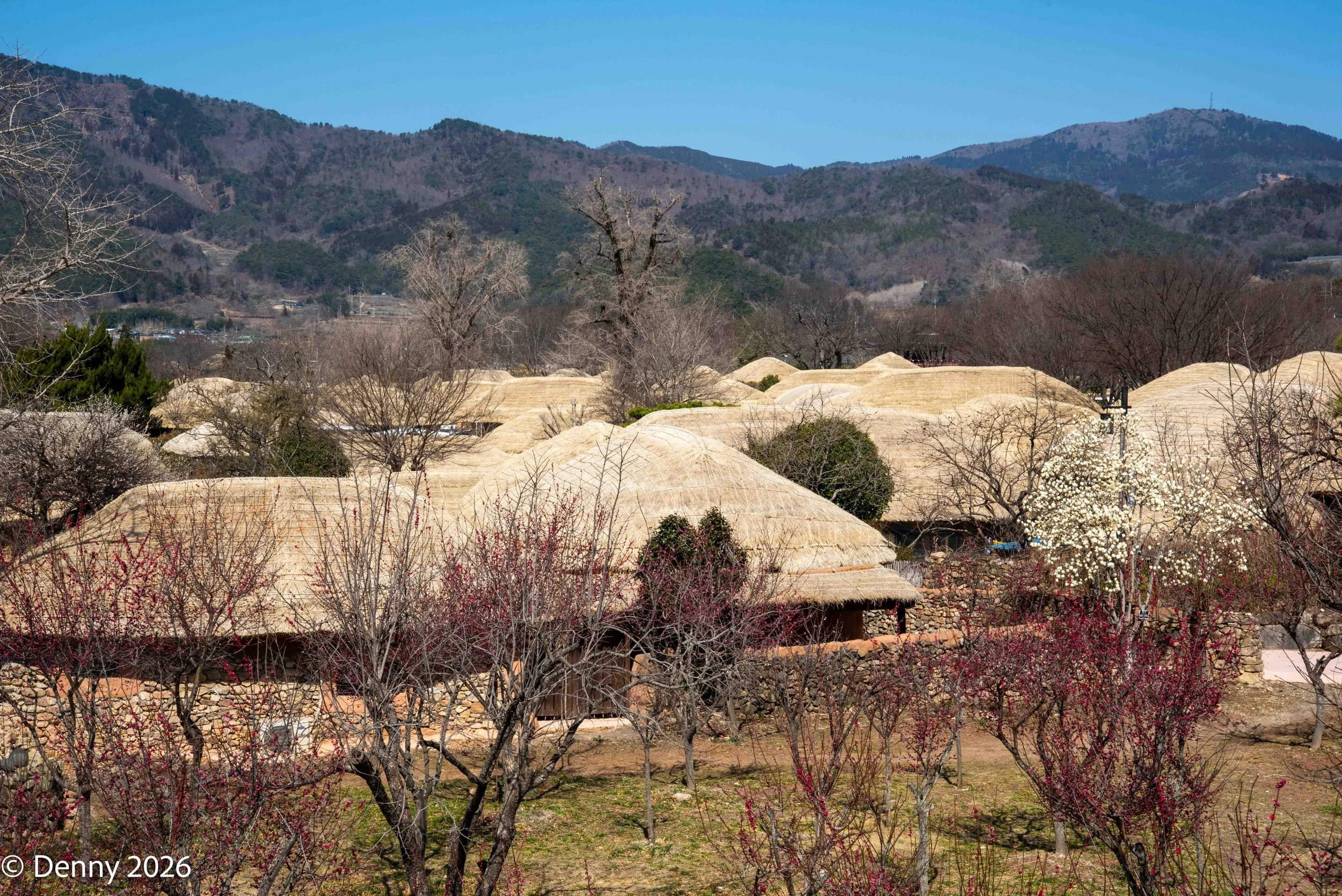
The enclosed village occupies an area of 2.3 hectares and inside the wall are about 90 households and despite its tourist significance, the homes are mostly occupied. Typically, these private residences are made up of two or three separate thatched buildings surrounding an enclosed courtyard and usually a vegetable garden.

Most of the homes had fruit trees too and the spring blossoms of the peach, plum and cherry trees were just appearing.

Naganeupseong Folk Village, Suncheon

Vegetable garden, Naganeupseong Folk Village

Naganeupseong’s Walled Village was listed on the UNESCO World Heritage tentative list in 2011.

The thatched roofs are made from rice stalks and have successive layers of thatching making the roof covering a very thick and effective thermal insulator.

Monica took us on a preliminary introductory tour of the village and we then had a coffee break and a light lunch before commencing our exploration of the site.

We wandered along the narrow paths between the homes and then climbed up onto the wall and slowly strolled to the highest point which required climbing some quite steep and uneven sized stone steps. At this lookout point we had an impressive view of the whole village and its multitude of thatched roofs.

Steps from village to top of wall

We subsequently followed the perimeter wall around to the starting point and rejoined our fellow travellers. The glorious blue sky and no wind conditions made our visit to this historic location a thoroughly enjoyable and interesting interlude.

Gingko trees beside wall, Naganeupseong Folk Village

Naganeupseong Folk Village with surrounding fortress wall, Suncheon

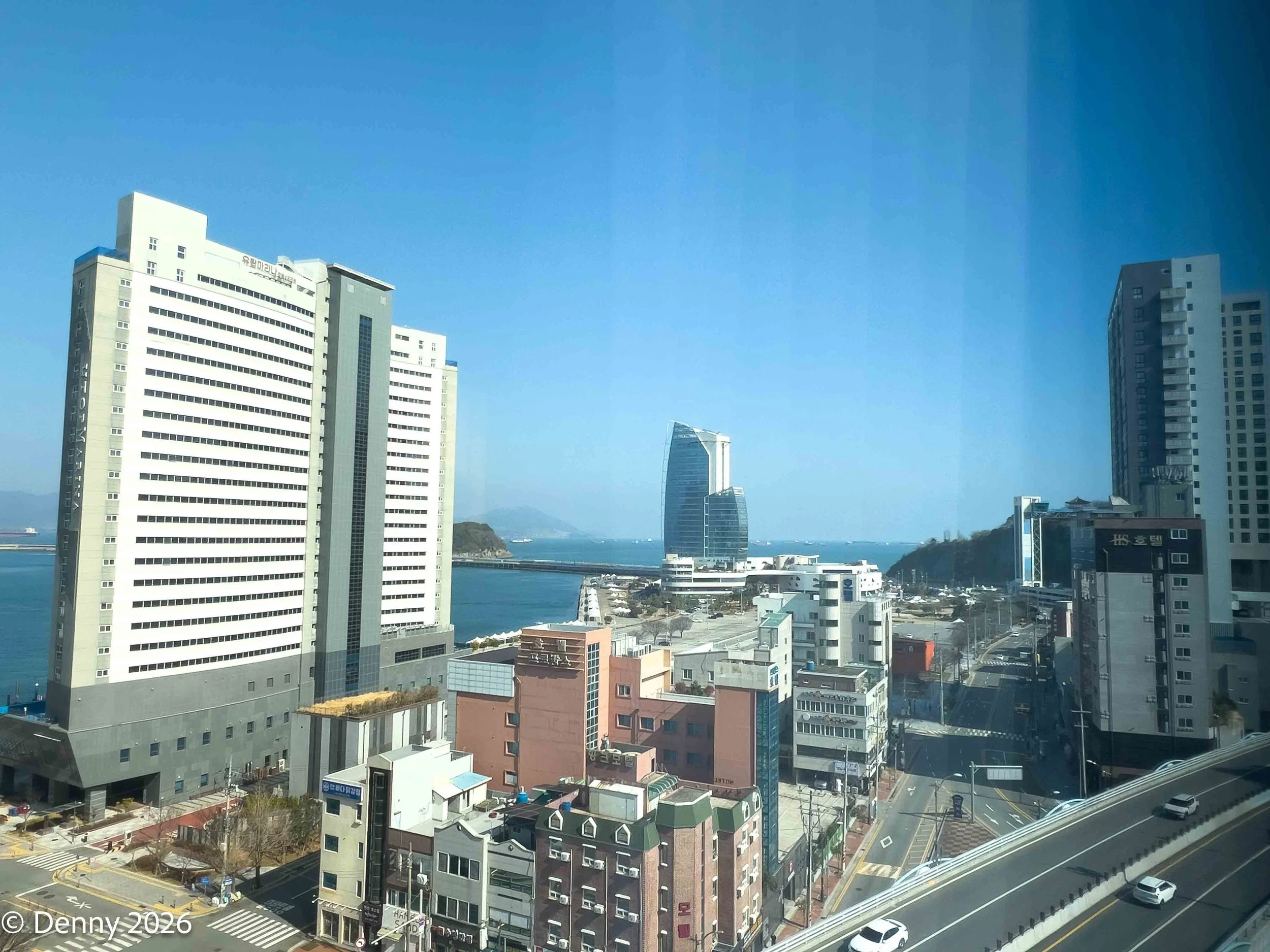
To complete our day’s journey, we had just over an hour’s drive down to the coastal city of Yeosu where we gleefully met the ocean again, or more correctly we encountered the South China Sea. These being the first maritime views since leaving Seoul.

View from our room at the Shilla Stay hotel, Yeosu

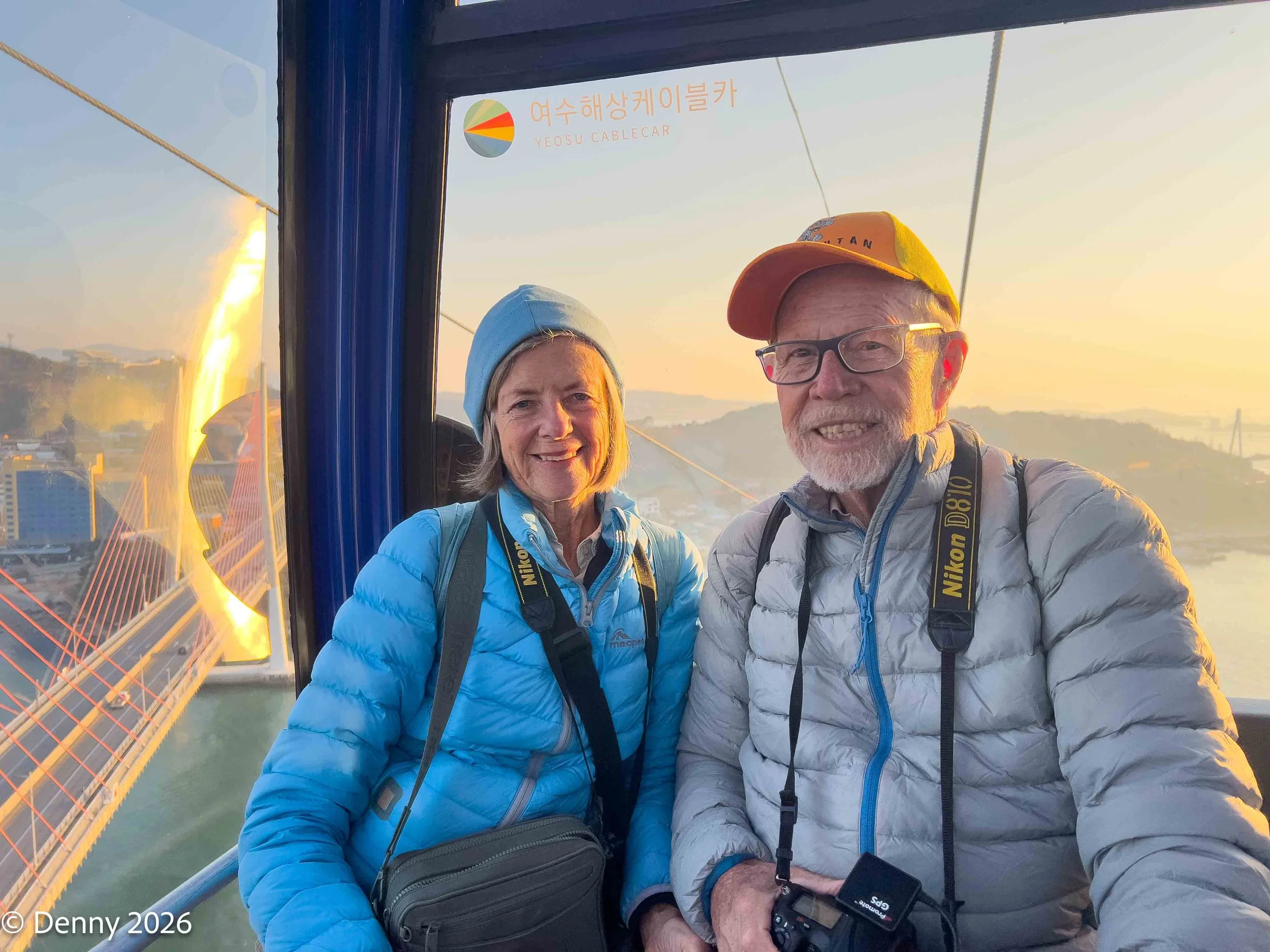
The twilight hours in Yeosu were spent taking a cable-car ride high across the harbour and return.

View from cable car platform, Yeosu

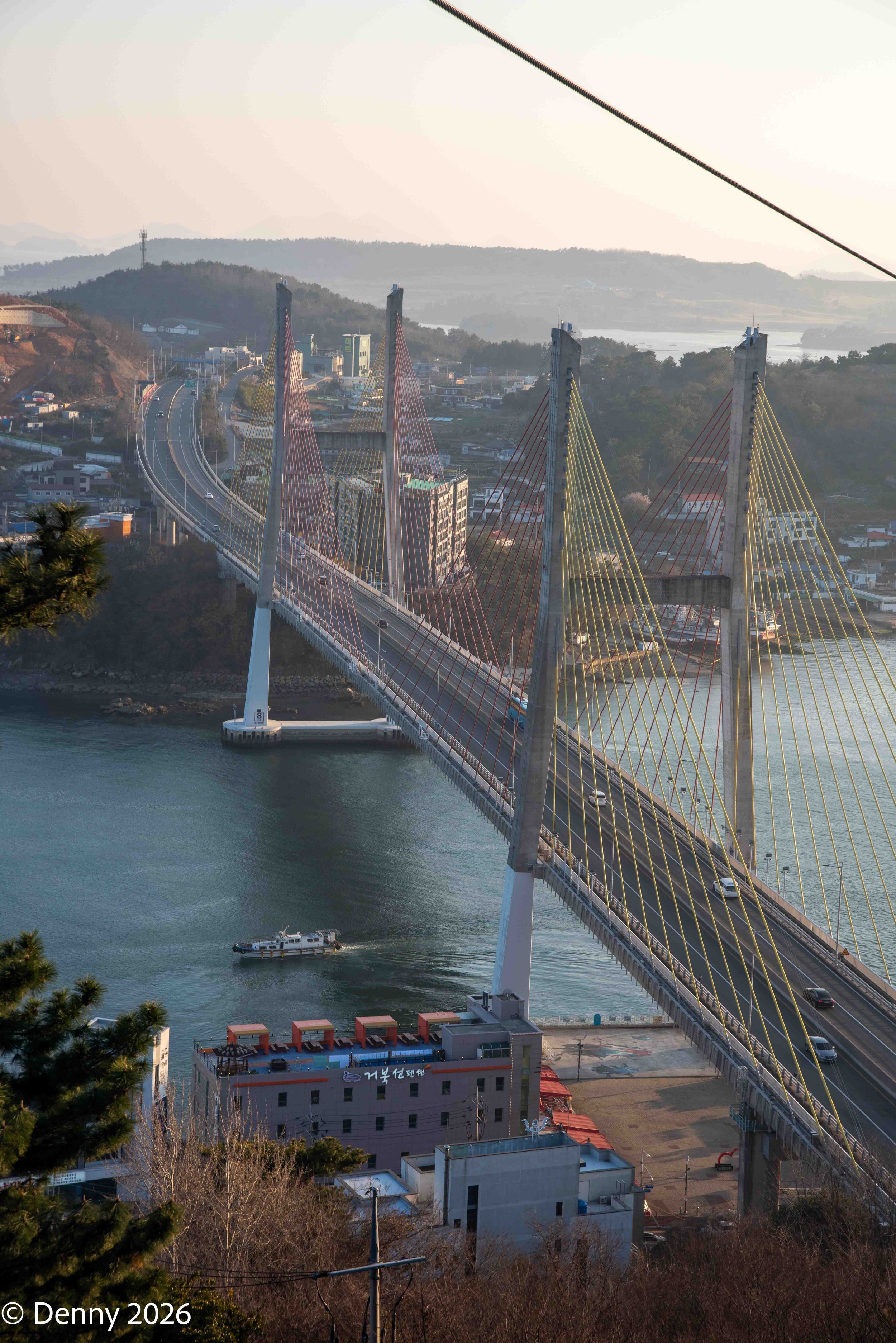
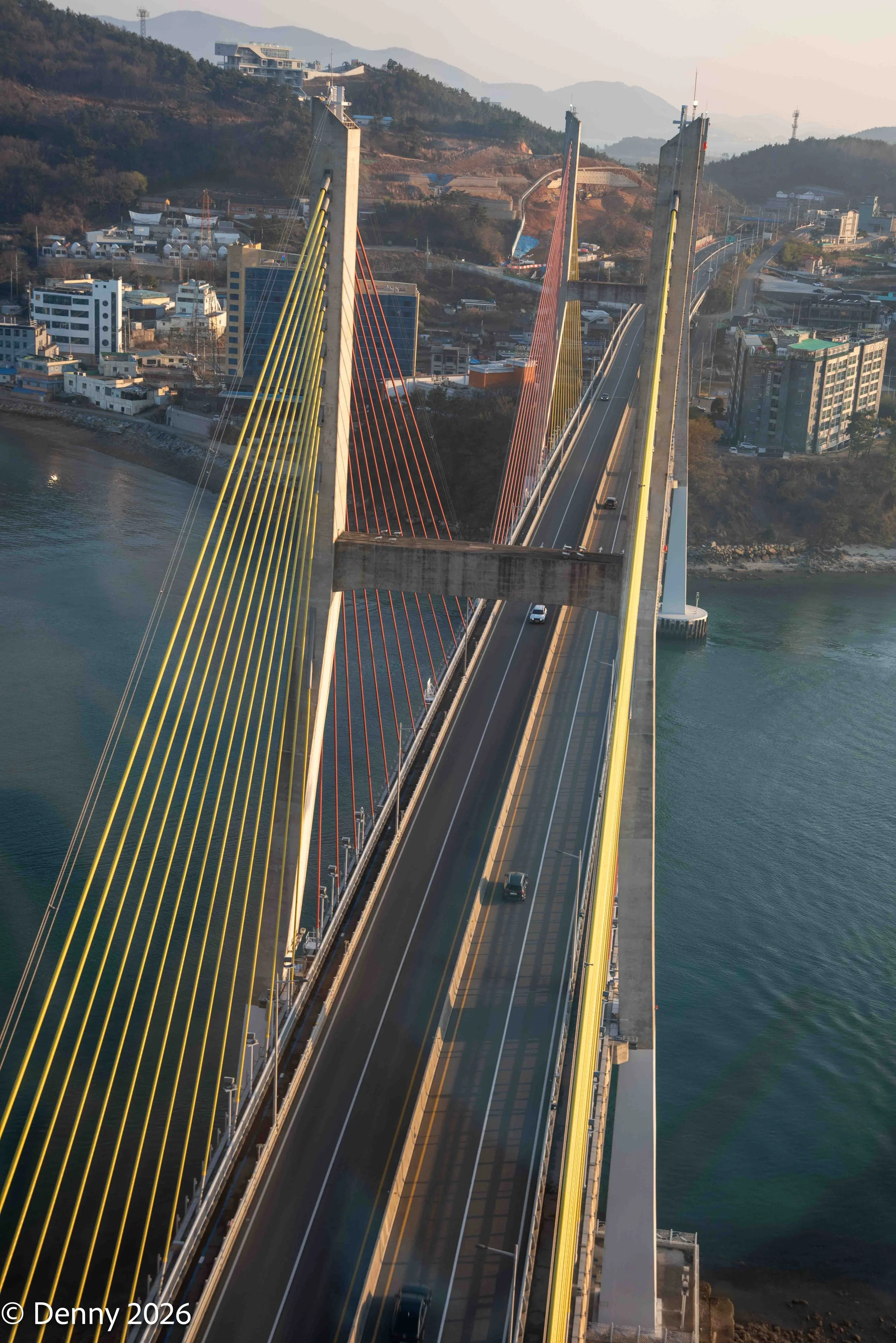
The views of the complex waterways of Yeosu’s harbour were spectacular. Between the various land points were the two impressive suspension bridges namely the Dolsandaegyo and the Geobukseondeagyo bridges. The panorama across the harbour entailed a view of several small islands, fish farms and numerous large freighter vessels awaiting docking. One of the closest islands is Odong Island and it has a walkway and road across the 200 m to the island.

View from cable car

View from cable car

View from cable car

View from cable car platform

View from cable car platform

Sunset from cable car platform

We returned to our Shilla Stay hotel where we had a pleasant evening meal overlooking the harbour and the bright city lights.

Today has been a great day of travel and sight-seeing made especially enjoyable by the perfect weather.

Tomorrow we move on to South Korea’s second largest city of Busan. This will entail a good deal of travel time so we need to have a fairly early start tomorrow morning.

DAY 6: Wednesday 18th March 2026 GWANGJU

We awoke to find the predictions of rain for today were absolutely correct. Having had breakfast we boarded our bus and headed back towards Damyang, a town we’d passed through yesterday on our way to Gwangju.

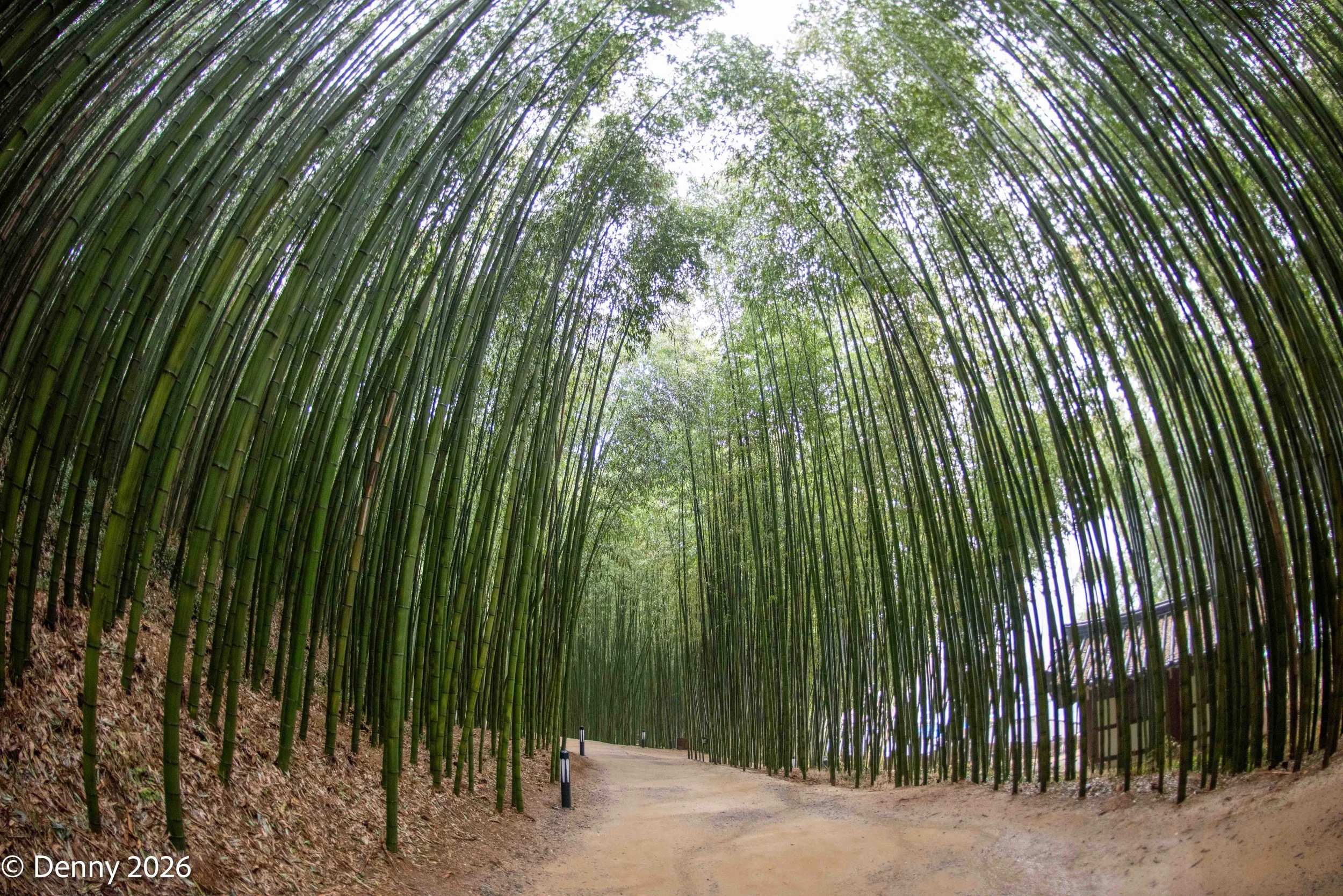
Our thirty minute journey had us arriving at the Juknokwon bamboo garden in Damyang and at this stage the rain had abated somewhat and was now just a slight drizzle.

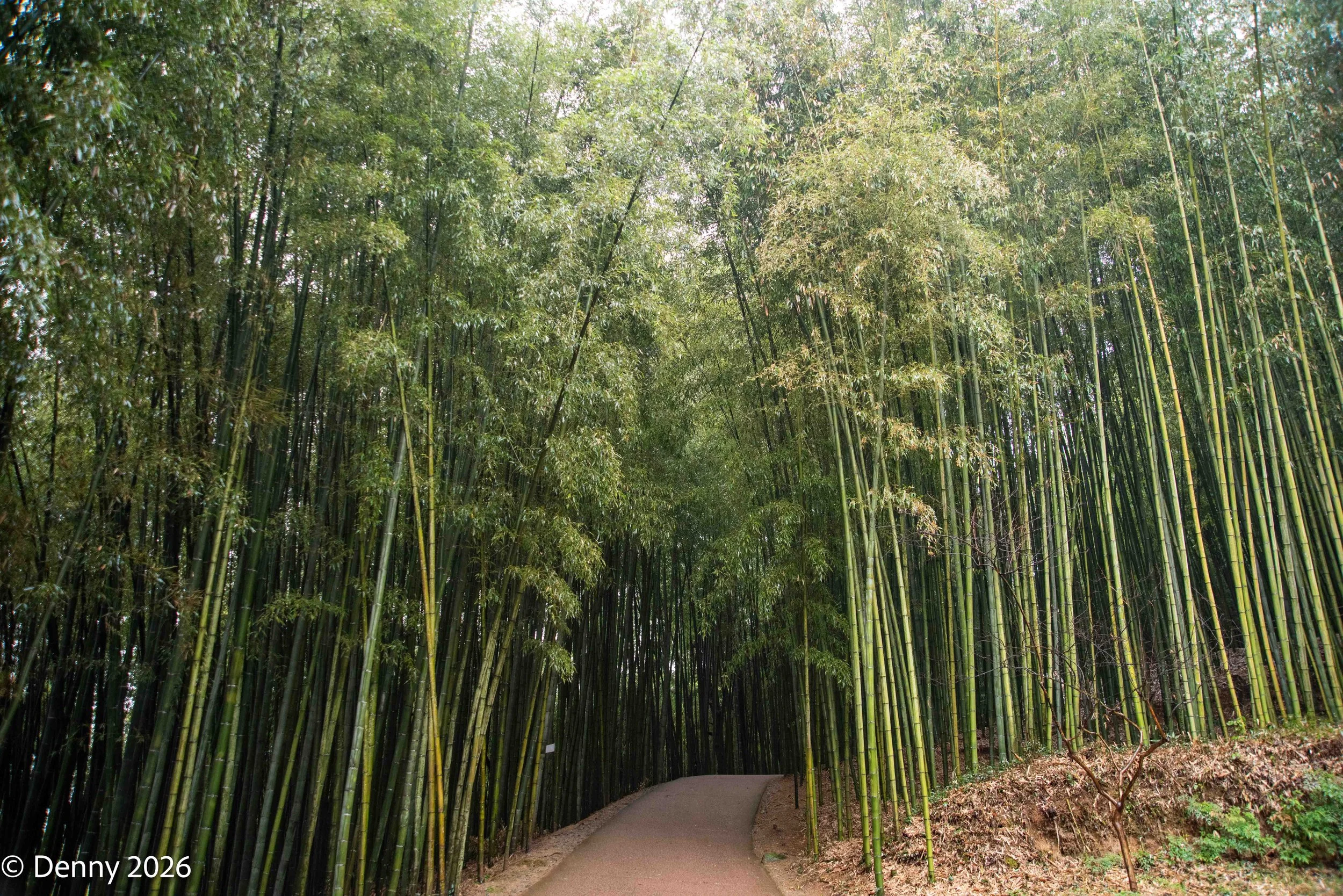
Bamboo or ‘daenamu’ is one of the most revered plants in Korea  and has multiple uses. It’s employed as sturdy construction material especially for scaffolding but other uses include basket weaving, being splintered into chopsticks, carved to make spoons and harvested for its delicious tender shoots. Bamboo is immortalised in Korean paintings, literature and poetry.

We spent about two hours at the Juknokwon bamboo garden wandering with our umbrellas through a maze of branching tracks that fortunately eventually led us back to the main gate as desired. The track signs were mostly in Korean and it would be very easy to become ‘bamboozled’ and get lost!

Bamboo, Juknokwon Bamboo Garden

We noted that there were several different species of bamboo some with large and deep green trunks and some others with thin yellow stems. It’s hard to rationalise when wandering through this giant forest that bamboo is a member of the grass family.

The experience of meandering amongst these very tall bamboo plants was somewhat enhanced by the rain due to the wet trunks and leaves being shiny and glistening.

Bamboo stem

Bamboo leaves

Juknokwon Bamboo Garden

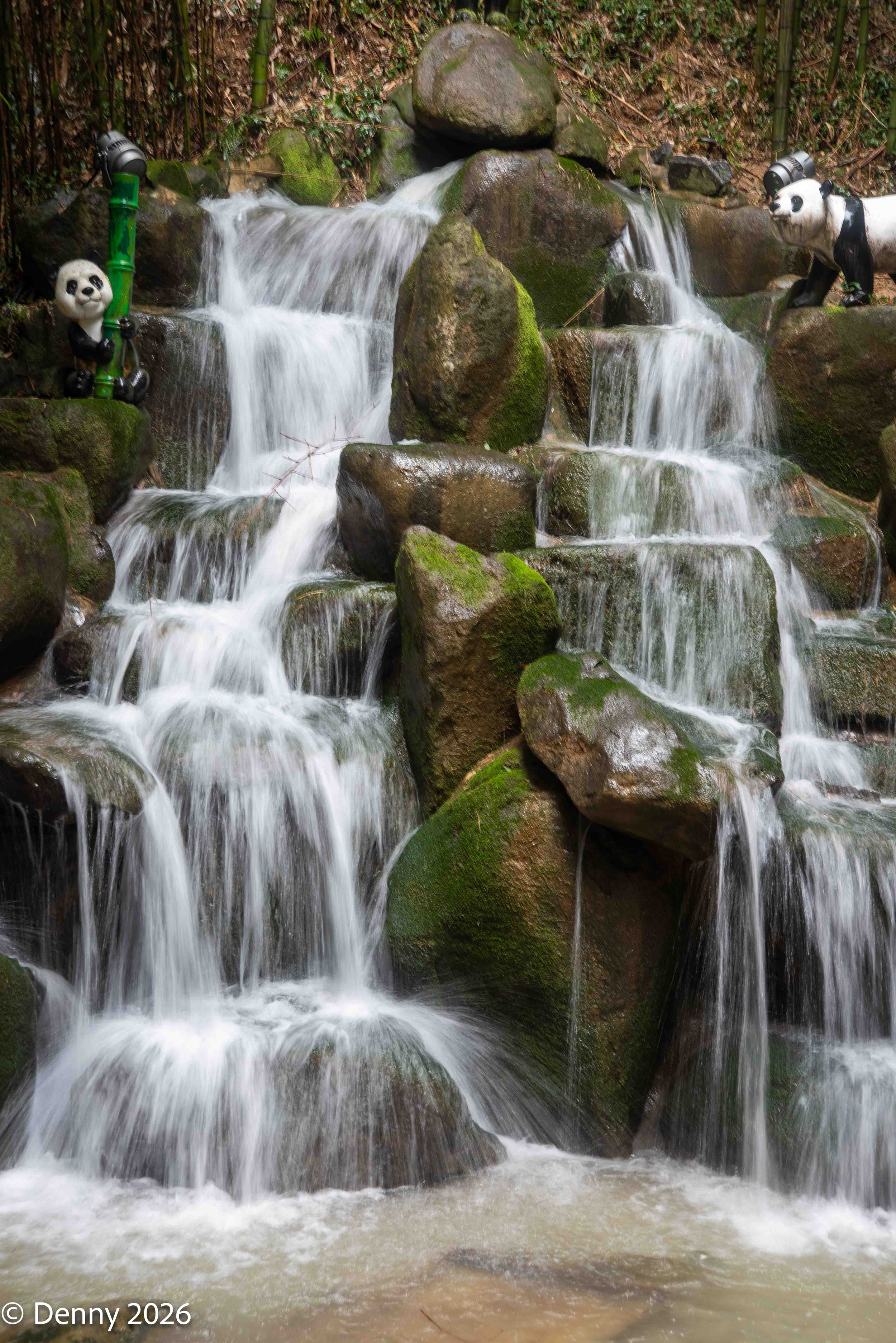
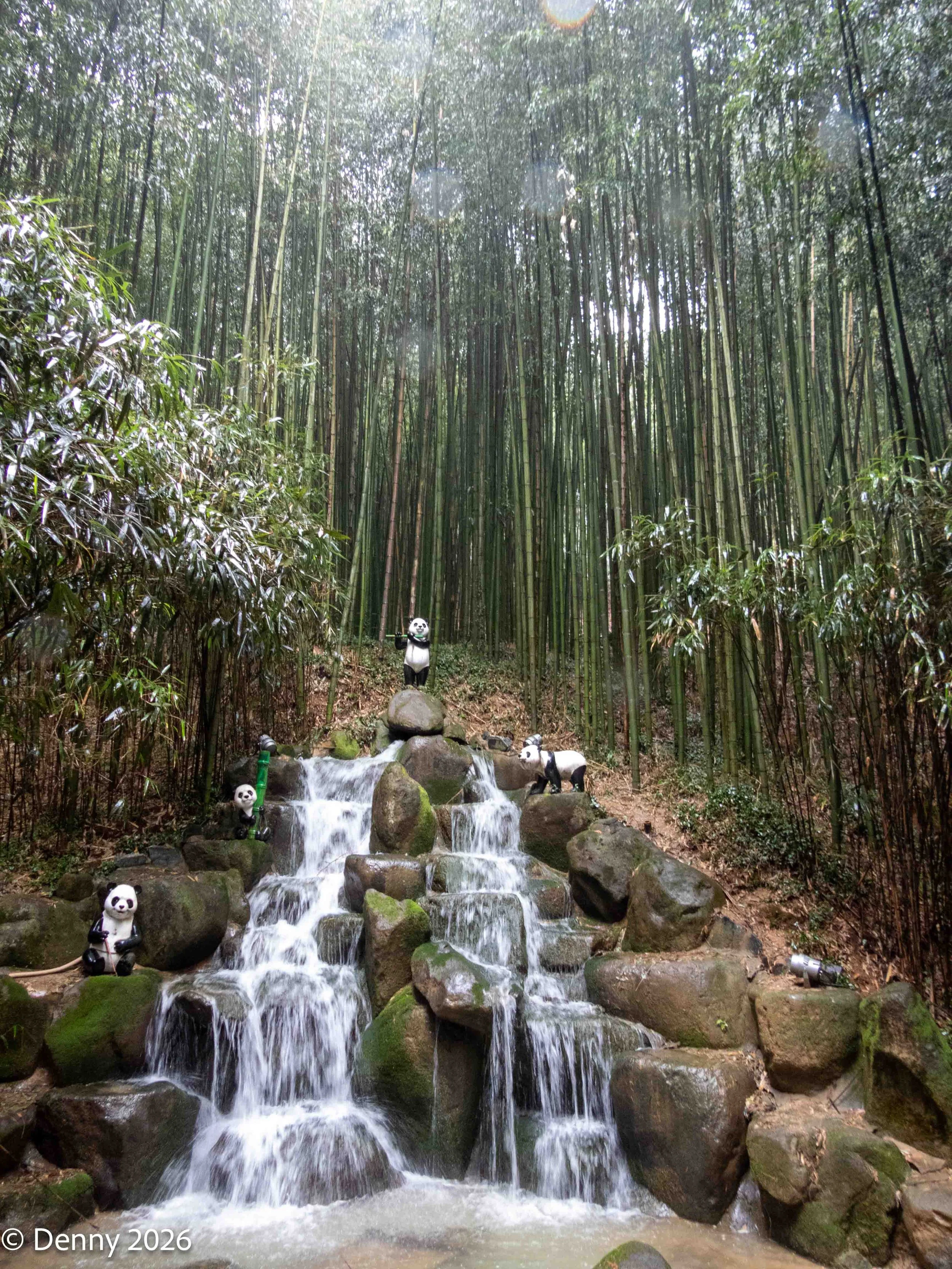
The experience of being in a bamboo forest reminded us of our travels in a Chinese nature reserve where we encountered pandas eating bamboo. Juknokwon’s forest was not to be outdone by China as it has dozens of pandas although made from plaster of Paris!

Waterfall, Juknokwon Bamboo Garden

Waterfall with pandas

We then headed back to Gwangju and alighted at Chungjang-ro street with its numerous boutiques reknowned for shopping, fashion and cafes.

We spent some time walking along one of the side streets and were amazed to see the number of shops that specialised in enticing children to seek toys. There were lots of places where people were encouraged to buy random ‘mystery’ plastic balls from a machine with the hope that inside the ball was a gift worth more than the starting cost. There were many other shops where, for a small fee you could manipulate a miniature clasp and crane and hopefully with skill snare a toy from a bin filled with fluffy rabbits, dolls, puppies and other delightful gems.

Toy shop

We visited a several shoe shops but most were sports shoes and the only one with women’s dress shoes had them priced at near the $300 mark.

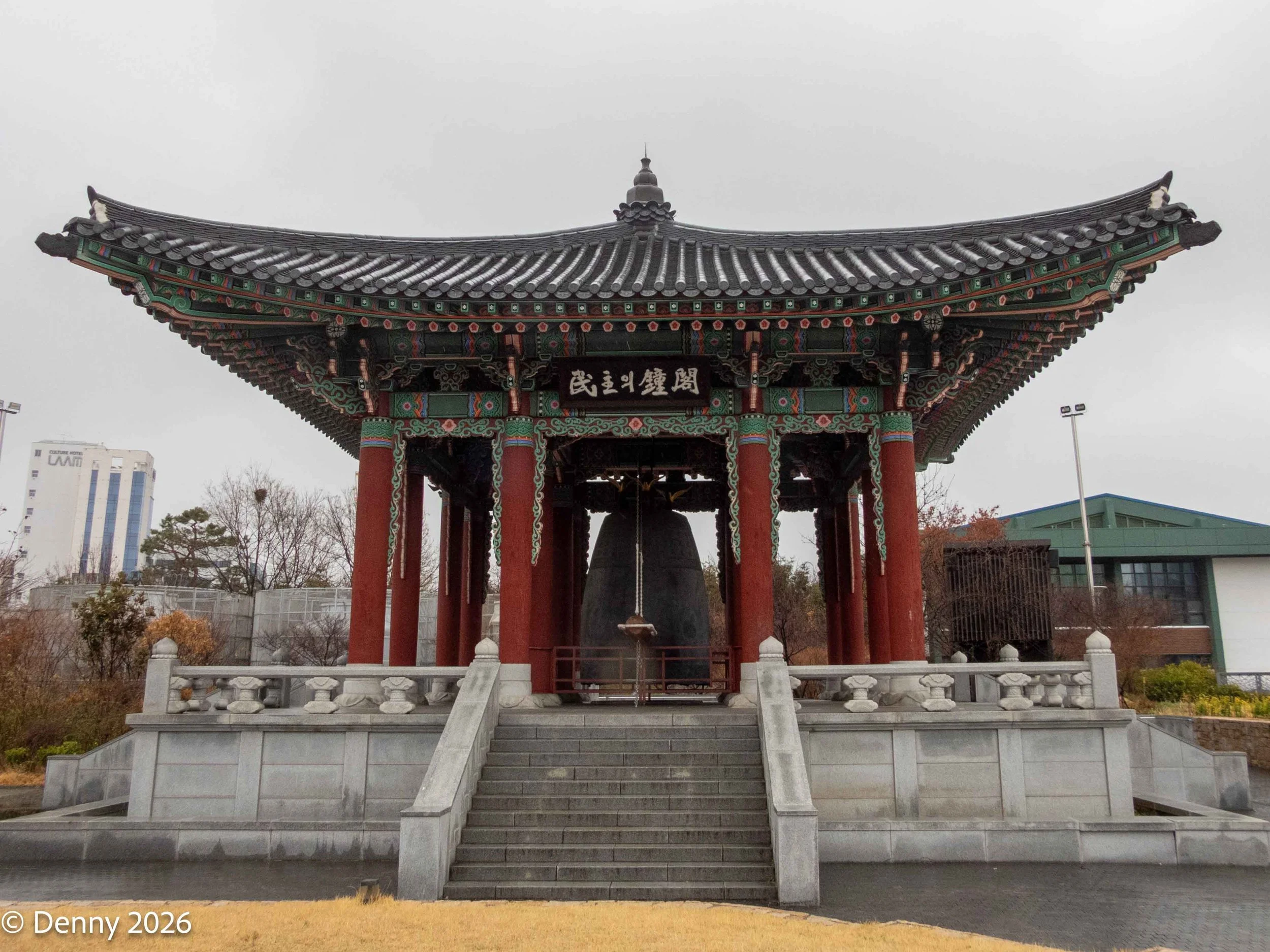
Rather than spending time in the shopping precinct we wandered further afield and went to the Democracy Bell Pavilion. This is an area that has historic significance as its where student activists were tortured and killed during protests against corrupt governments in 1974, 1980 and 1982. The memorial to  these brave Koreans is in the form of a giant bronze bell which is 4.2 m high and weighs just over 30 tonnes. It is held within a Korean modelled wooden shrine adjacent to the large open concourse area where student protests occurred all those years ago.

Democracy Bell Pavilion

We then spent a short time in the close by National Asian Culture Centre but with time running short we did little apart from visit the library.   

Our group having reassembled, we took a short bus trip to the Gwangju Traditional Cultural Centre for an opportunity to learn something of Korean traditional music and dress.

As students, we spent an exhilarating hour of drum practice under the captivating control of our enthusiastic drum master. The drum we each had was a traditional double ended Korean drum somewhat like two fused bongos. We learnt various patterns of drumming style and by the hour’s end we were reasonably well coordinated with our master and his assistant who accompanied us on occasions with an ancient cornet.

Musicians, Gwangju Traditional Cultural Centre

Our next experience was to dress in traditional Korean hanbok involving multicoloured attire. Our cultural expert on Korean dress gave us an interesting summary of the variation in dress characteristics depending on the wearer’s class status. She also covered the ins and outs of customary etiquette.

Our group with our cultural experts, Gwangju Traditional Cultural Centre

To finish the day we had a Korean barbecue at a local restaurant. The tender Korean fillet and sirloin beef was cooked at our table and was complemented by an extensive range of tasty side dishes.

Korean barbecue

The meal was delectable and thoroughly enjoyed by all.

We returned to our hotel at around 20:30 and took time to catch up on diaries, down-loading photos, checking emails and laundry issues.

Despite the disappointing weather, we’ve had an entertaining day and tomorrow we leave Gwangju and head for the coastal city of Yeosu.

DAY 5: Tuesday 17th March 2026 JEONJU – DAMYANG – GWANGJU

Our morning bus journey southwards was through quite mountainous regions and the highway involved numerous road tunnels ranging in length from as little as a hundred metres to several kilometres. A small distance outside Jeonju we noticed a series of hills covered with traditional grave mounds in what are pre- Christian style cemeteries. These earthen mounds are semi-cylindrical and about one metre high. The graves we observed were quite obviously in pristine condition as is emphasised through the strong Korean custom to revere ones ancestors.  

Between the small mountain ranges we encountered fertile valleys where farms were involved in various agricultural pursuits principally being grain (maize and rice) production and fruit orchards. Surprisingly, in three days of travel through South Korea we have yet to see any farms where sheep, cattle, goats or even horses are present.

Our first stop for the morning was at Mt. Maisan where we walked two kilometres from the car park to the Tapsa Buddhist Temple.

Walk to Tapsa Buddhist Temple, Mt Maisan

Top of Mt Maisan

Walk to Tapsa Buddhist Temple, Mt Maisan

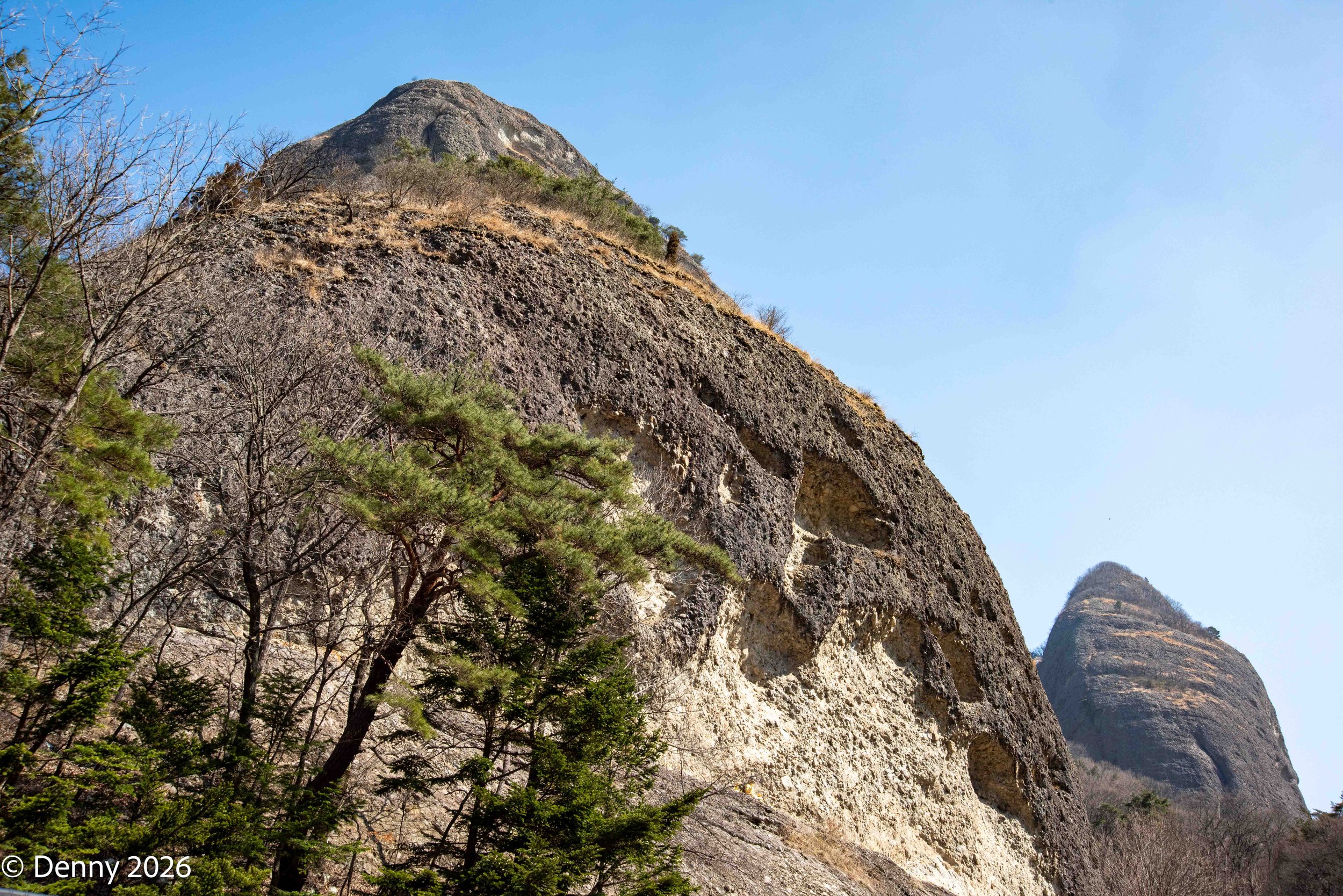
Peaks of Mt Maisan

This temple and its eighty or more stupas were built entirely out of local stones with no concrete or mortar having been used. The stone stupas or towers were constructed about thirty years ago by a hermit called Yegapy Yong.

Temple and Stupas

The backdrop to this peculiar temple is the fascinating geological feature of two dominant mountain peaks comprising conglomerate rock. The rounded peaks of these two mountains have the shape of two inverted parabolas and are locally known as the ‘horse ears’. Legend has it that two fairies, one male and one female were called to return to heaven by their creator but just before dawn they were spotted making their escape by an early rising housewife and were instantly transformed to stone. They then fell back to Earth as the two Maisan peaks!  

Temple and Stupas, Mt Maisan

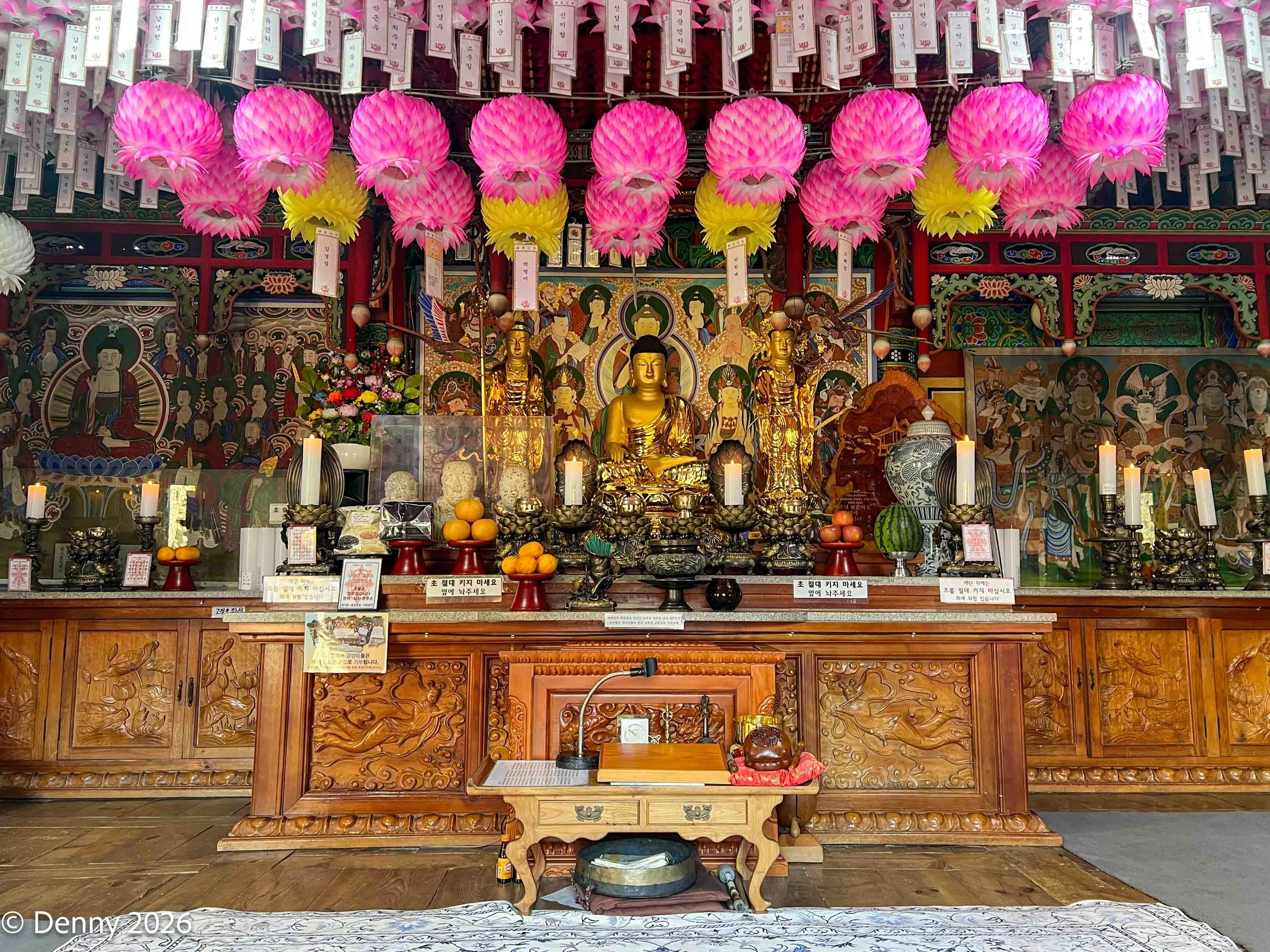
The actual Buddhist temple itself is minute and has a small golden Buddha surrounded by colourful paper flowers and other garish ornamentation.

Golden Buddha inside Buddhist temple,

We then spent an hour or so in the tourist area where there were hundreds of carved wooden items for sale plus a number of local foods and drinks.

Amongst the more unusual drinks was a dark coloured health elixir called kudzu which had an unusual ‘medicinal’ taste somewhat like unroasted peanuts. The liquid is extracted from the scrambling kudzu vine that has one metre long tubers that can weigh up to 180 kg. Kudzu is an introduced and invading species that is causing terrible problems for native plants due to its capacity to smother all surrounding vegetation. We observed the steam extraction of the kudzu liquid from the macerated tubers and then the packaging machine that was sealing the liquid into small sachets.

Roots of kudzu vine (Pueraria montana)

Extracting juice from Kudzu

We next drove to Seokjeong, a town noted for its hot springs and allied therapy services often described by the unattractive term ‘wellness’.

We pent two hours in the local hydrotherapy pool and spa. The spa bath had a number of high pressure water jets to offer body massage and bubbly sections for relaxation. One pressure jet was powerful enough to hurt if you approached too closely!  We had two separate visits to the adjacent sauna set at 67C and after ten minutes of sweltering heat we then found the spa to be comparatively cold on returning to the water.

During these two hours we were the only people in the large spa and pool area and on leaving, the general feeling was that we’d all had fun and enjoyed this interlude and afternoon’s ‘wellness’ activity.    

The day’s travel ended with a ninety minute drive from Seokjeong to Gwangju where we will have two night’s accommodation at the Holiday Inn.

Tomorrow we’ll spend the day exploring the delights of Gwangju.

DAY 4: Monday 16th March 2026 SEOUL - SUWON - JEONJU

After an early breakfast we loaded our luggage onto the bus and proceeded southwards from Seoul on the main highway that heads towards Busan.

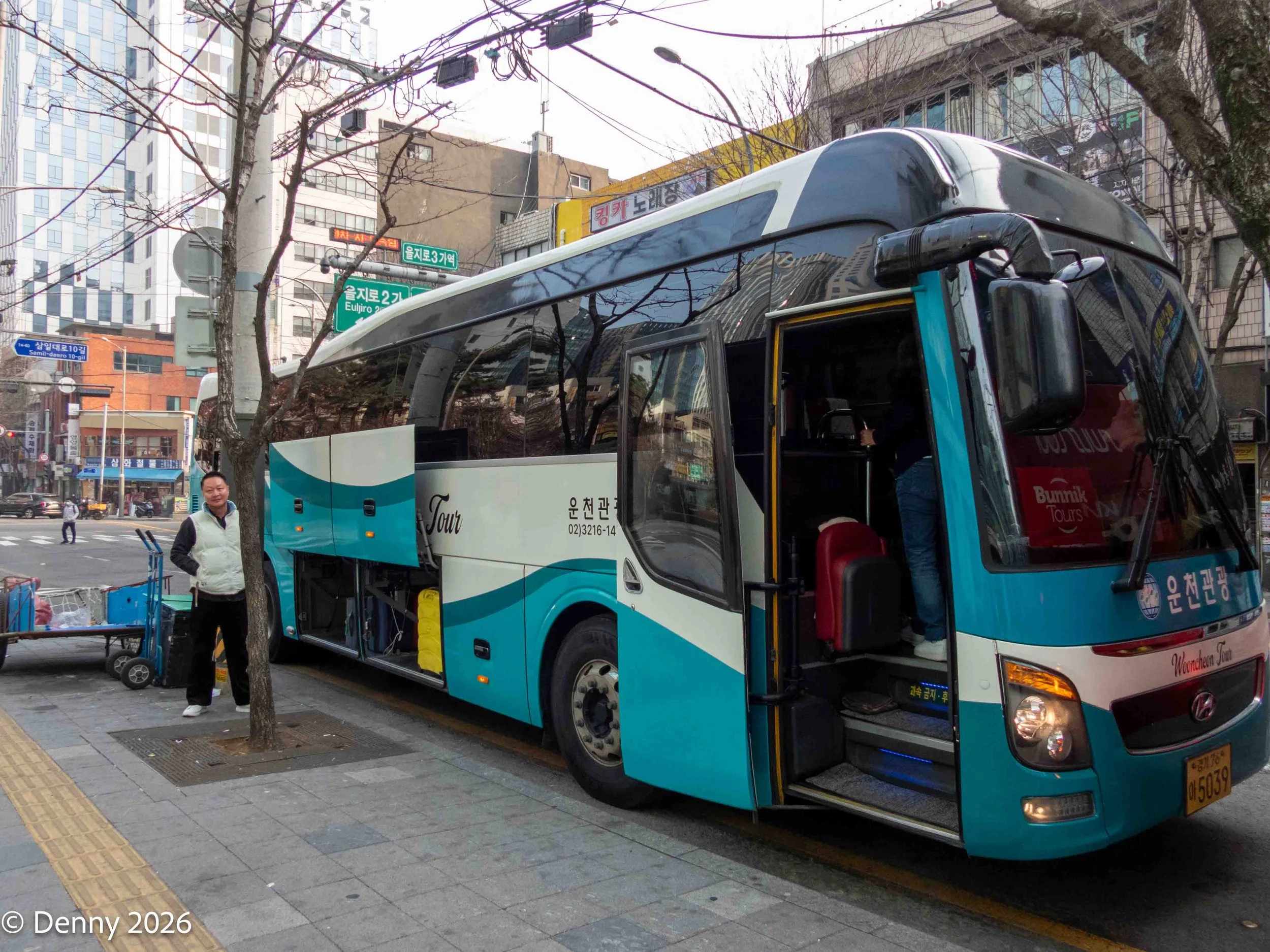
Mr Kim (our driver) with our bus, Seoul

In the southern suburbs there is a major US military base which has occupied this area since the Korean War ended in July 1953.

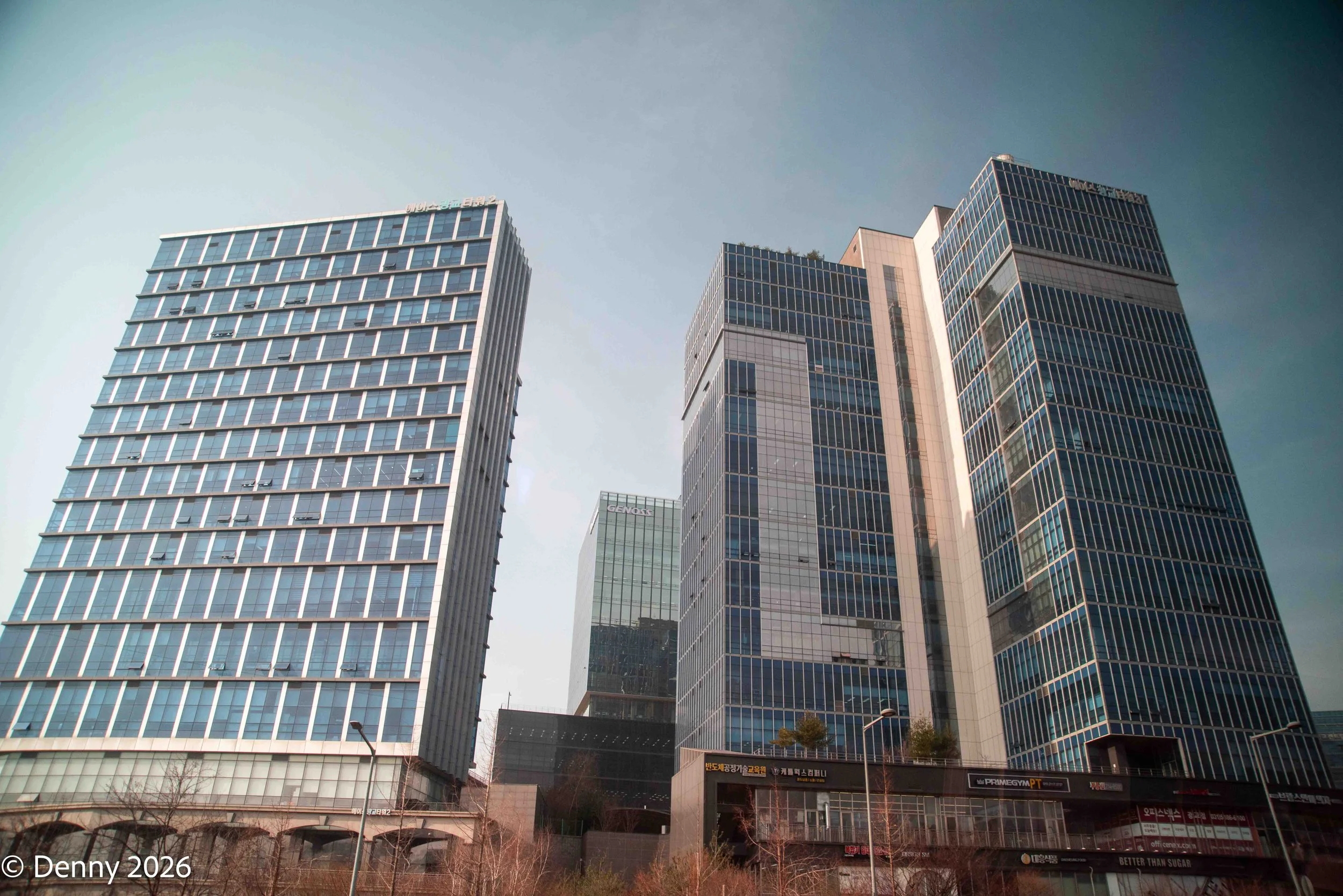
The first twenty kilometres of travel was through regions of high density residential accommodation as indicated by the never ending multi-storied blocks of flats.

Multi-storied buildings, Seoul

Further south we diverted further to the west to head for Suwon. The landscape now changed to mostly flat agricultural areas with numerous rice paddies being prepared for springtime planting. In addition we encountered areas where there were kilometres upon kilometres of plastic covered hemispherical greenhouses for the production of tomatoes, strawberries, capsicums and other vegetables. 

After an hour we arrived at the old fortress city of Suwon which is the capital of Gyeonggi Province.

The name Suwon means ‘water source’ which has its ancient derivation from the many high quality artesian wells in the area.

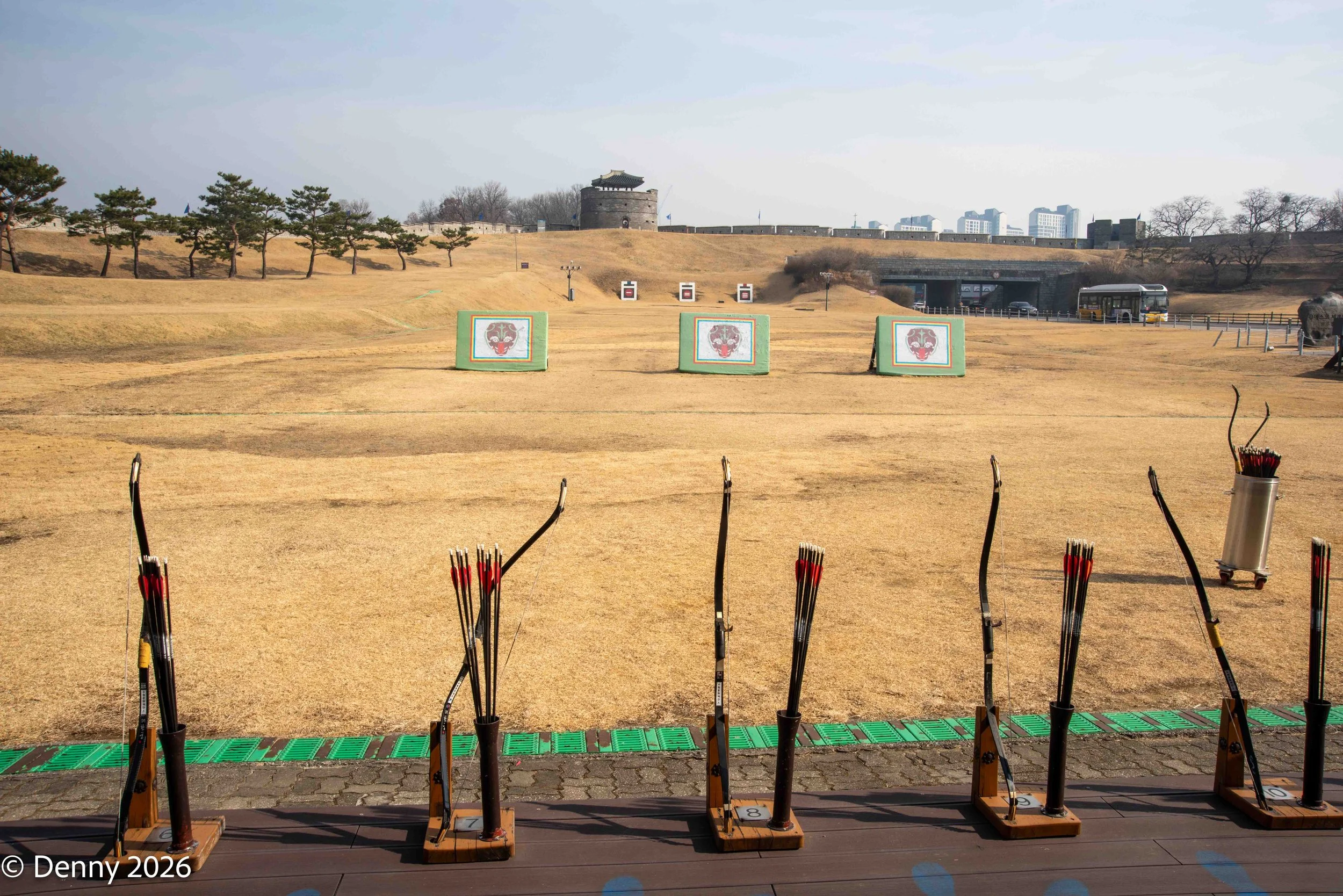
Before visiting the fortress we spent an entertaining forty minutes or so having an archery lesson followed by target practice.

Our coach gave us instructions that Monica translated and after an initial session we were assigned ten arrows to fire at a (1m x 1m) target about 50 m away. Most of us had minimal success but some of our last arrows hit the target but certainly were not bullseyes!

Traditional archery, Suwon Hwaseong

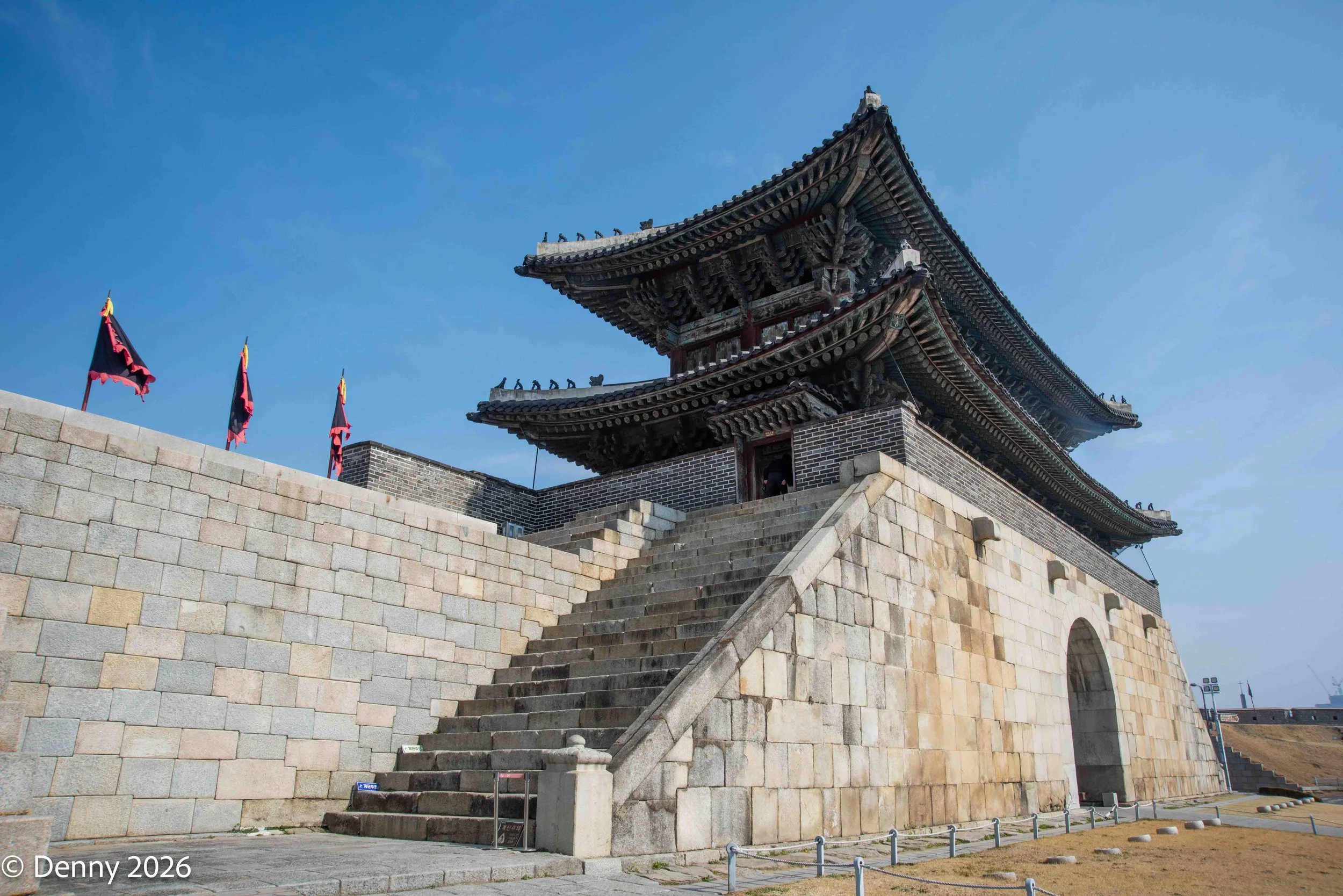
The main historical sight in Suwon is the Hwaseong Fortress that was built to surround the old Suwan. The external fortress wall averages 9 m in height and meanders for 5.5 km around the old city. The granite stone block wall incorporates elaborate gates and several other historical architectural facilities including parapets, embrasures, floodgates, observation platforms, cannon stands and domes.

Construction of the fortress began during the reign of King Jeongjo (1776-1800) in memory of his father Prince Sado.

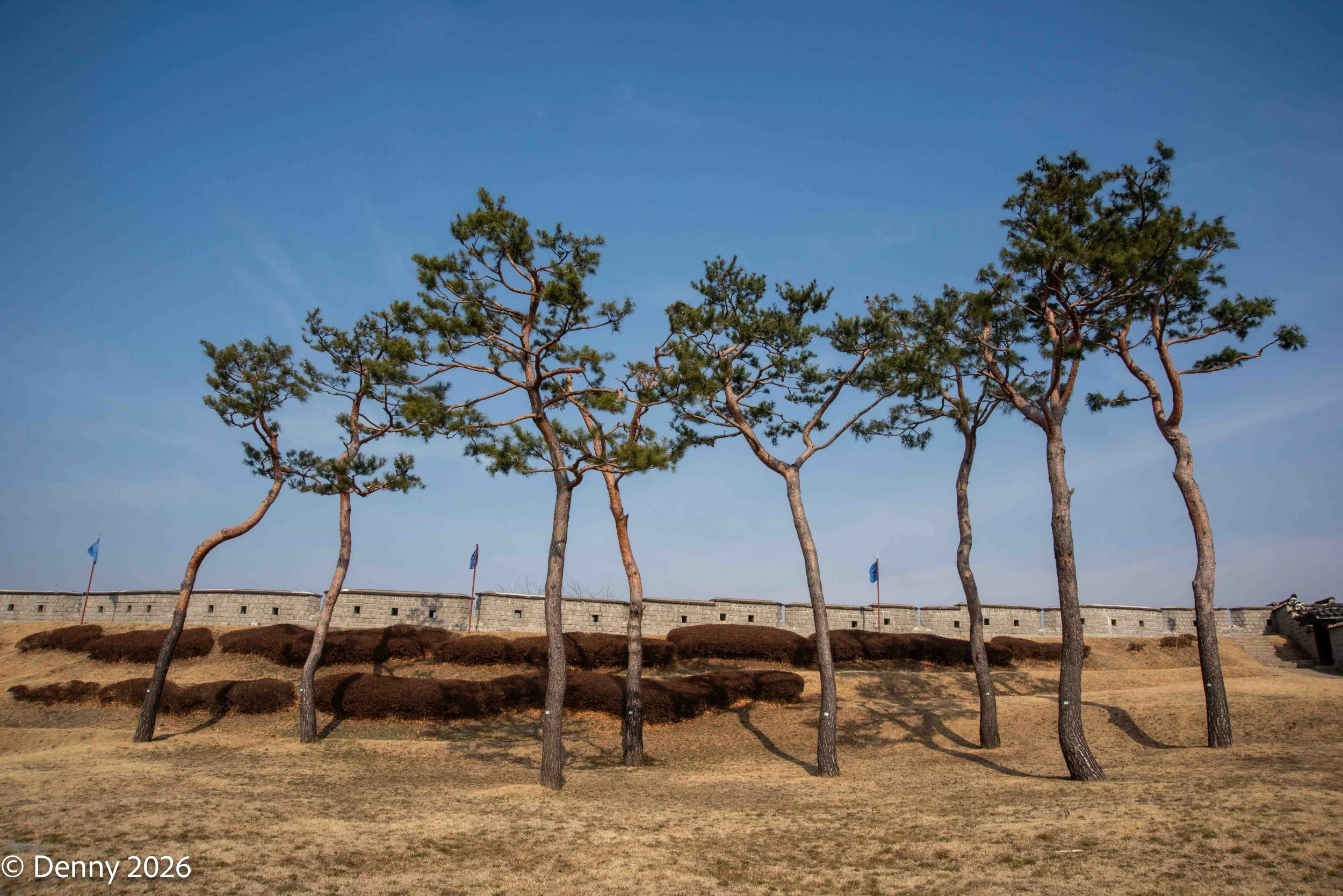
Conifers, Suwon Hwaseong

We spent an hour wandering along the top of the wall and noted that substantial sections of the wall have been restored. We were informed that this work was undertaken in the late 1970s in a major project funded by the South Korean government.

Suwon Hwaseong Fortress

Stone wall, Suwon Hwaseong Fortress

Suwon Hwaseong Fortress

Having departed Suwon we finished our day’s southern travel at the city of Jeonju.

Agricultural land en route from Suwon to Jeonju

Bridge and agricultural land en route from Suwon to Jeonju

Agricultural land en route from Suwon to Jeonju

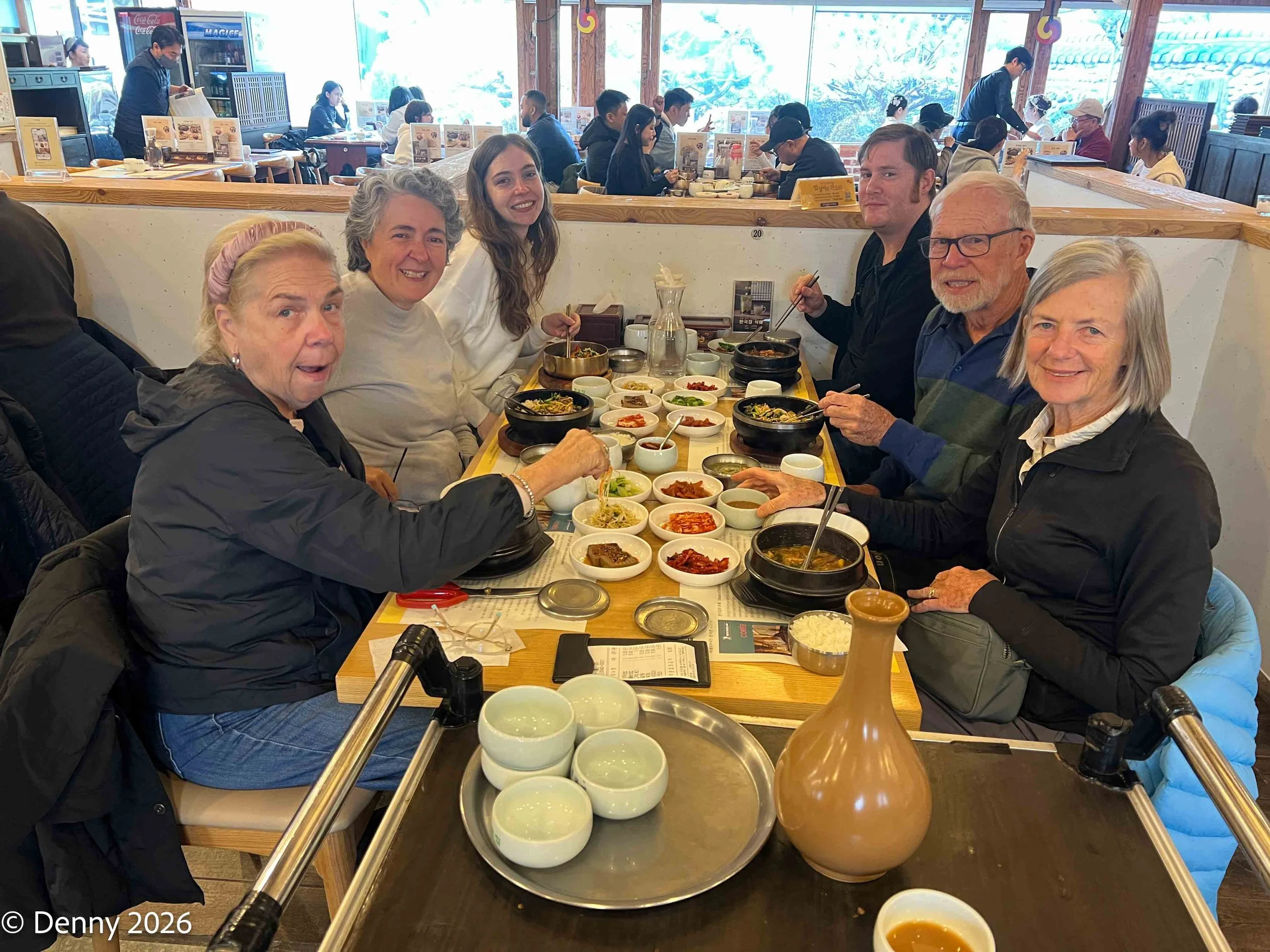
Jeonju was to provide us with a special introduction to Korean culinary specialties with a lunchtime gathering at a restaurant specialising in bibimbap.

Our lunch gathering at Jeonju

Unbeknown to us bibimbap is one of the most famous Korean foods worldwide. The dish we tried was beef bibimbap which comes in a very hot bowl with boiled rice in the base and the top covered in various vegetables, seaweed, tofu, egg and especially beef strips. The ingredients are then to be mixed together and enjoyed which certainly we did. There were other side dishes to supplement the bibimbap and there are a number of variations to bibimbap including sanchae (mountain roots), raw beef and octopus to name but a few.

Our group outside the restaurant

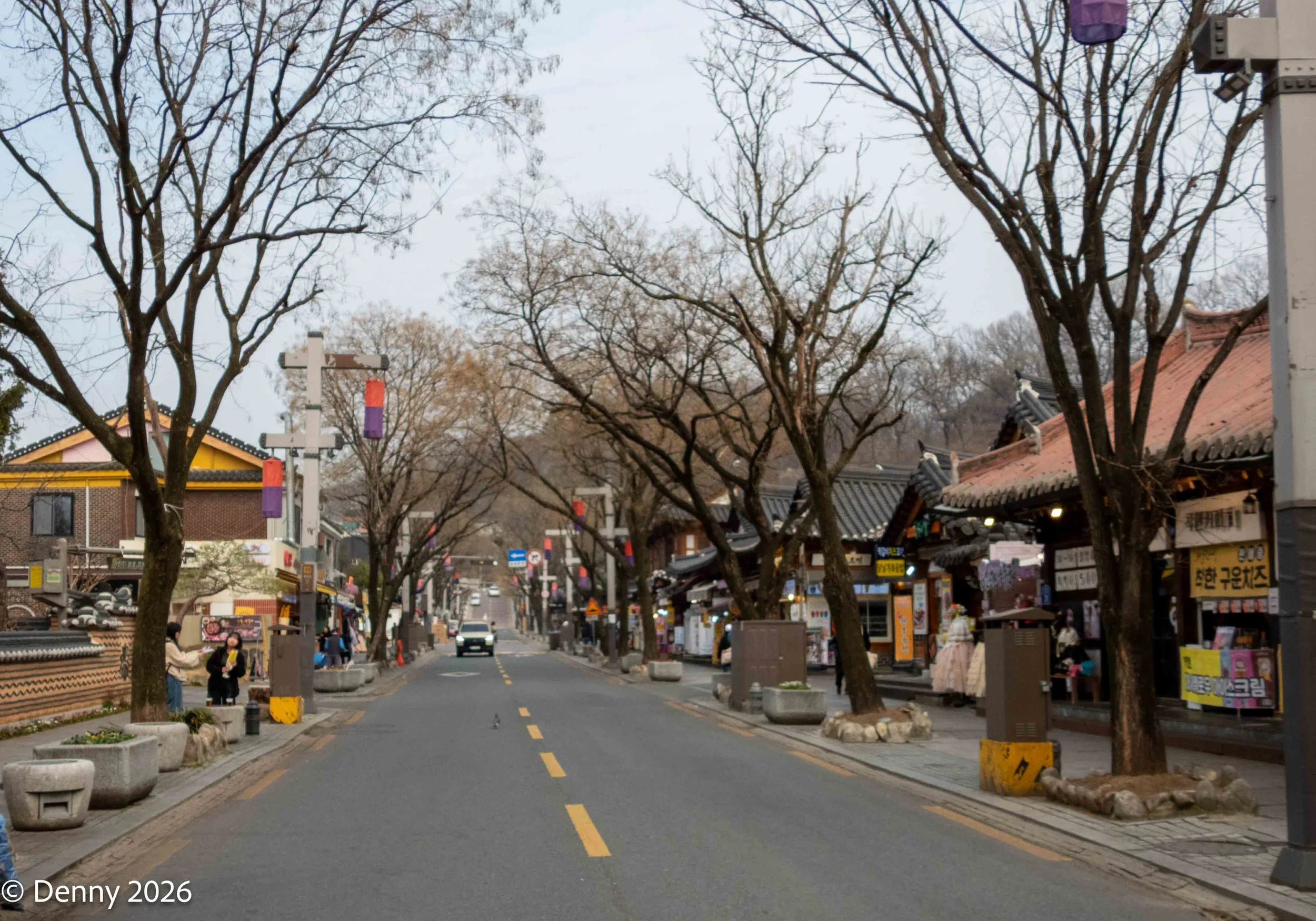
For the next two hours we had free time in Jeonju during which we wandered through the streets of this tourist town which was particularly quiet due to it being Monday.

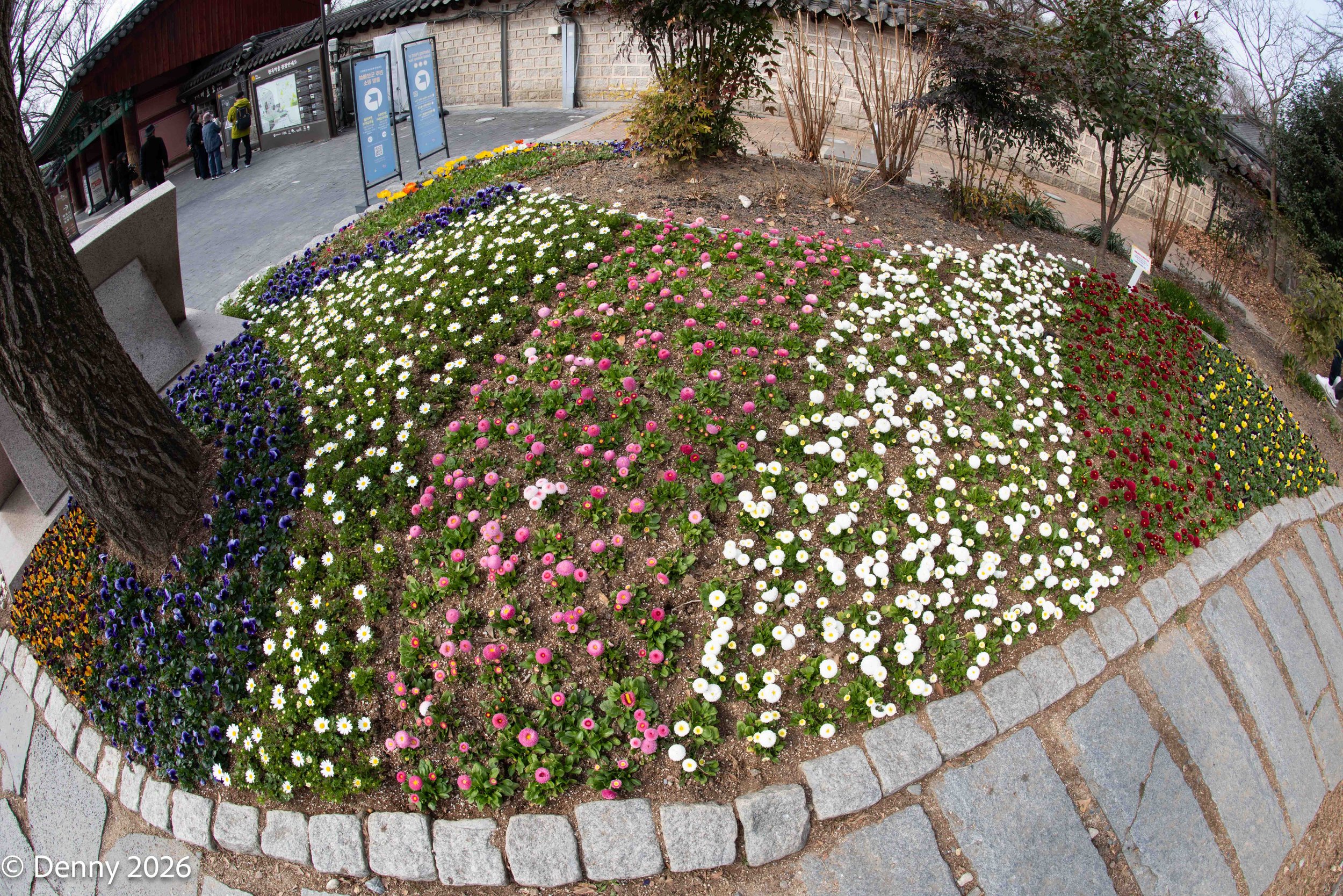
Spring flowers in garden, Jeonju

Spring flowers in garden, Jeonju, South Korea, 16 Mar 2026

In the main area there were the ubiquitous tourist souvenir shops and cafes but surprisingly we found quite a few places specialising in tarot cards, fortune telling, hand reading and iridology. One of the fortune tellers was absent from his shop and came rushing back as we neared. We suspect that he’d been called away by unforeseen circumstances!

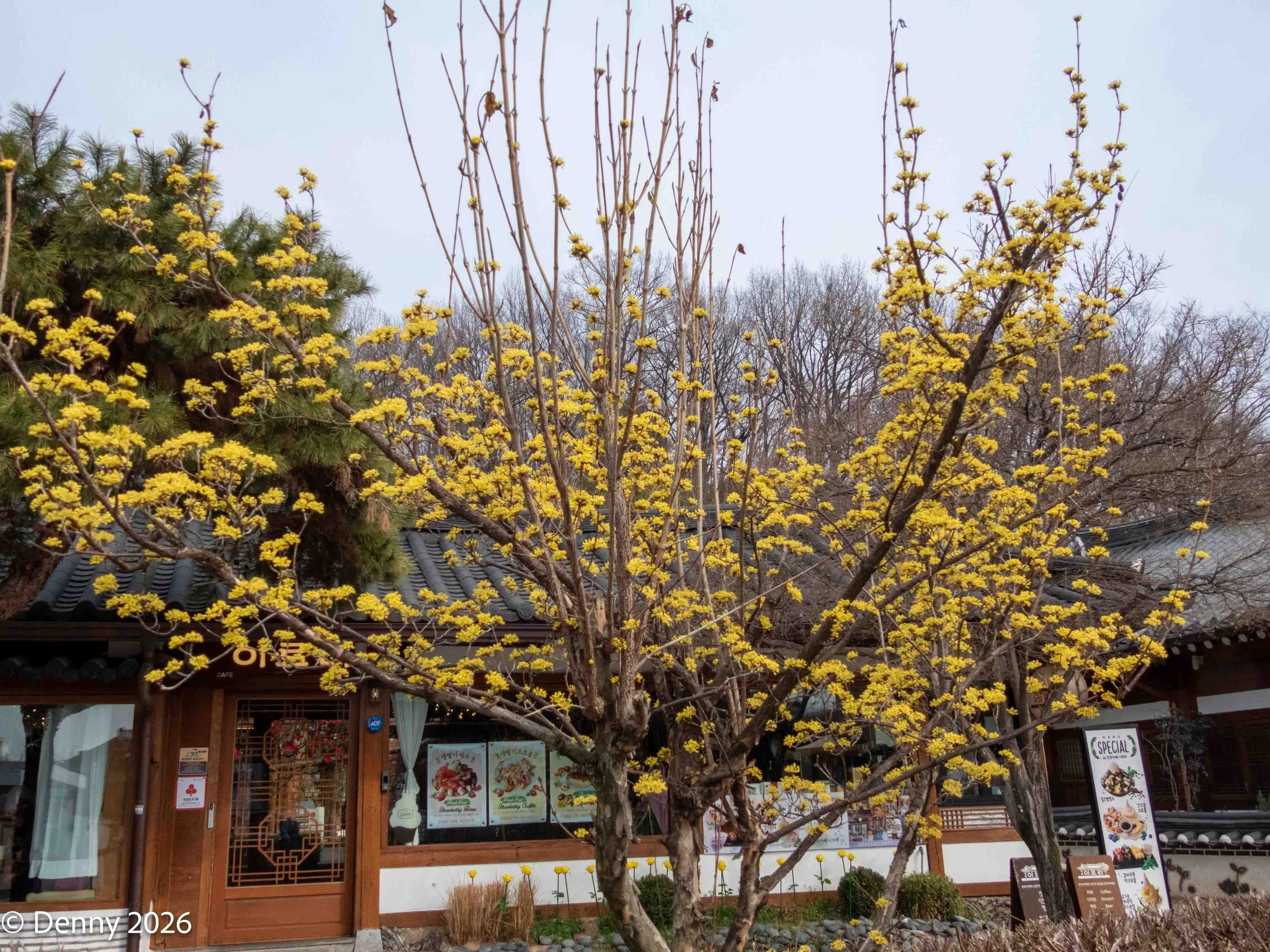
The streets were decorated along the way with beautifully manicured flower gardens and decorative shrubs some now coming into their springtime blossoms.

Main tourist street, Jeonju

Blossom

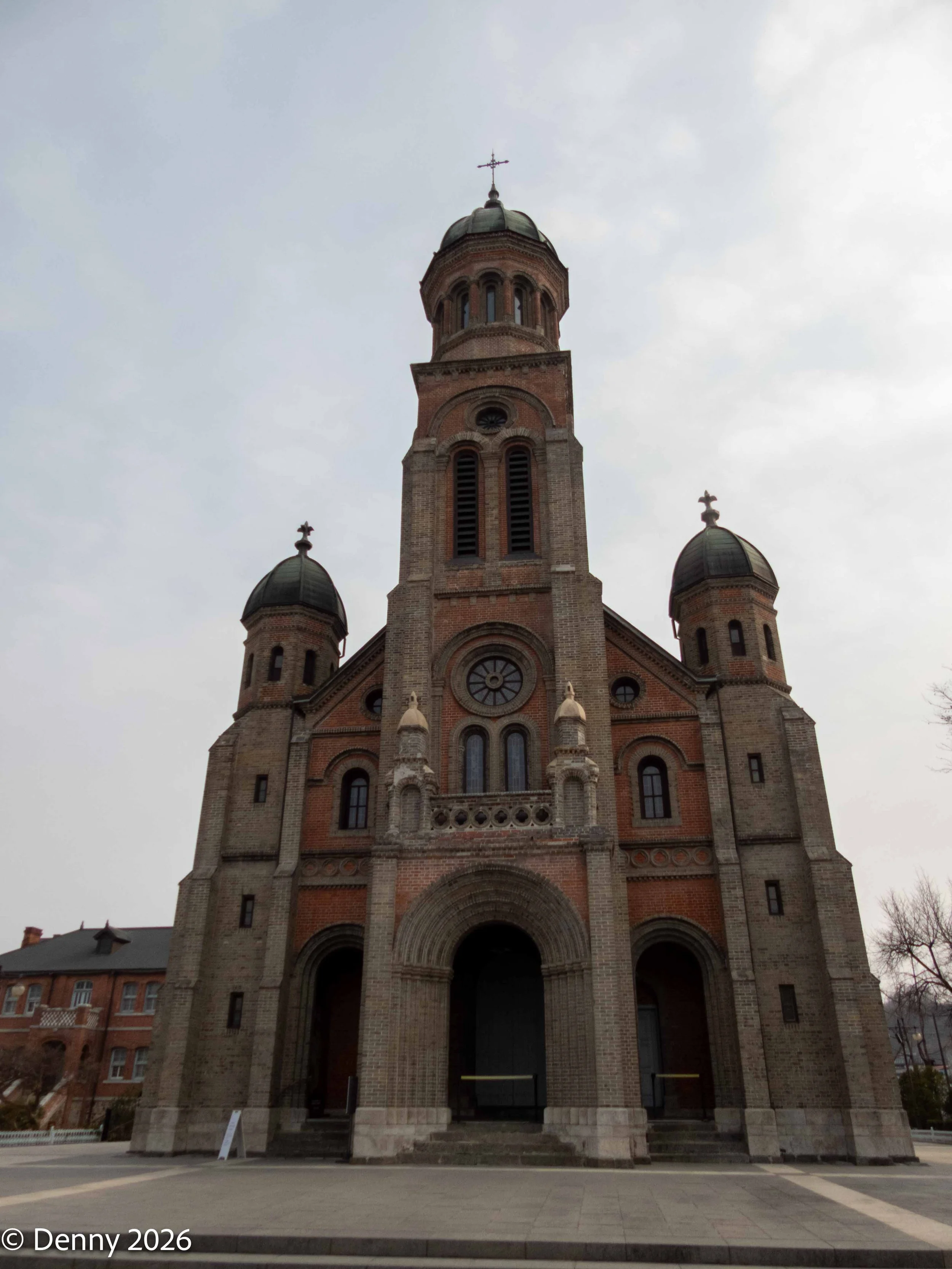
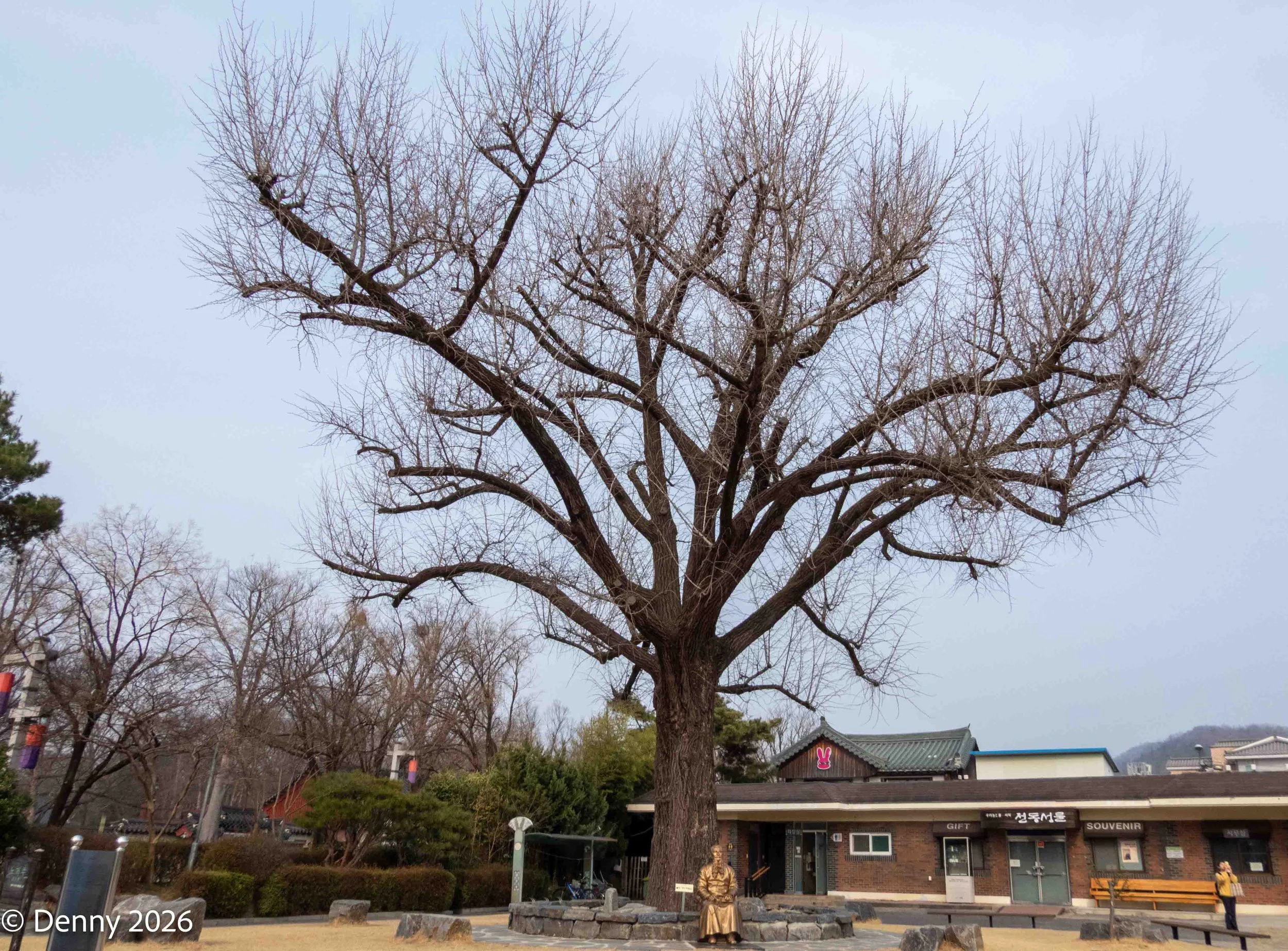
The local Catholic Cathedral is an impressive and imposing structure being built in 1914 on the site of the holy historic martyrs who in the 1790s refused to follow the Confucian tradition of obeying ancestral rituals. The cathedral’s foundation outline represents a silhouette of the Virgin Mary providing you have a flexible imagination. In the grounds of the cathedral is a massive gingko tree underneath which sits a bronze statue of the priest Francois Baudounet who was the principal instigator in having the cathedral built.           

Roman Catholic Church

Gingko tree in church gardens, Jeonju

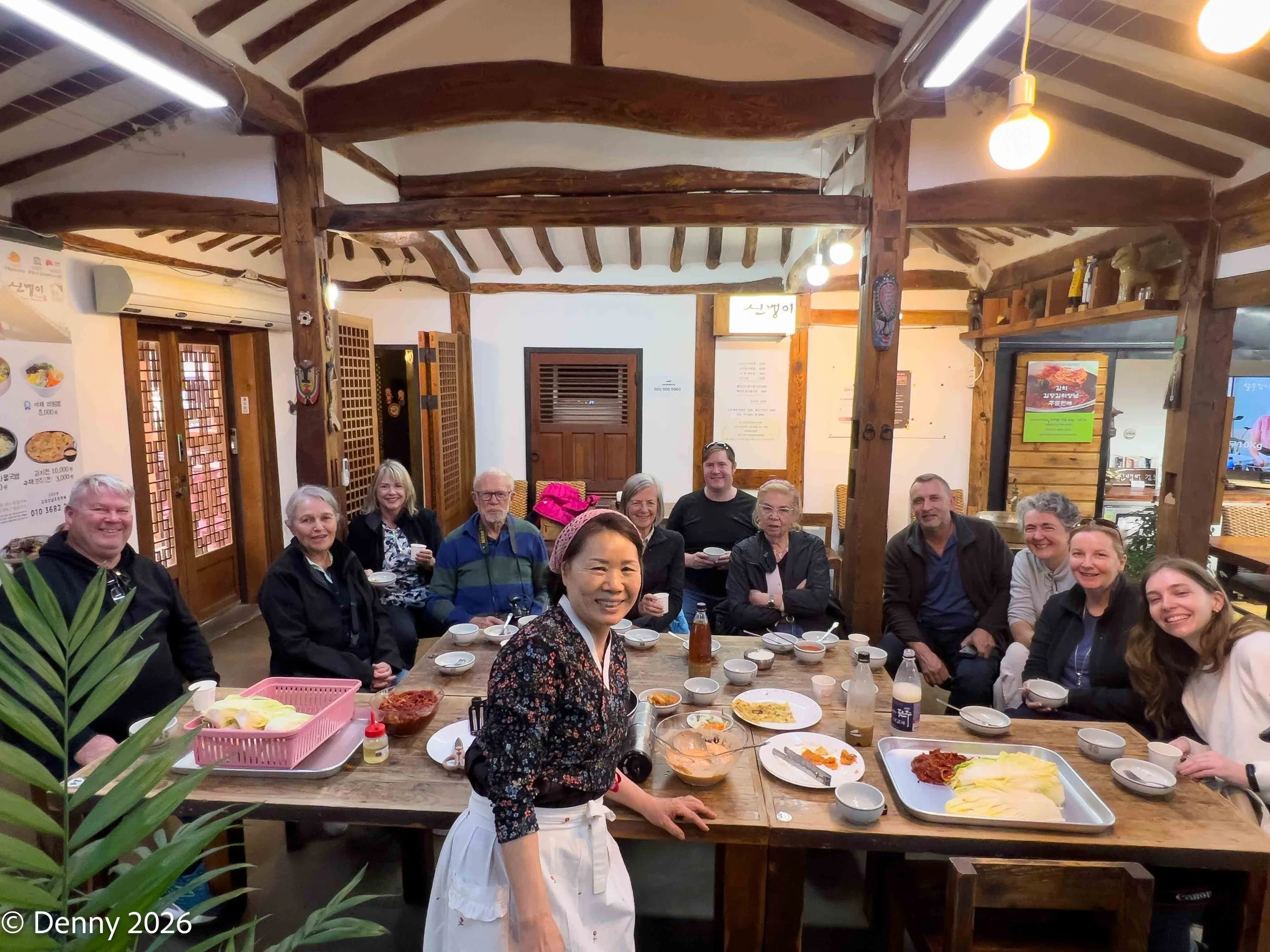
We finished the day’s activities with an entertaining session in a local restaurant learning the art and culinary skills needed in the preparation of kimchi (sometimes referred to as gimchi).

Kimchi is institutionalised in Korea to the same extent that curry is to India. Without doubt it is the most commonly included component of Korean meals and its production is featured both domestically and at nation-wide festivals.

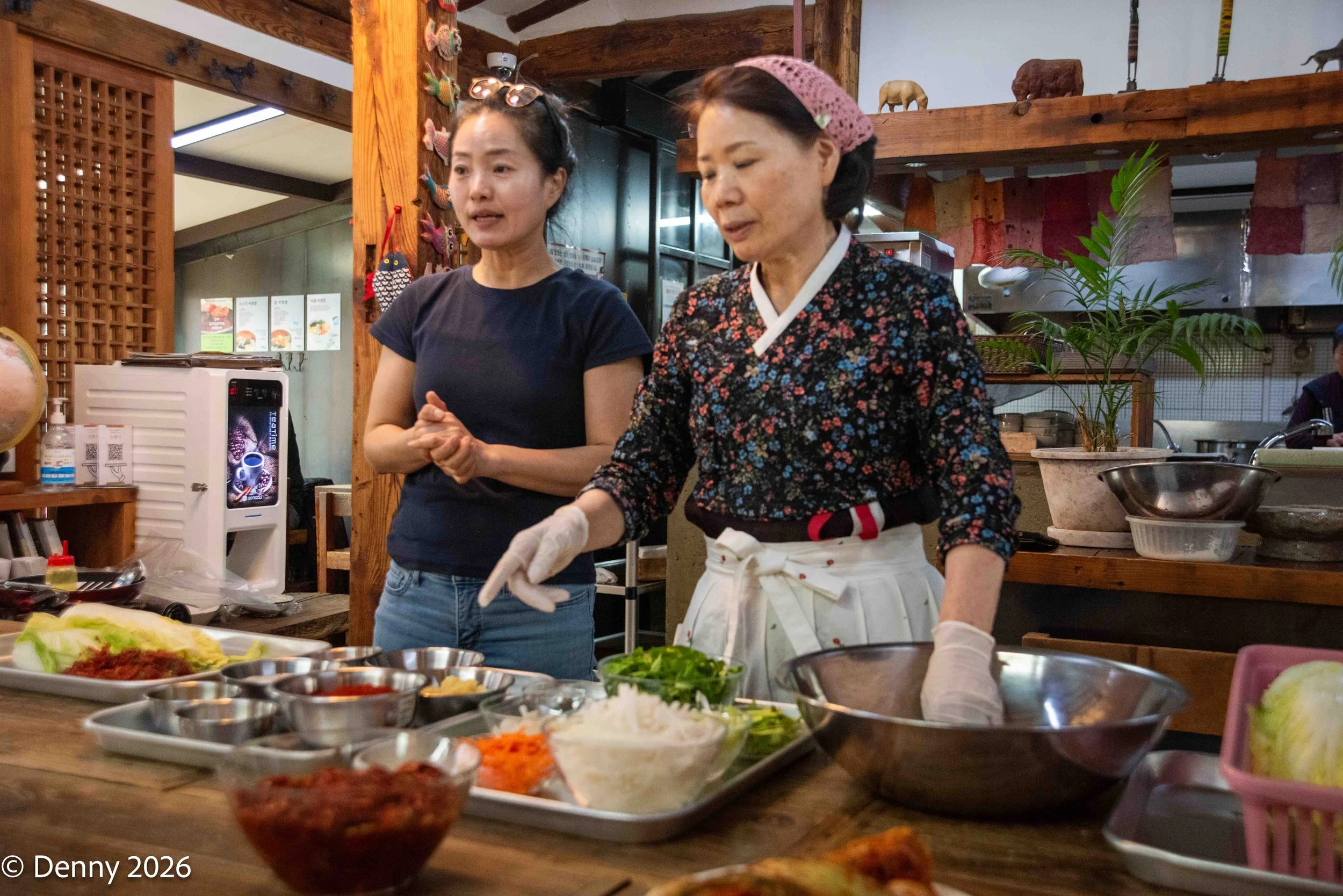
Our delightful kimchi teacher showed us the preparation of the cabbage, its salting stage and the making of the kimchi sauce. The sauce used is a complex mixture of spices (especially garlic and chilli powder) and vegetables which eventually provide the fermentation basis for the cabbage to become delectable and tangy.

Preparation of kimchi

Preparation of kimchi

Our kimchi instructor then cooked some pancakes made from a kimchi base. We tried these tasty morsels of vegetable based pancake together with some local alcoholic drinks one of which was super sweet cinnamon based.

We finally met up with our bus driver Mr. Kim again and were driven to the Best Western Jeonju Hotel where we’ll stay for just one night.

Tomorrow we head further south to end up at Gwangju with the day including a longer walk to a Buddhist temple and a visit to a hot spring spa bath.

DAY 3: Sunday 15th March 2026 SEOUL

After a much needed evening’s sleep we awoke at 06:00 to a cloudy morning with hints that drizzly rain had occurred overnight.

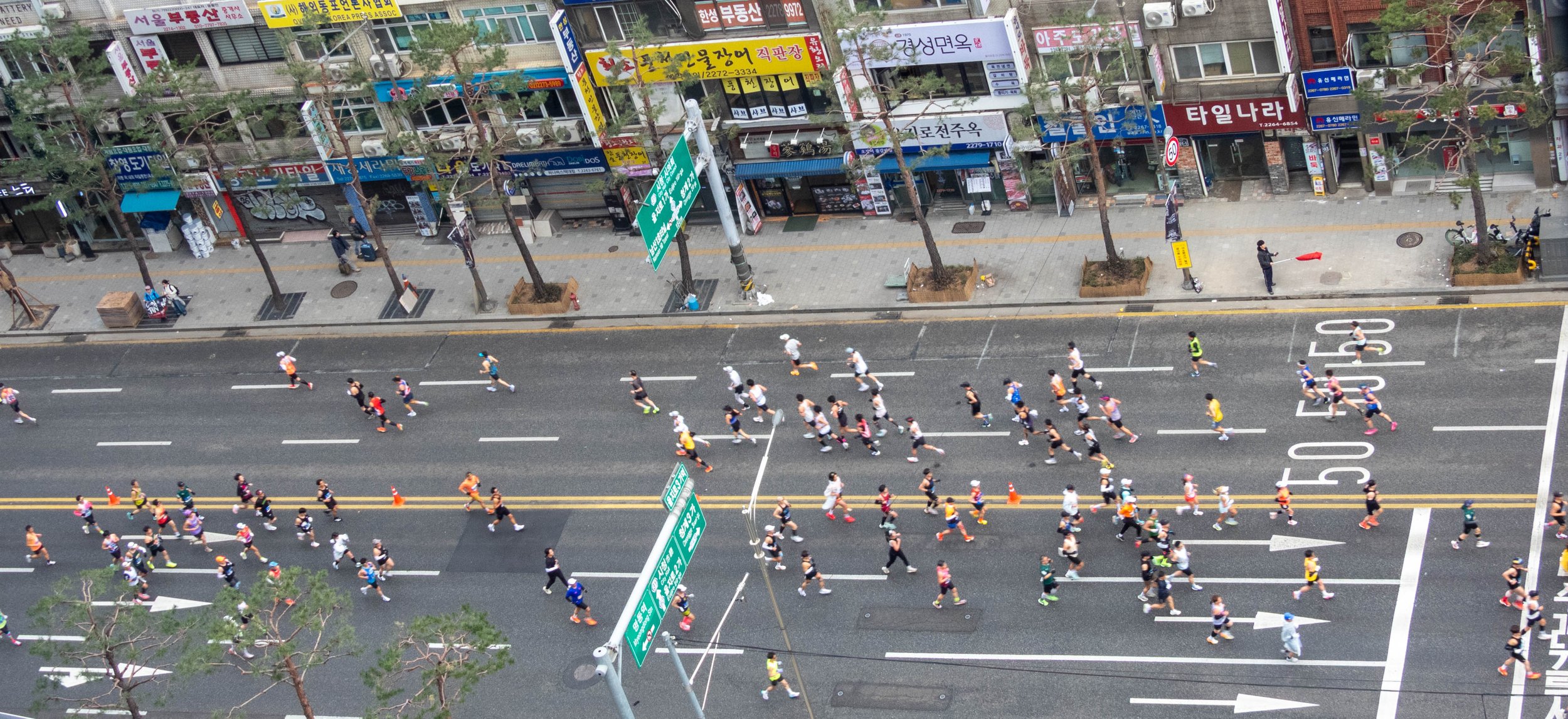
We had a hearty breakfast and when we returned to our hotel room we were pleasantly surprised to observe on the street below, the commencement of the Seoul marathon. Apparently there were over 20 000 runners in the combined marathon and 10 km events and the stream of athletes from super-fast to weekend joggers continued past our hotel for over an hour.

Seoul marathon

At 09:00 we met up with Monica and boarded our bus which is big enough to accommodate forty passengers and yet our group is just twelve including our guide.

Seoul is regarded as the most cosmopolitan of the Asian capitals and the density of sky-scrapers is extraordinary. The population of Seoul city is about nine million although the greater metropolitan region comprises around twenty four million which is about half the total population of South Korea.

Our first stop on this brief tour of Seoul was at the Gyeongbokgung Palace referred to as the Palace of Shining Happiness. The palace built in 1395 is at the heart of the old walled city and was the residence of King Taejo and his successors up to 1592 when it was burnt down during a battle with Japan. It was rebuilt in 1867 as the King’s centre of government and administration.

Gyeongbokgung Palace from outside

The palace occupies an extensive area much of which is now open garden space but formerly provided housing for the government officials and general staff.

Within the grounds there are a number of pagodas built from granite stone and having decorative roofs with elaborately painted timber eaves and concrete cylindrical tiles.

Amongst the pagodas we visited was the King’s throne palace with its wall behind the throne being a famous Korean painting illustrating the ying-yan opposites of the sun and the moon.

King's Throne building, Gyeongbokgung Palace

King's throne, Gyeongbokgung Palace

Pavilion in gardens, Gyeongbokgung Palace

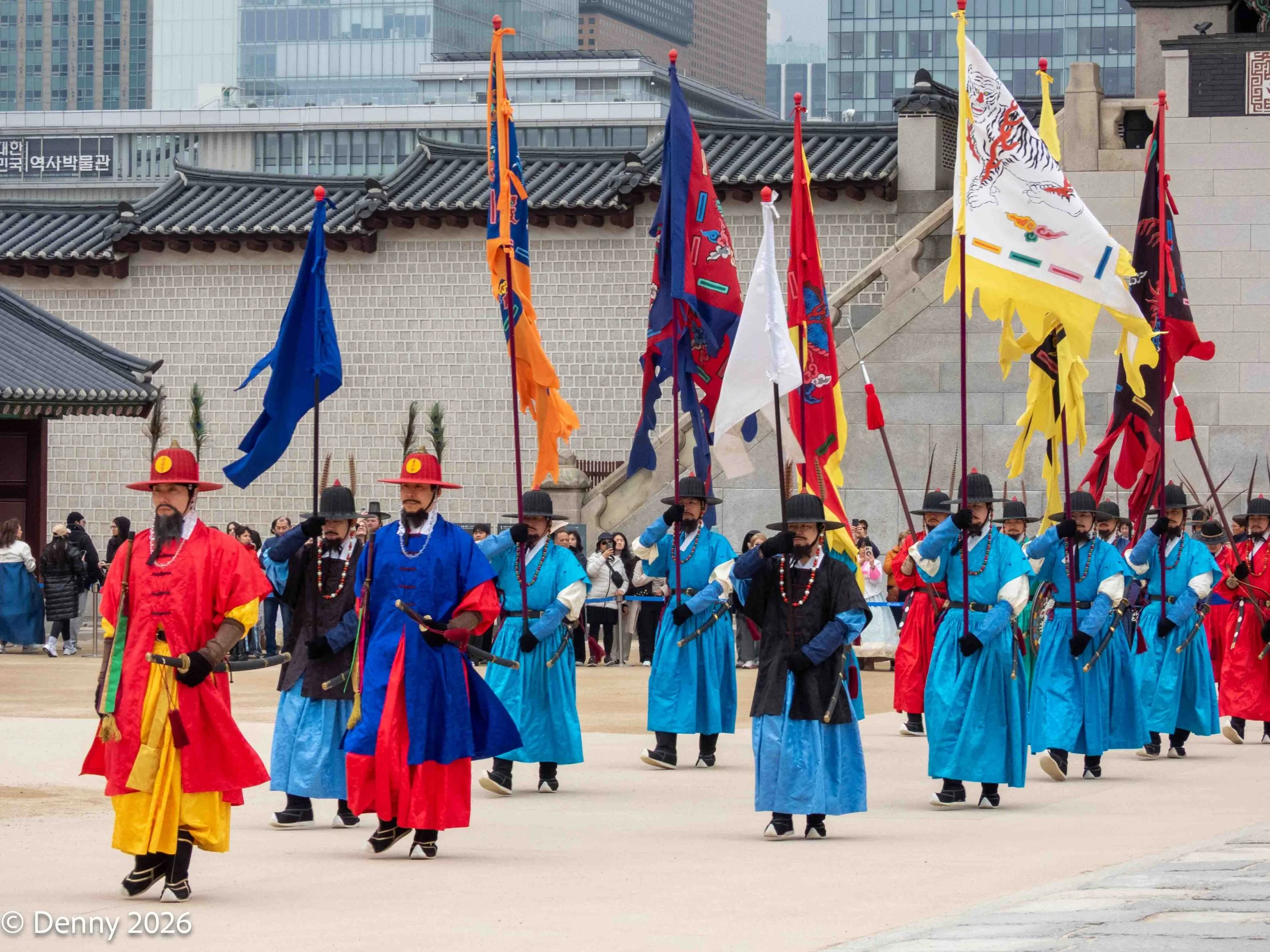
A highlight of our visit to the Gyeongbokgung Palace was the opportunity to observe the ceremony of the Changing of the Palace Gate Guards. The ceremony is conducted much as it would have been when kings and queens occupied the palace in times past.

The participants wear elaborate and highly colourful costumes with ancient brass instruments and very loud drums providing the marching music. The guards have very stern and some even scowling faces suggesting that they regard this ceremony as a highly serious formal event each day and not an act for tourists’ entertainment.

Changing of the Guard, Gyeongbokgung Palace

Changing of the Guard, Gyeongbokgung Palace

Changing of the Guard, Gyeongbokgung Palace

After our palace visit our bus driver drove us to the in-door Gwangjang Market where we had free time for an hour to wander and observe the hustle and bustle of Sunday market.

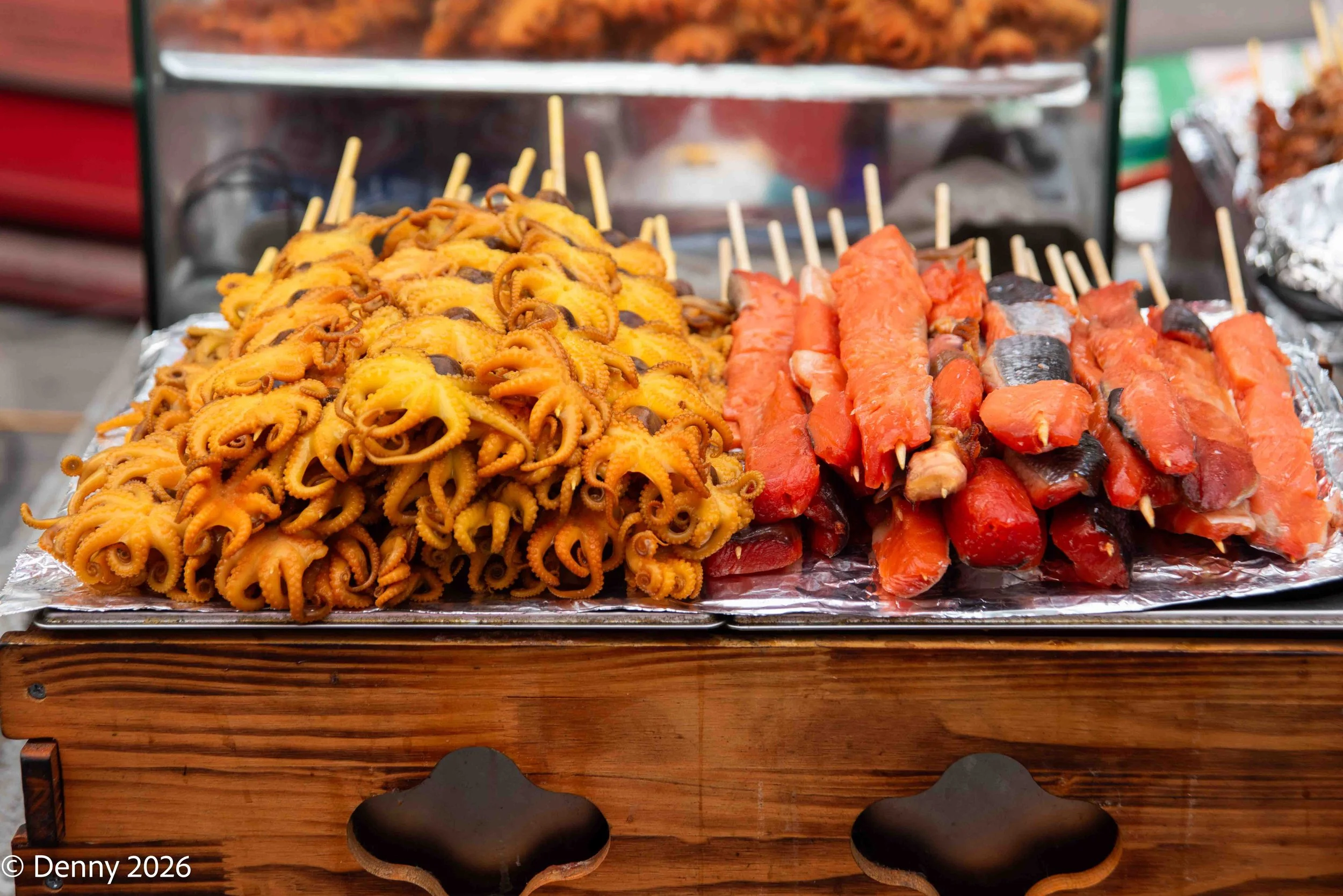
The huge market area was very crowded with queues of people lining up to buy a varied and often unusual collection of foods. Amongst the more peculiar offerings were fish intestines, live octopus, cows stomachs, seaweeds, dried fish and some unknown larvae.

We enjoyed sampling mung bean pancakes called bindaetteok and also tasted kimchi which is a spicy and tangy fermented cabbage treat. Others tried the mini seaweed rice rolls called mayak gimbap that are very similar to sushi. The range of dried fruits, spices and sweets on offer was extensive but the selection of uncooked meats and associated animal offerings didn’t have our taste buds tingling despite our guide’s suggestions.

Lady making mung bean pancakes

Gwangjang market

Gwangjang market

Preparing fish intestines, Gwangjang market

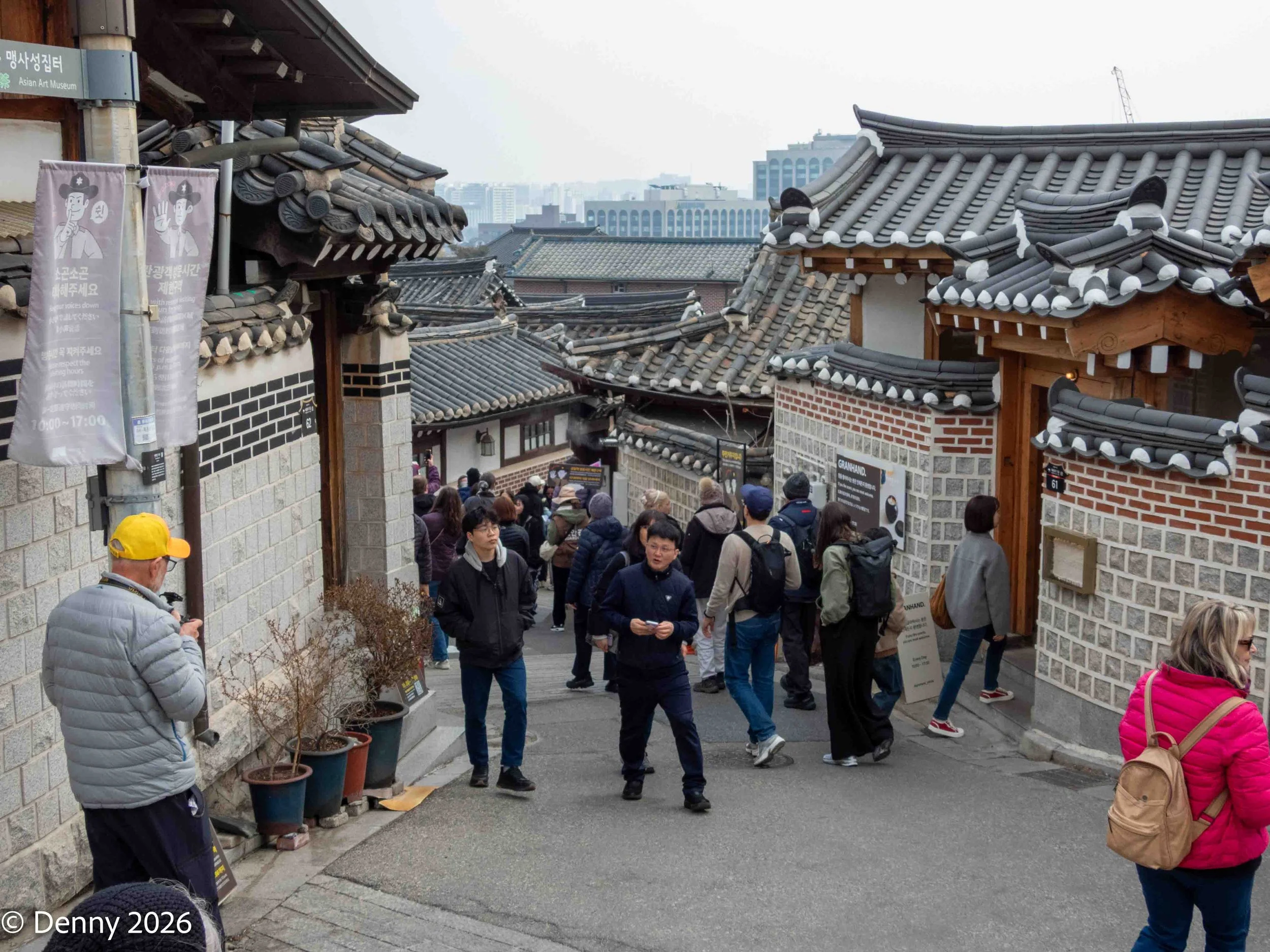
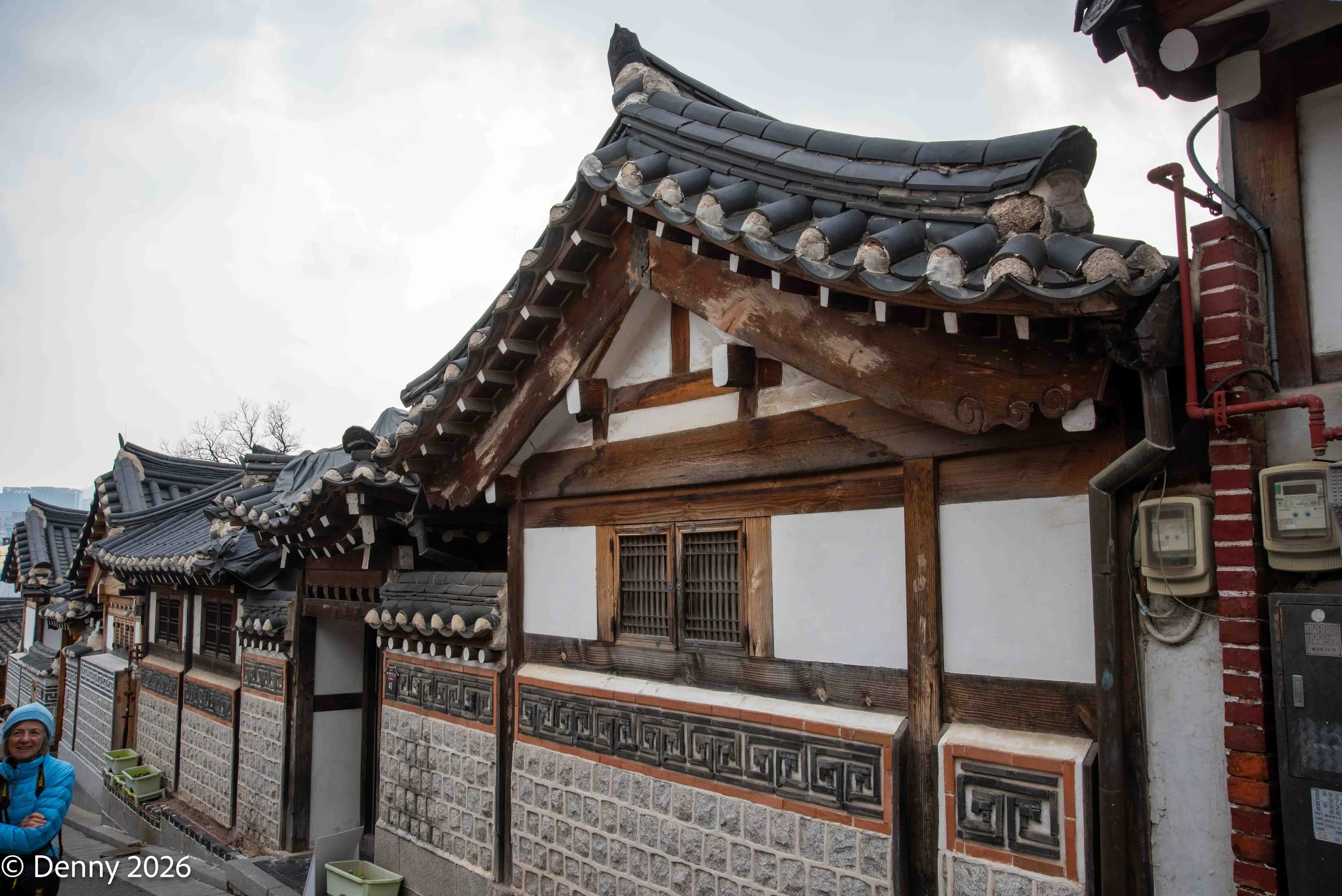
We then moved to visit the Bukchon Hanok village area. This part of the city showcases the traditional architecture of early Korean times. The buildings occupy a comparatively small hillside area where tourists are able to walk through laneways in amongst these highly attractive homes that are presumably occupied by wealthy residents. Several of the houses seem quite new or possibly they may just have been refurbished. 

Walking through Bukchon Hanok village

Bukchon Hanok village

Laneway with bin for collecting snow

Plum blossom, Bukchon Hanok village

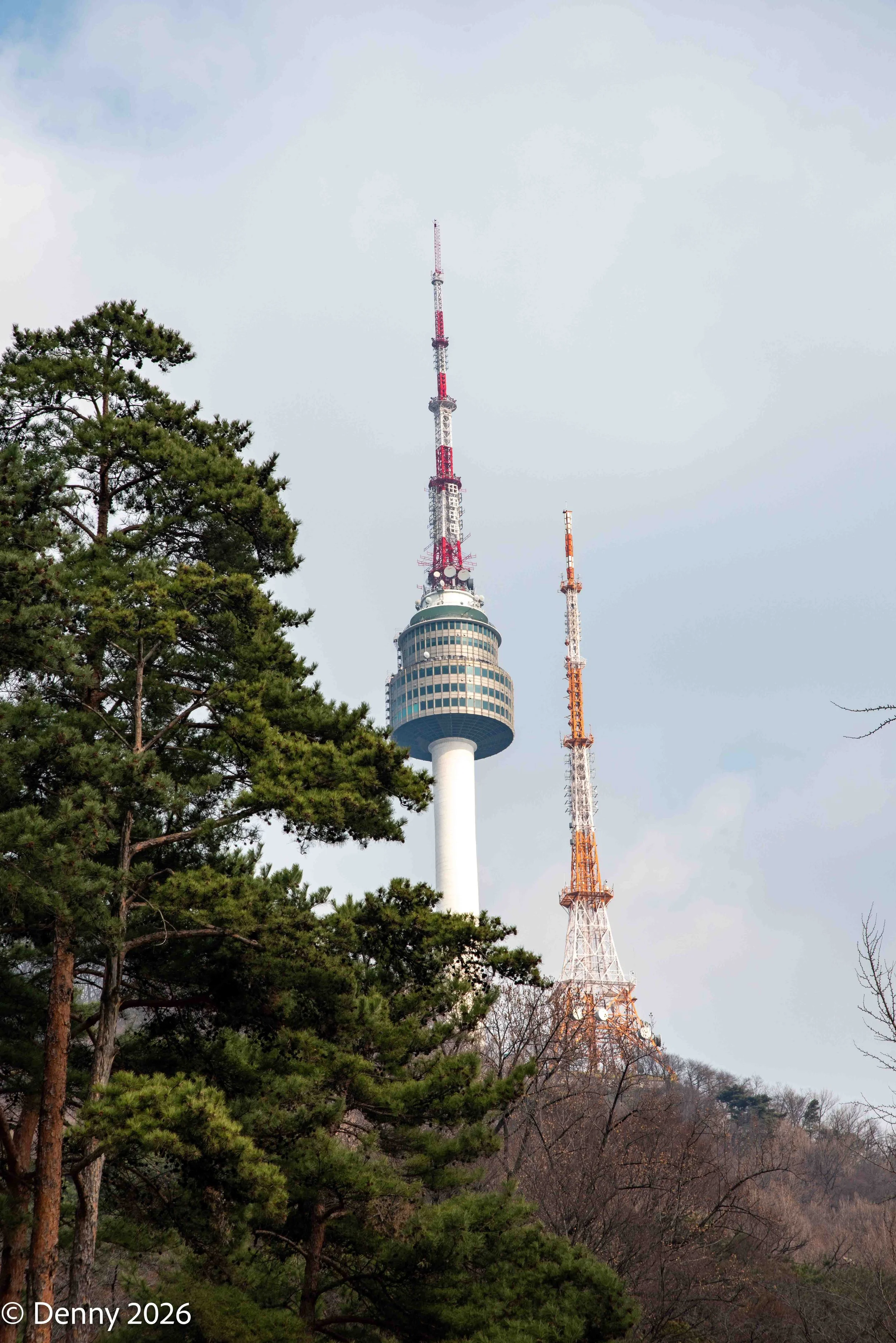
To complete the day’s sight seeing we headed skyward to Namsan or ‘South Mountain’, it being a 243 m high wooded mini-mountain which topographically is pretty much the centre of Seoul.

Atop of Namsan is the N (new) Seoul Tower which rises a further 243 m providing a very popular viewing platform. We had a less than perfect view as the conditions were initially cloudy and quite misty although things improved later when sunshine broke through.

N Tower on Mt Namsam

View of tower on Mt Namsam

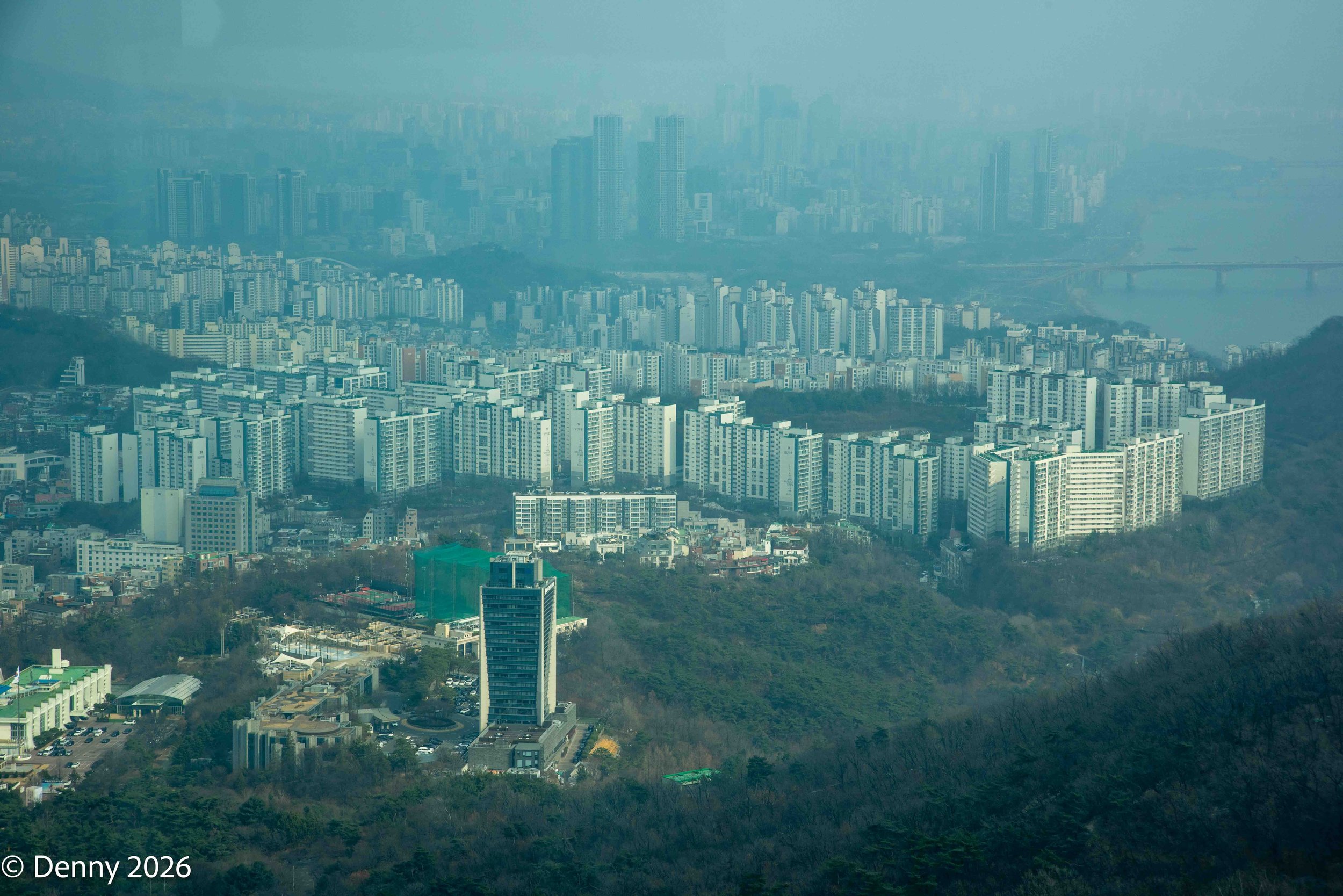
From the tower we had a panoramic view of the metropolis below its multi-storied buildings in every direction. We could see to the north the conically shaped Bugaksan (north peak mountain) and in the opposite direction we observed the Han River which flows from west to east through the southern suburbs of Seoul.

View from N Tower on Mt Namsam

View from N Tower on Mt Namsam

At this stage of the day we’d been on our feet for eight hours or more and we headed back to our hotel for refreshments and an evening meal.

Tomorrow we leave Seoul for the present time and drive initially to Suwon and then finish the day at Jeonju.

This day in Seoul has been most enjoyable and given us a preliminary insight to the history, culture, people and architecture of this fascinating country.

DAY 2: Saturday 14th March 2026 SEOUL

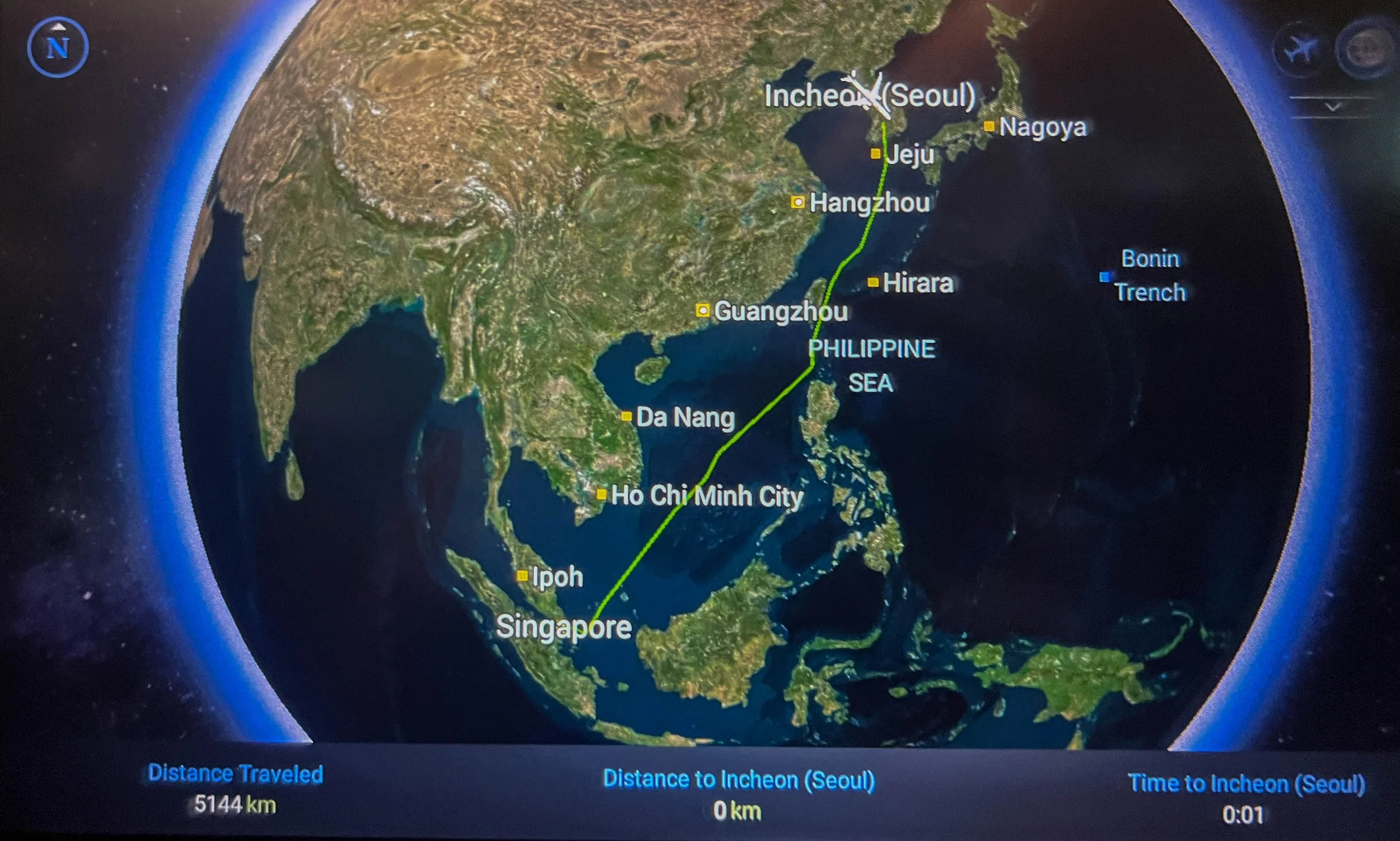
It was just on 07:00 when we landed at Incheon which is the International air terminal for Seoul.

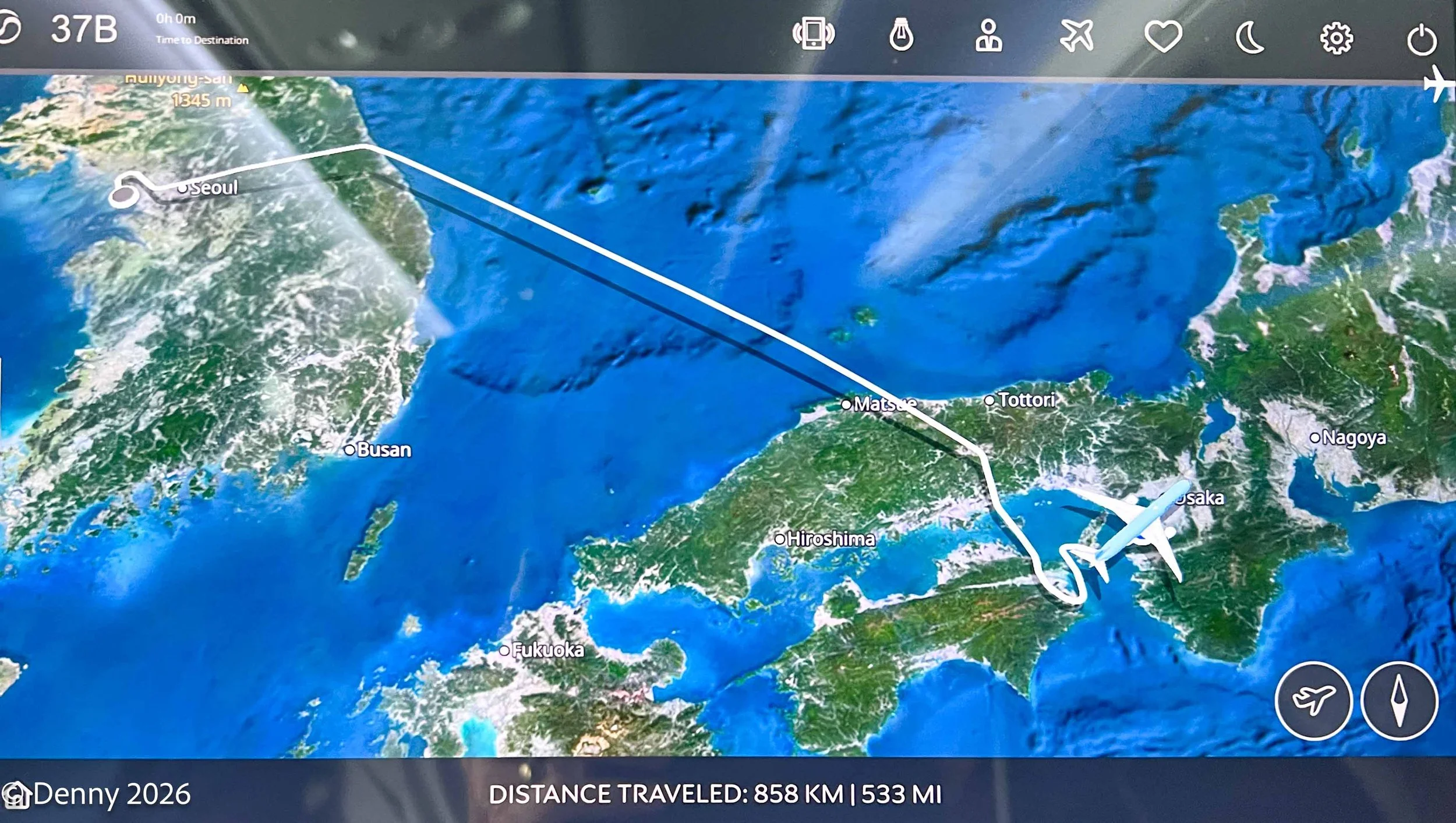
Flightpath, Singapore to Incheon (Seoul)

Flightpath, Singapore to Incheon (Seoul)

The security and passport checking procedure was slow due to the large number of passengers on our B-787 flight. The check required our photos to be taken as well as a scan of both index fingerprints.

We were delighted to see that our luggage had arrived safely in South Korea having last seen our bags at Hobart airport in what seemed a long time ago.

We passed through customs and there waiting in the passenger arrivals area was our smiling and very friendly Bunnik driver who informed us he spoke no English apart from saying “no English”.

The Incheon airport is about 70 km from central Seoul and the drive was initially fast on the expressway but once we encountered the city’s outer suburbs the traffic density made travel quite slow. Unsurprisingly, locally made Kia and Hyundai cars dominate the car market here and car colours we gauged are predominantly either black or white. Very few motorbikes were observed.

At just on 09:30 our driver dropped us off at our city hotel, namely the ‘Four Points Sheraton’ where we were informed that ‘check-in’ wasn’t available until about 15:00. Then through great fortune the front desk assistant made further enquiries for us and said there was one room now available which could be ours. Maybe she looked upon us as geriatrics and had a sense of concern or was it sympathy for the aged?

Our very adequate hotel room is on the 13th floor and the cityscape view is of skyscrapers in every direction. As we have no formal commitments until later this afternoon, this provided an opportunity for showering, relaxing and catching up on sleep which has been missing for the last day or so.

View from our room at Four Points Sheraton

Although there has been no rain, today’s weather conditions have been cloudy and quite cool with a maximum temperature of just 12C. The deciduous trees around the city are still exhibiting their winter drabness and devoid of new spring foliage which we are assured is imminent!

Our Bunnik tour group of eleven Australians assembled for the first time at 17:30 and we met our Korean tour leader Monica who is young, super friendly and obviously very enthusiastic about showcasing her country to our group.

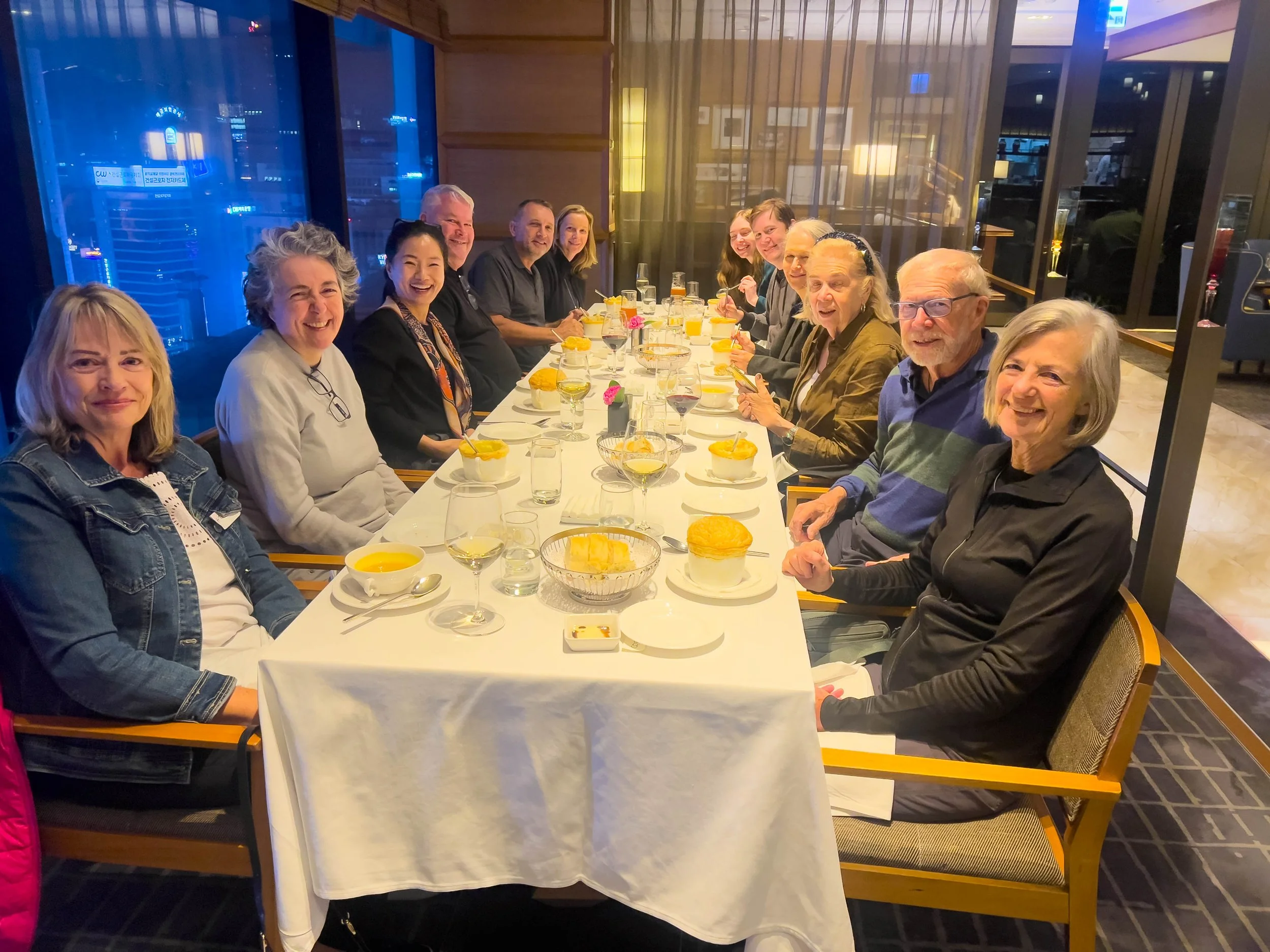
Monica gave us a potted summary of our planned next ten days of travel in South Korea and we then walked a few blocks to the Royal Hotel where we had our evening meal on the 21st floor. From the dining area we were overlooking a dazzling array of city skyscraper lights, neon signs and giant advertising screens atop many of the multi-storied buildings.

The excellent four-course meal didn’t entail Korean cuisine but nonetheless it was complemented with nice wines and ample opportunity for giving the group time to chat and learn a little about our fellow travellers.

View from restaurant, Royal Hotel

We returned to our Sheraton Hotel at around 21:00 and prepared for an early night after two days with minimal sleep.

On the return trip to our hotel we asked Monica where she was staying in Seoul overnight. She said it was forty minutes from our hotel and that she’d be using her BMW for transport. This comment caused interest and then she explained the acronym being ‘bus, metro,walk’!

Tomorrow we start our Korean holiday in earnest with a full day of walking and sight-seeing around some of the main tourist hot-spots of Seoul.

DAY 1: Friday 13th March 2026 HOBART - MELBOURNE - SINGAPORE - SEOUL

This was to be a day of travel and today being Friday the 13th we were hoping there were to be no glitches along the way.

David Smart very kindly provided our transport to the Hobart airport and by midday we were in Melbourne and our bags ticketed through to Seoul in South Korea.

As we had a four hour stopover in Melbourne we spent the first hour in the Virgin Lounge where amongst other issues we contacted the Sunboost technicians who were finalising the installation of our new solar battery. After downloading the new software for the new FOX 42 kWh battery we hoped that despite our absence, the system would now be working appropriately and that we could monitor our domestic energy issues during our five weeks away.

The great crowds of people we encountered on arrival in Melbourne thinned out at the International terminal and by the time we’d passed through the security check and passport control it was very quiet. We retrieved the GST on the new laptop we’d purchased recently and then purchased some Korean currency (won) and Japanese yen.  

Our Singapore Airlines flight to Singapore was on a Boeing 777-300 which left pretty much on time at 14:30. True to form, the Singapore service was impeccable and our usual holiday initiator of a mandatory ‘bloody-mary’ cocktail was top class.

Traditional bloody Mary on overseas flight, Melbourne to Singapore

The seven hour flight had us arriving in Singapore at around 21:00 local time.

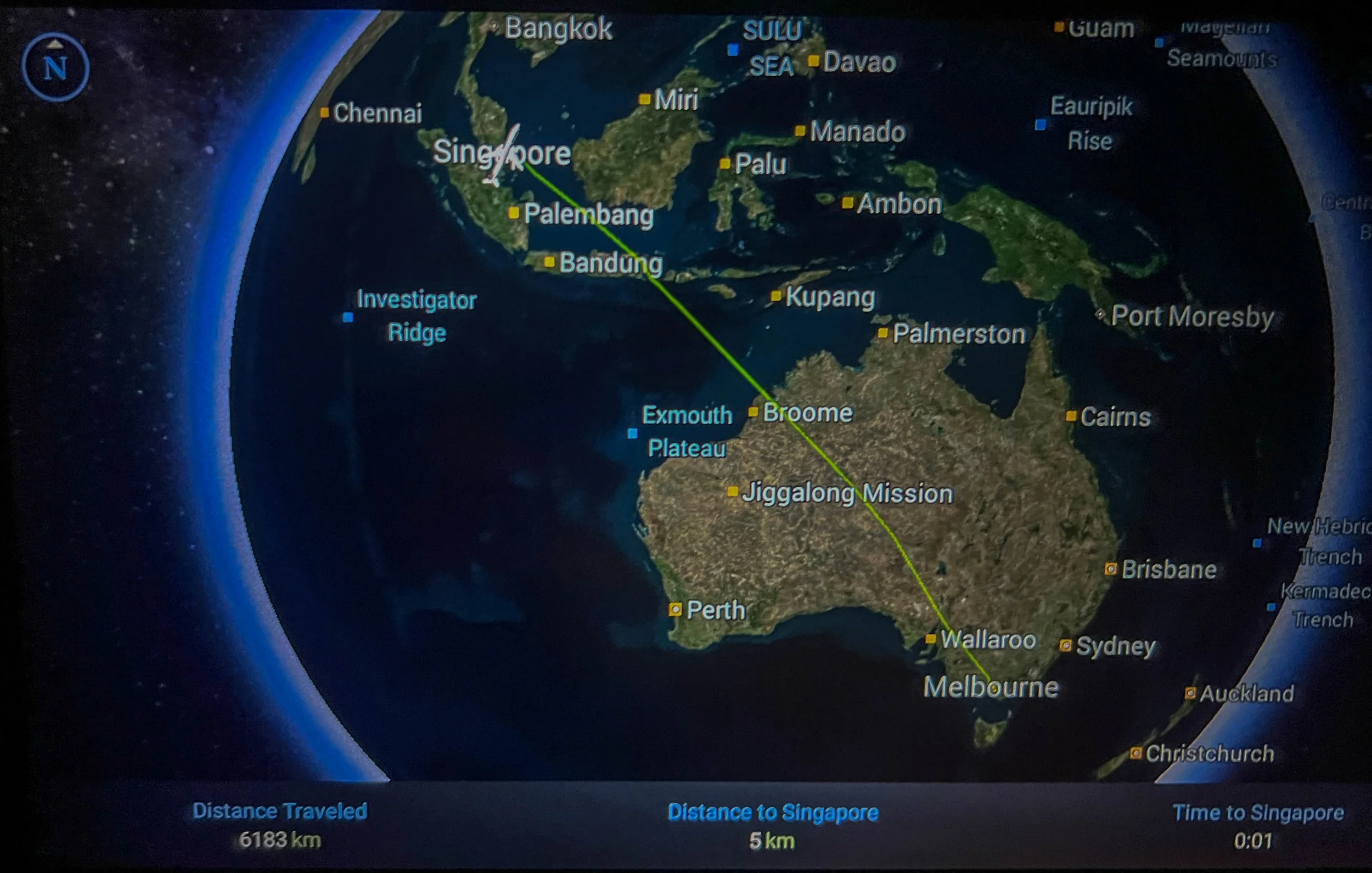
Flight path Melbourne to Singapore

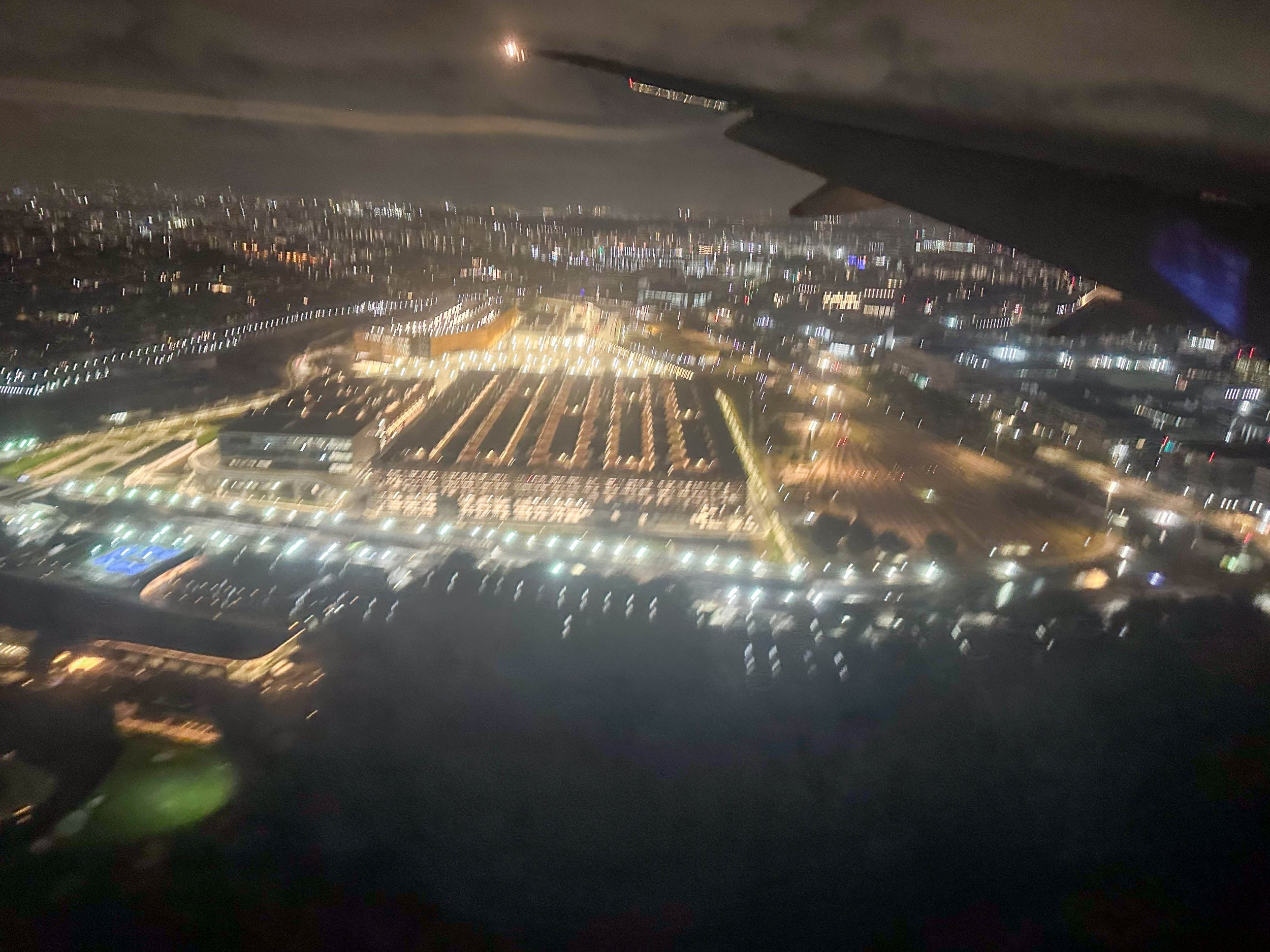
Flying into Singapore

We then we had a three hour layover until our flight to Seoul. We spent an hour or so in the Singapore Airlines SilverKris lounge enjoying some cold drinks and the opportunity to recharge phones and headphones. It was then time to commence the final leg of our day’s travels and we headed off to gate E26 a substantial distance away.

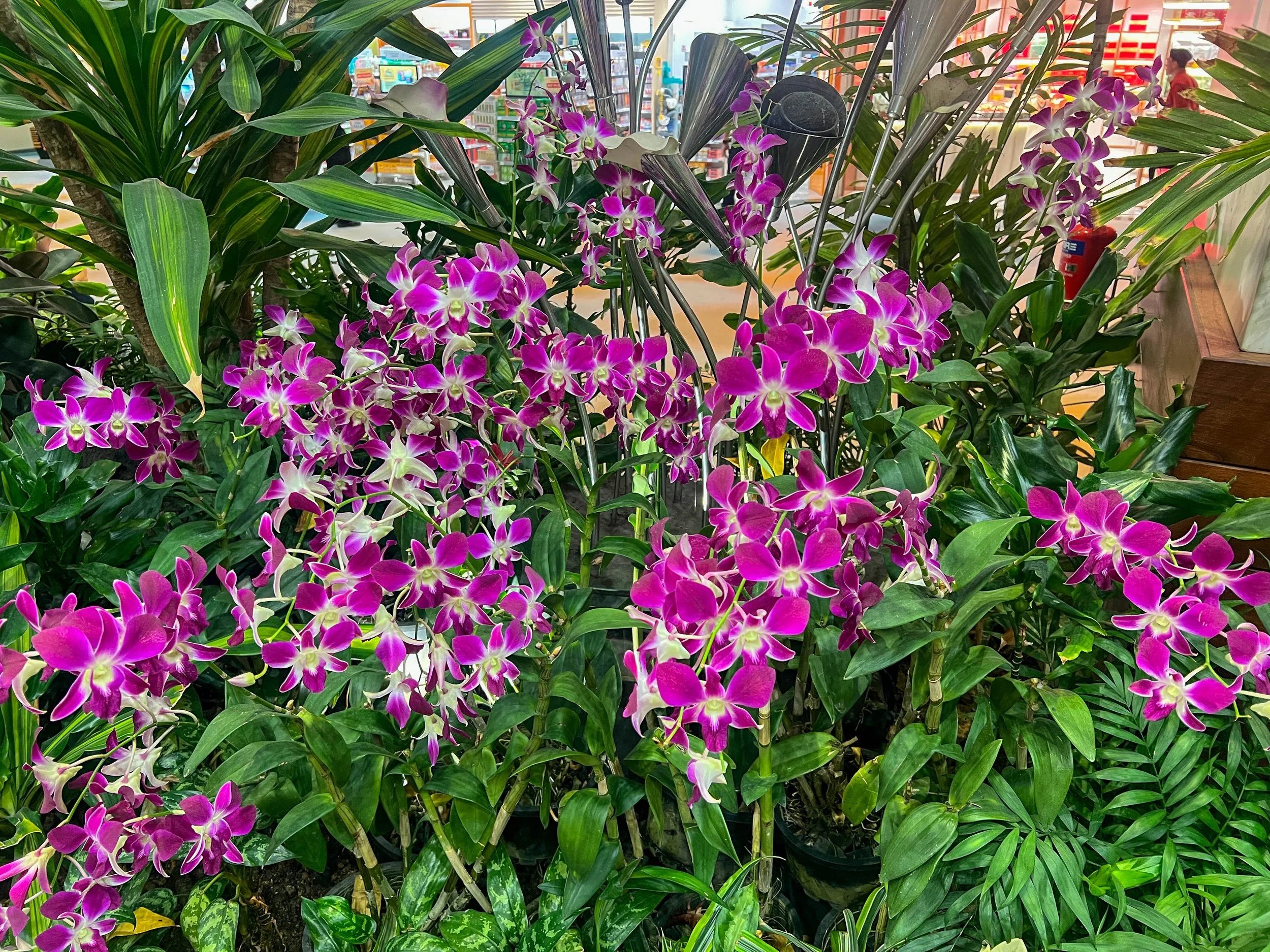
Orchids at Changi Airport, Singapore,

The flight to Seoul was on a comparatively new Boeing 787-10 with more leg room than the B777. We departed Singapore just after midnight local time and travelled through the night for around six hours to arrive at Seoul’s International airport at Incheon.

We thus ended our Friday 13th after 24 hours of time in planes and departure lounges.

OUR TRAVELS IN SOUTH KOREA AND JAPAN, MARCH - APRIL 2026

Watch this space for our upcoming trip to South Korea and Japan, March-April 2026

We are about to embark on an expedition to South Korea and Japan.

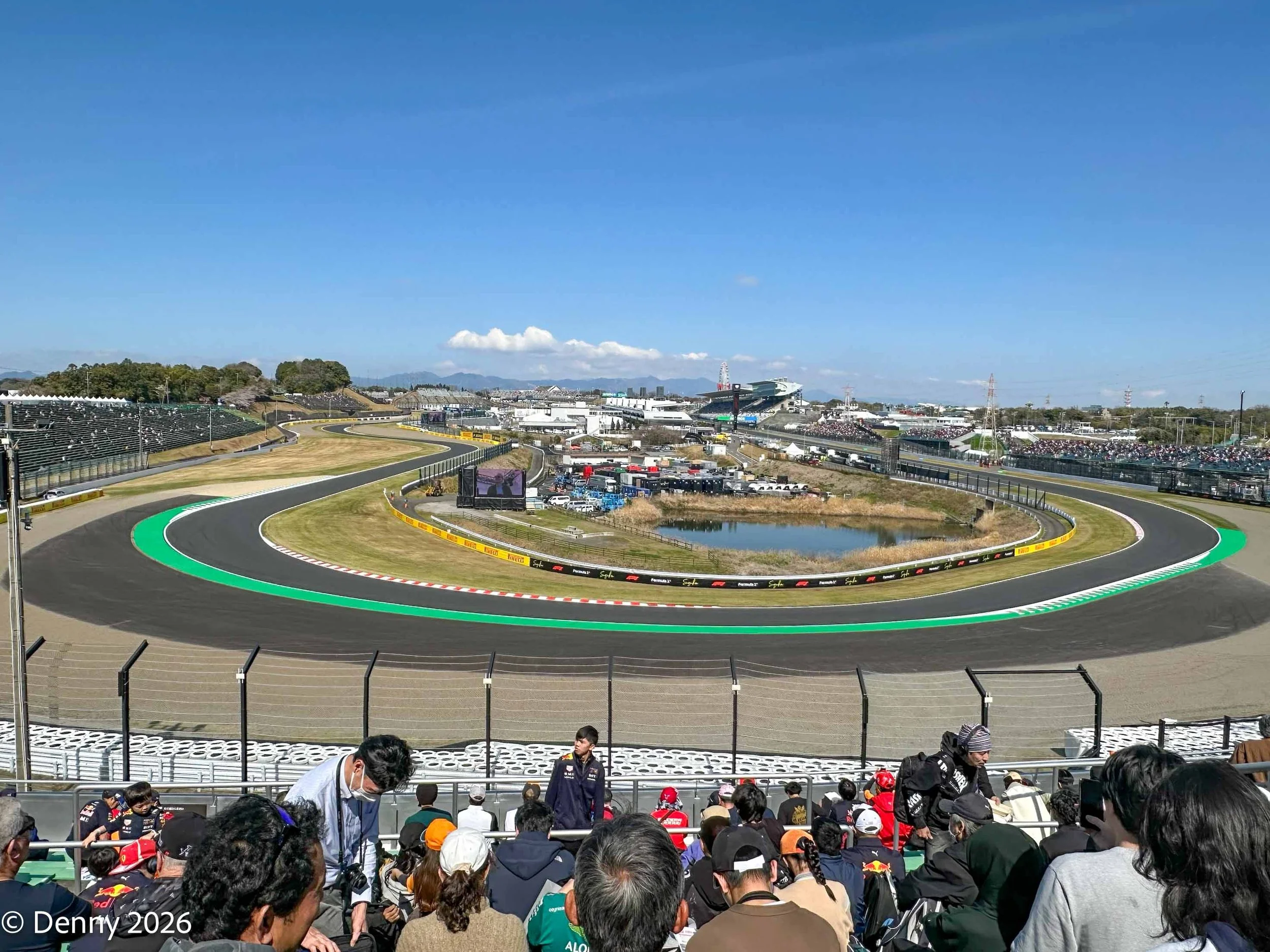
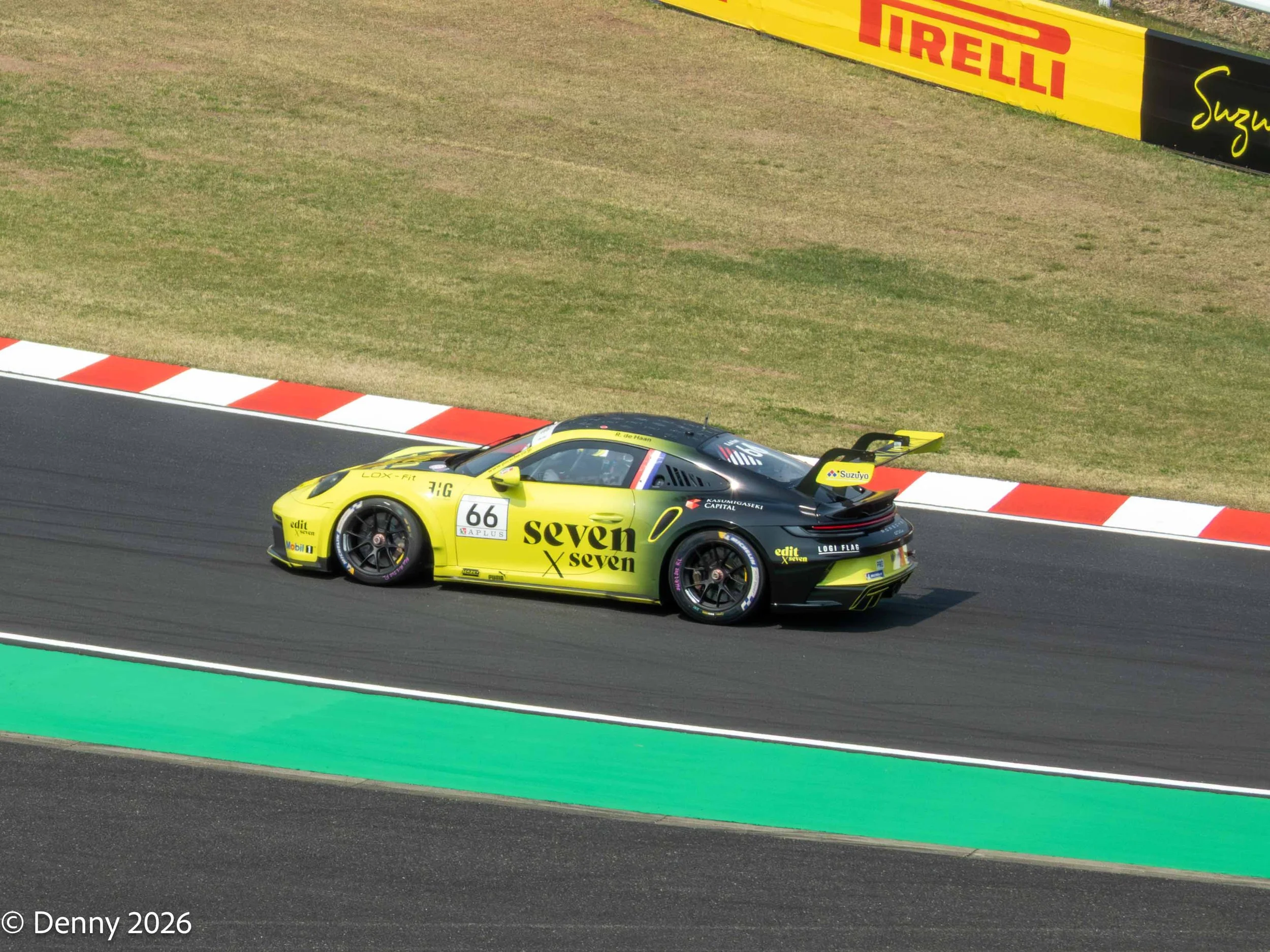
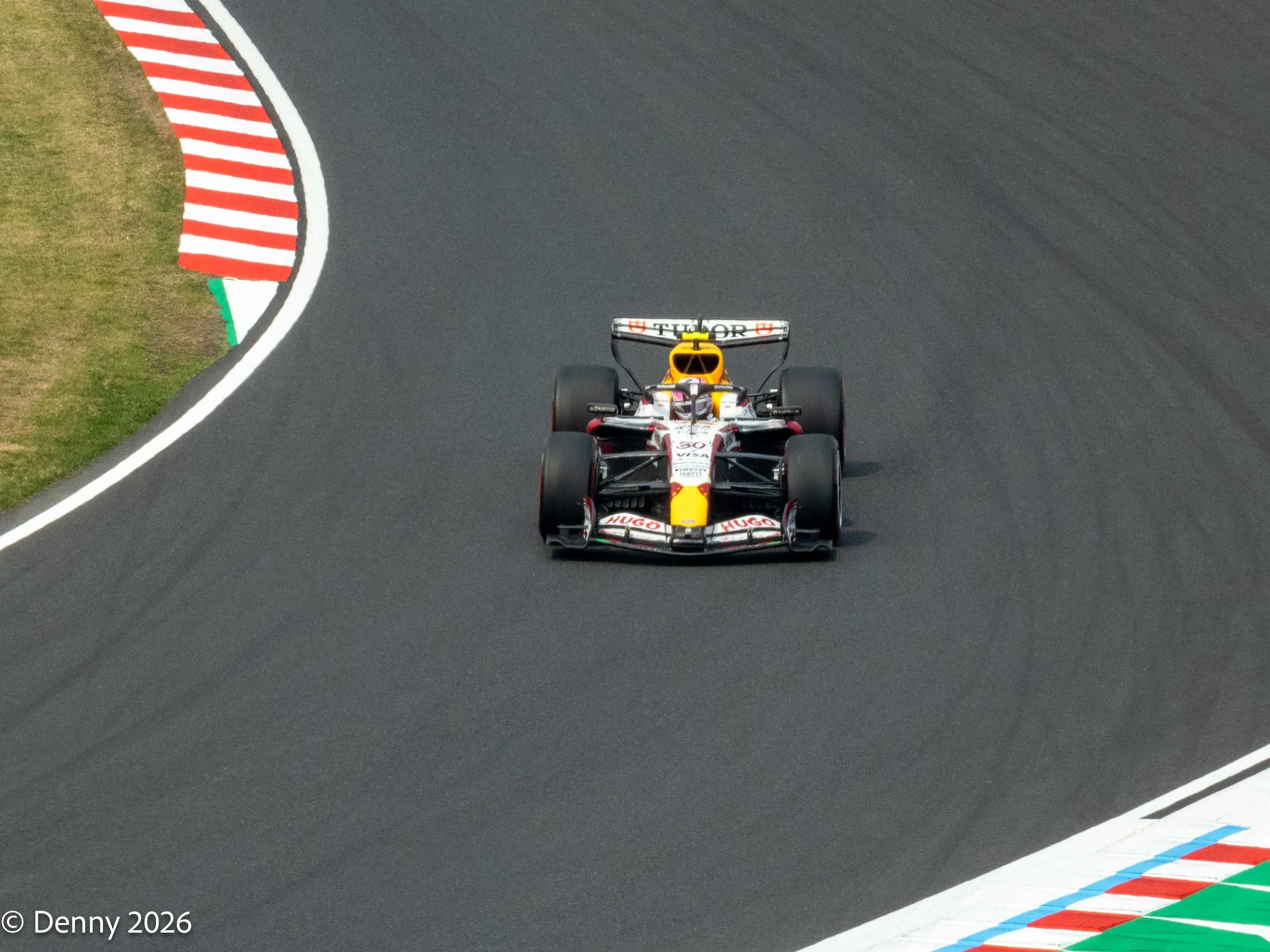
We are doing a 10-day tour with Bunnik in South Korea starting on 14 March. We then fly to Japan where we will meet up with our son Marcus and son-in-law Bryce. The boys will then spend three days at the Japanese F1 Grand Prix at Suzuka.

After the F1 GP we have a few days in Tokyo, relaxing and seeing some of the sights in and around Tokyo.

We then join another Bunnik tour which is basically around what is known as ‘The Golden Route’ in Japan.

During our stay we hope to experience some of the highlights of South Korea and Japan, countries which we have not previously visited.

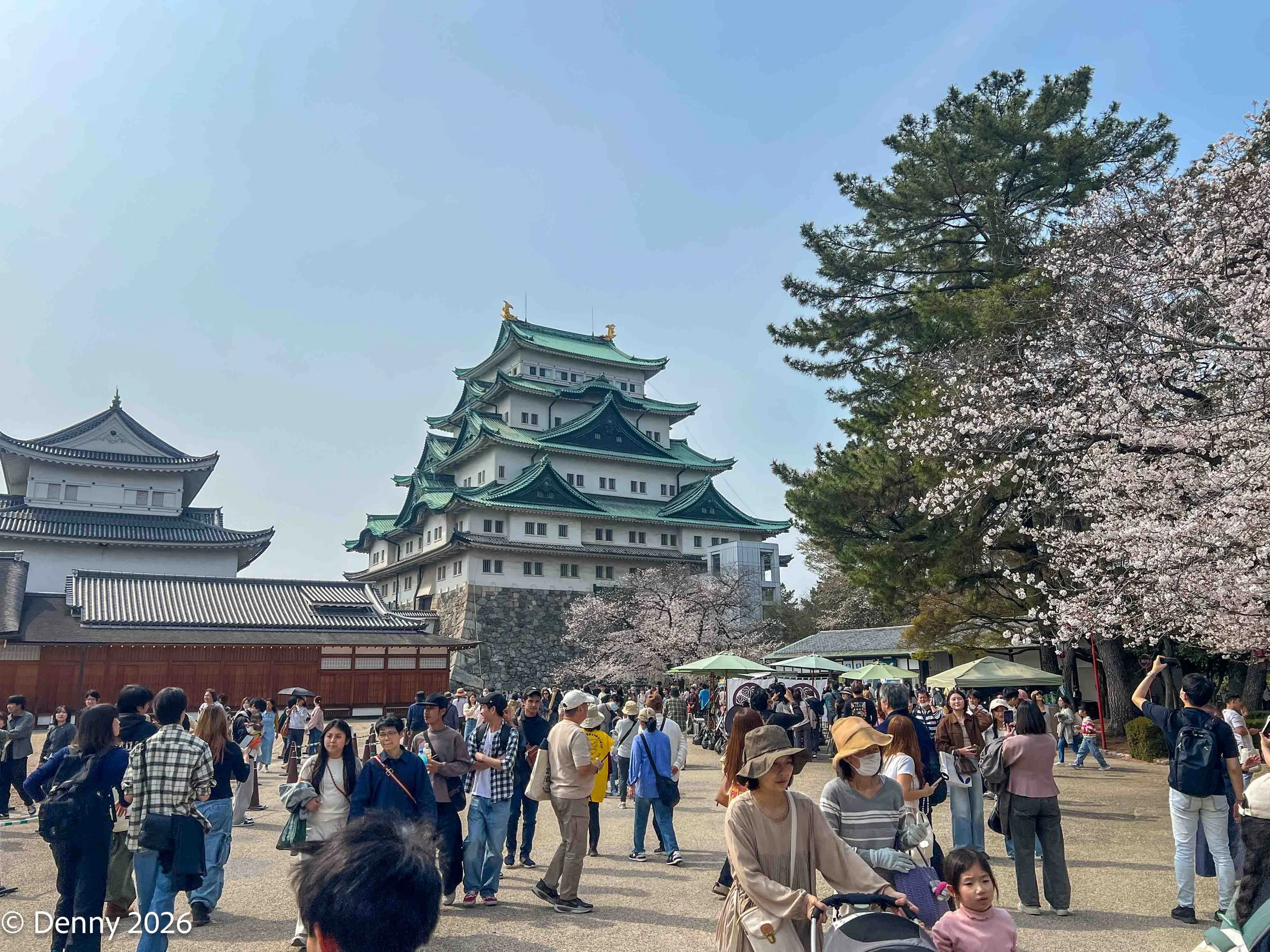
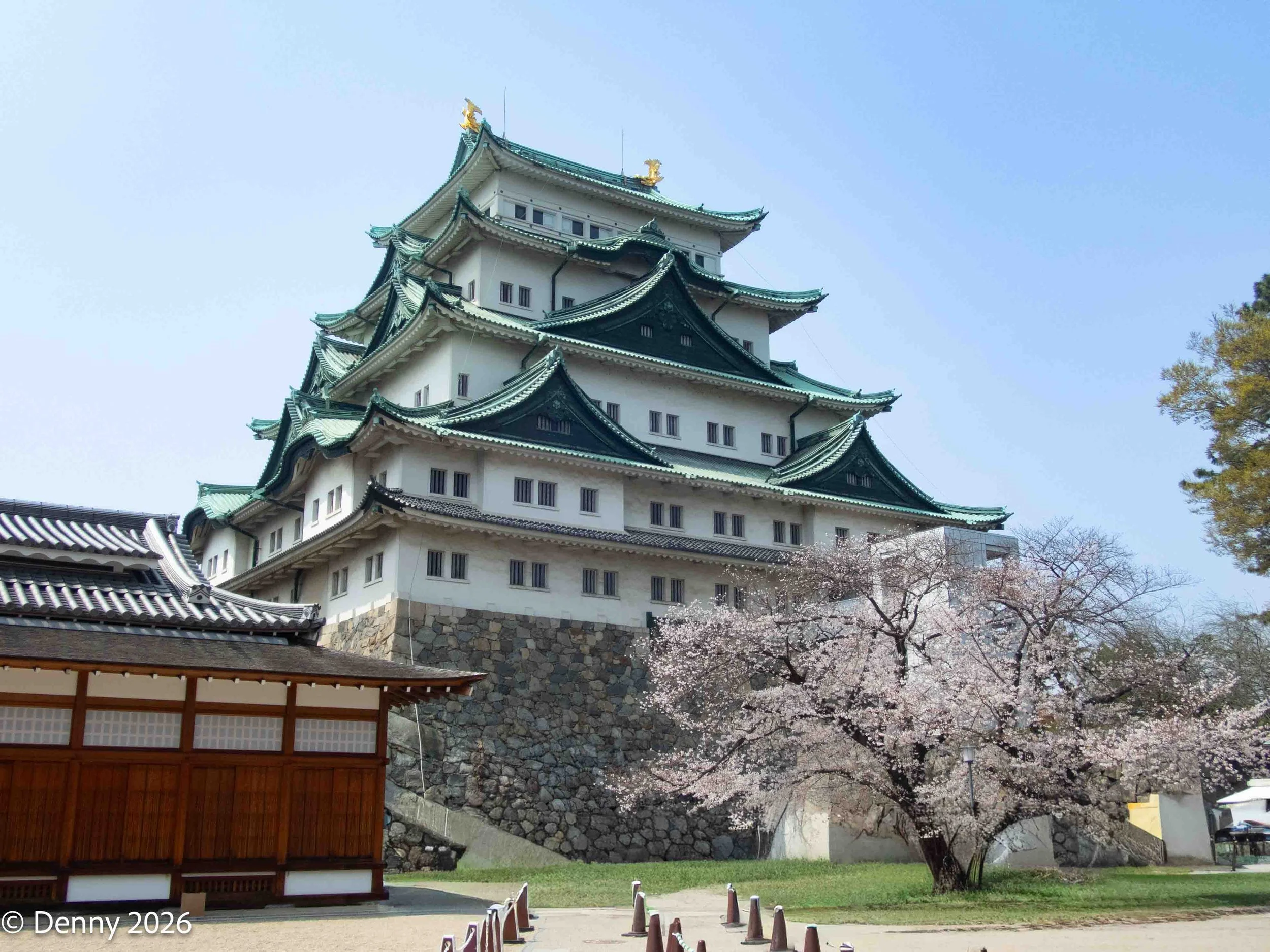
Our springtime itinerary is quite varied including natural scenery, big cities, traditional villages, historical sites and experiencing the cultural and culinary diversity of this Asian region. We hope the cherry blossom is at its best.
Our modes of transport include boats, bullet trains, a cable car, coaches, ferries, high-speed trains, subways and a dinner cruise.

The tours will be busy but they do include some free time to relax and take stock.

Watch this space to follow our adventures although updates may be spasmodic depending on access to the internet.