
The first half of the day was to be spent learning a little of the history of the Silla kingdom that flourished for more than a thousand years in the southeastern Korean peninsula from 57 BCE until 925 AD.
We started by visiting the Gyeongju National Museum which comprises a number of exhibition halls covering the times of the Silla Dynasty from pre-historic stone-age era through to the bronze, gold and iron ages.
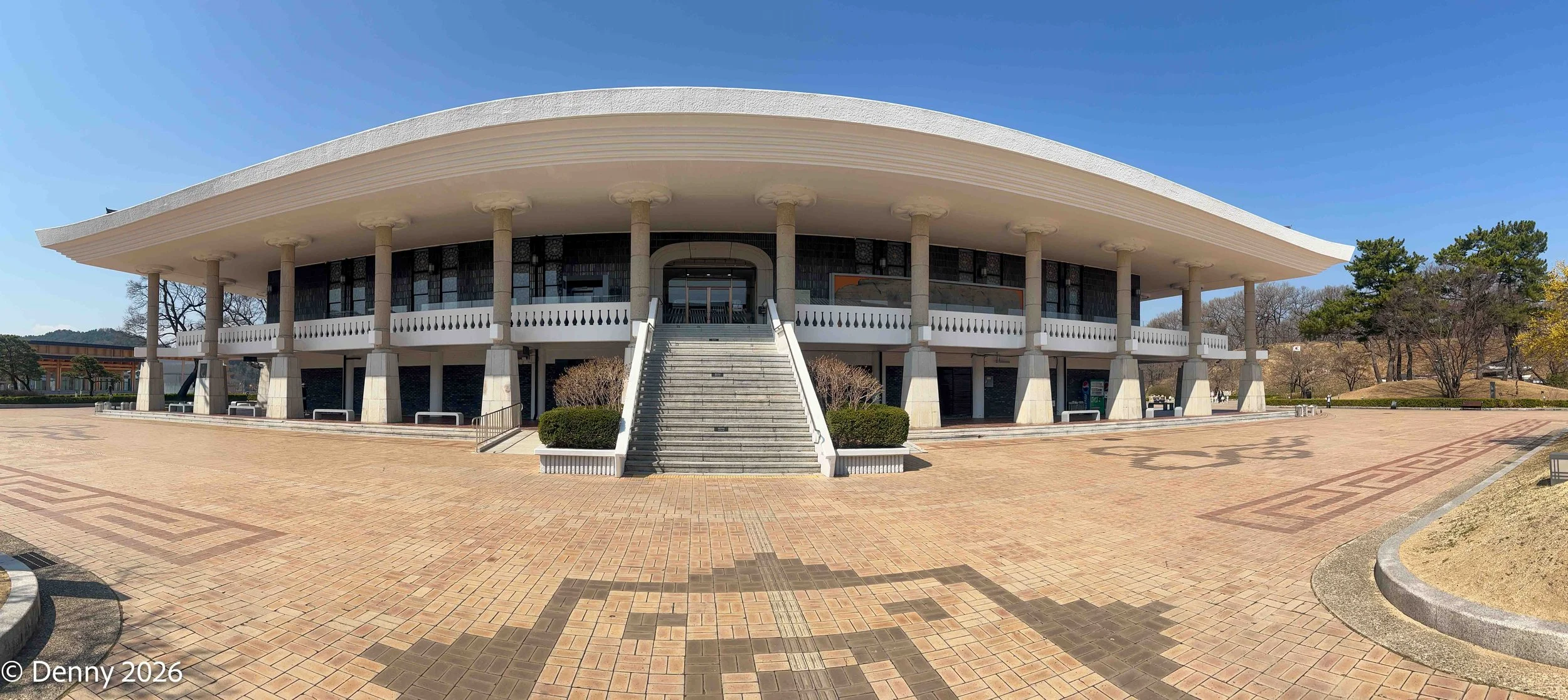
Gyeongju National Museum
The range of exhibits on display was amazing with a vast array of stone tools, ancient clay pots and iron implements forming the main theme in gallery one.
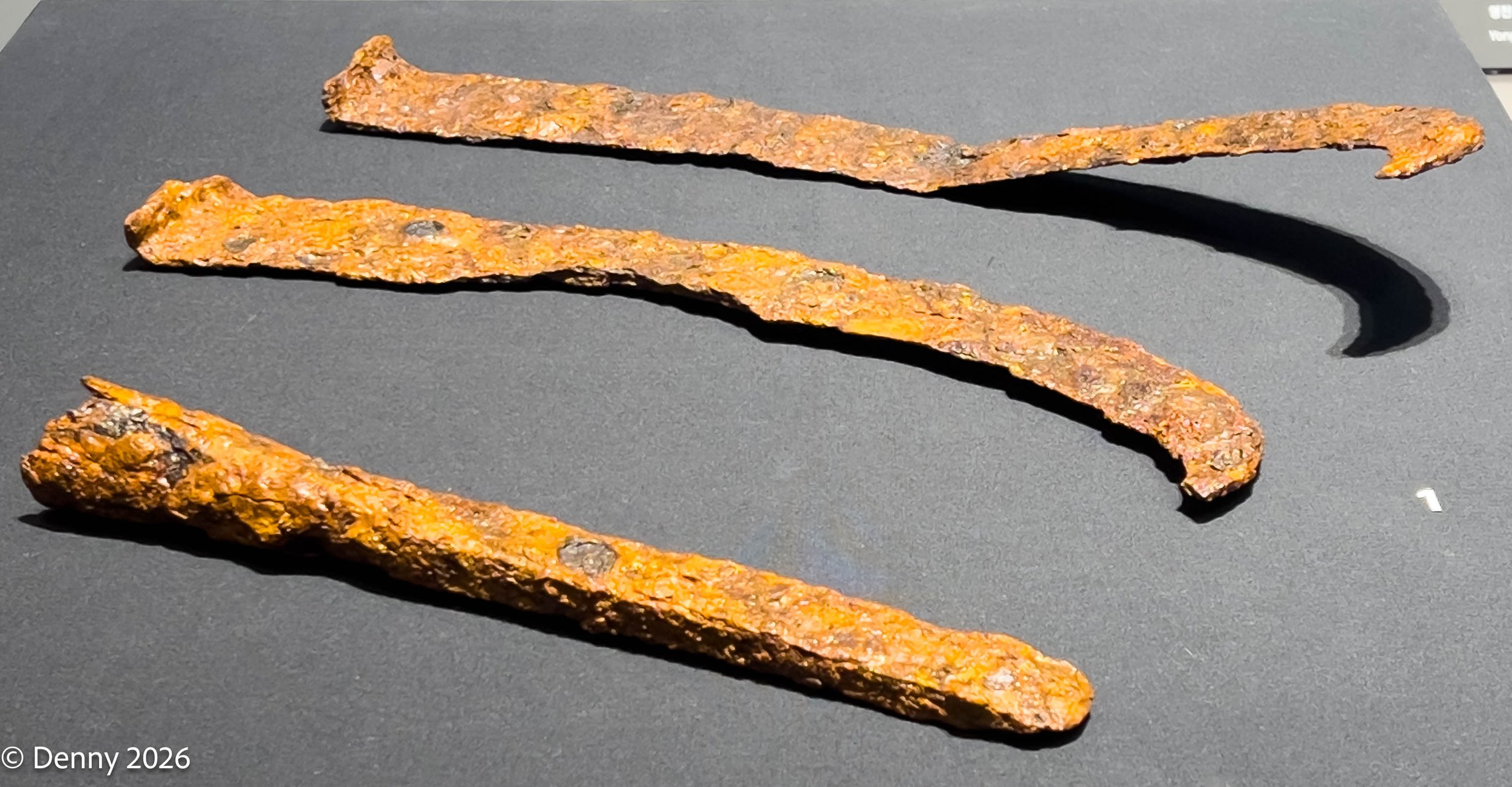
Iron implements, Gyeongju National Museum

Bird shaped vessel used in funerary rituals, Gyeongju National Museum
Perhaps the most intriguing gallery followed next where exhibited were hundreds of priceless artifacts recovered from Silla tombs and most significantly from the excavation of the nearby Cheonmachong Tomb.
The craftsmanship evident in the gold jewellery on display was extraordinary with chains, bracelets, rings and especially golden crowns being quite exquisite.
The Silla King Cheonmachong’s gold crown and belt were visually spectacular and in such pristine condition considering their age. Not surprisingly, Gyeongju was regarded as the cradle of Korea’s Golden Age.
The artifacts remaining from Silla today are only a fraction of what was originally discovered. Invading rebels and particularly 16th century Japanese treasure hunters completed what had been a progressive looting throughout the AD centuries.
The Gyeongju National Museum also has an outdoor exhibition area where there are about 1,400 stone structures including foundation stones, small pagodas and an assortment of Buddhist sculptures.
Of particular interest was the huge Divine ‘Emille’ Bell of Great King Seongdeok which is regarded as the finest example of Silla’s metal crafts. It was cast in bronze in 771 AD and at 20 tonnes it is one of the largest bells in Asia. Its sonorous tones that are said to be audible up to 60 km away have been described as the voice of a lost child calling for its mother. The word ‘Emille’ is the Silla word literally meaning ‘mummy’.
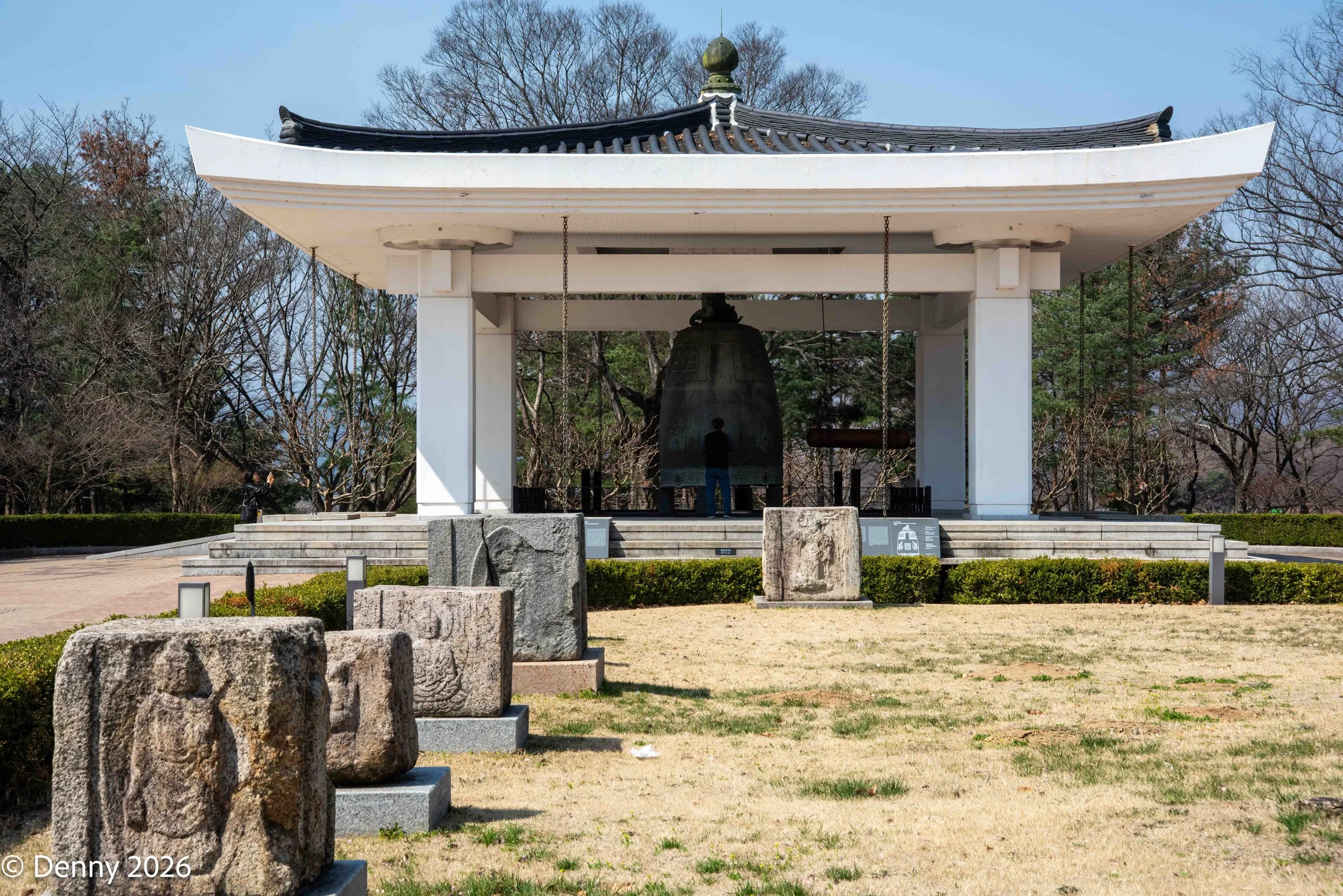
Divine ‘Emille’ Bell of Great King Seongdeok, Gyeongju National Museum
We certainly could have spent much more time in the museum but our itinerary precluded this and we had to move on.
We took a short walk from the museum along a pathway past lawns and gardens to a stone astronomical observatory. On the way we encountered a group of twelve or so older women wearing red and white uniforms all in crouched positions very busily weeding a garden section using small hand hoes.
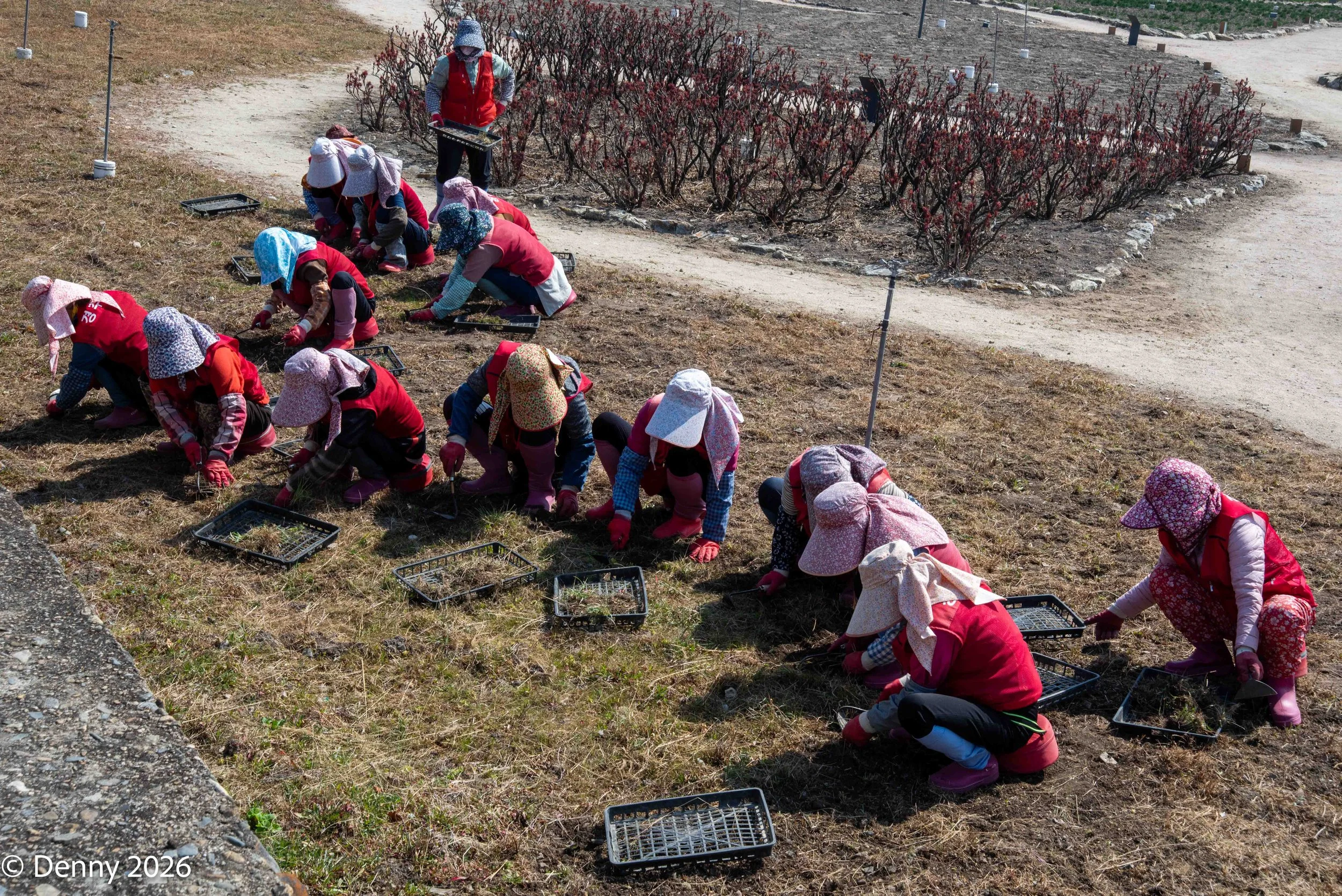
Women weeding garden en route to Cheomseongdae observatory, Gyeongju
The stone observatory is presumed to have been built during the time of Queen Seongdeok who reigned from 632 - 647 AD as the 27th ruler of the Silla Kingdom. It is one of the oldest structures in South Korea and understood to be the oldest astronomical observatory in Asia. Astronomers question just how the tower was used, but they point with interest to the coincidence of there being 365 upper stones, 12 rectangular base stones and 12 separate levels of stones above and below the central window.
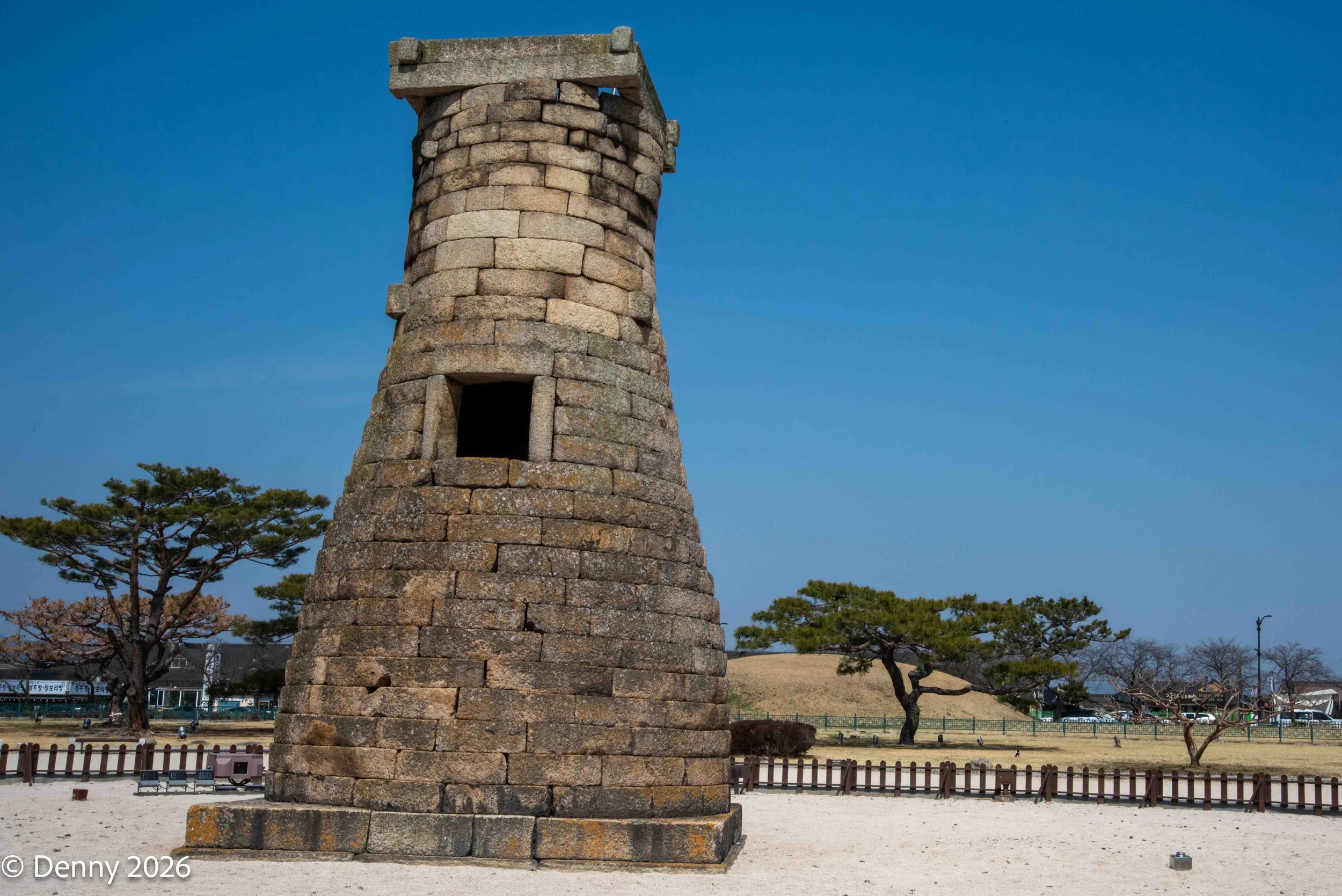
Cheomseongdae observatory, Gyeongju
The observatory is a twenty-seven tiered stone tower about 30 m high positioned so as to track the sun and the movement of other celestial bodies. This information was apparently of astrological significance in foreseeing the country’s future but also of astronomical importance in offering planting and harvesting guidance to farmers.
Other theories for the tower’s existence suggest that it may have been used for ancillary purposes such as an altar or a religious symbol or even a commemorative monument.
We spent the next four hours wandering around in sections of the fifteen hectare Tumuli Tomb Park. In the park there are twenty ‘earth mound’ tombs of varying sizes but each one consists of a large, semi-elliptical grass covered hill over a royal tomb way beneath.

Pathway through Tumuli Tomb Park, Gyeongju

Our group walking through Tumuli Tomb Park, Gyeongju

Double Tomb in Funery moundscape, Tumuli Tomb Park

Funery moundscape, Tumuli Tomb Park, Gyeongju
The largest of the tombs, that of King Michu who reigned from 262 – 285 AD is classified as the ‘Great Tomb’ and this one has not been excavated.
We were able to enter the excavated ‘Heavenly Tomb’ of Silla King Cheonmachong. This is also known as the ‘Flying Horse Tomb’ due to a painted artifact discovered showing a unicorn like image. This Cheonmachong tomb is about 50 m in diameter and 12.7 m high. It was excavated in 1973 and its collapsed wooden and stone burial chambers were found to contain countless important Silla treasures. It is now a wonderfully presented underground museum showing how the tomb might have looked thousands of year’s ago.

‘Heavenly Tomb’ of Silla King Cheonmachong
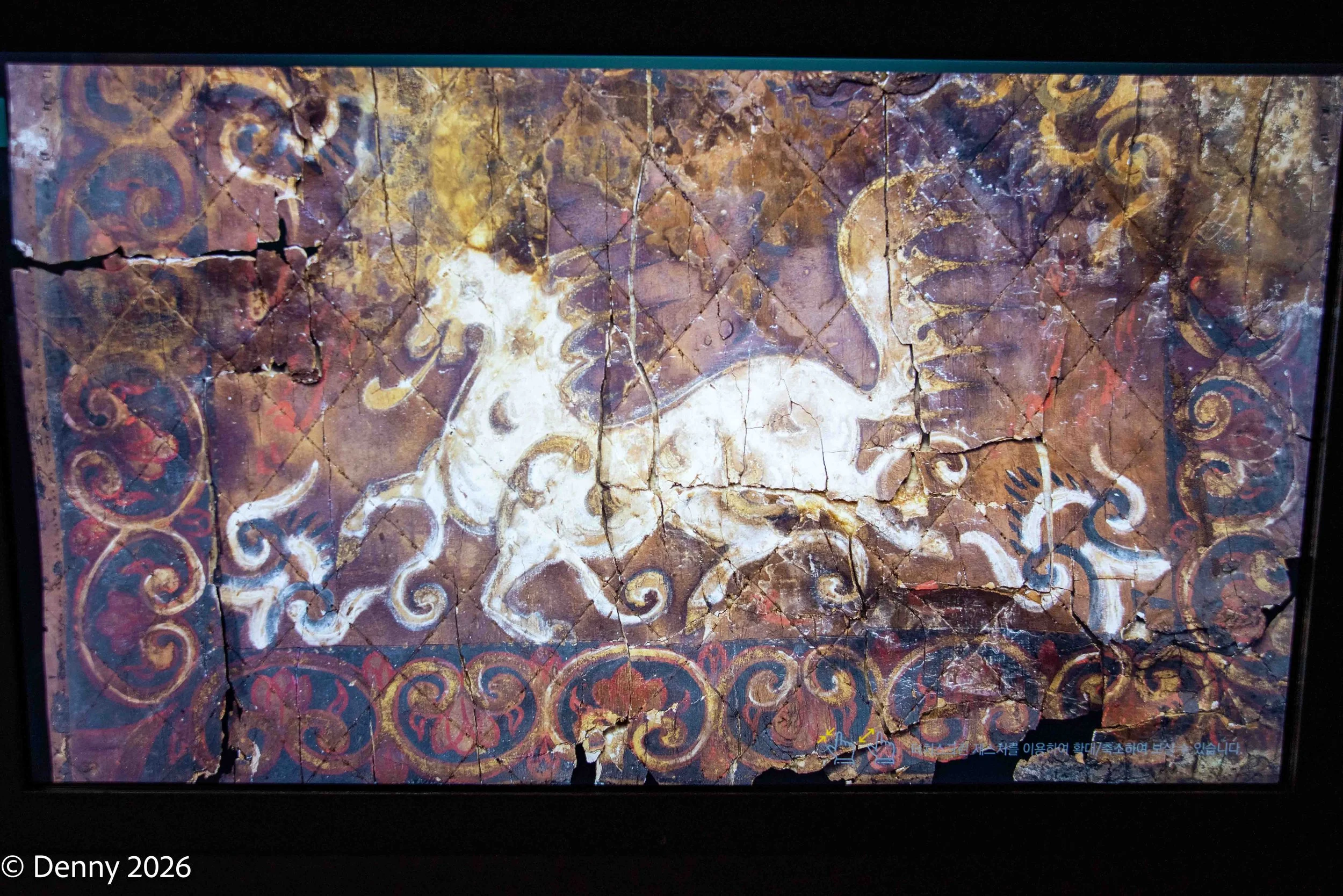
Flying Horse painted artifact

Artefacts in ‘Heavenly Tomb’ of Silla King Cheonmachong
We finished our Tumuli Park visit by going to the new Interpretation Centre that showed in excellent detail how these massive burial tombs were constructed and details of the excavation processes that have occurred in recent times.
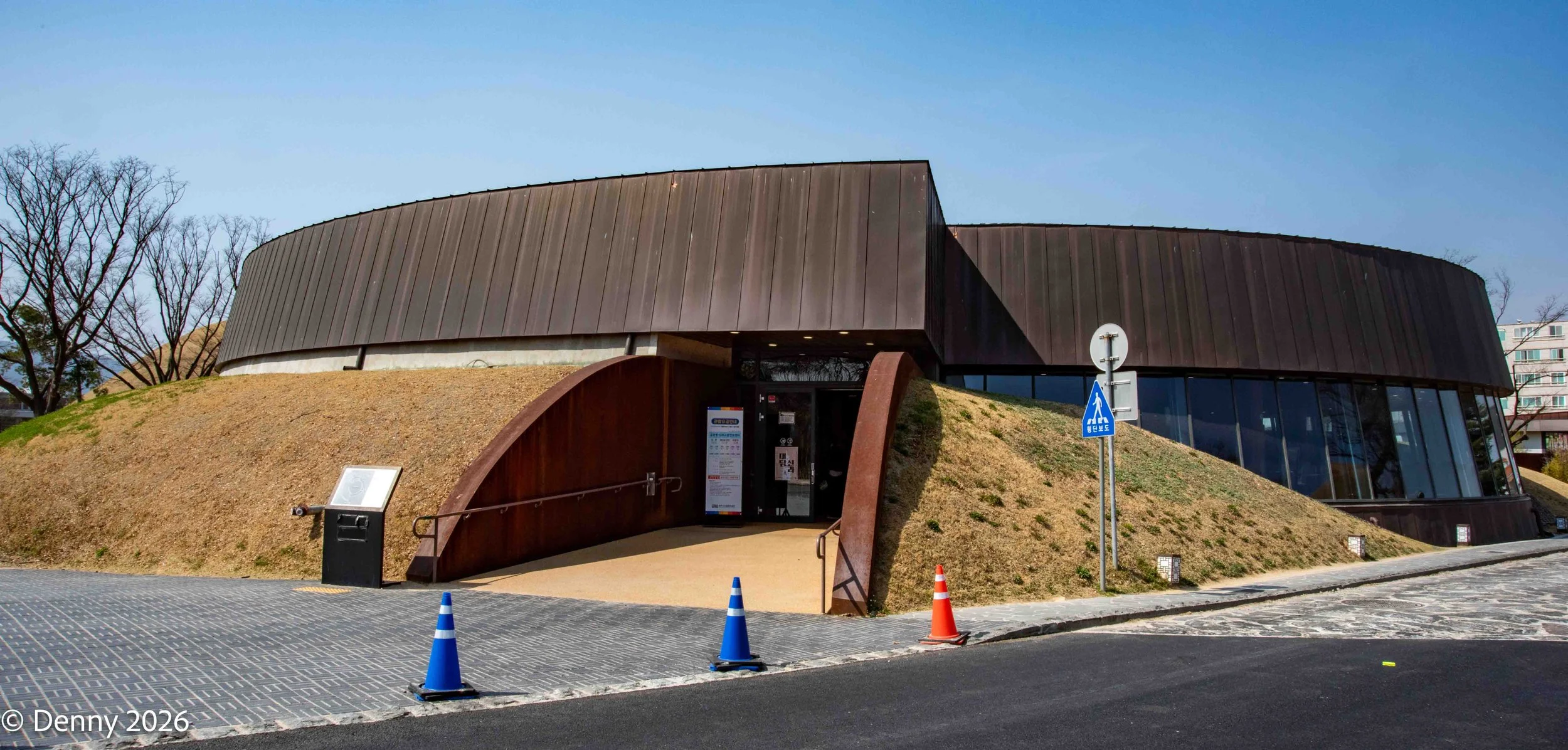
Interpretation Centre, Gyeongju
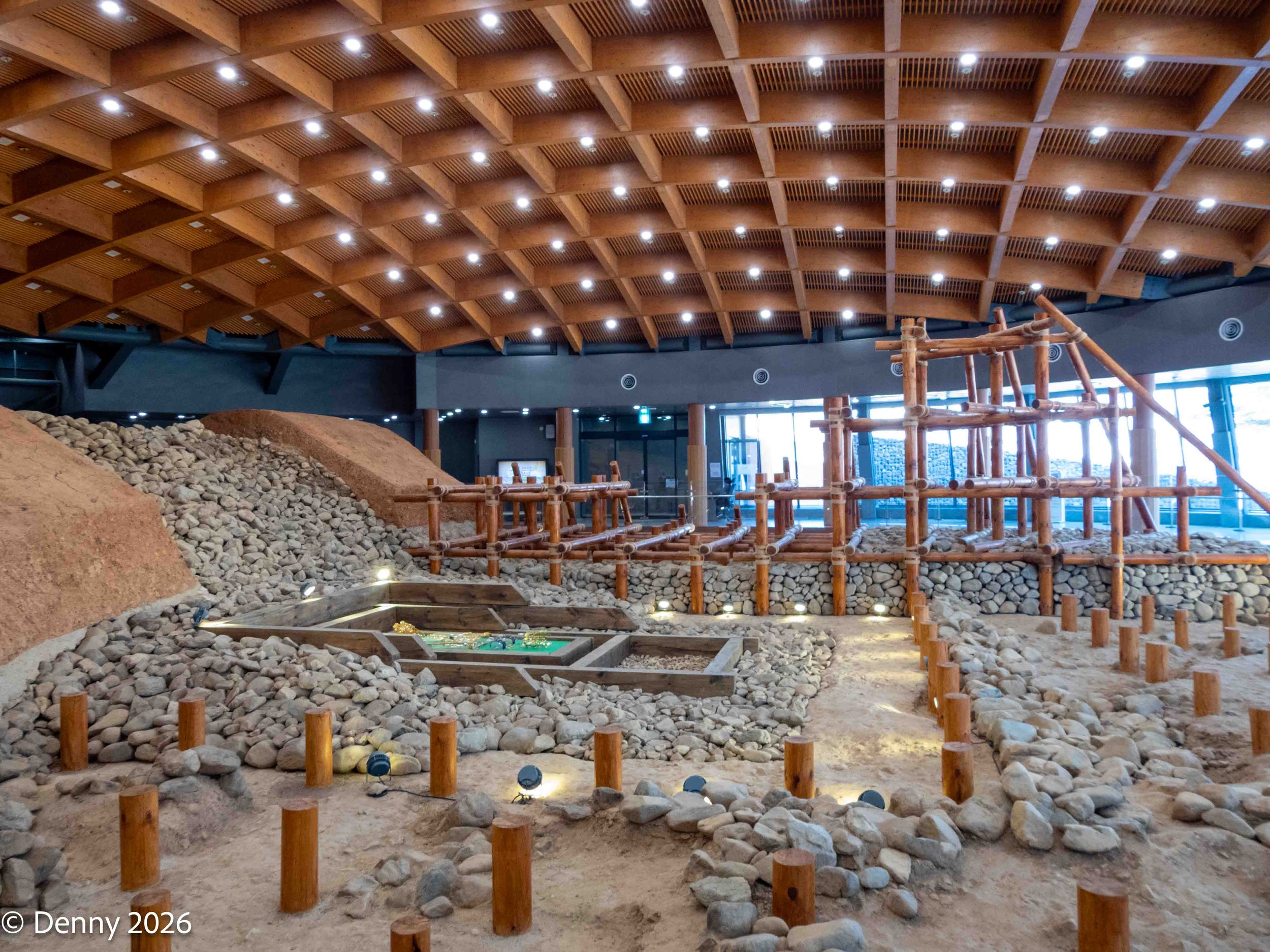
Interpretation Centre, Gyeongju
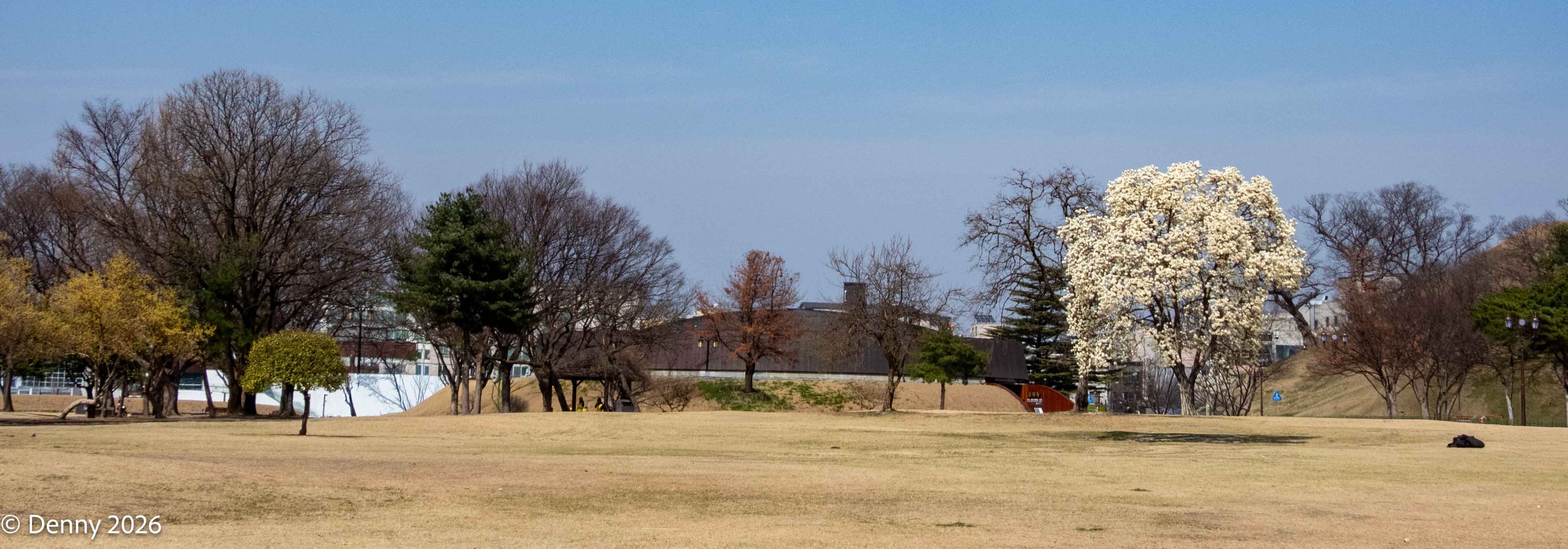
Interpretation Centre and gardens, Gyeongju
We then gathered and Mr. Kim drove us to the Gyeongju Railway Station where at precisely 15:06 we boarded the ‘bullet’ train to Seoul. The journey took just on two hours with the maximum speed being 300 km/h.

Bullet train, arriving Gyeongju Railway Station
At Seoul, another bus was waiting to deliver us to our Novotel Hotel and in the meantime Mr. Kim drove the whole distance of 400 km non-stop to deliver our larger luggage items that were not permitted on the ‘bullet’ train.
We all needed a good night’s rest after these last few days of frenetic activity.
Tomorrow we complete our South Korean tour with, amongst other things visiting the DMZ area shared with North Korea.