
Our morning bus journey southwards was through quite mountainous regions and the highway involved numerous road tunnels ranging in length from as little as a hundred metres to several kilometres. A small distance outside Jeonju we noticed a series of hills covered with traditional grave mounds in what are pre- Christian style cemeteries. These earthen mounds are semi-cylindrical and about one metre high. The graves we observed were quite obviously in pristine condition as is emphasised through the strong Korean custom to revere ones ancestors.
Between the small mountain ranges we encountered fertile valleys where farms were involved in various agricultural pursuits principally being grain (maize and rice) production and fruit orchards. Surprisingly, in three days of travel through South Korea we have yet to see any farms where sheep, cattle, goats or even horses are present.
Our first stop for the morning was at Mt. Maisan where we walked two kilometres from the car park to the Tapsa Buddhist Temple.

Walk to Tapsa Buddhist Temple, Mt Maisan

Top of Mt Maisan

Walk to Tapsa Buddhist Temple, Mt Maisan
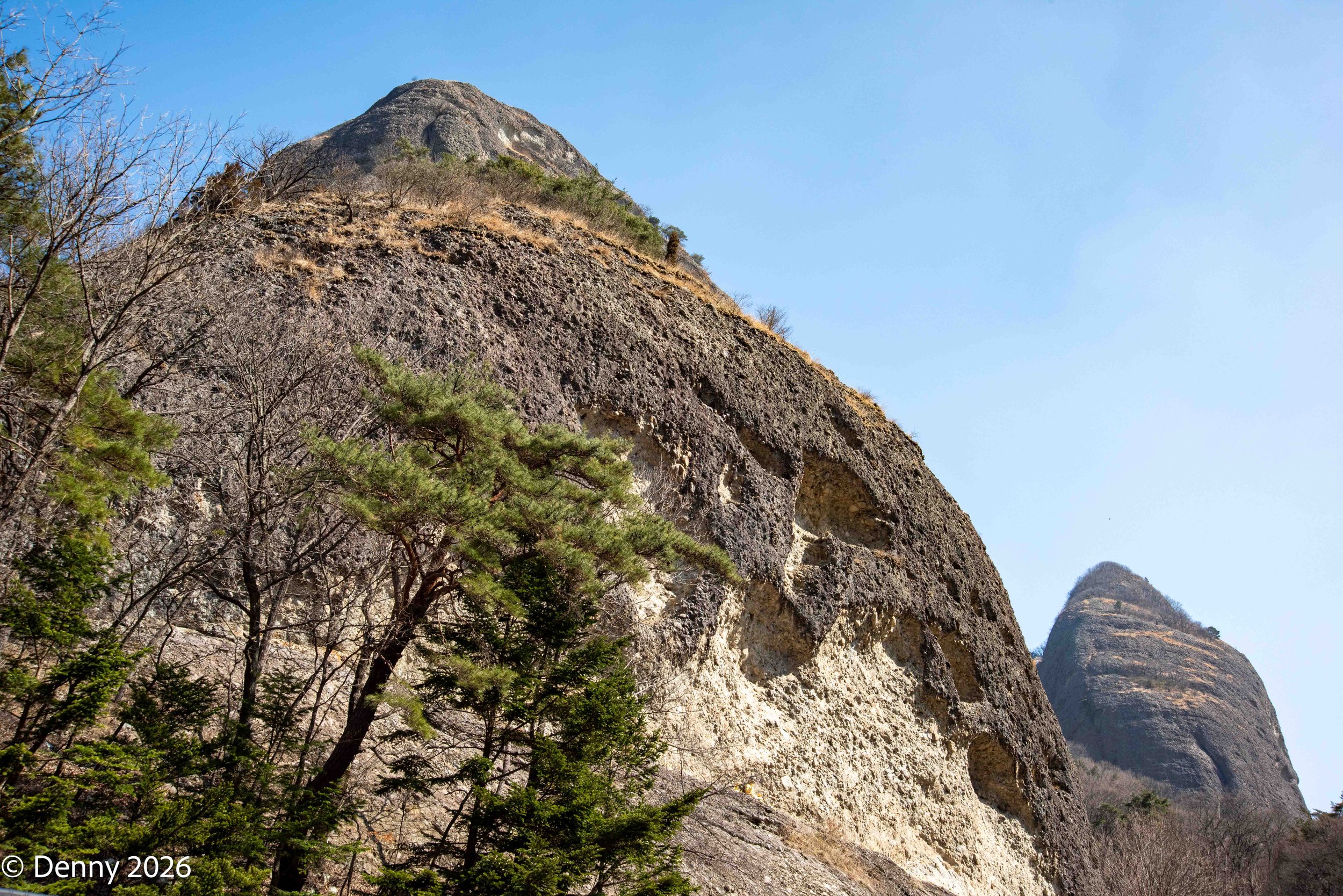
Peaks of Mt Maisan
This temple and its eighty or more stupas were built entirely out of local stones with no concrete or mortar having been used. The stone stupas or towers were constructed about thirty years ago by a hermit called Yegapy Yong.

Temple and Stupas
The backdrop to this peculiar temple is the fascinating geological feature of two dominant mountain peaks comprising conglomerate rock. The rounded peaks of these two mountains have the shape of two inverted parabolas and are locally known as the ‘horse ears’. Legend has it that two fairies, one male and one female were called to return to heaven by their creator but just before dawn they were spotted making their escape by an early rising housewife and were instantly transformed to stone. They then fell back to Earth as the two Maisan peaks!

Temple and Stupas, Mt Maisan
The actual Buddhist temple itself is minute and has a small golden Buddha surrounded by colourful paper flowers and other garish ornamentation.
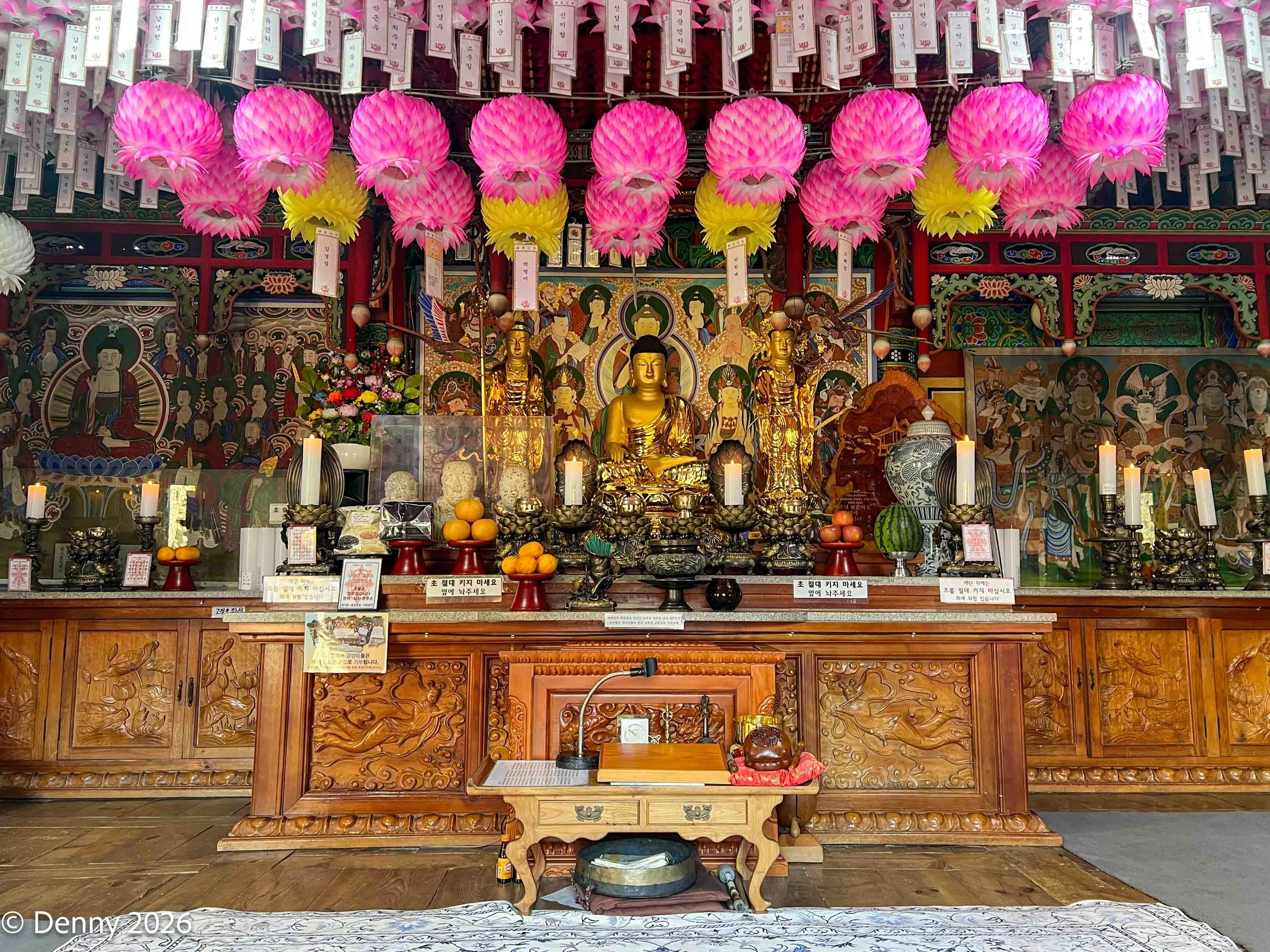
Golden Buddha inside Buddhist temple,
We then spent an hour or so in the tourist area where there were hundreds of carved wooden items for sale plus a number of local foods and drinks.
Amongst the more unusual drinks was a dark coloured health elixir called kudzu which had an unusual ‘medicinal’ taste somewhat like unroasted peanuts. The liquid is extracted from the scrambling kudzu vine that has one metre long tubers that can weigh up to 180 kg. Kudzu is an introduced and invading species that is causing terrible problems for native plants due to its capacity to smother all surrounding vegetation. We observed the steam extraction of the kudzu liquid from the macerated tubers and then the packaging machine that was sealing the liquid into small sachets.

Roots of kudzu vine (Pueraria montana)

Extracting juice from Kudzu
We next drove to Seokjeong, a town noted for its hot springs and allied therapy services often described by the unattractive term ‘wellness’.
We pent two hours in the local hydrotherapy pool and spa. The spa bath had a number of high pressure water jets to offer body massage and bubbly sections for relaxation. One pressure jet was powerful enough to hurt if you approached too closely! We had two separate visits to the adjacent sauna set at 67C and after ten minutes of sweltering heat we then found the spa to be comparatively cold on returning to the water.
During these two hours we were the only people in the large spa and pool area and on leaving, the general feeling was that we’d all had fun and enjoyed this interlude and afternoon’s ‘wellness’ activity.
The day’s travel ended with a ninety minute drive from Seokjeong to Gwangju where we will have two night’s accommodation at the Holiday Inn.
Tomorrow we’ll spend the day exploring the delights of Gwangju.